
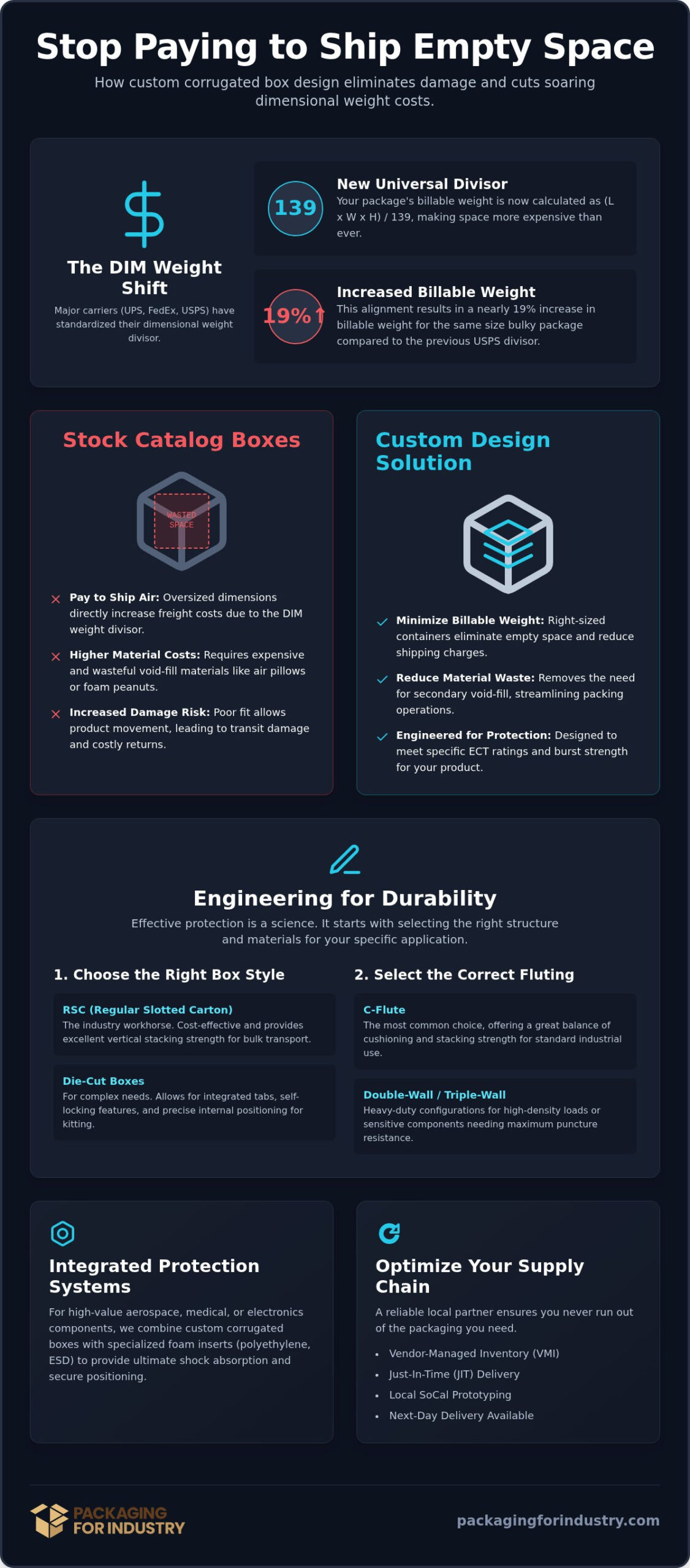
If you’re still using stock catalog boxes, you’re likely paying to ship empty space. With the July 2026 alignment of the USPS dimensional weight divisor to 139, matching FedEx and UPS, the billable weight for bulky packages has increased by nearly 19%. Implementing a custom corrugated box design for product protection is no longer just about safety; it’s a critical strategy for controlling your total landed costs.
We understand the frustration of seeing high-value components arrive damaged or watching freight surcharges eat into your margins. It’s a difficult balance to maintain, especially when unreliable lead times from standard suppliers threaten your production schedule. You need a solution that protects your product without inflating your shipping budget.
This guide shows you how to bridge the gap between engineering and economics. You’ll learn to design packaging that eliminates transit damage while stripping away unnecessary dimensional weight. We will also cover how a reliable, local supply chain partner can provide the recurring inventory you need to keep your operations running smoothly.
Key Takeaways
- Understand how structural engineering, rather than just dimensions, serves as the foundation for eliminating transit damage.
- Select the correct fluting profiles and linerboard weights to ensure your packaging meets industrial crush resistance standards.
- Learn to combine custom corrugated box design for product protection with specialized foam inserts for high-value aerospace or medical equipment.
- Optimize your procurement process by utilizing vendor-managed inventory (VMI) to maintain a reliable, recurring supply of custom-sized packaging.
- Reduce lead times through local Southern California prototyping and next-day delivery options in Los Angeles, Orange County, and the Inland Empire.
The Fundamentals of Custom Corrugated Box Design for Industrial Protection
Effective custom corrugated box design for product protection is not a simple matter of measuring length, width, and height. It is a disciplined engineering process that accounts for the specific stresses of the industrial supply chain. While stock boxes are readily available from catalog suppliers, they’re designed for general applications rather than the unique weight distribution or fragility of specialized industrial gear. Relying on a one-size-fits-all container often leads to structural failure during stacking or transit, especially for high-value components in the aerospace and electronics sectors.
Structural engineering is the foundation of a successful package. At PFI, we analyze the structural requirements of your product to determine the necessary bursting strength and edge crush test (ECT) ratings. We don’t just provide a container; we engineer a system that maintains its integrity under the pressure of palletized loads and long-haul shipping. By utilizing custom design packaging, you ensure that the corrugated material acts as a rigid exoskeleton, absorbing external impacts and preventing internal product movement.
RSC vs. Die-Cut: Choosing the Right Box Style
The Regular Slotted Carton (RSC) is the workhorse of industrial shipping. It’s cost-effective, easy to assemble, and provides excellent vertical stacking strength. For many manufacturers, the RSC is the ideal choice for bulk transport. However, when your product requires precise internal positioning or complex packaging kitting, a die-cut box is often the superior solution. Die-cut designs allow for integrated tabs, self-locking features, and custom cutouts that hold components securely without the need for excessive tape. Assessing these styles early in the design phase helps you balance operational speed with the level of protection required for your specific inventory.
The Hidden Costs of Oversized Packaging
Freight costs are increasingly driven by volume rather than actual weight. As of August 2026, major carriers including UPS, FedEx, and USPS have aligned their dimensional weight divisor at 139. This means every cubic inch of empty space in an oversized box directly increases your billable weight. When you use a stock box that’s even slightly too large, you’re paying to ship air. By right-sizing your containers through custom corrugated box design for product protection, you can lower packaging costs significantly.
A reduction of just one inch in a single dimension can lead to substantial freight savings across your entire supply chain. Additionally, custom-sized boxes reduce the need for expensive void-fill materials like air pillows or kraft paper. This streamlines your packing process, reduces warehouse waste, and ensures your team isn’t wasting time on unnecessary assembly steps. Precision in sizing is one of the most direct ways to improve your bottom line while maintaining high standards for product safety.
Engineering for Durability: Material Selection and Fluting
Selecting the correct material is the most critical step in custom corrugated box design for product protection. A corrugated sheet is an engineered sandwich consisting of two flat linerboards and a wavy interior known as the medium. The fluting of this medium determines the box’s thickness, cushioning ability, and vertical stacking strength. While many catalog suppliers offer generic grades, industrial applications often require a precise match between material density and the physical profile of the cargo. With containerboard prices seeing a net increase of $100 per ton in the first half of 2026, over-specifying your materials is a costly mistake you can’t afford.
For standard industrial needs, C-flute remains the most common choice due to its balance of cushioning and stacking strength. However, when precision and clean folding are required for internal inserts, B-flute is often superior. For high-density loads or sensitive aerospace components, we often recommend an upgrade to double-wall or even triple-wall corrugated. These heavy-duty configurations provide the puncture resistance and structural integrity necessary for harsh transit environments. If you are unsure which material grade fits your application, you can request a packaging quote to have our team evaluate your specific requirements.
Material Strength: Bursting Test vs. Edge Crush Test (ECT)
While the traditional Mullen (Bursting) test measures the force required to puncture a box wall, the Edge Crush Test (ECT) has become the modern industrial standard. ECT measures the compression strength of the corrugated board on its edge, serving as the primary indicator of how well a box will perform when stacked on a pallet. This metric is vital for warehouse optimization, especially following the March 2026 update to the ISTA 3E standard for unitized loads. Matching your box’s ECT rating to the weight of your palletized inventory ensures that the bottom layers don’t collapse during long-term storage or long-haul trucking.
Specialized Industrial Corrugated Options
Standard corrugated boxes are often just the starting point for a comprehensive industrial solution. For high-volume manufacturing, heavy-duty bulk bins, often called Gaylord boxes, allow for the efficient movement of raw materials or finished parts across the shop floor. For electronics and semiconductor manufacturers, we provide anti-static and ESD-shielded corrugated options to prevent latent component failure caused by electrostatic discharge.
- Partitions and Dividers: These custom inserts prevent part-on-part contact, which is essential for painted or machined surfaces.
- Weather-Resistant Coatings: Specialized liners protect against moisture and humidity during sea freight or outdoor staging.
- Military-Spec (Mil-Spec): We engineer packaging that meets stringent government durability and environmental requirements.
By focusing on these technical specifications, you move beyond simple “box buying” and into true supply chain optimization. Proper material selection reduces both material waste and the financial risk of transit damage.
Integrated Protection: Combining Boxes with Custom Foam Inserts
External durability is only one part of the equation. Even the strongest triple-wall box cannot prevent damage if the product inside is free to shift or vibrate against the container walls. For manufacturers in the medical and aerospace sectors, custom corrugated box design for product protection must include a secondary internal layer. Integrated foam inserts act as a shock absorber, decelerating the force of impacts before they reach your sensitive equipment. This synergy between the rigid outer shell and the compliant inner cushioning is what separates an engineered solution from a standard shipping container.
Designing these systems requires a deep understanding of your product’s fragility and weight distribution. When we engineer a “foam-in-box” solution, we aren’t just adding padding; we’re creating a secure environment that maintains the product’s orientation throughout the shipping cycle. This is especially vital for recurring industrial needs where components must be kitted or organized for immediate use upon arrival at a manufacturing facility.
Selecting Foam Materials for Impact Absorption
Selecting the right foam depends entirely on your product’s G-force tolerance and weight. Polyethylene (PE) foam is a dense, closed-cell material ideal for heavy industrial parts that require rigid support and multi-impact resistance. In contrast, polyurethane (PU) is a softer, open-cell foam that provides superior cushioning for lightweight, fragile items. For electronic assemblies, we utilize specialized anti-static foam inserts to prevent latent component failure caused by electrostatic discharge. You can learn more about custom foam packaging options to see which material suits your specific application.
Prototyping the Perfect Fit
Precision is non-negotiable when combining foam with corrugated shells. We use CAD/CAM technology to engineer custom cavities that match the exact geometry of your product. This eliminates the need for manual wrapping and reduces the risk of human error on the packing line. PFI provides free prototyping and samples so you can test the fit and performance of your packaging before committing to a full production run. This phase is critical for verifying impact resistance through drop tests and compression analysis, ensuring your solution meets the updated March 2026 ISTA standards for unitized loads.
Beyond one-way shipping, these integrated solutions can be designed for recurring industrial use. By combining heavy-duty corrugated or plastic crates with durable foam assemblies, you create a closed-loop system for inter-plant transport. This approach reduces long-term material costs and supports a more sustainable, efficient supply chain. If your current packaging relies on loose-fill or excessive tape, it’s time to transition to a more professional, engineered solution.
Optimizing Procurement: From Design to Vendor Managed Inventory
Procurement is often the overlooked bottleneck in industrial packaging. Designing the perfect container is only half the battle; if your supplier can’t maintain a consistent flow of materials, your production line risks a complete standstill. When you transition from buying stock sizes to a dedicated custom corrugated box design for product protection, you’re investing in a more predictable logistics model. To get an accurate quote, you should provide specific data beyond simple dimensions, including the weight of the internal contents, the required stacking height, and any specialized kitting needs.
We help manufacturers move away from the “emergency order” cycle. By establishing a recurring supply plan, you ensure that custom sizes available for your specific components are always on hand. This reliability is especially critical for aerospace and medical device companies where shipping delays can have cascading effects on project timelines and patient care. Streamlining this process also involves looking at how boxes arrive; we offer pre-assembled kitting services to reduce the labor time your warehouse team spends on the packing line.
Vendor Managed Inventory (VMI) for Packaging
Warehouse space is expensive, and cluttering your floor with months of packaging inventory is a poor use of capital. Our Vendor Managed Inventory (VMI) programs solve this by shifting the burden of stock management to us. We track your actual usage and schedule replenishment based on real-world demand rather than guesswork. This proactive approach prevents production stops caused by unexpected packaging shortages and keeps your facility lean. You can explore our VMI services for industrial packaging to see how we can optimize your storage footprint.
Lowering Costs through Bulk Strategies
While catalog suppliers offer convenience, they often come with high markups that impact your bottom line. We position PFI as a cost-saving alternative to big-box catalog suppliers by focusing on industrial-scale efficiency. Our team performs a cost-reduction analysis to find the “sweet spot” between order volume and your specific warehouse constraints. By right-sizing your custom corrugated box design for product protection and ordering in bulk, you significantly reduce the per-unit cost while maintaining superior protection. We also offer just-in-time (JIT) delivery for Southern California manufacturers, providing the benefits of bulk pricing without the storage headaches.
The PFI Advantage: Custom Packaging Engineering in Southern California
Choosing a local partner for your custom corrugated box design for product protection provides a level of responsiveness that national catalog suppliers simply cannot match. For manufacturers in Anaheim, Irvine, and the greater Los Angeles area, proximity translates to more than just lower shipping costs; it means having a packaging consultant available for on-site reviews and rapid troubleshooting. We treat packaging as a critical component of your industrial infrastructure rather than a generic commodity. Our team specializes in the high-stakes requirements of the aerospace and medical device sectors, where a single transit failure can result in significant financial loss and operational delays.
By focusing on the intersection of engineering and economics, we identify hidden inefficiencies in your current supply chain. Whether it’s replacing oversized stock boxes to avoid DIM weight surcharges or integrating custom foam to eliminate the need for excessive bubble wrap, our goal is to streamline your workflow. We don’t just sell boxes; we provide a comprehensive system of protection that adheres to the latest 2026 ISTA and ASTM standards.
Southern California Logistics Support
Lead times are a frequent pain point when dealing with distant vendors. PFI eliminates this friction by offering local next-day delivery throughout Southern California, including Orange County, San Diego, and the Inland Empire. This regional focus allows us to support just-in-time (JIT) manufacturing schedules that national suppliers struggle to meet. When your production volume spikes, you need a partner that can scale with you immediately. Contact our Anaheim-based team for a custom quote to see how our local presence can stabilize your packaging supply.
Getting Started with Your Custom Design
The transition to an engineered packaging solution begins with a thorough review of your current methods. To initiate a custom corrugated box design for product protection, our engineers need specific data regarding your product’s weight, fragility, and typical shipping route. We use this information to create a digital prototype followed by a physical sample for your approval. This prototyping phase is essential for verifying the fit of internal kitting and ensuring the material grade, whether it’s double-wall RSC or a custom die-cut, meets your durability requirements.
- Step 1: Provide product dimensions and weight for an initial engineering review.
- Step 2: Receive a free prototype to test in your specific warehouse environment.
- Step 3: Finalize your material specs and establish a recurring delivery schedule.
Our process is designed to be transparent and efficient, moving you from a design concept to a finished production run without the “fluff” of traditional sales cycles. We focus on tangible outcomes: zero transit damage, reduced freight costs, and a reliable supply of custom-sized packaging.
Secure Your Industrial Logistics and Reduce Landed Costs
Effective custom corrugated box design for product protection is a pragmatic necessity in an era of rising freight costs and aligned carrier surcharges. By transitioning from stock catalog containers to engineered solutions, you eliminate the empty space that inflates dimensional weight fees. It’s the most direct path to ensuring your high-value components arrive without defect. Whether you require heavy-duty triple-wall boxes for manufacturing or integrated foam inserts for sensitive aerospace gear, the right design balances structural integrity with fiscal responsibility.
PFI serves as your steady partner in Southern California, offering free prototyping and CAD design support to solve your most complex packaging challenges. Our local expertise in the medical and aerospace sectors ensures your shipments meet the most stringent industry standards. With local next-day delivery throughout Orange County and Los Angeles, we provide the supply reliability your production schedule demands.
We look forward to helping you optimize your supply chain and eliminate the professional stress of transit damage.
Frequently Asked Questions
How do I determine if I need double-wall or single-wall corrugated boxes?
Double-wall corrugated is required when your product weight exceeds the limits of standard single-wall containers or when high stacking strength is necessary. Single-wall boxes are suitable for lighter items, but double-wall (5-ply) provides the structural integrity needed for heavy industrial parts and palletized loads. We evaluate your product’s weight and fragility to recommend the specific material grade that ensures safety throughout the supply chain.
Can custom corrugated boxes help reduce my UPS and FedEx shipping costs?
Custom corrugated box design for product protection significantly lowers freight expenses by reducing dimensional weight surcharges. Carriers like FedEx and UPS calculate billable weight based on package volume using a 139 divisor. By right-sizing your boxes to fit your product exactly, you eliminate the empty space that leads to expensive surcharges. This optimization ensures you aren’t paying to ship air across your distribution network.
What is the minimum order quantity for custom-sized industrial boxes?
Minimum order quantities depend on the complexity of the box design and the manufacturing equipment used. While we focus on recurring industrial needs, we maintain flexibility to support specialized runs for the aerospace and medical sectors. We recommend requesting a quote to compare packaging pricing based on your specific annual volume. Our goal is to find the sweet spot between unit cost and your warehouse space constraints.
Do you provide custom foam inserts to fit inside the corrugated boxes?
We specialize in integrated packaging solutions that pair custom corrugated boxes with specialized foam inserts. Our team engineers polyethylene and polyurethane cushioning to match the exact geometry of your components. This approach is superior to generic void-fill because it prevents product movement and absorbs shocks that a box alone can’t handle. It’s a critical requirement for protecting sensitive electronics and high-value medical devices during transit.
How long does the prototyping process take for a new custom box design?
Our prototyping process for custom corrugated box design for product protection is designed for speed and typically takes three to five business days. Once our engineers receive your product dimensions or CAD files, we create a physical sample for your approval. This allows you to verify the fit and structural capabilities before we move to full-scale production. Rapid prototyping ensures your project stays on schedule while eliminating the risk of design errors.
Does Packaging For Industry offer local delivery in Orange County and Los Angeles?
We offer local next-day delivery to manufacturers throughout Orange County, Los Angeles, and the Inland Empire. By utilizing our Anaheim-based fleet, you avoid the long lead times and high shipping costs associated with national catalog suppliers. This local logistics support is essential for companies practicing just-in-time inventory management. We ensure your packaging arrives exactly when it’s needed on your production line.
What is a Vendor Managed Inventory (VMI) program for packaging?
A Vendor Managed Inventory (VMI) program is a proactive supply chain solution where we manage your packaging stock levels for you. We track your usage and deliver replenishment orders automatically to prevent production delays. This system allows you to maintain lower inventory levels on-site, freeing up valuable warehouse space and capital. It’s a pragmatic choice for businesses looking to streamline their procurement processes and improve supply reliability.
Can you design mil-spec corrugated boxes for defense and aerospace contracts?
We design and manufacture mil-spec corrugated boxes that comply with the strict durability standards required for defense and aerospace contracts. Our engineering team is familiar with the specialized material grades and structural requirements needed for government-spec packaging. We provide the documentation and testing necessary to ensure your shipments are protected against the harsh environmental conditions often encountered in military logistics and long-term storage.