
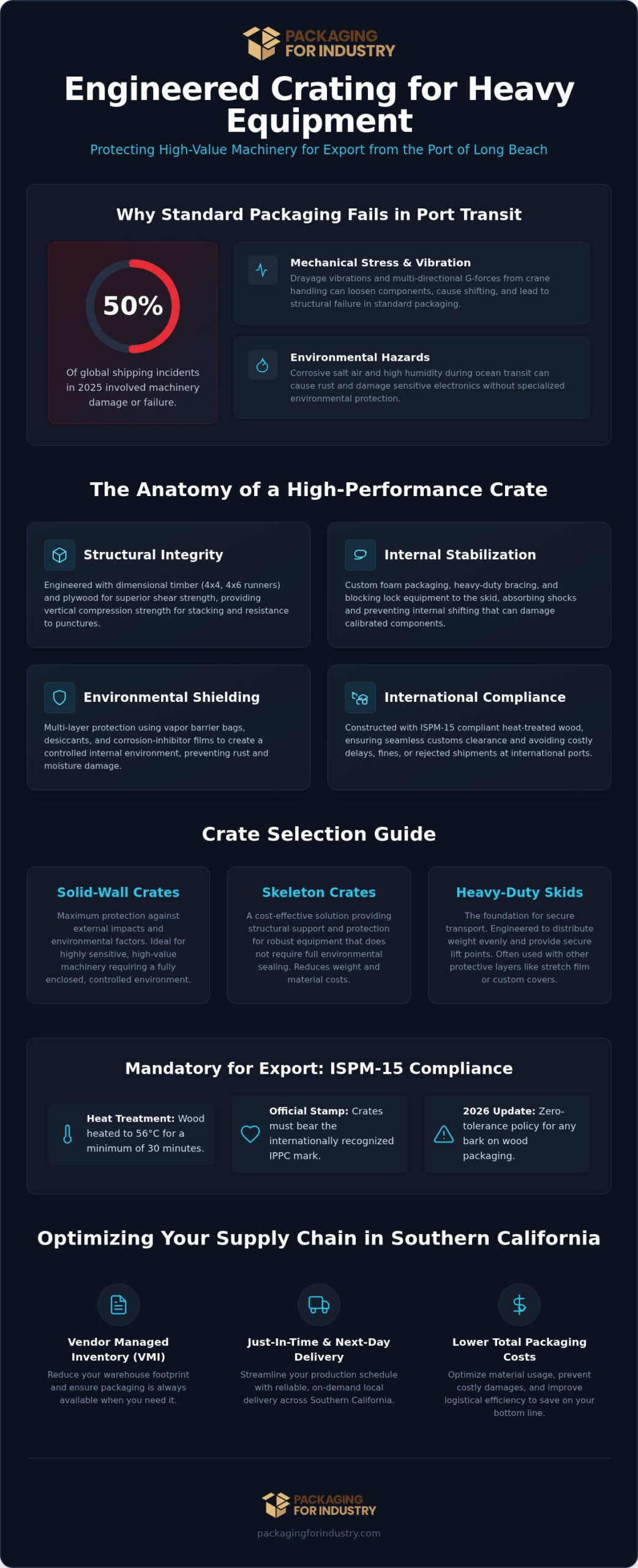
Did you know that machinery damage or failure accounted for over 50 percent of global shipping incidents in 2025? When your high-value equipment is headed for the Port of Long Beach, a standard wooden box is rarely enough to protect against the mechanical stresses of ocean transit. You need engineered stabilization. Securing custom crates for heavy equipment shipping out of Long Beach requires a precise balance of structural integrity and logistical compliance to prevent costly transit delays or total cargo loss.
You likely already know that an unbalanced load or a missed ISPM-15 stamp can derail your entire production schedule. It is frustrating to deal with inconsistent lead times or the high risk of damage during drayage and port handling. This guide will show you how to specify, engineer, and procure custom heavy-duty crates that ensure your machinery arrives in perfect condition. We’ll examine the technical requirements for internal stabilization, the latest 2026 export regulations, and how to streamline your procurement process for maximum cost efficiency and reliability.
Key Takeaways
- Understand why engineered structural support is mandatory to withstand the mechanical stresses of drayage and crane handling at the Port of Long Beach.
- Learn how to select custom crates for heavy equipment shipping out of Long Beach that utilize ISPM-15 compliant heat-treated wood for seamless international export.
- Compare solid-wall wood crates, skeleton crates, and heavy-duty skids to find the most cost-effective protection for your specific machinery dimensions.
- Discover how custom foam inserts and internal stabilization work together to eliminate transit damage for high-value or unbalanced loads.
- Explore how leveraging Vendor Managed Inventory (VMI) and local next-day delivery in Southern California can reduce your total packaging costs and warehouse footprint.
Why Standard Packaging Fails Heavy Equipment at the Port of Long Beach
Heavy industrial equipment isn’t just large; it’s often unbalanced and highly sensitive to external movement. Relying on standard off-the-shelf solutions is a significant liability for your bottom line. True wooden crate construction for industrial use focuses on load-bearing engineering rather than just simple enclosure. Specifying custom crates for heavy equipment shipping out of Long Beach ensures that your machinery doesn’t just fit in a container, but survives the mechanical rigors of the journey.
The San Pedro logistics corridor presents unique challenges for heavy loads. Drayage vibrations during the trip from a local manufacturing facility to the terminal can loosen critical fasteners if the cargo isn’t properly dampened. Once at the port, crane-to-ship handling subjects the load to significant multi-directional G-forces. Standard pallets often fail because they lack the lateral stability required for high-center-of-gravity machines. This leads to “walking,” where the equipment shifts inside the container, causing structural damage. In 2025, machinery damage was the primary cause of shipping incidents globally, accounting for over 50 percent of all cases. The financial impact of these failures often includes:
- Expensive repair costs and the replacement of sensitive calibrated components.
- Liquidated damages for missed delivery milestones on industrial contracts.
- Increased insurance premiums and the potential loss of professional reputation.
Mechanical Stress Factors in Port Transit
Lifting a 40,000-pound piece of equipment requires precise weight distribution and structural reinforcement. If your crate isn’t engineered with specific lift points and internal blocking, the frame can buckle under its own weight during crane operations. We utilize custom design packaging to integrate heavy-duty bracing that locks the equipment directly to the skid. This prevents the internal shifting that destroys sensitive electronics or calibrated components during high-vibration transit. Proper engineering ensures that the crate acts as a rigid exoskeleton, absorbing external impacts before they reach the machinery.
Environmental Hazards of Ocean Shipping
The Port of Long Beach is a primary gateway for Pacific trade, but ocean transit exposes cargo to corrosive salt air and extreme humidity. Raw wood naturally absorbs moisture, which can then get trapped inside a sealed container. We mitigate this risk by combining solid-wall crates with vapor barrier bags and desiccant packs to maintain a controlled internal environment. For sensitive surfaces, we integrate specialized foam packaging and corrosion-inhibitor films. This multi-layered approach ensures your equipment remains rust-free and operational upon arrival at its destination.
Engineering Custom Crates: Materials and Compliance Standards
Engineering custom crates for heavy equipment shipping out of Long Beach requires a data-driven approach to material selection. For machinery weighing over 10,000 lbs, standard construction methods aren’t sufficient. We prioritize dimensional timber, such as 4×4 or 4×6 runners, to provide the necessary vertical compression strength for stacking. Plywood is often specified for sidewalls because of its superior shear strength and resistance to punctures, which is critical during multi-modal transfers.
Structural integrity extends to the base. We engineer skids to handle specific point-load stresses, ensuring the weight is distributed evenly across the floor of the container. This level of precision is vital when managing the complexities of heavy equipment logistics in Southern California. To ensure internal components stay calibrated, we integrate custom foam packaging that acts as a shock absorber against the constant vibrations of road and rail transit.
International Export Requirements (ISPM-15)
If your equipment’s destined for international markets, heat-treated wood isn’t optional. ISPM-15 standards require all solid wood packaging material to be heated to a core temperature of 56°C for at least 30 continuous minutes. As of 2026, regulatory enforcement has tightened. There’s now a zero-tolerance policy for bark on wood packaging, as it can harbor pests that survive the heat treatment process. Every crate must feature a permanent, legible IPPC mark on at least two opposite sides. We recommend branded heat-stamps over ink, as they remain legible even after exposure to the harsh environment of Pacific transit routes. Non-compliance leads to immediate shipment rejection or expensive quarantine fees at the destination port.
Structural Design for Heavy Loads
The base design determines how easily your cargo moves through the terminal. We offer both 2-way and 4-way entry skids. For loads exceeding 10,000 lbs, 2-way entry is often preferred for its increased structural rigidity. Wall framing depends on the sensitivity of the machine. While triple-wall corrugated is effective for lighter aerospace components, heavy machinery typically requires solid wood framing with 3/4-inch plywood sheathing. When designing custom crates for heavy equipment shipping out of Long Beach, we prioritize the use of lag bolts instead of nails for heavy-duty applications. Lag bolts provide superior withdrawal resistance and allow your team to disassemble the crate safely without damaging the equipment. If you need to compare packaging pricing for your next project, our engineering team can provide a detailed material specification tailored to your machine’s dimensions.
Crate Selection Guide: Solid vs. Skeleton vs. Heavy-Duty Skids
Choosing the right structural design for your shipment is a critical decision that impacts both safety and your bottom line. It isn’t just about the box. When procuring custom crates for heavy equipment shipping out of Long Beach, you must select an enclosure style that balances protection levels with transit costs. The three primary configurations—solid-wall, skeleton, and heavy-duty skids—each serve specific operational needs based on the sensitivity and dimensions of your machinery.
Calculating the ROI of enhanced protection is straightforward when you consider the stakes. The international maritime industry loses an estimated $6 billion annually due to cargo damage, often caused by improper securing or inadequate packaging. Investing in an engineered crate is an insurance policy against these losses. While a heavy-duty skid might save on material costs, the potential for a multi-million dollar insurance claim on an unprotected machine far outweighs the initial expense of a solid-wall enclosure.
When to Specify Solid-Wall Construction
Solid-wall wood crates offer the highest level of security and environmental defense. These are mandatory for high-precision medical devices or Aerospace packaging solutions where even minor exposure to dust or moisture can cause failure. The solid sheathing, typically 1/2-inch to 3/4-inch plywood, prevents theft and tampering by fully concealing the contents. It also provides a rigid surface for attaching desiccant packs and vapor barriers, which are essential for long-haul Pacific transit. If your equipment has sensitive surfaces or calibrated internal components, solid-wall construction is the professional standard.
The Use Case for Skeleton Crates
Skeleton or open-slat crates are an efficient middle ground for rugged industrial equipment. These structures use a heavy-duty frame but leave gaps between the wooden slats, significantly reducing the tare weight of the shipment. This weight reduction is a primary driver for lowering packaging costs in air-freight applications. Skeleton designs also offer excellent visibility for customs officials at the Port of Long Beach, allowing for inspections without the need to disassemble the entire crate. We often recommend these for durable castings, frames, or large valves that don’t require total environmental isolation. Even with an open design, these custom crates for heavy equipment shipping out of Long Beach must still meet strict Compliance Standards for heat-treated wood to ensure they pass international borders without delay.
For oversized items that exceed standard container dimensions, heavy-duty skids are the most pragmatic choice. These consist of a reinforced base engineered to support the machine’s specific footprint. While they don’t offer sidewall protection, they provide the structural foundation needed for crane lifting and flat-rack securing. When using skids, we integrate specialized tie-down points and recommend heavy-duty tarping to protect against the elements during drayage and ocean transit.
Preparing for Shipping: Logistics and On-Site Crating Strategies
Successful transport begins long before the machine reaches the terminal. Coordinating custom crates for heavy equipment shipping out of Long Beach requires a synchronized effort between your production team and our packaging engineers. A comprehensive pre-shipping checklist is the first line of defense. This includes precise weighing, measuring, and identifying lift points to ensure the crate’s internal blocking aligns with the machine’s structural frame. Identifying the center of gravity is critical; an off-center load can lead to catastrophic failure during crane lifts at the port.
For many industrial clients, the choice between on-site crating and factory crating depends on the machine’s dimensions and the project’s timeline. On-site crating eliminates the risk of damage during initial transport to a packaging facility. It’s particularly efficient for oversized loads that require specialized permits to travel the designated Heavy Haul Route toward San Pedro and Long Beach. Conversely, factory crating in a controlled environment can lower packaging costs by utilizing specialized assembly tools and packaging kitting for recurring shipments.
Facility Preparation for Crating Teams
To ensure a smooth on-site operation, your facility must be prepared for a crating crew. This involves clearing a dedicated staging area with enough clearance for heavy-duty forklifts and wood construction tools. Engineers require detailed technical drawings and center-of-gravity data before arrival to finalize the crate’s internal bracing design. Safety is the priority. We follow strict protocols for machinery blocking and bracing to ensure the equipment is immobilized before the sidewalls are secured. Providing these details early prevents production delays and ensures the crate is built to the exact specifications of the load.
Logistics Coordination for Port Delivery
The Port of Long Beach processed 779,331 TEUs in June 2026, a volume that demands precise scheduling. We recommend ‘Just-in-Time’ crating to minimize the warehouse footprint of your finished goods. Once the equipment is crated, coordination with drayage providers is essential, especially for loads exceeding 80,000 pounds that require Overweight Special Vehicle Permits from the City of Long Beach. Proper labeling and IPPC marking must be legible for international stevedores to avoid customs holds. Managing the transition from a flatbed truck to an ocean container requires a crate designed for multi-point lifting, ensuring the cargo remains stable through every stage of the terminal transfer.
Optimizing Your Supply Chain with PFI’s Custom Crating Solutions
Packaging For Industry (PFI) approaches crating as a comprehensive system of protection and logistical optimization. We don’t just build boxes; we engineer solutions that lower your total cost of ownership. By utilizing custom design packaging, we eliminate the waste of over-packaging while providing the structural integrity required for high-value machinery. Every project begins with free prototyping to verify that internal blocking and foam inserts align perfectly with your machine’s frame. This proactive testing phase is a critical step in procuring custom crates for heavy equipment shipping out of Long Beach, as it prevents costly errors before full production begins.
Our Anaheim base provides a strategic advantage for manufacturers in the San Pedro Bay area. We combine local expertise in the Southern California port corridor with a nationwide shipping reach, ensuring your equipment is protected whether it’s moving across the county or across the Pacific. By acting as a seasoned industrial consultant, we help you navigate the intersection of engineering and economics, ensuring your packaging spend is an investment in reliability rather than a sunk cost.
The Financial Benefits of VMI for Crating
For manufacturers with recurring shipment schedules, Vendor Managed Inventory (VMI) provides a significant competitive advantage. Southern California real estate is expensive, and storing bulky, custom-sized crates consumes valuable floor space. Our VMI programs allow you to free up that space by housing your inventory in our facility. We monitor your production levels and provide local next-day delivery to ensure you never face a stockout. This system improves your cash flow because you only pay for the packaging as it’s used, effectively moving your packaging costs from a fixed to a variable expense that scales with your output.
Next Steps: Requesting an Engineered Quote
Transitioning from a technical challenge to a logistical success starts with a detailed consultation. When you’re ready to request a packaging quote, our team needs specific data to provide an accurate engineered response. Please have your machine’s dimensions, weight, center-of-gravity points, and destination port ready. Our timeline from initial design to delivery in Long Beach is streamlined to match your production schedule. We prioritize precision and efficiency, ensuring that your custom crates for heavy equipment shipping out of Long Beach meet every regulatory and structural requirement. Contact us today to compare packaging pricing and secure a dependable partner for your industrial logistics.
Securing Your Industrial Assets for Global Transit
Protecting high-value machinery requires more than just a wooden enclosure; it demands structural engineering tailored to specific load-bearing requirements. You’ve learned how internal stabilization, material selection, and regulatory compliance work together to prevent transit damage. Utilizing custom crates for heavy equipment shipping out of Long Beach is the most effective way to safeguard your investment against the mechanical and environmental stresses of Pacific trade routes. It’s a pragmatic step toward eliminating professional stress and ensuring your operational goals remain on track.
PFI stands ready to support your manufacturing or distribution operations with ISPM-15 export certified materials and free custom prototyping to ensure a perfect fit before full production. Our local Southern California presence allows for next-day delivery and integrated VMI programs that lower your total packaging costs while freeing up valuable warehouse space. We focus on the intersection of engineering and economics to provide a reliable system of protection for every piece of equipment you ship.
Your machinery represents a significant capital investment. We’re here to provide the steady, dependable partnership you need to move that equipment safely across the globe. Let’s work together to optimize your logistics and achieve zero-damage delivery for your next project.
Frequently Asked Questions
What is ISPM-15 and why does my heavy equipment crate need it?
ISPM-15 is the international standard for wood packaging that requires heat treatment to prevent the spread of invasive pests. All wood crates for international export must be heat-treated to a core temperature of 56°C for 30 continuous minutes. PFI provides ISPM-15 compliant crates featuring the mandatory IPPC mark. Non-compliance results in immediate port delays or shipment rejection at the destination, making it a critical requirement for global trade.
How do I determine if I need a solid wood crate or a skeleton crate?
Selecting between solid and skeleton crates depends on your machinery’s sensitivity and the shipping method. Solid-wall crates provide maximum environmental protection and security for high-value components like medical or aerospace devices. Skeleton crates use an open-slat design to reduce tare weight and air-freight costs. If your equipment is rugged and durable, a skeleton crate offers visibility for customs inspections while helping you lower packaging costs.
Can PFI build custom crates on-site at my manufacturing facility in Long Beach?
Yes, PFI provides professional on-site crating services directly at your manufacturing facility in Long Beach and throughout Southern California. This service is ideal for oversized machinery that is difficult to transport to our Anaheim facility before it is secured. Our team arrives with all necessary materials to engineer and assemble custom crates for heavy equipment shipping out of Long Beach, ensuring your specific timeline and safety protocols are met.
What information do I need to provide for a custom heavy equipment crate quote?
To provide an accurate engineered quote, we require the physical dimensions, total weight, and center-of-gravity points of your equipment. It is also helpful to identify the destination, transit method, and any specific lift points or fragile components. Providing technical drawings or CAD files allows our engineers to design internal blocking and bracing that ensures zero-damage delivery. You can request a packaging quote online to begin the analysis of your project.
Do you offer foam-lined crates for sensitive industrial machinery?
We specialize in integrating custom foam packaging within our wood crates to protect sensitive industrial machinery. Depending on your specific needs, we use polyethylene, polyurethane, or anti-static ESD foam to provide necessary shock absorption and vibration dampening. This multi-layered approach prevents internal components from shifting or sustaining damage during the rough handling typical of port logistics and long-haul ocean transit. Custom foam assemblies are tailored to your product’s unique geometry.
How does a Vendor Managed Inventory (VMI) program work for custom wood crates?
Our VMI program involves PFI managing your stocking levels based on your actual production usage. We store your custom-sized crates in our facility to free up your warehouse space in Southern California. Our team conducts regular inventory reviews and provides local next-day delivery as you need them. This ensures you always have a consistent supply without tying up capital in excess inventory, effectively simplifying your entire purchasing and warehouse process.
What is the weight limit for your custom-engineered industrial skids?
There is no fixed weight limit for our custom-engineered industrial skids because each is designed for a specific load-bearing requirement. We have engineered bases for equipment exceeding 40,000 pounds by utilizing heavy-duty dimensional timber runners like 4×6 or 4×8 lumber. Our engineers calculate the base strength needed to support your machine’s specific footprint. This ensures it remains stable during crane lifts and flat-rack securing at the terminal without buckling or shifting.
How do I prevent corrosion on metal parts during ocean shipping from the Port of Long Beach?
Preventing corrosion during ocean transit requires a controlled internal environment inside the crate. We utilize vapor barrier bags and desiccant packs to manage humidity levels during the long journey from the Port of Long Beach. For metal surfaces, we often apply specialized corrosion-inhibitor films. These materials, combined with solid-wall custom crates for heavy equipment shipping out of Long Beach, protect your machinery from salt air and moisture throughout the entire supply chain.