
If you think custom crating is just an added expense, you’re likely paying for it twice: once at the loading dock and again when your customer rejects a damaged shipment. Securing the right custom crates for shipping Los Angeles industrial equipment requires a precise balance of engineering and economics. You’ve likely dealt with the frustration of long lead times or crates that are so over-engineered they drive your freight costs through the roof. It’s a common struggle for manufacturers trying to maintain a lean supply chain while meeting strict international export standards.
We understand that your primary goals are zero-damage delivery and predictable lead times. This guide will show you how to procure engineered crates that eliminate transit damage and optimize your logistics operations. We’ll examine the 2026 ISPM-15 enforcement updates, including the mandatory hyphen in compliance marks, and how to navigate the latest international tariff schedules. You’ll learn how the right crate design reduces dimensional weight to lower your total landed cost and ensures your cargo moves through the supply chain without delays or non-compliance penalties.
Key Takeaways
- Understand why standard pallets and boxes fail for heavy machinery and how engineered enclosures provide the structural integrity required for high-value industrial assets.
- Discover how to select the right materials for custom crates for shipping Los Angeles exports, including heat-treated lumber that meets the strict 2026 ISPM-15 compliance standards.
- Compare the performance of traditional full-wood crates against engineered hybrid solutions to find the best balance between structural protection and freight weight reduction.
- Learn the five critical data points required to request a packaging quote that ensures your crate dimensions are perfectly specified for both your cargo and your carrier’s requirements.
- Identify how local next-day delivery and specialized expertise in aerospace and aviation packaging can streamline your Southern California supply chain and eliminate long lead times.
The Necessity of Custom Crates for Los Angeles Industrial Shipping
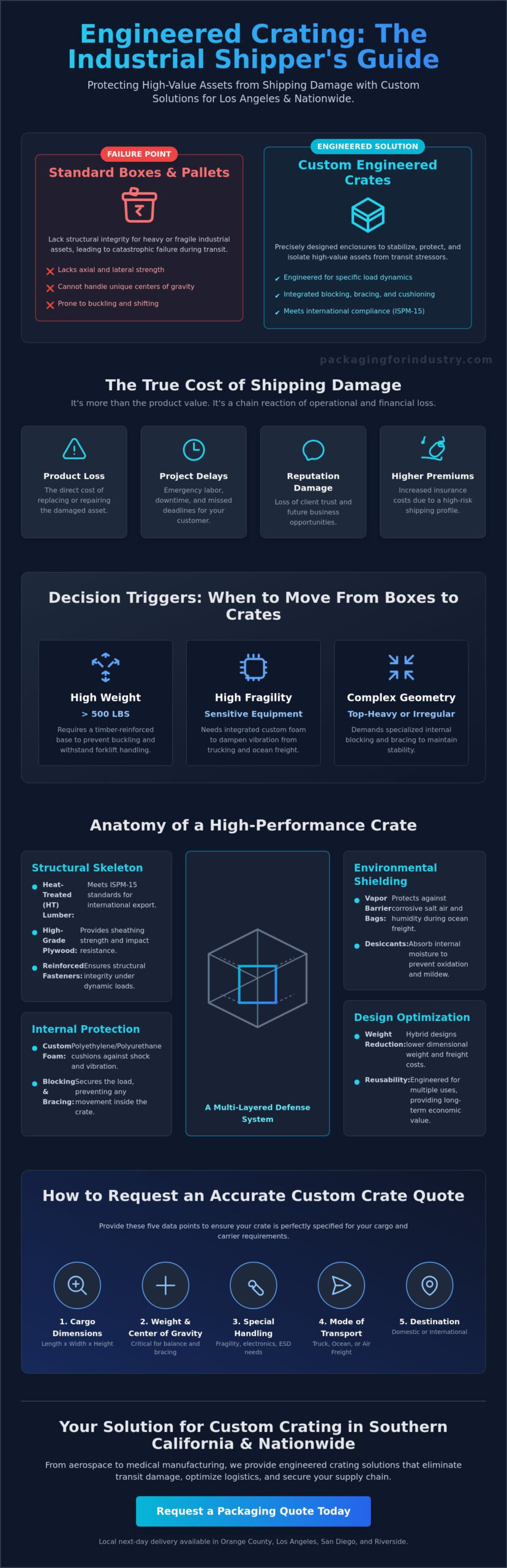
A Crate is more than just a wooden container; it’s a precisely engineered enclosure designed to stabilize and protect high-value assets during the rigors of transit. For manufacturers across Southern California, relying on standard off-the-shelf solutions often leads to catastrophic failure. Standard pallets and double-wall corrugated boxes simply lack the axial strength required to support heavy industrial machinery or the lateral stability to prevent shifting in an ocean container. In the Los Angeles logistics landscape, where shipments move through high-density hubs and the Port of Los Angeles, “protection-first” procurement is the only way to safeguard your bottom line.
Specialized sectors like aerospace and medical manufacturing in Orange County and LA County can’t afford the risks associated with generic packaging. When you specify custom crates for shipping Los Angeles industrial goods, you’re investing in a system designed to handle the specific stressors of the regional supply chain, from drayage vibrations to port handling equipment. Standard packaging fails because it treats every load the same, ignoring the unique centers of gravity and delicate calibration points found in industrial equipment.
When to Move from Boxes to Custom Crates
Transitioning to custom solutions usually happens when weight, fragility, or geometry exceeds the capabilities of traditional packaging. If your equipment weighs more than 500 pounds, a timber-reinforced base becomes essential to prevent the floor from buckling during forklift maneuvers. Sensitive electronics and medical devices require more than just a box; they need integrated custom foam packaging to dampen the vibrations of long-haul trucking and ocean freight. Non-standard or top-heavy equipment presents unique center-of-gravity challenges that only a custom-engineered crate can address through specialized internal blocking and bracing that keeps the load upright and stationary.
The Economic Impact of Shipping Damage
The true cost of shipping damage goes far beyond the price of the product itself. When a machine arrives at a job site damaged, the secondary costs include emergency field labor, expensive replacement parts, and the potential loss of a long-term client relationship. Engineered crates act as a physical insurance policy for your most valuable assets. By utilizing a robust crating strategy, businesses often see a reduction in insurance premiums for high-value freight because carriers recognize the lower risk profile of properly crated goods. Before your next major shipment, it’s wise to request a packaging quote to evaluate how an engineered solution can stabilize your supply chain and eliminate these hidden financial drains.
Engineering and Material Selection for High-Value Protective Crating
High-performance crating requires more than basic carpentry. It demands a rigorous selection of materials based on load dynamics and environmental stressors. We utilize heat-treated (HT) lumber, high-grade plywood, and reinforced fasteners to build a structural skeleton that withstands stacking pressures and forklift impacts. These units are frequently engineered to allow for re-use, providing both economic and operational longevity. For companies sourcing custom crates for shipping Los Angeles machinery, material density is a critical variable. Our custom design packaging team provides free prototyping to ensure every component fits perfectly before production begins.
Beyond the wooden shell, we address environmental risks. Ocean freight exposes cargo to salt air and humidity, which can lead to rapid oxidation. We mitigate this by integrating vapor barrier bags and desiccants within the crate. This creates a hermetically sealed environment for your equipment. To ensure the design meets your specific operational needs, you can request a packaging quote that includes a full engineering review of your cargo’s requirements.
Selecting the Right Protective Foam Inserts
The choice between Polyethylene (PE) and Polyurethane (PU) foam depends entirely on the weight and fragility of the item. PE is a high-density, closed-cell foam ideal for heavy industrial parts that require firm support. PU is a softer, open-cell foam better suited for lighter, more delicate instruments. For aerospace components and sensitive electronics, we provide specialized ESD (electrostatic discharge) foam to prevent static damage. Integrating custom foam packaging ensures that shock and vibration are absorbed by the material rather than the equipment. Precision-cut inserts eliminate internal movement, which is the primary cause of damage during rough handling in LTL shipping environments.
International Compliance: ISPM-15 and Heat Treatment
International shipping regulations are strict and non-negotiable. As of January 1, 2026, APHIS has resumed full enforcement of ISPM-15 marking requirements. This includes the mandatory hyphen separating the country and facility codes in the compliance mark. There is no grace period for non-compliance; crates that fail to meet these standards face immediate quarantine or rejection at the destination port. We use only HT lumber that meets these global standards, protecting Los Angeles exporters from costly customs delays. With lumber futures at $597.50 per 1,000 board feet as of June 2026, efficient material use is essential for maintaining your budget while ensuring full regulatory compliance.
Crate Design Comparison: Full Wood vs. Engineered Hybrid Solutions
Choosing the right architecture for your custom crates for shipping Los Angeles products is a decision that impacts your total landed cost as much as the protection of the cargo itself. In the 2026 logistics market, where ground parcel rates are 38.9% higher than the 2018 baseline, every pound of unnecessary packaging weight directly erodes your margins. Shippers must decide between the maximum durability of all-wood construction and the economic efficiency of hybrid designs. This choice depends on your weight-to-strength requirements and whether your cargo will face the high-density stacking common in modern LTL freight environments.
With lumber futures currently at $597.50 per 1,000 board feet as of June 2026, material optimization is no longer optional. While the previous section detailed the engineering of these materials, the structural layout determines how effectively they perform under stress. We analyze your supply chain to determine if a traditional build is necessary or if a lighter, hybrid solution can achieve the same protection at a lower freight class. This strategic approach ensures you aren’t paying for structural capacity you don’t actually use.
Heavy-Duty Full Wood Crates
- Best for: Loads exceeding 1,000 lbs, long-term warehouse storage, and high-value international exports.
- Structural Features: These units feature heavy-duty skidded bases, framed ends, and reinforced lids to support vertical stacking.
- Durability: Engineered to withstand multi-leg journeys involving ocean containers, rail, and heavy-duty forklifts.
Full wood crates provide the ultimate axial strength. If your equipment requires long-term storage or will be stacked multiple levels high in a warehouse, the timber-framed walls provide the necessary compression resistance. These are the gold standard for oversized machinery where the risk of puncture or crushing is highest during transit.
Hybrid and Combo Crating Solutions
Hybrid solutions integrate heavy-duty corrugated boxes with timber-reinforced bases and internal blocking. This architecture offers a superior weight-to-strength ratio for mid-weight industrial parts. By replacing wooden side panels with triple-wall corrugated sheets, we significantly reduce the crate’s tare weight. This reduction is vital for domestic air freight where dimensional weight pricing is most aggressive.
These combo crates are ideal for medical devices or electronics that require the stability of a wood skid but don’t need the puncture resistance of a full timber wall. They offer a lower total cost of ownership by reducing both material expenses and outbound freight charges. As more shippers move freight downstream to LTL options to manage rising truckload costs, hybrid crating provides the flexibility to maintain protection while keeping shipment weights manageable.
Buying Guide: How to Spec Custom Shipping Crates for Procurement
Procurement errors in industrial packaging often lead to a cycle of overspending and delayed shipments. To secure the right custom crates for shipping Los Angeles manufactured goods, your specifications must be precise from the start. Measurement errors are the most common cause of procurement delays. When you provide dimensions, you must distinguish between the internal clearance required for the cargo and the external footprint that determines your freight costs. Because ground parcel rates are projected to rise 5.4% year-over-year in 2026, even a few inches of unnecessary external volume can significantly inflate your transportation budget.
An accurate request a packaging quote relies on five essential data points. First, provide the exact length, width, and height of the cargo at its widest points. Second, specify the total weight. Third, identify the center of gravity for unbalanced loads. Fourth, detail the handling requirements, such as four-way forklift access or recessed hardware. Finally, define the destination to ensure compliance with international HT standards. Providing this data upfront prevents the “guesswork” that leads to poorly engineered crates or unexpected price adjustments later in the production cycle.
Step-by-Step Specification Process
Determining the weight capacity is only the first step; you must also account for how that weight is distributed. Unbalanced loads require specialized internal blocking to prevent the crate from tipping during transit. You should also select your closure types based on the end-user’s needs. Screws are preferable for high-value equipment that requires careful unpacking or inspection, while nails are suitable for one-way, high-volume shipments. For machinery with delicate finishes, specify the need for corner and edge protection to prevent the timber frame from making direct contact with the product’s surface.
Optimizing Lead Times and Inventory
Custom crating doesn’t have to result in long lead times if you integrate Just-In-Time (JIT) management into your procurement strategy. By coordinating your production schedule with our design team, you can ensure that crates arrive exactly when the machinery is ready for the loading dock. This approach reduces warehouse clutter and frees up valuable floor space in your Southern California facility. Local next-day delivery in Los Angeles and Orange County further streamlines this process, allowing you to maintain a lean inventory without risking shipping delays. To begin optimizing your supply chain, request a packaging quote today and let our engineers review your specific cargo requirements.
PFI: Your Solution for Custom Crating in Southern California and Nationwide
PFI serves as a central hub for industrial protection across the Southern California corridor. For businesses requiring custom crates for shipping Los Angeles high-value cargo, we provide more than just timber and fasteners. We offer a comprehensive logistical system designed to withstand the rigors of global transit. Our local next-day delivery service covers Orange County, Los Angeles, and San Diego, ensuring that your production schedule is never stalled by packaging delays. For multi-site manufacturers, our national shipping capabilities guarantee that your packaging standards and structural specifications remain consistent across all your North American facilities.
We position ourselves as a strategic partner rather than a simple vendor. While local shops might offer basic box construction, PFI integrates engineering expertise with economic optimization. We analyze your entire supply chain to identify where better crate design can lower your total landed cost. This approach is essential for companies navigating the complex 2026 shipping environment, where Port of Los Angeles tariffs and rising parcel rates demand maximum efficiency. By choosing PFI, you’re securing a dependable partner that values long-term reliability and tangible, real-world outcomes.
Specialized Sector Expertise
High-stakes industries require specialized compliance and precision. Our team has deep expertise in aerospace and aviation packaging, where weight optimization and shock protection are paramount. We understand the rigorous requirements of mil-spec packaging for defense contractors and provide clean-room compatible crating for sensitive medical and semiconductor equipment. Our prototyping services act as a final safeguard; we ensure a perfect fit for complex components before you commit to a full production run. This level of technical oversight eliminates the risk of field failures and protects your professional reputation.
Efficiency Services for Manufacturers
Modern manufacturing demands operational agility and lean inventory. We support these goals through Vendor Managed Inventory (VMI), which ensures your facility never faces a stock-out of critical shipping supplies. Additionally, our packaging kitting services streamline your assembly line by delivering pre-assembled component sets directly to your workstations. These services remove the administrative burden of supply management and free up valuable warehouse floor space. Ready to optimize your protection and reduce your logistical stress? Request a custom crating quote today and see how our engineered solutions can stabilize your supply chain.
Secure Your Supply Chain with Engineered Crating
Success in industrial logistics requires a move away from generic packaging toward engineered protection. We’ve explored how selecting the right materials and architecture can lower your total landed cost while ensuring zero-damage delivery. By prioritizing custom crates for shipping Los Angeles machinery, you eliminate the high cost of transit damage and the operational stress of shipping delays. Remember that full ISPM-15 compliance is now mandatory for all international wood packaging. Our use of heat-treated lumber and precise marking ensures your cargo clears customs without the risk of rejection or quarantine.
Your equipment deserves a physical insurance policy that balances structural integrity with freight economics. We provide free prototyping for custom designs and offer local next-day delivery across Southern California to keep your assembly line moving. Whether you’re in aerospace, medical, or heavy manufacturing, we’re ready to serve as your proactive logistics partner. Take the first step toward a more reliable supply chain and Request a Custom Crating Quote for Your Next Shipment. We look forward to helping you protect your most valuable assets.
Frequently Asked Questions
How long does it take to design and build a custom shipping crate?
Lead times for custom crating typically depend on the complexity of the design and current material availability. Most standard industrial orders are completed within three to five business days following design approval. If your project requires an initial prototype to verify the fit for a sensitive aerospace component, you should account for additional time in your production schedule to ensure the engineering meets your requirements.
Do custom crates for shipping Los Angeles need to be ISPM-15 compliant?
International shipments require full compliance with ISPM-15 standards to avoid quarantine at destination ports. When ordering custom crates for shipping Los Angeles products globally, we use heat-treated lumber marked with the mandatory 2026 compliance stamp. This ensures your cargo moves through the Port of Los Angeles without regulatory delays or rejected entries at the final destination.
What is the difference between a crate and a pallet for heavy equipment?
A pallet is a load-bearing platform used for transport, while a crate is a six-sided enclosure that provides comprehensive physical protection. While pallets are sufficient for stable, low-profile loads, crates are necessary for heavy industrial machinery that requires lateral stability. A crate protects against stacking pressures and environmental exposure that a standard pallet cannot withstand during multi-leg journeys.
Can custom crates be reused for multiple shipments?
Custom crates can be engineered for multiple uses if you specify this requirement during the design phase. By utilizing screws instead of nails or adding heavy-duty reusable latches, we create a durable enclosure that survives multiple transit legs. This is an effective strategy for companies that manage internal equipment transfers or closed-loop supply chains between regional manufacturing facilities.
How do custom foam inserts improve the safety of a shipping crate?
Custom foam inserts act as a shock absorption system by decoupling the product from the wooden exterior of the crate. We select specific foam densities, such as Polyethylene or Polyurethane, based on the fragility and weight of your equipment. These precision-cut inserts eliminate internal shifting, which is the primary cause of damage during rough handling in high-density LTL freight environments.
Does PFI offer on-site crating services in Southern California?
We specialize in the design, manufacturing, and delivery of engineered crating solutions throughout Southern California. While our primary focus is on providing high-quality custom and stock packaging materials, we work closely with industrial partners to meet their specific operational workflows. You should contact our sales team directly to discuss your specific logistical needs and how our delivery network can support your facility.
What information do I need to provide for a custom crate quote?
You should provide the cargo’s exact dimensions, total weight, and the location of the center of gravity if the load is unbalanced. It’s also important to specify handling requirements like forklift access points or the need for vapor barrier protection for ocean freight. Providing this data allows us to generate an accurate quote that balances structural integrity with freight cost optimization.
Can PFI handle both small custom orders and high-volume production?
Our production facility is equipped to manage both specialized one-off prototypes and high-volume industrial runs. We support manufacturers with various production scales, offering local next-day delivery across Orange County and Los Angeles to maintain supply chain flow. Whether you need a single crate for a delicate medical device or bulk quantities for a distribution center, we provide scalable solutions for your operations.