
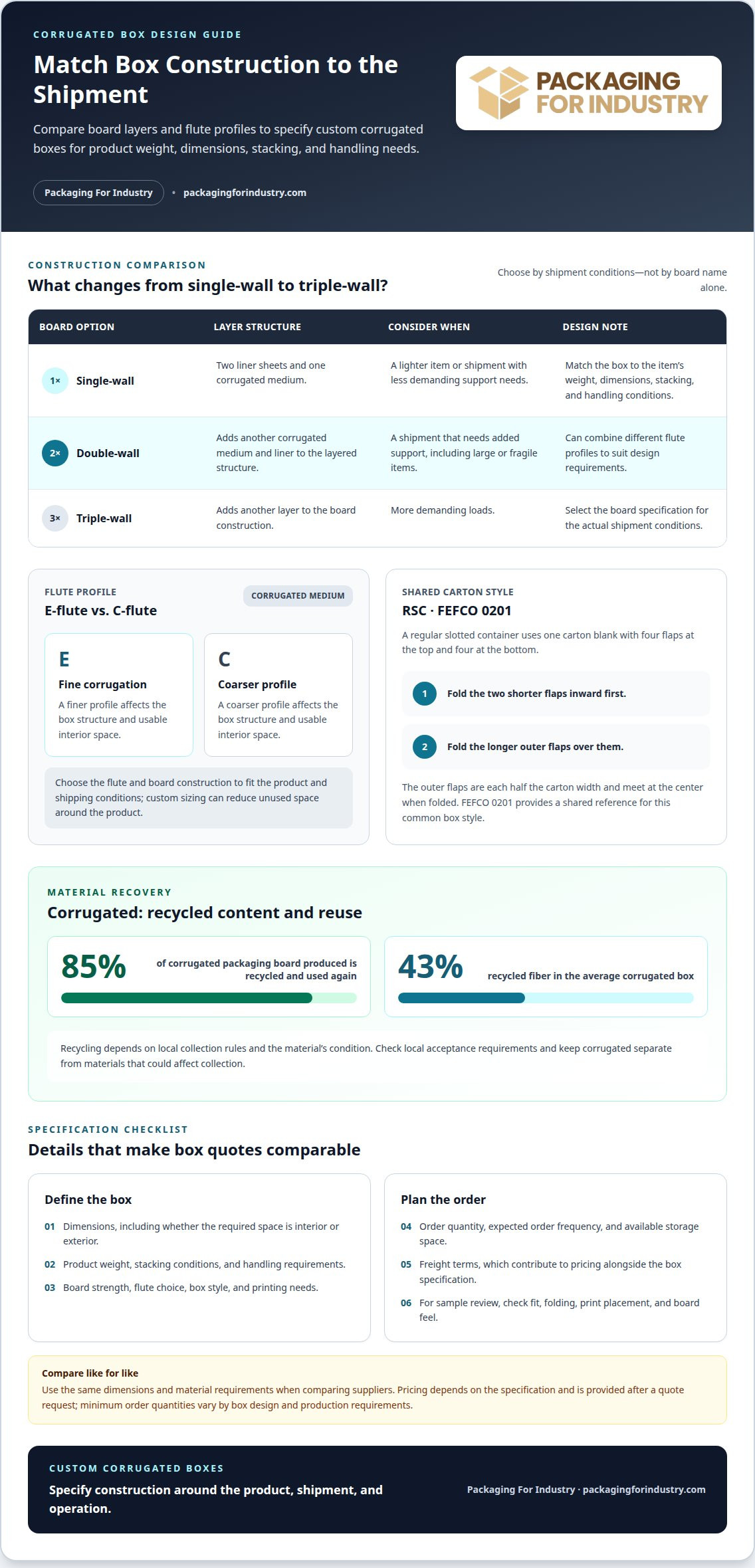
85% of corrugated packaging board produced is recycled and used again, and the average corrugated box is made from 43% recycled fiber. For businesses sourcing custom double-wall RSC shipping boxes in Santa Ana, recyclability and protection for large or fragile items can both inform the box design.
It’s reasonable to want packaging that protects products without using more material than necessary. RSC boxes have four flaps at both ends, while double-wall construction is an option when a shipment needs added support.
This article explains how RSC construction works, how flute choices affect box design, and what to consider about recyclability and double-wall strength. You’ll be better equipped to specify box dimensions and protection for the products you ship.
Key Takeaways
- Match single-wall or double-wall construction and flute options to the item’s size, weight, and protection needs.
- Understand how box materials affect recyclability, and consider material use alongside the protection your shipment requires.
- Box dimensions, construction, and order quantity can all influence pricing, so define your packaging needs before requesting a quote.
- Learn how RSC flap design and sealing contribute to a practical shipping carton for warehouse and distribution use.
- Custom packaging design can help address large or fragile items, with foam packaging as an option for added product protection.
Can I get shipping boxes in E-flute, C-flute or double wall?
Yes. Custom corrugated boxes can use E-flute, C-flute, or double-wall construction, depending on the product and shipping conditions. Single-wall board has two liner sheets and one corrugated medium. Double-wall board adds another corrugated medium and liner to create a layered structure for shipments that need more support. Triple-wall board adds another layer for demanding loads. Choose based on the item’s weight and dimensions, stacking conditions, and handling requirements.
Flute selection affects a box’s structure and usable interior space. E-flute has a fine corrugation, while C-flute has a coarser profile. Double-wall board can combine different flute profiles to suit design requirements. Rather than choosing by name alone, match the construction to the shipment: a compact component and a large, heavy assembly place different demands on a corrugated box. Custom sizing can also reduce unused space around the product.
Corrugated materials are available in recycled kraft and white finishes. Kraft offers a natural brown appearance; white board provides a lighter surface for printing, product identification, or handling labels. Printing requirements and box style can influence material selection, especially when labels need clear contrast. Corrugated packaging is recyclable, and the average corrugated box is made from 43% recycled fiber. In addition, 85% of corrugated packaging board produced is recycled and used again.
For Santa Ana businesses, corrugated recycling depends on local collection rules and the material’s condition. Follow local acceptance requirements and keep corrugated separate from materials that could affect collection. Commercial packaging requirements can vary by location and use, so don’t assume one rule applies to every operation.
Packaging companies serving Santa Ana can produce custom double-wall RSC boxes when they support corrugated design and manufacturing. For local sourcing, compare box dimensions, board construction, and printing needs in a packaging quote. Corrugated box options can be tailored to shipping and storage requirements.
ECT and burst-test ratings measure different aspects of board performance. ECT measures edgewise compression strength, while burst testing measures resistance to rupture under pressure. Available ratings depend on the selected board specification. Choose a rating based on product weight, stacking, and distribution conditions, rather than treating either measure as a complete description of performance.
Are your custom boxes eco-friendly and recyclable?
Corrugated boxes can support material recovery when placed in an appropriate recycling stream. Recycled content, box construction, printing, and added coatings all affect material choices. For purchasing teams, the practical goal is to balance product protection with the amount and type of packaging used. A single-wall box may suit a lighter item, while a heavier product or demanding stacking conditions may call for stronger construction.
Custom boxes are made to suit the selected dimensions, board construction, and box style. These choices affect the production setup and material required. Pricing depends on the specification and is provided after a quote request. Key factors include box dimensions, board strength, printing, order quantity, and freight. Larger quantities can change per-box pricing, but also affect storage space and inventory needs.
Minimum order quantities vary by box design and production requirements. A custom size may need a different setup from a standard shipping box, and printing can add production considerations. Rather than assume one minimum applies to every box, define the size, material, print requirements, and expected order frequency. These details help establish a workable quantity and avoid ordering more packaging than your operation can use.
For example, a warehouse shipping the same component regularly can plan orders around usage and available storage. A business testing a new product may want to assess a sample before committing to a larger production run. A sample lets the team review dimensions, fit, folding, print placement, and board feel. It doesn’t replace production specifications, but it can reveal mismatches before a custom run proceeds.
Compare suppliers by assessing sample fit, board consistency, print quality, quoted quantity, and freight terms together. Request the same dimensions and material requirements in each quote so you’re comparing equivalent boxes. Common ordering mistakes include measuring outside dimensions when interior space is required, omitting product weight, and overlooking stacking or storage conditions. Confirming these details before production helps avoid unnecessary specification changes.
To assess recyclability, consider whether the box can enter your operation’s corrugated recycling stream and whether other packaging components need separation. Keep box design functional: unnecessary layers, oversized dimensions, or extensive printing may add material without improving protection. For custom orders, provide the product dimensions, shipping use, stacking needs, print requirements, and estimated quantity when you request a custom box quote. This gives the quote a clear basis for comparing construction, order volume, and freight.
RSC shipping box construction and FEFCO 0201 style
The regular slotted container, or RSC, uses one carton blank with four flaps on top and four on the bottom. The outer flaps are each half the carton width, so they meet at the center when folded. This straightforward design suits many shipping and storage needs because the same basic closure pattern works at both ends. FEFCO 0201 identifies a common regular-slotted box style. It gives buyers and packaging teams a shared reference when discussing a carton’s construction.
To close an RSC, fold the two shorter flaps inward first. Then fold the longer outer flaps over them and secure the center seam with packaging tape. Use the same sequence for the bottom before loading and the top after filling. For example, a warehouse packing a rectangular component can use the center seam as a consistent sealing reference. A clear packing sequence also helps different shifts assemble cartons consistently.
RSC construction isn’t the only option for a shipping carton. A regular slotted container with variable flaps has outer flaps that overlap by at least one inch. This changes how the top closes and may suit a design that needs more flap coverage. A full-overlap carton goes further: its outer flaps overlap the box’s full width. The added panel coverage may be useful when the design calls for a more covered top or bottom.
A five-panel wrap uses one piece of cardboard to wrap around a product. Unlike an RSC, which uses a carton blank with top and bottom flaps, the wrap folds around the item to form five panels. This construction can suit a long product that benefits from a close-fitting, sleeve-like carton. For instance, panels can cover the sides and ends of a long component. Product shape and packing method help determine whether this style suits the operation.
Choose a box style by considering the item’s shape and how it will be packed. Then determine which panels need coverage, where the carton will be sealed, and how it will be handled in transit. An RSC has a familiar center-seam closure; full-overlap construction provides flap coverage across the box width. Variable-flap and five-panel-wrap designs meet different structural needs. Compare a sample with the product and packing process before approval. Confirm the blank style, flap arrangement, dimensions, and closure method together so the production specification describes the intended carton.
RSC shipping box construction and FEFCO 0201 style
FEFCO 0201 is a standard reference for a regular slotted container design. Using this style code in a box specification helps purchasing, packaging, and production teams discuss the same carton format. It also gives a clear starting point when requesting a corrugated box quote. The code alone doesn’t define the complete order: dimensions, board construction, printing, and intended use still need to be specified.
RSC cartons are commonly used for shipping and storage because their construction suits routine packing and handling. For a purchasing team, the key question is whether this familiar format fits the product and packing process. A rectangular component with straightforward loading may suit an RSC, while an unusual shape or packing requirement could call for another carton style. Choosing based on the application helps avoid a familiar design that doesn’t suit the actual operation.
Full-overlap cartons have a different flap arrangement: the outer flaps overlap the box’s full width. This may suit a package design that calls for more complete coverage across the closure area. A regular slotted container with variable flaps has outer flaps that overlap by at least one inch. These constructions aren’t interchangeable, so state the selected style clearly in the box specification.
A five-panel wrap is made from one piece of cardboard and forms a different structure from an RSC. It can be considered for long products that need a wraparound carton. For example, a long industrial part may be easier to pack in a wrap designed around its length than in a conventional box. Product geometry and packing sequence help determine whether this style is appropriate.
Compare these styles based on the product’s shape, how it enters the carton, and which surfaces need coverage. A standard RSC may suit routine shipping, while a full-overlap carton or five-panel wrap may better fit a particular design requirement. Record the selected style alongside dimensions and board requirements so purchasing and production use consistent terms. For repeat orders, keeping that specification helps prevent confusion between similar carton designs.
For a custom box order, define the carton style before approving artwork or production. This keeps the design discussion focused: the style identifies the format, while dimensions and material requirements describe the specific box. Clear specifications help Santa Ana operations teams coordinate packaging orders with receiving, storage, and shipping workflows.
Double-wall boxes for large or fragile items
Large products create different packaging demands from compact components. Their dimensions can make handling and stacking more challenging, while fragile surfaces need protection from movement and contact. When specifying custom double-wall RSC shipping boxes in Santa Ana, start by assessing the packed product, handling conditions, and storage plan. Double-wall construction adds another corrugated layer compared with single-wall board, but the complete design must still suit the item and shipping process.
Map the product’s shape and weight distribution before setting box dimensions. A broad, flat item may need support across its base, while a tall component may need protection from shifting. Specify interior dimensions around the packed item, including any foam or cushioning. For example, a part with projecting corners may need clearance at those points, while a close-fitting insert can limit movement elsewhere.
Stacking strength depends on more than the number of board layers. Box dimensions, load position, closure quality, and storage conditions all affect performance. A large carton carrying a heavy component places different demands on its top and bottom than a compact box. Review how cartons will be stacked in storage or transit, then design the package to support the load as intended. Extra board alone won’t correct a poor internal fit.
Fragile products often need internal protection designed alongside the carton. Foam can cradle a sensitive instrument, separate parts, or prevent direct contact with the box walls. A component with delicate edges may need shaped supports rather than loose fill. For custom double-wall RSC shipping boxes in Santa Ana, consider how cushioning protects the item in every direction, especially around corners and protrusions. Assess the packed configuration as a complete system, including inserts and closure.
Printing and identification can support daily handling. Review artwork proofs for label placement, handling instructions, and colors before production. Keep important markings visible on the assembled carton, away from flaps and seams. Clear product identification can help warehouse staff match cartons to orders. Check the physical sample for fit, packing access, stacking orientation, and legible markings before approving the design.
The practical takeaway is to specify double-wall board to suit the shipment’s dimensions and handling needs, then design internal protection for fragile products. Custom sizing can address large formats, uneven loads, and repeatable packing requirements. A coordinated design connects product protection with the way your team packs and ships.
Packaging For Industry (PFI): Custom Packaging Design Services
Packaging For Industry (PFI) provides custom packaging design services for manufacturing, warehousing, and aerospace operations. The design process can coordinate box requirements with Foam Packaging when products need integrated protection. This helps teams address product-specific packaging needs within their existing packing and shipping workflows.
Share the application, product details, and operational challenges the packaging needs to address. PFI can develop a design suited to those requirements. For recurring packaging needs, Vendor Managed Inventory (VMI) and Just-In-Time (JIT) inventory management can support supply planning.
Contact Packaging For Industry to discuss your packaging requirements.
Put the Next Box Design to Work
Start your next packaging decision with the item that causes the most concern: a fragile part, an awkward footprint, or a carton that takes up too much space. For Santa Ana teams evaluating custom double-wall RSC shipping boxes, turn that challenge into a clear design brief with product dimensions, packing steps, and handling needs.
Packaging For Industry (PFI) supports the broader packaging workflow with Foam Packaging, Stretch Film, and Vendor Managed Inventory (VMI) for Packaging. Aligning protective materials and supply planning with your shipping process helps your team make practical decisions about recurring packaging needs.
Bring together the product being shipped, its packing method, and the operational issue you want to solve. These details give the next design conversation a useful starting point.
A well-specified package gives your team a clear path from design to everyday use.
Frequently Asked Questions
How do I provide artwork for my box?
Send the logo and branding assets along with the wording you want printed. Include any internal item number or product name used by receiving staff, and identify which carton panels need those details. If you have multiple box designs, label each artwork file with the corresponding box or part number. Keeping files and item references aligned helps prevent artwork from being assigned to the wrong packaging order.
What factors affect my box pricing?
Custom box pricing is quoted for the specified design and order quantity. For a useful comparison, ensure each quote covers the same configuration and delivery destination. Then consider delivered cost alongside storage capacity, expected usage, and replenishment needs. A lower unit price may not suit an operation that lacks space for excess cartons or uses the design infrequently.
What are the specifications of a double-wall RSC box, and how does it compare with single-wall construction?
A double-wall RSC is a regular slotted carton made with two corrugated layers; single-wall construction uses one. Double-wall is an option for shipments that need more board support, while the product, packing method, and distribution conditions guide the specification. Include the packed product’s weight and handling requirements in the box request. If a customer or internal specification requires a particular test rating, state it clearly.
What custom sizes, flute combinations, and corrugated grades are available for double-wall RSC boxes?
Custom box dimensions can be developed around your product, with double-wall construction specified using suitable flute combinations and corrugated grades. Provide the required interior dimensions and describe how the carton will be used, including whether it will travel by parcel or freight. If your operation has an existing packaging specification, include it with the request. This helps align the proposed box with purchasing and warehouse requirements.
What is the minimum order quantity for custom double-wall RSC boxes in Santa Ana?
The minimum order quantity is established for the specific custom design and production run. For a recurring packaging item, provide expected order patterns and usage so the quantity fits your purchasing cycle. If the box is for a new product launch, include that context too. These details help shape an order plan around actual demand, rather than leaving cartons to occupy valuable warehouse space.
How much do custom double-wall RSC shipping boxes cost by size and order quantity?
Pricing is provided after a quote request for the required box configuration and order quantity. There isn’t one universal price by size because custom specifications and order plans differ. For a useful comparison, request pricing for a quantity your team can store and use. Include the Santa Ana delivery destination so freight is part of the evaluation, not an afterthought.
What are typical production lead times and delivery options for custom boxes in Santa Ana?
Production timing depends on the design and order schedule. Packaging For Industry provides next-day delivery in Southern California and fast nationwide shipping. Santa Ana buyers can include their required delivery window and receiving constraints in a quote request. If shipments need to arrive in stages, describe that plan so the packaging schedule can be considered alongside production or warehouse needs.
What printing, color, and branding options are available for custom RSC boxes?
Custom printed corrugated boxes are available with printing up to four colors. Branding can support product identification, company marks, or handling messages. Decide which information must appear on every carton and which details can go on a separate label. For operations packing several product lines, consistent names or item references can make cartons easier to identify during receiving, picking, and shipping.