
In a year where containerboard prices have surged by an unprecedented $140 per ton, continuing to ship “air” in oversized catalog boxes isn’t just an operational inefficiency; it’s a direct tax on your company’s bottom line. You’ve likely felt the squeeze of rising DIM weight surcharges or the frustration of seeing high-value components arrive at a client site damaged because of a one-size-fits-all shipping approach. Most manufacturers realize that standard solutions often lead to wasted warehouse space and inflated freight costs, yet finding a partner who prioritizes engineering over generic inventory remains a significant hurdle.
Implementing custom engineered packaging solutions Orange County businesses can rely on is the most effective way to protect your margins and your products simultaneously. This guide will show you how precision design reduces shipping damage to near zero while optimizing your logistics for the 2026 regulatory landscape. We’ll examine how localized prototyping and Vendor Managed Inventory (VMI) programs streamline your operations, reduce your footprint, and lower your total cost of ownership in Southern California’s competitive industrial market.
Key Takeaways
- Learn why multi-material systems using heavy-duty corrugated and protective foam outperform stock catalog boxes for sensitive electronics and medical devices.
- Discover how custom engineered packaging solutions Orange County specialists design can help you avoid costly UPS and FedEx dimensional weight surcharges.
- Find out how to utilize free prototyping and CAD design to verify product fit and protection levels before starting full-scale production.
- Optimize your operational flow and reclaim warehouse space by leveraging Vendor Managed Inventory (VMI) and just-in-time local delivery.
The Strategic Value of Custom Engineered Packaging in Orange County
For industrial manufacturers in Southern California, packaging is often the last consideration in the production cycle, yet it carries the heaviest burden for the bottom line. Relying on stock catalog boxes for high-value assets creates a dangerous gap between production quality and customer delivery. Professional packaging engineering bridges this gap by treating the shipping container as a precision tool rather than a commodity. By utilizing a multi-material approach, custom engineered packaging solutions Orange County businesses can integrate heavy-duty corrugated shells with precision-cut foam inserts and custom crates to ensure every component remains immobile and protected throughout the supply chain.
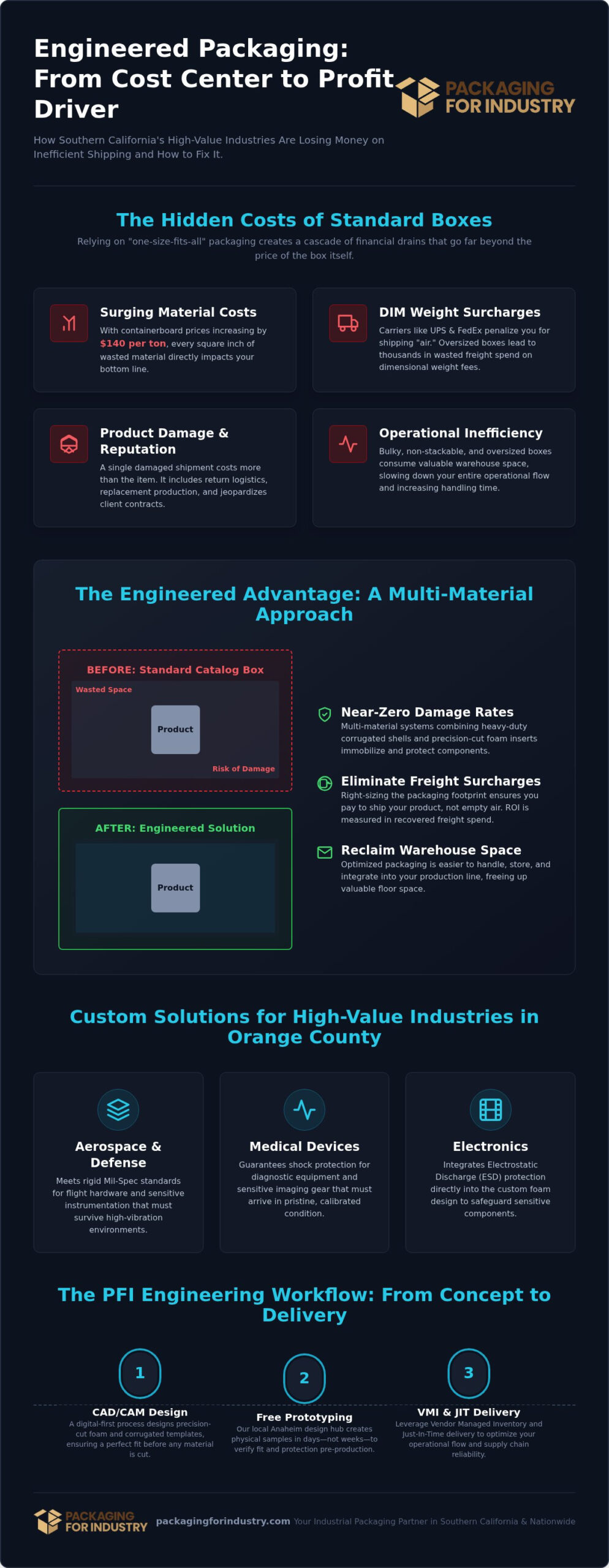
The economic impact of “under-packaging” is obvious through visible damage claims, but “over-packaging” is a silent profit killer. Using a box that is three inches too large in every dimension might seem safe, but it leads to thousands of dollars in wasted freight spend due to dimensional weight (DIM) surcharges from carriers like UPS and FedEx. Engineered solutions solve this by right-sizing the footprint, ensuring you don’t pay to ship empty air. This strategic approach transforms packaging from a simple expense into a measurable source of cost savings.
Addressing Orange County’s High-Value Industry Requirements
Local manufacturers in specialized sectors face unique logistical hurdles that standard supplies cannot clear. Within the aerospace and defense sector, meeting rigid Mil-Spec standards is mandatory for flight hardware and sensitive instrumentation. A standard double-wall box simply won’t suffice when transporting components that must survive high-vibration environments or extreme handling conditions.
Medical device companies face similar pressures, requiring shock protection for sensitive imaging gear and diagnostics equipment that must arrive in pristine, calibrated condition. Furthermore, the electronics industry relies on protective foam packaging that integrates Electrostatic Discharge (ESD) protection directly into the custom design. These industries don’t just need a container; they need a validated system that guarantees the integrity of their engineering upon arrival.
The Cost of Failure vs. The ROI of Engineering
Calculating the true cost of a shipping failure goes beyond the price of the item itself. You must account for the logistical cost of the return, the labor for inspection, the production time for a replacement, and the intangible damage to your professional reputation. In a market as competitive as Southern California, a single damaged shipment can jeopardize a long-term contract.
Packaging ROI is defined as the total capital recovered by reducing product damage rates and eliminating freight surcharges, weighed against the initial investment in a custom design. By choosing custom engineered packaging solutions Orange County providers offer, you effectively insure your shipments through geometry and material science. This proactive investment pays for itself by streamlining warehouse operations and ensuring that your freight spend is focused on the product, not the empty space surrounding it.
The PFI Engineering Workflow: From CAD Design to Free Prototyping
Buying industrial packaging shouldn’t be a reactive response to a high damage report. It’s a technical process that requires a proactive engineering mindset. PFI delivers custom engineered packaging solutions Orange County manufacturers use to secure their most sensitive assets, moving away from the “one-size-fits-all” catalog approach. Instead of guessing which stock size might work, we use CAD and CAM software to design precision-cut foam and corrugated templates. This digital-first approach ensures every insert and outer shell integrates perfectly before a single piece of material is cut. Because our design hub is located right in Anaheim, we can move from a digital concept to a physical sample in days, not weeks.
Speed is a critical factor for Southern California businesses facing tight production deadlines. By keeping the design and iteration process local, we eliminate the long lead times associated with national catalog suppliers. Our team acts as a dedicated extension of your operations, focusing on how the packaging interacts with your product, your warehouse staff, and the final end-user. This level of oversight ensures that the final design isn’t just protective; it’s also economically optimized for your specific shipping volumes.
Step 1: The Initial Packaging Review and Analysis
Our process begins with a deep dive into your product’s physical profile and its expected journey. We don’t just look at dimensions; we evaluate weight distribution, fragility points, and whether the item will travel via LTL (Less-Than-Truckload) or standard parcel carriers. Modern leadership increasingly recognizes that supply chain expertise must extend down to the granular level of asset protection. During this phase, we identify where your current packaging fails, whether it’s insufficient corner and edge protection or a box footprint that wastes valuable warehouse space.
Step 2: Prototyping and Physical Testing
Once the design is finalized in CAD, we provide free prototyping for local Orange County manufacturers to verify the solution in person. This isn’t a rough mockup; it’s a physical sample you can fit-test with your actual product to ensure total security. We simulate real-world stress through drop testing and vibration analysis to ensure the heavy-duty corrugated boxes and foam inserts perform under pressure. This stage allows us to refine the design to remove unnecessary material, which lowers your per-unit cost without compromising safety. If you’re ready to see how a prototype can improve your shipping cycle, you can request a custom packaging quote to start the analysis.
Multi-Material Integration: The Science of Superior Protection
Effective protection requires an integrated system rather than a collection of separate components. We view this as a three-part architecture: the outer shell, the internal cushioning, and the surface interface. By selecting custom engineered packaging solutions Orange County businesses can ensure these layers work in tandem to neutralize impact energy before it reaches the product. This systems-based approach is supported by the standards set by the Institute of Packaging Professionals (IoPP), which emphasizes the technical relationship between material properties and logistical stresses. When these materials aren’t synchronized, the risk of internal migration and vibration damage increases significantly.
Advanced Corrugated Solutions: Double and Triple Wall
The outer shell serves as the first line of defense against puncture and compression. While double-wall corrugated is the standard for most industrial applications, heavy machinery or flight hardware often requires the structural integrity of triple-wall corrugated. This material provides the stacking strength necessary for ocean freight and international export where containers are stacked multiple levels high. When specifying custom engineered packaging solutions Orange County manufacturers often choose triple-wall to replace heavier, more expensive wood crates. We also apply specialized weather-resistant coatings to corrugated shells to protect against humidity and moisture during long-haul sea freight.
Beyond the outer shell, we design internal structures like custom partitions and dividers for high-volume part manufacturing. These dividers prevent part-on-part contact, which is essential for painted or polished surfaces that are prone to scuffing. The internal cushioning layer itself must be matched to the product’s specific G-force rating and weight. Polyethylene (PE) foam is a closed-cell material ideal for heavy items that need high shock absorption and multi-drop durability. It doesn’t bottom out under heavy loads, making it the preferred choice for industrial motors and aerospace components.
Precision Foam Inserts: Die-Cut vs. CNC Routed
Conversely, Polyurethane (PU) foam is an open-cell, softer material designed for lightweight, delicate instruments that require gentle deceleration. For semiconductor and medical device manufacturers, the necessity of Anti-Static and ESD foam cannot be overstated. These materials prevent electrostatic discharge that can lead to latent electronic failure in sensitive components. You can explore custom foam packaging options to see how these materials are precision-cut using CNC routing for a perfect fit. CNC routing allows for complex, three-dimensional cavities that die-cutting cannot achieve, providing a superior level of security for complex geometries.
By integrating these materials into a single, cohesive unit, we eliminate the need for excessive bubble wrap or loose-fill peanuts. This doesn’t just improve protection; it also speeds up your packing line. Your team can simply drop the product into a pre-defined foam cavity, close the box, and move to the next unit. This efficiency reduces labor costs and ensures that every item is packed with the same level of precision, regardless of who is working the shift.
Optimizing Operational Flow with VMI and JIT in Southern California
Orange County industrial real estate costs remain among the highest in the country, which means every square foot of your warehouse must remain productive. Storing massive quantities of empty boxes or bulky pallets of wholesale packaging supplies is an operational liability that ties up capital and limits your manufacturing capacity. When you implement the custom engineered packaging solutions Orange County specialists design for your workflow, you gain the ability to reclaim that floor space. Consolidating your vendor list with a local partner allows you to synchronize the arrival of your corrugated shells, foam inserts, and consumables with your actual production schedule.
The Financial Benefits of Managed Packaging Programs
Learn about our VMI programs to understand how we stabilize your procurement cycle. Vendor Managed Inventory (VMI) shifts the burden of stock monitoring from your team to ours. PFI tracks your usage rates and automatically replenishes your inventory before it hits a critical low. This model significantly improves cash flow because you aren’t paying for months of inventory to sit on a shelf. It also eliminates the risk of production shutdowns caused by lead-time delays or the sudden price spikes currently affecting the containerboard market. By maintaining a steady flow of materials, you can focus your internal resources on assembly and quality control rather than inventory management.
Local Logistics: The Anaheim Advantage
Our proximity in Anaheim allows us to serve as a high-response stretch wrap supplier and logistics hub for the Inland Empire, Los Angeles, and Orange County. We provide just-in-time delivery for all your critical shipping components, from heavy-duty corrugated to machine-grade stretch film. This local service model reduces the carbon footprint of your supply chain and eliminates the high freight costs associated with shipping packaging materials across state lines. Because our trucks are in your area daily, we can respond to production surges with next-day delivery. This level of agility is essential for manufacturers who need to keep their shipping docks clear and their pallets moving without being bottlenecked by a lack of supplies.
Request a packaging quote to optimize your inventory
Why PFI is the Preferred Industrial Packaging Partner in Anaheim
Choosing a partner for your manufacturing facility involves more than just selecting a part number from a website. When searching for an industrial packaging supplier near me, businesses in Southern California often find that while many vendors sell materials, few understand the engineering required to protect high-value assets. At PFI, we focus on the specific geometry and fragility of your product to design custom boxes in Anaheim that outperform standard catalog options. This technical focus ensures that your shipments are not just packed, but secured against the specific mechanical stresses of your supply chain.
As a dedicated bulk packaging supplier, we understand that high-volume operations require more than just quantity; they require fiscal efficiency. We analyze the hidden costs of oversized containers, such as the dimensional weight surcharges from FedEx and UPS that can silently erode your margins. By engineering a tighter, more protective footprint, we provide a cost-saving alternative to large, impersonal suppliers who profit from selling you more material than you actually need. You can request a custom packaging quote to see how our engineering-first approach compares to your current stock SKU costs.
From Prototyping to Full Rollout: Our Commitment
Our process is built on transparency and technical validation. We offer no-obligation initial packaging reviews for local manufacturers to identify immediate opportunities for footprint reduction or damage prevention. Whether you need a small run of specialized protective foam packaging for a pilot program or high-volume production for a global rollout, our Anaheim facility is equipped to scale with you. You’ll work with a dedicated account manager who understands the unique lead-time requirements and operational pressures of Southern California’s manufacturing corridors. This local oversight ensures that design changes and prototyping happen in real-time, avoiding the delays common with distant corporate offices.
Secure Your Assets and Optimize Your Supply Chain
An engineering-first philosophy is the only way to ensure long-term supply chain reliability in a high-cost market. By prioritizing the physical requirements of the asset over the convenience of a stock SKU, we provide a level of security that generic suppliers cannot match. We invite you to compare your current damage rates and freight surcharges with the precision of a PFI engineered solution to see the difference in total cost of ownership. Our team is available for site visits across Orange County to evaluate your packing lines and warehouse flow firsthand. It’s time to stop settling for boxes that don’t fit and start using custom engineered packaging solutions Orange County businesses trust to deliver their most valuable products safely.
Contact our Anaheim team for a site visit and packaging review
Secure Your Supply Chain with Precision Engineering
Transitioning to custom engineered packaging solutions Orange County specialists provide is a strategic shift from managing expenses to generating ROI. It’s a technical necessity in a market where shipping “air” in stock boxes is no longer sustainable. By moving away from generic catalog options and toward CAD-driven, multi-material systems, you protect both your products and your bottom line. Our deep expertise in aerospace and medical device packaging ensures that even the most sensitive flight hardware or imaging gear survives the rigors of the modern shipping environment without the burden of dimensional weight surcharges.
The proximity of our Anaheim facility allows for a level of agility that national suppliers can’t match. You can leverage free prototyping and fit-testing to verify your designs locally while utilizing our VMI programs and local next-day delivery to reclaim valuable warehouse floor space. Shifting your logistics to a local, engineering-focused partner ensures your operations remain lean, reliable, and ready for growth throughout 2026 and beyond.
We look forward to helping you eliminate shipping damage and optimize your Southern California logistics today.
Frequently Asked Questions
What are custom engineered packaging solutions?
Custom engineered packaging solutions are protective systems designed specifically for a product’s unique dimensions, weight, and fragility. This process integrates CAD design with a multi-material approach, combining heavy-duty corrugated shells with precision-cut foam inserts or custom crates. Unlike standard catalog options, these solutions are validated through prototyping to survive specific shipping environments and mechanical stresses.
How does custom packaging reduce shipping costs for Orange County businesses?
Custom packaging reduces costs by right-sizing the container to eliminate “dead air” and minimize dimensional weight (DIM) surcharges from carriers like UPS and FedEx. By utilizing custom engineered packaging solutions Orange County manufacturers can also lower their total cost of ownership by reducing product damage rates. This prevents expensive replacement cycles, return freight fees, and the labor costs associated with inspecting damaged goods.
Does PFI offer free packaging prototypes in Southern California?
Yes, PFI provides free prototyping and fit-testing for local manufacturers throughout Southern California. This allows your operations team to verify the physical fit and protection levels of a design using your actual product before moving into full-scale production. It’s a proactive step that ensures the final packaging system meets your exact specifications while identifying opportunities to reduce material waste.
What industries benefit most from custom engineered packaging?
High-value sectors like aerospace, medical device manufacturing, and electronics benefit most because they require precision protection and often must meet rigid regulatory standards. These industries ship sensitive components that are prone to vibration or shock damage. Custom engineering is also essential for heavy machinery manufacturers who need the structural integrity of triple-wall corrugated or custom wood crates to ensure safe transit.
Can custom foam inserts prevent ESD damage for electronics?
Custom foam inserts can be fabricated from specialized Anti-Static or Electrostatic Discharge (ESD) materials to protect sensitive semiconductor components. These materials prevent the buildup of static electricity that occurs when products shift during transit. Integrating these materials into your custom engineered packaging solutions Orange County ensures that electronic components arrive in calibrated, working condition without latent circuit damage.
How does a Vendor Managed Inventory (VMI) program work for packaging?
In a VMI program, PFI monitors your packaging stock levels and replenishes them automatically based on your production schedule and usage data. This service allows you to reclaim valuable warehouse floor space by only keeping a few days’ worth of inventory on-site. It eliminates the administrative burden of tracking stock and prevents production shutdowns caused by unexpected packaging shortages.
What is the difference between double-wall and triple-wall corrugated boxes?
Double-wall corrugated features two layers of fluting, providing the standard strength needed for most industrial shipping needs. Triple-wall corrugated adds a third fluting layer, creating extreme stacking strength and puncture resistance for heavy-duty applications. Triple-wall is frequently used as a lightweight, cost-effective alternative to wood crates for shipping heavy motors, flight hardware, or international sea freight.
Why should I choose a local Anaheim packaging supplier over a national catalog?
Choosing a local Anaheim supplier gives you the agility of next-day delivery and direct access to packaging engineers for rapid design iterations. National catalog suppliers often have long lead times and lack the specialized engineering support needed for complex industrial assets. Working locally reduces your freight costs and allows for on-site packaging reviews where we can analyze your packing line efficiency firsthand.