
Sourcing custom polyurethane foam packaging in Los Angeles? Share a sample or your packaging requirements to request a custom foam packaging quote and compare options for fit, firmness, thickness, and shape. The final dimensions can be tailored to the available space and how the cushion will be used.
Choosing foam packaging means more than matching a familiar feel. A packaging supplier can assess a sample, recommend firmness and thickness, and account for liners, installation clearance, and fit. These details help manufacturers and operations teams in Los Angeles, Orange County, and San Diego compare custom foam packaging options and specify a cushion suited to its application.
Key Takeaways
- A foam sample can help buyers select a replacement cushion’s material feel, firmness, thickness, and shape.
- Density relates to durability, while ILD/IFD describes firmness; specifying both helps match the cushion to its intended use.
- Accurate custom dimensions account for usable space, liners, and installation clearance to address fit concerns and reduce shipping damage.
- Cutting, die-cutting, or molding can suit different foam geometries and production volumes when requesting a foam packaging quote.
- PFI combines foam packaging with custom packaging design and inventory support to help businesses maintain packaging supply.
What if my custom cushion does not fit?
A poor fit may result from incorrect dimensions, foam selection, or firmness. A cushion that slides inside its enclosure may need a revised length or width; one that feels too hard may need a different firmness. When requesting a custom foam packaging quote, share a sample and the cushion’s intended use and available space so the supplier can review the fit and specifications.
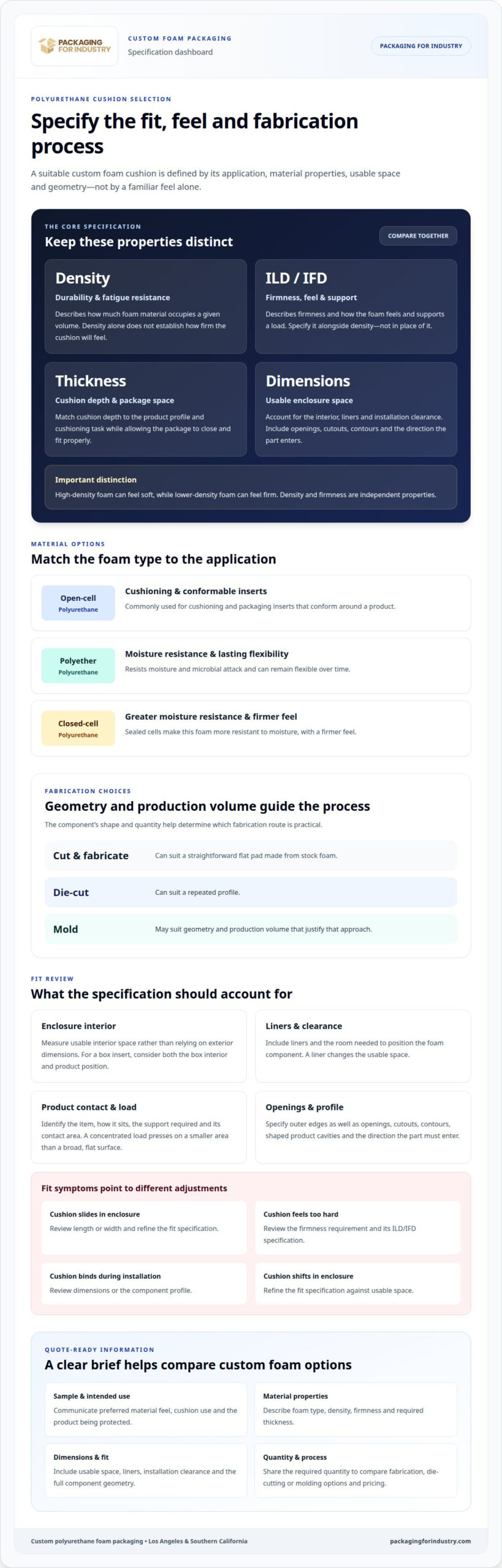
Density and firmness describe different material properties. Density measures how much foam material occupies a given volume and influences durability and fatigue resistance. ILD or IFD measures firmness, indicating how foam feels and supports a load. These properties are independent: high-density foam can feel soft, while lower-density foam can feel firm. Specifying density alone does not establish the cushion’s feel, so compare both requirements when evaluating a packaging quote.
Foam type matters, too. Open-cell polyurethane is commonly used for cushioning and conformable packaging inserts. Polyether polyurethane resists moisture and microbial attack and can remain flexible over time. Closed-cell polyurethane has sealed cells, is more resistant to moisture, and feels firmer. A custom foam packaging supplier can help match the material to the application, not just the sample’s appearance.
- Foam type: Match the material to the cushioning application and exposure conditions.
- Density: Specify the durability and fatigue-resistance requirement.
- Firmness: Use an ILD/IFD specification to describe feel and support.
For a fit review, a fabricator compares the sample and specifications with the enclosure’s usable space, including liners and installation clearance. If the cushion binds during installation, its dimensions or profile may need adjustment. If it shifts in the enclosure, the fit specification may need refinement. Reviewing material, density, firmness, and fit together helps you evaluate a custom foam packaging quote and align the fabricated cushion with its intended use.
Custom foam dimensions and precision cutting for a quote
A custom foam packaging quote starts with a component that fits both the product and its enclosure, not just a general length and width. A packaging supplier can review the usable space, liners, and installation clearance. For a foam insert inside a box, the design must consider the box interior and the product’s position. Provide these dimensions when requesting a quote to help specify a finished shape that fits and is practical to install.
Polyurethane foam parts can be made by cutting and fabricating stock, die-cutting, or molding. The right process depends on the component’s geometry and production volume. A straightforward flat pad may suit fabrication from stock, while a repeated profile may call for die-cutting. Molding may suit a part whose geometry and volume justify that approach. Include the shape and quantity in your request to compare practical options and pricing.
Dimension review should cover more than the component’s outside edges. A packaging supplier considers openings, cutouts, contours, and the direction the part must enter its packaging. For example, an insert with a shaped product cavity needs dimensions for both the outer perimeter and the cavity. A liner also changes usable space, so include it in the specification when requesting a foam packaging quote.
- Usable space: Measure the enclosure interior rather than relying on exterior dimensions.
- Installation clearance: Include liners and room needed to position the foam component.
- Geometry and volume: Use these factors to compare stock fabrication, die-cutting, or molding.
A custom foam packaging design can coordinate the component’s dimensions with the product and its pack. Clear specifications, including quantities, help a packaging supplier prepare a quote, compare packaging options, and support repeatable packaging for manufacturing and shipping operations.
How a foam fabricator helps choose cushion firmness and thickness
For a custom foam packaging quote, start with the application rather than a firmness label. The fabricator reviews the item being cushioned, how it sits, and the support it needs. A packaging insert for a fragile component may need a different balance from one for a durable part. The available cavity and how the foam contacts the product also help define the specification.
Next, the fabricator evaluates the load and contact area. A concentrated load presses on a smaller area than a broad, flat surface, which can affect the firmness and thickness to specify. ILD or IFD describes firmness and relates to feel and support, while density relates to material content, durability, and fatigue resistance. Include both in your requirements; neither specification replaces the other.
Specify thickness in relation to the available space and cushioning task. The fabricator considers whether the foam can support the product without interfering with the package’s closure or fit. For example, an insert surrounding a component needs enough depth for its profile while leaving room for the packaging structure. Liners and installation clearance also affect usable dimensions. Include these details when requesting a foam packaging quote.
- Application: Identify the product, its position, and the support required.
- Firmness: Specify ILD/IFD to describe feel and support needs.
- Thickness: Match cushion depth to the product profile and available package space.
- Density: Select with durability and fatigue resistance in mind.
A foam sample can communicate your preferred feel, but the fabricator considers it alongside the application and packaging geometry. If the cushion must conform around an irregular component, the recommendation accounts for its shape and contact points. This helps turn a general preference, such as “softer,” into quote specifications for fit, support, and intended use.
Custom polyurethane foam and cushion fabrication
Custom fabricated polyurethane foam cushioning in Los Angeles starts with translating a packaging requirement into a controlled design. A product drawing, sample, or existing package can help a packaging supplier plan a quote and establish how the foam component relates to the packed item. The design record should show its orientation and key features, giving production, purchasing, and packing teams a shared reference for repeat orders.
A prototype provides a practical review point before production. Teams can assess how the component works during pack-out, whether the item can be placed and removed as intended, and whether the package closes with the foam in position. If the review identifies a needed change, update the specification before producing the finished packaging components. A confirmed design helps keep quote planning and repeat orders aligned.
Custom fabrication can also support coordinated packaging assemblies. The foam part must work with the other package components and the actual packing sequence. For example, a package assembled in stages may need an insert that can be positioned without blocking the next step. Recording these interfaces gives the supplier and production team a useful reference for quoting and repeat supply, not just a drawing.
Revision control matters when a product or package changes. A clear, current specification helps purchasing and operations teams distinguish the approved design from an earlier version. This is especially useful for recurring orders, where small design changes can affect how a package assembles or holds its contents. Documenting changes helps keep future production and packaging supply aligned with the intended configuration.
Outdoor or high-heat applications require material selection to account for exposure conditions, which can affect foam performance. The fabricator should consider the operating environment alongside the package design, rather than assuming a cushion for indoor use is suitable elsewhere. Review the prototype, packing sequence, and current design record as parts of the same fabrication process before requesting a quote or placing a repeat order.
Material selection should reflect the conditions identified for the application. Polyether polyurethane resists moisture and microbial attack and stays flexible over time, making it useful for cushioning and general fabrication. Where those characteristics suit the intended use, teams can consider it for a fabricated cushion. Its stated characteristics do not replace checking the finished component in the package and packing sequence. Recording the chosen material with the approved design gives production and purchasing teams a consistent reference for quotes, reorders, or revisions.
During prototype review, teams can check whether the selected foam works as intended with the packed item and surrounding package components. If the material or cushion shape changes, update the specification so the current configuration is clear to those fabricating and assembling it. Keeping the material decision with the design record also helps purchasing plan repeat orders and maintain a reliable packaging supply if application requirements change. This connects material selection to practical checks of the finished package.
Los Angeles and Southern California service
For manufacturers and distribution centers in Los Angeles, Orange County, and San Diego, foam packaging must work within the full shipping operation. Cushion components may fit inside a corrugated box, crate, or reusable container. A fabricator coordinates the foam’s shape and dimensions with the package layout, product handling, and intended destination. This helps businesses specify packaging around their operating needs and request a foam packaging quote.
Foam cushion fabrication turnaround in Los Angeles depends on the component’s geometry, material, production method, quantity, and specification readiness. A straightforward cut from stock follows a different process from a molded part or detailed profile. These requirements shape the production schedule, so one timeline does not apply to every custom order. Share these details with your packaging supplier to compare pricing and coordinate local packaging delivery.
Across Southern California, project information helps move a design from requirements to finished components. Product dimensions, sample parts, packaging layouts, and drawings clarify how the foam must fit. For example, an insert for a fragile assembly may need shaped cavities, while a simple protective pad may use a basic profile. The intended packaging method also affects the finished design.
- Product and package: Establish how the item sits within its box or container.
- Component details: Define the required shape, openings, and fit.
- Production needs: Identify the quantity and fabrication method for the order.
- Delivery planning: Coordinate finished packaging components with the receiving operation.
Buyers in Los Angeles, Orange County, and San Diego can align foam packaging specifications with warehouse, manufacturing, and distribution workflows. A complete design brief connects the product, foam component, and outer package in one coordinated system. It also gives purchasing and operations teams a clearer basis for requesting a quote, comparing project requirements, and planning packaging delivery across locations.
Industries Served
Custom polyurethane foam cushions support industrial packaging needs in Los Angeles, Orange County, and San Diego. Manufacturers use shaped cushioning to position parts inside boxes, crates, and other shipping containers. Warehouses, distributors, and fulfillment centers can source tailored foam components to organize products and support consistent packing workflows. The design depends on the item, package, and handling requirements, so buyers can request a foam packaging quote based on their operation.
Aerospace companies may package components with varied shapes and contact points. Custom foam inserts can create dedicated spaces that help keep parts separated during handling and transit. The aerospace packaging context often involves coordinating protective components with the product and its outer packaging, rather than selecting a generic pad. Buyers can discuss custom sizes and bulk packaging supply to match their requirements.
Electronics businesses can use foam cushioning to position equipment or components inside a shipping package. Medical companies also package products that need a defined place within a container. In both cases, the cushion’s shape and fit should reflect the actual packaged item and workflow. Product-specific design helps buyers source suitable protective foam packaging instead of relying on one insert for unlike components.
Food companies, construction suppliers, and other industrial businesses have distinct packaging operations. Foam may cushion equipment, packaging components, or goods moving through distribution. The application and environment guide material and component design. Needs can vary within one industry, so the product and shipping configuration matter more than the industry label alone when requesting a quote or coordinating bulk supply.
- Manufacturing: Cushion parts and assemblies within shipping packs.
- Aerospace: Accommodate components with defined positions and contact points.
- Electronics and medical: Fit product-specific items within protective packaging.
- Warehousing and distribution: Support repeatable packing and product separation.
For buyers evaluating foam packaging, start with the item being packed and how it moves through the operation. Share these details when requesting a foam packaging quote to connect cushion design to practical needs across manufacturing, storage, and shipment. This helps teams source components suited to their products in Los Angeles, Orange County, and San Diego.
Benefits of Custom Polyurethane Foam Cushions
A custom polyurethane cushion can position a product inside its shipping package and separate it from nearby items. For example, a shaped cavity can keep a component seated instead of shifting freely inside a box. When evaluating a foam packaging quote, this design can help address product movement and contact during handling, supporting efforts to reduce shipping damage and lower packaging costs.
Custom shapes also let a packaging layout account for product contours, openings, and contact points. An insert can provide dedicated spaces for multiple components, helping prevent parts from knocking against one another. For manufacturers shipping assemblies, custom foam inserts can make the pack easier to load and keep components organized through storage and distribution.
A well-defined fit can support consistent packing. When each cushion has a set position in the package, warehouse teams can follow a repeatable arrangement instead of improvising with loose cushioning. A design that aligns with the box or container can also use interior space efficiently while leaving room for the product and packaging components.
- Product positioning: Shape cavities around items to limit unwanted movement inside the package.
- Part separation: Create dedicated spaces for components shipped together.
- Repeatable packing: Use a defined insert layout for consistent placement across shipments.
- Packaging coordination: Design the cushion to work with the box, crate, or container.
Custom foam can help purchasing and operations teams compare packaging pricing and evaluate the full packaging system. A cushion that fits the product and outer pack may reduce reliance on improvised fill, simplify pack-out decisions, and support efforts to lower packaging costs. The right design depends on the item, package, and handling process, so consider foam as part of the complete shipping configuration when sourcing custom foam inserts. For businesses in Los Angeles, Orange County, and San Diego, this application-focused approach can support product protection and more organized packaging operations.
Why Choose Packaging For Industry (PFI) for Foam Packaging
Packaging For Industry (PFI) is a practical option when a standard cushion does not suit your product or packing process. PFI provides foam packaging and custom packaging design for businesses that need packaging tailored to an application. Its design work can bring product requirements and packaging components together in one coordinated solution.
A custom foam insert may need to position a shaped part inside a box or separate components within a package. PFI’s design service supports this planning by connecting the foam component with the product and its packaging. This helps manufacturers address fit concerns and develop a repeatable pack-out approach for warehouse or distribution operations.
Foam is one part of a shipping system. Stretch film can support the packaging needs of palletized goods, while foam cushions products within their package. For businesses managing ongoing packaging supply, PFI also offers Vendor Managed Inventory for packaging. This option is relevant when inventory coordination is part of the operational challenge alongside product protection.
- Foam Packaging: Support product-specific cushioning requirements.
- Custom Packaging Design Services: Coordinate foam and package design around the application.
- Stretch Film: Address packaging needs for palletized shipments.
- Vendor Managed Inventory: Include packaging inventory coordination in supply planning.
PFI is a suitable fit when your business needs custom packaging design, foam packaging, or a more coordinated approach to packaging supply. To request a custom foam packaging quote, share your application, dimensions, and quantity when you contact Packaging For Industry (PFI).
Frequently Asked Questions
Can you match a foam sample?
Yes, a sample can guide a custom foam specification. Its shape and feel provide a reference for discussing the replacement component, while the product and package determine how it should function. A fabricator can review the sample alongside a drawing or packaging layout to identify relevant features, such as cutouts or contact areas. This distinguishes a visual match from a cushion designed for the same application.
Do you have minimum order quantities?
Minimum quantities depend on the foam component and fabrication method. A simple part cut from stock has different production needs from a die-cut component or molded shape. Geometry, production volume, and degree of customization all influence how an order is planned. For recurring packaging, the quantity needed over time can also shape purchasing, especially when packaging must stay aligned with production use.
What types of polyurethane foam do you supply?
Polyurethane foam is available for protective packaging applications, with material selection based on the part and its environment. Open-cell foam is commonly used for cushioning and conformable inserts; closed-cell foam has sealed cells and greater resistance to moisture. Polyether and polyester polyurethane also have different material properties. These distinctions help define a suitable specification, rather than treating every polyurethane foam cushion as interchangeable.
Can I get custom polyurethane foam cushion fabrication in Los Angeles?
Yes. Packaging For Industry (PFI) provides foam packaging and custom packaging design for industrial applications, including custom fabricated polyurethane foam cushioning in Los Angeles. A project can be designed around the product, packaging configuration, and required component shape. This is useful when a standard pad does not accommodate the item or packaging teams need a defined insert for repeatable packing.
Can Los Angeles foam suppliers cut polyurethane cushions to custom sizes and shapes?
Custom foam components can be fabricated in specified sizes and shapes for packaging applications. Design details may include a product cavity, edge profile, or openings for particular features. Cutting and fabricating stock, die-cutting, and molding are possible approaches, depending on geometry and production volume. The resulting component can be planned as part of a box, crate, or other industrial package, rather than as an isolated cushion.