
A single G-force spike during transit can turn a mission-critical flight computer into a six-figure liability. For manufacturers operating in the Southern California aerospace corridor, the margin for error in logistics is virtually nonexistent. You understand that standard off-the-shelf cushioning cannot meet the rigorous demands of flight-critical hardware. The difficulty often lies in matching foam density to sensitive G-force ratings while navigating the complexity of aerospace flammability and ESD standards. Securing reliable custom foam packaging for aerospace avionics SoCal is about more than just padding; it’s a strategic move to eliminate professional stress and avoid high replacement costs.
This guide provides a pragmatic roadmap to help you specify, select, and procure precision-engineered inserts. You’ll learn the technical requirements for shock-absorbing materials and how to maintain strict compliance without over-engineering your costs. We’ll also examine how localized vendor-managed inventory and custom-cut prototypes can resolve supply chain delays. By following this framework, your operation can achieve zero-damage shipping rates and benefit from reliable local delivery throughout Orange and LA Counties. Whether you are shipping across the country or within the SoCal corridor, these solutions ensure your avionics arrive ready for flight.
Key Takeaways
- Understanding the density differences between PE and PU foam is essential for matching shock absorption to specific avionics G-force ratings.
- Learn how to specify custom foam packaging for aerospace avionics SoCal that meets both ESD protection standards and aerospace flammability requirements.
- Optimize your warehouse efficiency in Orange and LA Counties by utilizing Vendor Managed Inventory (VMI) to mitigate long lead times and space constraints.
- Eliminate the risk of damaged hardware by leveraging CAD/CAM design and free prototyping to ensure a precision fit before full-scale production.
- Discover why an integrated approach, combining custom crates, corrugated boxes, and foam inserts, is the most cost-effective way to achieve zero-damage shipping rates.
The Critical Role of Shock Absorbing Foam in Aerospace Avionics
Shock-absorbing foam in the aerospace sector is a precision-engineered material designed to decelerate energy before it reaches sensitive flight hardware. It isn’t just “padding” for a box; it’s a technical barrier that manages the physics of motion. To protect high-value electronics, Package cushioning must account for the specific fragility rating, or G-factor, of the component. This rating represents the maximum acceleration a piece of hardware can withstand before it breaks. If a shipping container experiences an impact that exceeds this G-limit, the internal circuitry can fracture even if the exterior of the box remains intact.
Standard materials like bubble wrap or packing peanuts fail because they don’t provide predictable resistance. Under the weight of a heavy avionics chassis, bubble wrap often bottoms out, which transfers the full force of a drop directly to the hardware. Loose-fill peanuts shift during transit, eventually leaving critical corners exposed to impact. For procurement officers sourcing custom foam packaging for aerospace avionics SoCal, these failures lead to expensive hardware replacements and logistical delays that your project timeline can’t afford.
Why Avionics Require Specialized Cushioning
Circuit boards and sensors are highly susceptible to micro-vibrations that occur during long-haul ground transport. High-performance foam acts as a dampening system, filtering out high-frequency tremors that cause solder joint fatigue or connector loosening. When a single sensor failure can ground an entire aircraft, the cost of specialized cushioning is a minor investment compared to the price of a mission delay. Precision-cut foam ensures that delicate sensors remain calibrated, protecting the integrity of the flight data system from the cleanroom to the final installation.
The SoCal Logistics Challenge: Vibration and Handling
Operating within the Southern California aerospace corridor presents unique logistical hurdles. Components moving through high-traffic hubs in Los Angeles or the Port of Long Beach are subject to frequent “touches” by forklift operators and warehouse personnel. Every time a crate is handled, the risk of a high-impact event increases. Our Aerospace Packaging Solutions are engineered to withstand this repetitive stress. In the dense LTL networks of Orange County and LA, your custom foam packaging for aerospace avionics SoCal must be designed to survive both the constant vibration of freeway transit and the rigors of multi-stop delivery routes.
Comparing Foam Materials: PE vs. PU for Sensitive Avionics
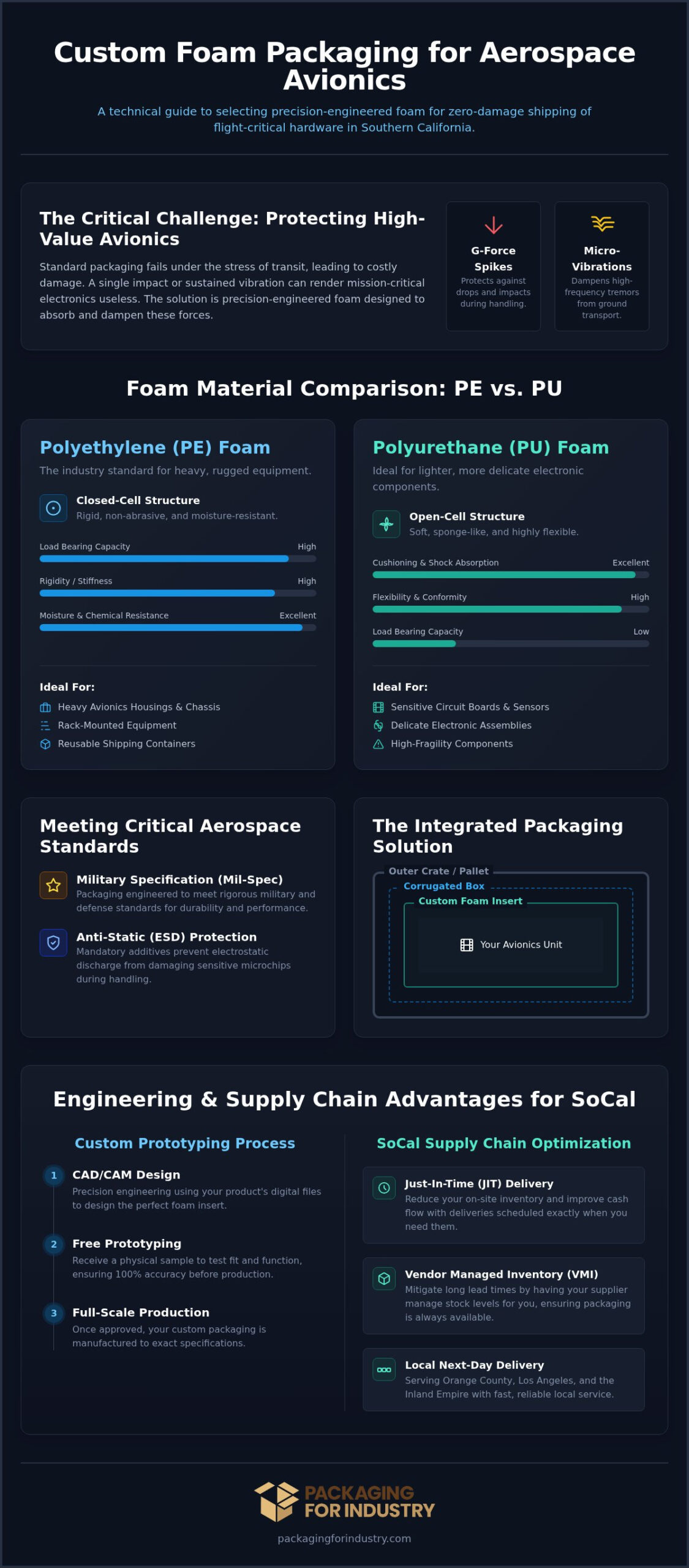
Selecting the right material for custom foam packaging for aerospace avionics SoCal depends on the physical properties of the hardware and the specific logistical environment. The two primary choices are Polyethylene (PE) and Polyurethane (PU). These materials differ significantly in their cell structure and density, which directly impacts how they manage kinetic energy during transit. Professionals usually choose based on the static loading of the component, which is the weight of the item divided by the surface area touching the foam.
Density is measured in pounds per cubic foot (pcf). Higher density foams provide stiffer resistance, while lower density foams offer a softer deceleration stroke. PE is a closed-cell foam, meaning the cells are sealed and trapped with air. This makes it rigid, non-abrasive, and buoyant. PU is an open-cell foam, which allows air to flow through the material like a sponge. This results in a much softer, more flexible cushion. For any flight-critical electronic assembly, Anti-Static (ESD) additives are mandatory. These additives prevent electrostatic discharge from damaging sensitive microchips during the unboxing or handling process.
Polyethylene (PE) Foam: Rugged Protection for Heavy Units
PE foam is the industry standard for heavier avionics housings, flight data recorders, and rack-mounted equipment. Its high load-bearing capacity ensures that heavy units don’t bottom out during a drop. Because it’s a closed-cell material, it’s naturally resistant to moisture, oils, and chemicals. This makes it ideal for long-term storage in varied environments or for reusable aerospace shipping containers that must endure years of service. Its structural integrity allows for precise CAD/CAM routing, ensuring a perfect friction-fit for heavy hardware. If your operations require high-durability inserts, you can compare packaging pricing for custom-cut PE solutions.
Polyurethane (PU) Foam: Soft Cushioning for Delicate Sensors
When you’re shipping lightweight sensors, delicate glass displays, or intricate kitting sets, PU foam is often the superior choice. Its open-cell structure provides a gentle nesting effect that protects highly fragile components from micro-vibrations. Many aerospace firms utilize convoluted (egg-crate) PU foam for versatile kitting because it conforms to irregular shapes easily without requiring custom die-cuts for every part. This Protective Foam Packaging is frequently treated with pink anti-static agents to ensure full ESD compliance. Using PU ensures that even the most sensitive custom foam packaging for aerospace avionics SoCal remains lightweight and cost-effective while providing maximum cushioning for low-mass items.
Meeting Aerospace Standards: ESD and Compliance
Compliance in the aerospace sector isn’t just a regulatory hurdle; it’s a fundamental risk management strategy. For manufacturers in the Southern California aerospace corridor, failing to meet ESD or flammability standards can result in rejected shipments, contract penalties, or catastrophic hardware failure. When you specify custom foam packaging for aerospace avionics SoCal, the design must account for these technical requirements from the initial prototype phase. Precision-engineered inserts ensure compliance by eliminating internal part movement, which significantly reduces the risk of friction-induced static or physical abrasion during transit.
The distinction between “Pink Foam” and “Black Foam” is a critical procurement decision. Pink foam is anti-static, meaning it’s treated to prevent the generation of static charges. It’s suitable for most dissipative needs but doesn’t shield the component from external electrostatic fields. Black foam is conductive; it’s impregnated with carbon to create a path to ground. Choosing the wrong material can lead to latent damage that isn’t detected until the avionics are installed. Additionally, flammability requirements like FAR 25.853 are often mandatory for materials used in flight-critical environments. Our team ensures your materials meet these benchmarks while maintaining the necessary shock-absorption properties.
ESD Protection: Preventing Latent Electronic Failure
Latent failure is the most significant threat to high-value avionics. This type of damage occurs when a static discharge creates a micro-fracture within a circuit that doesn’t immediately break the component. The hardware might pass a bench test but fail weeks later during a flight. Anti-static foam prevents the triboelectric charging that occurs when parts rub against their packaging. To provide a comprehensive solution, we often recommend using static shielding bags in conjunction with custom-cut foam. This multi-layered approach ensures that sensitive sensors and processors remain protected from both physical impact and invisible electrical threats.
Mil-Spec and Industry Certifications
Defense contractors in Orange County and Los Angeles often have to navigate the complexities of MIL-STD-2073. This standard dictates precise preservation and packing methods for military-grade hardware. We help SoCal contractors meet these rigorous requirements by providing Military Packaging solutions that align with specific contract line items. Our local expertise allows us to provide the documentation and material certifications necessary for government audits. By sourcing your custom foam packaging for aerospace avionics SoCal through a partner that understands these standards, you protect your hardware and your professional reputation.
Optimizing Your SoCal Supply Chain with JIT and VMI Programs
Real estate costs in Orange County and Los Angeles make warehouse space a premium asset. Storing large volumes of bulky foam inserts can quickly become an operational burden. Procurement managers often face a choice between ordering in bulk to lower packaging costs or maintaining lean inventory to save floor space. This is where a localized supply chain strategy becomes essential. By utilizing Vendor Managed Inventory (VMI) and Just-In-Time (JIT) delivery, you can maintain a steady flow of custom foam packaging for aerospace avionics SoCal without cluttering your facility with months of stock. This approach is particularly effective for managing the high-traffic logistics hubs of Southern California, where shipping delays at major ports or freeway congestion can disrupt national supply chains.
Reducing Lead Times for Custom Foam Inserts
The primary challenge with custom-engineered foam is the typically long lead time required for precision cutting and ESD treatment. PFI addresses this by stocking your specific inserts at our facility. This proactive approach eliminates the lead-time surprises that can ground a production line. From a financial perspective, a Vendor Managed Inventory program improves your cash flow by reducing the capital tied up in on-site inventory. You only pay for what you need, when you need it, ensuring that your logistical budget remains as efficient as your engineering. We manage the stock levels so you can focus on the assembly of flight-critical hardware.
Local Support for Anaheim, Irvine, and El Segundo
Having a partner headquartered in Anaheim provides a distinct logistical advantage for the Southern California aerospace corridor. Whether your operations are in Irvine’s tech centers or El Segundo’s Aerospace Row, local proximity allows for rapid responses to design changes or urgent order spikes. We provide next-day local delivery to ensure your shipping department never waits on a late truck. This geographical proximity also facilitates a more collaborative engineering process. Our team can perform a local site review to analyze your current packing flow and identify opportunities for optimization. This hands-on support is critical for maintaining high-reliability custom foam packaging for aerospace avionics SoCal throughout the product lifecycle. You can Contact Us to schedule a local site review and evaluate your current warehouse logistics.
Engineering Your Solution: PFI’s Custom Prototyping Process
Precision engineering is the final step in securing your supply chain. Even the highest quality materials can’t protect sensitive electronics if the fit is imprecise. A loose cavity allows for the very micro-vibrations and impacts we’ve worked to eliminate. To solve this, we treat the design of custom foam packaging for aerospace avionics SoCal as an extension of your own engineering department. Our process focuses on total accountability, moving from your technical specifications to a physical solution that guarantees a zero-damage shipping rate. By identifying potential failure points during the design phase, we help you lower packaging costs and avoid the professional stress of hardware replacement.
We offer free prototyping to ensure your team can verify the fit and function of an insert before committing to a full production run. This zero-risk approach is essential for avionics manufacturers in Orange County and LA who are working with tight tolerances and high-value components. It allows you to test the interaction between the foam, the static shielding bags, and the outer corrugated container. This integrated oversight ensures that every layer of your packaging system works in harmony to meet aerospace flammability and ESD standards.
From CAD Drawing to Physical Prototype
Our engineering team utilizes your 3D CAD models to engineer the perfect cavity for your hardware. This digital-first approach allows us to account for delicate connectors, toggle switches, and protruding sensors that require specialized clearance. We use CNC cutting technology to produce high-accuracy foam assemblies that mirror the exact geometry of your flight hardware. If a single material can’t provide the necessary protection, we can create multi-material “hybrid” inserts. For example, we might combine a rigid PE base for structural support with a soft PU top layer to cushion a fragile display. This level of precision is why SoCal contractors trust us to handle their most sensitive kitting requirements.
Kitting and Integrated Packaging Solutions
Efficiency on the production line is just as important as protection during transit. We provide comprehensive kitting services where your foam inserts arrive pre-installed in Custom Corrugated Boxes. This integrated solution significantly reduces labor costs by eliminating the time your warehouse staff spends assembling packaging components. It also streamlines your inventory management; instead of tracking three separate SKUs for boxes, foam, and labels, you manage one complete kit. Whether you need heavy-duty RSC boxes for international freight or custom-sized inserts for local LTL shipments, we provide a steady, dependable flow of supplies from our Anaheim headquarters. You can take the next step in optimizing your logistics by using the link below.
Secure Your Supply Chain with Precision-Engineered Protection
Protecting flight-critical hardware requires a move beyond generic cushioning. By aligning material density with specific G-force ratings and ensuring strict ESD compliance, you eliminate the threat of latent electronic failure. A localized approach to custom foam packaging for aerospace avionics SoCal allows your operation to bypass national supply chain bottlenecks. It’s a strategy that leverages vendor-managed inventory and just-in-time delivery from an Anaheim partner so your production line doesn’t stall.
Our team provides the CAD/CAM support and free prototyping necessary to guarantee a precision fit for your most sensitive components. We specialize in meeting the rigorous flammability and mil-spec standards required by the aerospace and defense sectors. With local next-day delivery available across Orange and LA Counties, you can maintain lean inventory levels while ensuring your hardware is always mission-ready. Take the next step toward zero-damage shipping and optimized logistics today.
We look forward to helping you streamline your packaging operations and protect your high-value avionics with confidence.
Frequently Asked Questions
What is the best foam for protecting lightweight avionics?
Polyurethane (PU) foam is the optimal choice for lightweight avionics and delicate sensors. Its open-cell structure provides a soft cushioning effect that effectively dampens micro-vibrations during transit. For high-value electronics, we typically recommend a convoluted or egg-crate PU design. This ensures the component is nested securely without excessive pressure. It’s also available with anti-static additives to prevent electrical damage, making it a versatile solution for sensitive, low-mass flight hardware and displays.
Does PFI provide ESD-compliant foam for aerospace electronics?
Yes, we specialize in providing ESD-compliant materials for the electronics industry. Our inventory includes both anti-static pink foam and conductive black foam to meet specific dissipative requirements. These materials are essential for preventing electrostatic discharge that can lead to latent circuit failure. We ensure all custom foam packaging for aerospace avionics SoCal meets necessary industry standards for electrical safety. It’s a secure environment for processors, memory modules, and other sensitive semiconductors.
How long does it take to get a custom foam prototype in Southern California?
Our local presence in Anaheim allows us to produce custom foam prototypes with industry-leading speed. While specific timelines depend on design complexity, our CAD/CAM support team typically delivers physical prototypes for review much faster than out-of-state suppliers. It’s a key benefit of our free prototyping offer. This rapid turnaround allows your engineering team to verify dimensions and fitment immediately, ensuring your project remains on schedule without waiting for long-distance shipments.
Can you provide foam inserts that meet Mil-Spec requirements?
We regularly manufacture foam inserts that comply with rigorous military specifications, including MIL-STD-2073. Our team is experienced in navigating the preservation and packing requirements mandated for defense contracts. We provide the necessary material certifications and documentation to ensure your shipments pass government audits. It’s vital for contractors in the Southern California aerospace corridor who must adhere to precise federal standards for high-reliability hardware and mission-critical electronic flight components.
What is the difference between anti-static and conductive foam?
Anti-static foam is treated with chemical additives to prevent the generation of static charges caused by friction. It’s easily identified by its pink color. Conductive foam is impregnated with carbon, allowing it to act as a shield by providing a path for electricity to ground. Conductive materials offer a higher level of protection for components that are extremely sensitive to external electrical fields. Choosing the right one depends on your hardware’s specific electronic sensitivity ratings.
Do you offer local delivery to aerospace firms in Irvine and El Segundo?
We provide next-day local delivery to aerospace manufacturers and defense contractors throughout the Southern California region. This includes primary hubs like Irvine, El Segundo, Huntington Beach, and Carson. Our Anaheim headquarters is strategically positioned to serve the entire aerospace corridor with our own fleet of trucks. This local logistics advantage ensures you receive your custom foam packaging for aerospace avionics SoCal exactly when you need it. You don’t have to worry about transit delays.
Is there a minimum order quantity (MOQ) for custom aerospace foam inserts?
We focus on serving B2B industrial clients and manufacturers who require recurring or bulk quantities of custom packaging. While we don’t handle one-time residential purchases, we work with aerospace firms to establish sustainable order volumes that lower packaging costs. Our goal is to provide a reliable supply chain for your ongoing production needs. We recommend you request a packaging quote to discuss your specific volume requirements and explore cost-saving options for your custom inserts.
How does a VMI program work for custom packaging materials?
Our Vendor Managed Inventory (VMI) program transfers the burden of stock management to us. We store your custom-engineered foam inserts at our facility and monitor your usage levels. When your inventory reaches a predetermined threshold, we automatically replenish your stock. It’s a system that prevents production stops while freeing up valuable warehouse floor space in high-cost areas like Orange County. This ensures you have the right materials on hand without overstocking your facility.