
A single cracked sensor during a cross-town haul can cost more than your entire fleet’s packaging budget for the year. You’ve likely experienced the stress of gear shifting in transit or the long lead times associated with national catalog suppliers. Sourcing custom foam inserts for broadcast equipment cases Los Angeles shouldn’t be a choice between high boutique prices and inadequate protection. We understand that in the broadcast industry, equipment downtime is a liability you can’t afford.
This guide demonstrates how to secure your high-value gear with precision-engineered inserts while you lower packaging costs through local Southern California supply chains. You’ll learn about material selection for maximum shock absorption and how custom sizes available through local manufacturing can reduce shipping damage. We’ll show you how to improve supply reliability with local packaging delivery and engineering that outlasts generic alternatives, ensuring your warehouse or production facility stays operational.
Key Takeaways
- Understand the technical differences between Polyethylene and Polyurethane foam to ensure your sensitive electronics have the correct density for maximum shock absorption.
- Discover how to lower packaging costs by sourcing custom foam inserts for broadcast equipment cases Los Angeles directly from a local manufacturer rather than national catalog suppliers.
- Learn why CNC-routed precision inserts provide superior durability over standard “pick-and-pluck” foam for high-value gear moving between Southern California studios.
- Reduce lead times and improve supply reliability by utilizing local next-day delivery and VMI stocking programs tailored for the Los Angeles production circuit.
- Take advantage of free prototyping services to verify the fit and protection of your broadcast assets before investing in a full fleet rollout.
Protecting High-Value Broadcast Gear in the Los Angeles Market
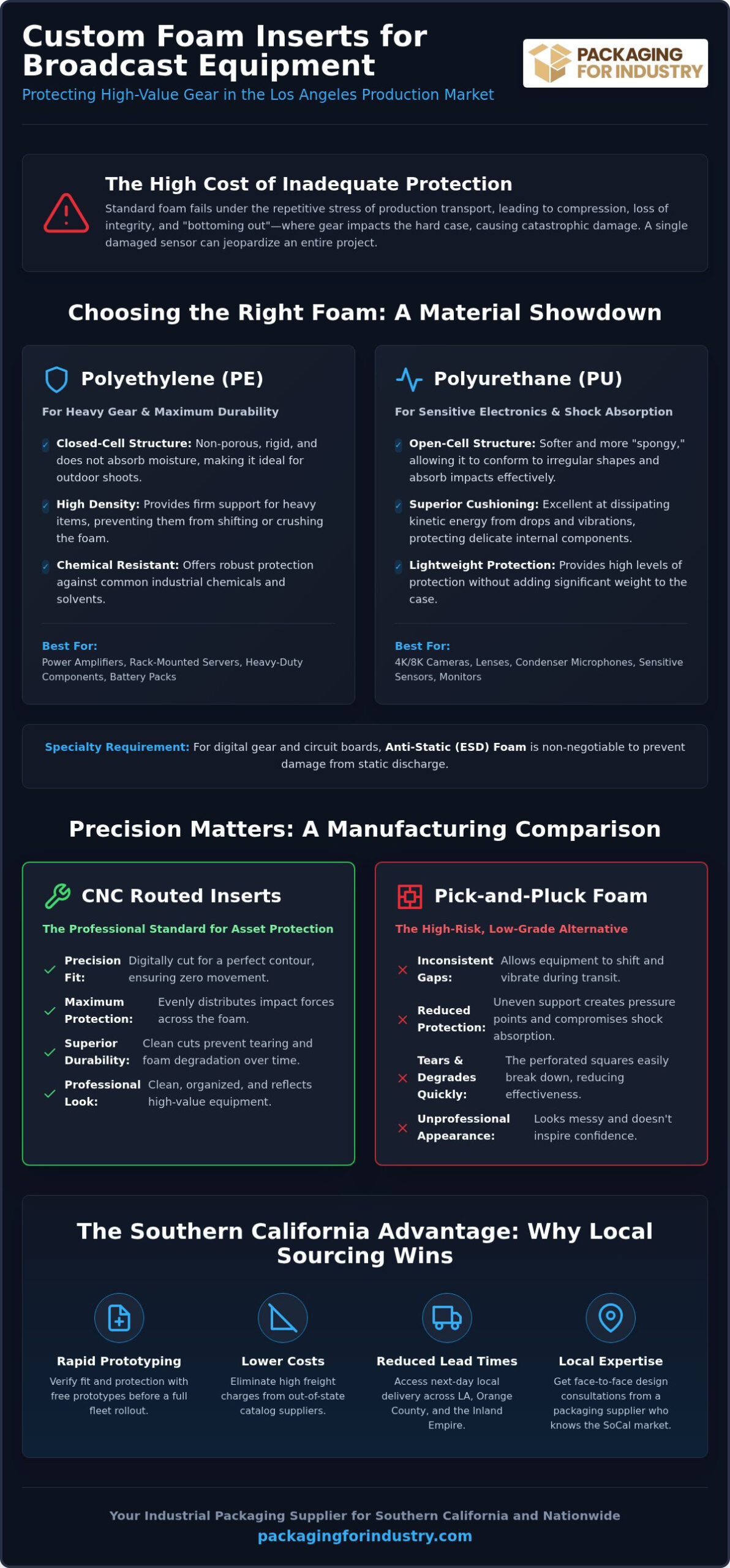
Production managers in Southern California handle assets that often cost hundreds of thousands of dollars. Moving these sensitive electronics from a Burbank studio to a Santa Monica set involves more than just physical transport; it requires managing the constant risk of impact and vibration. Standard shipping foam found in generic cases frequently fails because it isn’t designed for the repetitive stress of the SoCal production circuit. Over time, low-grade foam compresses and loses its structural integrity. This leads to “bottoming out,” where the equipment strikes the hard outer shell of the case during a sudden stop or a bump on the 405. For high-end broadcast houses, the hidden costs of using off-the-shelf foam include premature equipment degradation and expensive emergency repairs that blow through production budgets.
Securing custom foam inserts for broadcast equipment cases Los Angeles allows fleet managers to move beyond simple padding toward a precision-engineered solution. Industrial-grade foam suppliers focus on the specific g-force requirements of broadcast gear, ensuring that every camera, lens, and server remains stationary and protected. By choosing engineered foam packaging, you reduce shipping damage and eliminate the professional stress of equipment arriving dead on arrival at a remote shoot. This proactive approach to logistics is essential for maintaining a reliable production fleet in a market where downtime can cost thousands of dollars per hour.
Broadcast Equipment Vulnerabilities
Broadcast gear has specific “hot spots” that require specialized support. For example, 4K and 8K camera sensors are extremely sensitive to high-frequency vibrations that can misalign internal optics. A fundamental part of this engineering involves understanding foam cushioning materials and how they react to different frequencies. While a camera needs soft, energy-absorbing polyurethane, a heavy rack-mounted power amplifier requires high-density polyethylene to manage weight distribution and prevent the gear from shifting. Proper foam engineering ensures that heavy components don’t crush lighter, more delicate items stored in the same case.
The Los Angeles Production Advantage
The proximity of your supplier to major hubs like Hollywood and Burbank is a strategic asset. Working with an Anaheim packaging supplier allows for rapid prototyping and face-to-face design consultations that national catalog vendors can’t provide. Local sourcing significantly reduces lead times, which is critical when a production schedule changes at the last minute. Additionally, you’ll lower packaging costs by eliminating the high freight charges associated with shipping bulky foam inserts from out-of-state warehouses. Local delivery across Southern California ensures your gear is protected and ready for the next call time without the wait.
Selecting the Right Foam Material for Sensitive Production Electronics
Choosing the correct material for custom foam inserts for broadcast equipment cases Los Angeles is a calculation based on weight, fragility, and environmental exposure. You can’t use the same foam for a heavy power amp that you use for a delicate condenser microphone. The physics of protection depends on foam density, which is the weight of a cubic foot of the material. If the density is too low, the gear will crush the foam upon impact and “bottom out” against the case wall. If it’s too high, the foam won’t compress enough to absorb the shock, passing the kinetic energy directly into your equipment’s internal circuitry. To find the right balance for your fleet, it’s often helpful to compare packaging pricing and material specifications with an expert.
Longevity in the field also depends on whether you select closed-cell or open-cell foam. Closed-cell materials like polyethylene are non-porous and don’t absorb moisture, making them ideal for outdoor location shoots where humidity or rain is a factor. Open-cell polyurethane is softer and more breathable, but it can act like a sponge if exposed to liquids. For digital gear and circuit boards, anti-static (ESD) foam is a non-negotiable requirement. This specialized foam packaging is treated to dissipate static charges, preventing the invisible electrical arcs that can fry expensive sensors and processors during transit.
Polyethylene (PE) Foam for Heavy Gear
Polyethylene is the industry standard for heavy rack-mount equipment and large monitors. Its rigid, closed-cell structure provides superior support for items that would otherwise sink into softer materials. Because PE foam is resistant to chemicals and moisture, it remains durable over years of use in demanding environments. This rigidity also makes it the preferred choice for CNC routing, allowing for precise cutouts that hold heavy gear firmly in place without the foam deforming or losing its shape over time.
Polyurethane (PU) Foam for Delicate Components
Polyurethane offers the soft, pillowy cushioning required for lightweight lenses, microphones, and handheld accessories. It’s often used as a convoluted “egg-crate” insert in case lids to provide gentle downward pressure that keeps items from shifting. In many professional broadcast applications, we use a hybrid approach. This involves a base of high-density PE foam to support the weight of the gear, capped with a layer of soft PU foam to protect delicate surfaces and finishes. This multi-layer engineering ensures that every component of your production kit receives the specific level of protection it needs.
CNC Precision vs. Standard Inserts: A Performance Comparison
Many entry-level cases ship with “pick-and-pluck” foam. While convenient for hobbyists, this material is inadequate for professional broadcast environments. The pre-scored cubes eventually tear and crumble under the weight of heavy gear, leaving foam dust on sensitive lenses and allowing equipment to shift during transit. When you invest in custom foam inserts for broadcast equipment cases Los Angeles, you move from a temporary fix to an engineered solution. Industrial CNC routing provides a level of structural integrity that pre-scored foam cannot match, ensuring your equipment remains stationary even during rough handling between studio locations.
The choice between CNC routing and die-cutting depends on your production volume and the complexity of your gear. Die-cutting is efficient for high-volume runs of simple shapes, but broadcast equipment often requires complex, multi-level pockets. CNC routing allows for these intricate geometries without the expensive tooling costs associated with custom dies. This precision is achieved through advanced Custom Design Packaging Services, where CAD/CAM software creates a “glove-fit” for every component. Beyond protection, this level of organization improves your speed on set. When every accessory has a dedicated, labeled spot, inventory checks become instant, and the rental value of your kit increases due to its professional presentation.
The CNC Routing Advantage
CNC machines provide precision depth control that is impossible to achieve with manual cutting. This allows for multi-level equipment storage where a camera body sits at one depth while shallower pockets hold batteries or media cards nearby. The resulting edges are clean and non-abrasive. This is critical because rough foam edges can actually scratch high-end finishes or snag on delicate switches over time. By using CNC-routed polyethylene, you ensure a durable, long-term housing that won’t degrade after a few months of heavy use in the field.
Retrofitting Existing Cases
You don’t always need to purchase new hard shells to upgrade your fleet’s protection. Most Los Angeles production houses already own an extensive inventory of Pelican, SKB, or ATA cases. We can design custom foam assemblies specifically to fit these existing shells, which helps lower packaging costs significantly. This approach allows you to standardize your fleet, creating unified foam layouts across different case brands. Whether you’re dealing with non-standard rack heights or unique mobile workstations, local manufacturing allows for fast prototyping to ensure a perfect fit before you commit to a full rollout.
How to Specify Custom Foam Requirements for Your Production Fleet
Specifying custom foam inserts for broadcast equipment cases Los Angeles requires a methodical approach to ensure both protection and operational efficiency. You should start by conducting a thorough inventory of your gear and identifying sensitive “hot spots.” These include lens mounts, protruding knobs, or external antennas that are prone to snapping under pressure. Next, determine your primary transit method. Local studio-to-studio van transport in Southern California involves repetitive low-frequency vibrations, while international air freight requires compliance with ATA 300 standards. The third step involves measuring the internal case dimensions and the necessary gear clearances. Fourth, select your foam material based on the weight of the equipment and ESD requirements for digital components. Finally, you can request a packaging quote with your CAD specifications to begin the prototyping phase.
Measuring for a Precision Fit
Precision measurement is the foundation of a successful foam insert. You must calculate critical clearances between the equipment and the case wall to prevent “bottoming out” during a drop. A common mistake is measuring only the gear body while ignoring peripheral accessories such as BNC cables, power connectors, and mounting plates. We recommend designing “finger-pulls” or circular cutouts at strategic points around the gear. These allow technicians to remove equipment quickly and safely without prying at the foam or stressing the equipment chassis. This ergonomic detail is essential for fast-paced sets where every second counts and gear needs to be deployed instantly.
Cost-Reduction Packaging Analysis
Custom foam is a strategic investment that lowers overall operational costs for your production house. By reducing shipping damage, you minimize expensive insurance claims and the logistical nightmare of equipment downtime. For studio-wide fleet upgrades, we offer bulk packaging pricing that provides significant savings over individual case orders. Many Los Angeles warehouses also integrate their foam inserts with custom corrugated boxes for secondary shipping. This dual-layer approach provides an extra buffer for international transport while keeping the primary case clean and ready for the set. Standardizing your fleet with these engineered solutions ensures long-term reliability and equipment longevity across your entire operation.
Why PFI is the Leading Los Angeles Supplier for Custom Case Foam
Los Angeles is the global center of broadcast and film production. For houses in Burbank, Hollywood, and Santa Monica, logistical delays aren’t just inconvenient; they’re financially damaging. PFI serves these hubs as a local partner with deep expertise in industrial-grade protection. When you source custom foam inserts for broadcast equipment cases Los Angeles from us, you aren’t just buying material. You’re accessing an engineering team that understands the specific transit hazards of the Southern California production circuit. We provide free prototyping to ensure your broadcast gear fits perfectly before you commit to a full fleet rollout. This proactive step eliminates the risk of ordering inserts that don’t meet your exact depth or density requirements.
Our capabilities extend beyond foam to provide integrated solutions for manufacturers and warehouses that move heavy production assets globally. This includes custom crates and heavy-duty corrugated boxes designed for secondary shipping. By managing your entire protective system through one local supplier, you streamline your supply chain and reduce the administrative burden of juggling multiple vendors. Securing custom foam inserts for broadcast equipment cases Los Angeles from a local partner ensures your fleet is always production-ready and protected against the rigors of frequent transport.
The PFI Service Advantage
Efficiency is the core of our operation. We provide local next-day delivery across Los Angeles, Orange County, and the Inland Empire, ensuring your production schedule stays on track. For recurring production runs or high-volume studio needs, our Vendor Managed Inventory (VMI) programs keep your warehouse stocked with the exact inserts you need without tying up excessive capital. When you compare packaging pricing against national catalog suppliers, the savings become clear. You’ll lower packaging costs by eliminating high freight charges and leveraging our local manufacturing efficiency. Our goal is to improve your supply reliability while reducing shipping damage across your entire inventory.
Get Your Custom Foam Quote Today
Your broadcast project deserves more than a one-size-fits-all approach. We offer direct access to our engineering teams to solve complex protection challenges, from delicate sensor housings to heavy rack workstations. Custom sizes are available for any case brand, including Pelican, SKB, and specialized ATA shells. Whether you need a single prototype or a bulk order for a distribution center, we provide the technical support and local reliability your business demands. Don’t let inadequate foam compromise your high-value assets. You can request a packaging quote today to begin your custom design process.
Contact PFI for a custom foam quote
Securing Your Production Fleet with Local Engineering
Protecting high-value electronics requires moving beyond generic padding toward engineered solutions that address specific g-force and ESD requirements. You’ve learned how selecting the correct density of polyethylene or polyurethane foam prevents equipment from bottoming out during transit between studios. By choosing custom foam inserts for broadcast equipment cases Los Angeles, you ensure a professional presentation that maintains the long-term rental value of your kit.
Working with a local partner allows you to leverage expert CAD/CAM engineering support and free prototyping to guarantee a precision fit for every component. This approach doesn’t just reduce shipping damage; it also lowers packaging costs by eliminating high freight fees and enabling local next-day delivery across Southern California. Standardizing your fleet with these precision inserts provides the reliability your production schedule demands.
We look forward to helping you optimize your equipment protection and streamline your logistics with a dependable local supply chain.
Frequently Asked Questions
How much do custom foam inserts for broadcast cases cost in Los Angeles?
Pricing for custom foam inserts for broadcast equipment cases Los Angeles depends on the complexity of the CAD design, material choice, and production volume. We focus on helping you lower packaging costs by providing engineered solutions that eliminate the need for expensive boutique case replacements. To get an accurate figure for your specific fleet, we recommend you request a packaging quote. This allows our engineering team to conduct a cost-reduction analysis tailored to your specific gear requirements.
What is the best foam material for heavy rack-mounted broadcast gear?
High-density polyethylene (PE) foam is the industry standard for heavy rack-mounted equipment and power amplifiers. Its closed-cell structure provides the rigid support necessary to prevent heavy gear from shifting or bottoming out during transit. Unlike softer foams, PE maintains its shape over thousands of trips. This durability ensures long-term protection for your most substantial assets, especially when moving between different studio locations and sets across Southern California.
Can you create custom foam inserts for my existing Pelican or SKB cases?
Yes, we specialize in retrofitting existing hard shells from brands like Pelican, SKB, and various ATA case manufacturers. Reusing your current inventory of cases while upgrading to precision-cut foam is an excellent way to reduce shipping damage without the expense of buying new shells. We provide custom sizes available for any internal configuration. This standardization allows you to maintain a unified look and protection level across your entire production fleet.
How long does the prototyping process take for custom CNC foam?
Prototyping speed is a primary advantage of working with a local Anaheim packaging supplier. While turnaround times vary based on design complexity, our proximity to the Los Angeles production hub allows for rapid iterations. We offer free prototyping for product fit to ensure your gear is perfectly secured before moving to bulk packaging pricing. This local service model helps you avoid the long lead times typical of national catalog distributors.
Do you offer anti-static (ESD) foam for sensitive broadcast circuit boards?
We provide specialized anti-static (ESD) foam designed specifically to protect sensitive broadcast electronics and circuit boards. This material dissipates static charges that can occur during handling or transit, preventing invisible electrical damage to high-value sensors and processors. ESD foam is a non-negotiable requirement for digital gear. We can integrate it into hybrid foam assemblies to combine impact protection with electrical safety for your most delicate production equipment.
Is there a minimum order quantity for custom-cut broadcast foam inserts?
We prioritize business accounts with recurring needs, such as production houses, warehouses, or distribution centers. While we don’t focus on small retail-style orders, we provide competitive bulk packaging pricing for fleet-wide upgrades. Our goal is to support industrial operations that require a consistent and reliable supply of high-quality protection. If you are looking to standardize your gear, we can design a program that fits your specific volume and logistics requirements.
Do you provide local delivery to studios in Burbank and Hollywood?
Yes, we offer local next-day delivery throughout Southern California, including the major production hubs in Burbank, Hollywood, and Santa Monica. Our fleet serves Los Angeles County, Orange County, and the Inland Empire daily to ensure your gear arrives on time for your next call time. This local delivery capability significantly reduces your logistical stress and helps you avoid the high freight costs associated with shipping bulky items from out-of-state warehouses.
Can PFI help reduce shipping damage for my production gear?
Reducing shipping damage is the core focus of our custom engineering process. We use CAD/CAM support to create a precision fit that eliminates internal movement, which is the leading cause of equipment failure during transit. By performing a packaging review and cost-reduction analysis, we identify vulnerabilities in your current setup. Our industrial-grade custom foam inserts for broadcast equipment cases Los Angeles provide superior shock absorption compared to generic alternatives, keeping your gear operational.