
How much is a single micro-scratch on a precision lens costing your production line this year? While catalog suppliers offer generic solutions, they often fail to account for the specific material science required to protect sensitive glass and coatings. When you rely on standard packaging, you aren’t just buying a container; you’re often introducing a surface abrasion risk that custom foam inserts for optical component trays are specifically engineered to eliminate.
We understand that maintaining surface integrity is non-negotiable for your manufacturing yields. It’s frustrating to see high-value components arrive with damage due to inconsistent fit or abrasive materials. This 2026 buyer’s guide will show you how to specify precision-engineered inserts that achieve zero-damage transit while lowering your total procurement costs. We’ll cover the critical differences between Polyethylene and Polyurethane, the latest ANSI/ESD S541-2026 requirements, and how local vendor-managed inventory can simplify your purchasing. By the end of this guide, you’ll know exactly how to move away from expensive catalog markups toward a more reliable, custom-tailored supply chain that supports your automated assembly needs and improves overall supply reliability.
Key Takeaways
- Identify the specific material properties of Polyethylene and Polyurethane foam to prevent micro-scratches and ensure surface integrity for high-value optical components.
- Understand how CAD/CAM design processes for custom foam inserts for optical component trays provide the precision fit required for automated assembly and G-force protection.
- Implement Vendor Managed Inventory (VMI) and just-in-time delivery to eliminate stockouts and reduce the footprint of packaging materials in your warehouse.
- Lower your overall freight expenses and lead times by partnering with a local packaging supplier that provides next-day delivery throughout Southern California.
Why Precision Matters: Protecting High-Value Optics from Damage
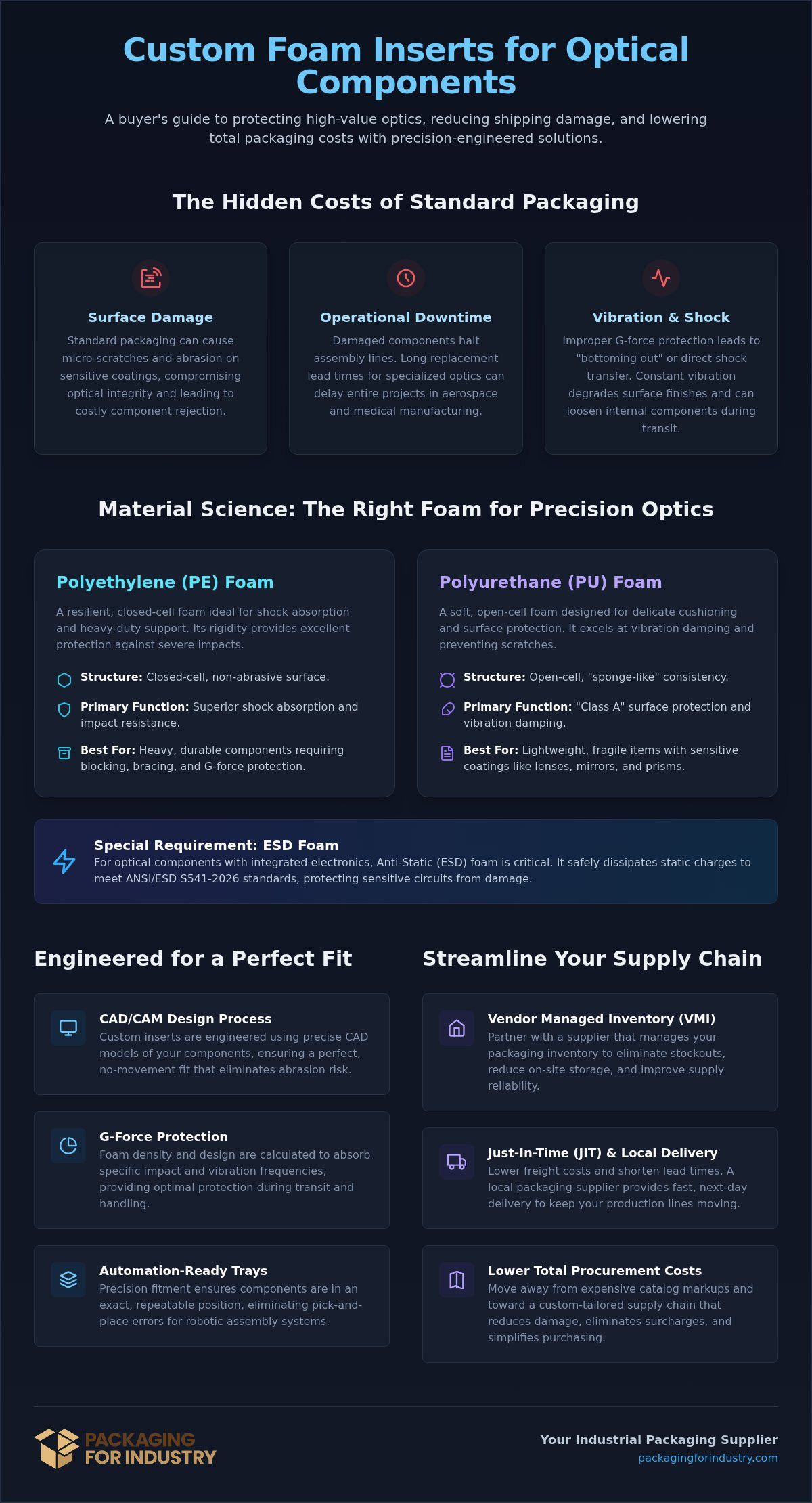
Precision optics represent some of the most sensitive assets in any industrial supply chain. Lenses, mirrors, and prisms aren’t just fragile; they’re often irreplaceable in the short term. When these components sustain damage during transit, the impact goes far beyond the price of the part. Standard foam packaging often fails because it’s designed for general impact resistance rather than the specific G-force sensitivities of high-end sensors and optical glass. If the foam is too rigid, it transfers shock directly to the component. If it’s too soft, the part “bottoms out” against the outer container.
The primary threat to optical integrity is often micro-abrasion. Even if a lens doesn’t crack, constant vibration against an abrasive foam surface can ruin delicate anti-reflective or polarizing coatings. Using custom foam inserts for optical component trays ensures that every part is immobilized in a non-abrasive environment. This level of engineering is essential for maintaining production line flow and ensuring that your quality control team doesn’t reject parts before they even reach the assembly stage. You can request a packaging quote to see how precision fitment can lower your total cost of quality.
The Hidden Costs of Shipping Damage
Shipping damage triggers a cascade of operational failures. Beyond the direct replacement cost, you must account for equipment downtime and the administrative burden of filing claims. In industries like aerospace or medical device manufacturing, replacement lead times for specialized optics can stretch into weeks. This delay can stall an entire project. Additionally, bulky, poorly designed packaging often results in higher shipping fees. Carriers apply surcharges for dimensional weight when oversized boxes are used to compensate for inadequate internal protection. The economic ripple effect of a scratched lens extends beyond the unit cost, often halting entire assembly lines and delaying multi-million dollar project milestones.
Vibration Damping for Sensitive Components
Transit involves constant harmonic vibrations that can loosen internal components or degrade surface finishes. Effective custom foam inserts for optical component trays are engineered to dampen these specific vibrations based on Package cushioning principles. This protection is critical whether the items are in transit or being moved into cleanroom storage. In automated assembly environments, a precision fit is non-negotiable. Robotic systems require components to be in an exact, repeatable position. If a part shifts during handling because of a loose-fitting tray, the resulting pick-and-place errors can cause significant damage to both the component and the assembly equipment.
By working with a local foam packaging supplier that understands these technical requirements, manufacturers can reduce shipping damage and improve supply reliability. PFI provides custom engineered solutions that prioritize both protection and operational efficiency for facilities across Southern California, ensuring your production stays on schedule with local next-day delivery options.
Material Science: Selecting the Right Foam for Optical Trays
Material selection is the foundation of any high-performance tray. While many catalog suppliers provide generic “soft” foam, precision optics require “Class A” surface protection. This designation ensures the material won’t leave chemical residue or cause micro-scratches on highly polished surfaces. Selecting the right density is a balancing act; the material must be firm enough to prevent the part from shifting, yet compliant enough to absorb energy during a drop.
The Vibration Sensitivity of Optical Components survey highlights how even minor environmental disturbances can impact performance. Consequently, the cell structure of your foam matters. Closed-cell foams provide a firm barrier against impact, while open-cell foams act as high-frequency dampers. For optical components integrated with sensors or semiconductors, specifying ESD foam packaging is essential to meet ANSI/ESD S541-2026 standards. These materials dissipate static charges that could otherwise bridge across sensitive circuits or attract dust to clean surfaces.
Polyethylene (PE) for Heavy Support
PE is a closed-cell material known for its rigidity and durability. It’s the ideal choice for heavier industrial optical assemblies or components that require long-term storage in varying humidity. Because PE is moisture-resistant, it won’t degrade or trap liquids that could lead to corrosion. When designing protective foam packaging for industrial use, PE provides the structural integrity needed for stacking and heavy handling. It doesn’t shed fibers, making it a reliable choice for environments where particulate contamination must be kept to a minimum.
Polyurethane (PU) for Delicate Cushioning
PU is a softer, open-cell material that provides superior cushioning for lightweight lenses and fragile filters. It’s highly conformable, meaning it can wrap around complex geometries without applying excessive pressure. However, in sealed environments, you must account for outgassing. Some standard PU foams release chemical vapors that can fog lenses over time. Specifying high-quality, low-outgassing PU is a critical step in engineering custom foam inserts for optical component trays. For certain applications, convoluted or “egg-crate” PU foam can provide a versatile solution for multi-sized components that require a soft touch.
Choosing the wrong material can lead to costly rejections and production delays. You can compare packaging pricing for different foam grades to ensure your components stay protected without overspending on over-engineered materials. PFI’s engineering team can help you navigate these material choices to find the most cost-effective balance of protection and performance.
Engineering the Fit: CAD Design and Prototyping for Precision Optics
Precision engineering for optical components leaves no room for manual guesswork. While generic foam blocks might provide bulk protection, they don’t offer the exact tolerances required for automated assembly lines or high-value lenses. Achieving a zero-damage transit environment starts with translating your component’s technical specifications into a digital blueprint. Developing custom foam inserts for optical component trays requires a sophisticated CAD/CAM workflow to ensure that every cavity provides uniform pressure and support across the entire surface of the part.
When you move away from one-size-fits-all solutions, you eliminate the “slop” or movement that causes micro-abrasions. These engineered inserts can be integrated directly into plastic or heavy-duty corrugated trays, creating a unified handling system for your warehouse or cleanroom. By matching the foam geometry to your component’s specs, you ensure that even the most fragile prisms remain immobilized during the most turbulent transit phases.
From Blueprint to Prototype
PFI leverages your existing CAD files to engineer exact-fit cavities that account for every protrusion and delicate edge of your equipment. This process isn’t just about fit; it’s about validating performance before a single production run begins. Our custom design packaging services include free prototyping for Southern California manufacturers. This allows your team to test for shock absorption and vibration damping in real-world shipping scenarios, ensuring the final product meets your internal quality standards without the risk of a costly miscalculation.
Custom Sizes and Die-Cutting Precision
Die-cutting remains the industry standard for high-volume, repeatable accuracy. Unlike hand-plucked foam, which is prone to tearing and inconsistent depths, die-cut inserts ensure that every tray in a thousand-unit order is identical. This repeatability is essential for automated pick-and-place systems that rely on exact coordinates. For complex, multi-depth optical component trays, CNC routing offers the ability to create varied pocket depths within a single piece of foam. This level of precision helps manufacturers lower packaging costs by maximizing material efficiency and reducing the footprint of the overall shipping container. Whether you need a custom packaging quote for a small pilot run or bulk packaging pricing for a global rollout, engineered precision ensures your supply chain remains reliable and cost-effective.
Maximizing Efficiency: Kitting and Vendor Managed Inventory (VMI)
Precision engineering is only half the battle in a modern industrial supply chain. If your production line stalls because you’re waiting on a foam shipment, the technical quality of the protection becomes irrelevant. Integrating custom foam inserts for optical component trays into a broader procurement strategy like VMI or JIT delivery ensures that your operational flow matches your engineering quality. This proactive approach reduces the administrative overhead of managing hundreds of recurring purchase orders and prevents the high costs associated with production stockouts.
By shifting from reactive ordering to a managed system, manufacturers can stabilize their supply reliability. This is especially critical for high-volume electronics or aerospace facilities where even a one-day delay in packaging delivery can halt multi-million dollar assembly schedules. We focus on the intersection of logistics and engineering to ensure your packaging supports your bottom line as much as it protects your products.
The PFI Vendor Managed Inventory Advantage
Warehouse floor space in Southern California, particularly in industrial hubs like Irvine and Carson, comes at a premium. Storing months of bulky foam packaging on-site is an inefficient use of expensive real estate. Our vendor managed inventory (VMI) programs solve this by shifting the storage and monitoring burden to our team. We conduct regular inventory reviews to ensure supply reliability, delivering exactly what you need based on your actual consumption. This just-in-time approach frees up your facility for high-value manufacturing while ensuring you never run out of critical protective materials.
Streamlining Assembly with Packaging Kitting
Assembly line speed is often throttled by the time it takes workers to prepare packaging for use. Packaging for manufacturers is most efficient when it arrives ready for the production floor. Through packaging kitting, PFI provides pre-assembled trays where the foam is already seated and ready for component insertion. Your team doesn’t spend labor hours unboxing foam and manually fitting it into corrugated or plastic bases. This reduces labor costs and minimizes the risk of assembly errors. By receiving kits that are ready for immediate use, you simplify the workflow for your warehouse or distribution center staff, allowing them to focus on core operations rather than packaging prep.
Sourcing Custom Foam Inserts in Southern California with PFI
Choosing a local partner for your protective packaging is a strategic decision that impacts both your lead times and your bottom line. Bulky materials like foam are notoriously expensive to transport over long distances because you’re essentially paying to ship air. When you source custom foam inserts for optical component trays from a regional supplier, you eliminate the high freight costs and international shipping delays that plague global supply chains. For manufacturers in Southern California, this proximity means your production line stays agile and responsive to changing demand.
PFI operates as a specialized industrial packaging supplier with a deep understanding of the unique requirements of the aerospace and medical device sectors. Our facility provides precision engineering and local next-day delivery, ensuring that your high-value optics are never sitting in a warehouse waiting for specialized protection. By keeping your supply chain local, you gain better oversight of the design process and faster turnaround on critical prototypes. This proximity allows for face-to-face collaboration during the CAD/CAM phase, which is essential for components with complex geometries.
Serving the SoCal Industrial Hub
Our logistics network is designed to support the specific needs of the region’s most demanding industries. We act as a dedicated Anaheim packaging supplier, providing custom boxes and foam to the dense manufacturing clusters in North Orange County. Our reach extends to firms in Irvine and Santa Ana, where optical engineering and semiconductor fabrication require strict ESD standards. For aerospace manufacturers in Carson and Torrance, PFI offers reliable local delivery that matches the fast-paced nature of defense and aviation contracts. We also provide consistent service to industrial centers in San Diego and Riverside, ensuring that high-quality packaging materials are available across the entire Southland.
Why Choose Packaging For Industry (PFI)?
PFI serves as the cost-saving alternative to large, impersonal catalog suppliers. While those companies offer stock sizes, they rarely provide the precision fit necessary for delicate lenses or prisms. We combine foam, custom corrugated boxes, and heavy-duty crates into one integrated solution. This holistic approach means you don’t have to manage multiple vendors for a single shipping unit. Our engineering team works directly with yours to ensure that every component of the package, from the outer box to the internal custom foam inserts for optical component trays, is optimized for both protection and cost-efficiency. If you’re ready to lower your shipping damage and improve supply reliability, it’s time to request a packaging quote from a partner that understands the Southern California industrial landscape.
Optimizing Your Optical Supply Chain for 2026
Securing high-value lenses and sensors requires a shift from commodity packaging to engineered protection. By selecting “Class A” surface-safe materials and utilizing CAD-driven designs, you eliminate the micro-scratches that drive up rejection rates. Implementing custom foam inserts for optical component trays isn’t just about protection; it’s a strategic move to lower your total procurement costs through better yields and smarter inventory management. Whether you’re managing a high-volume assembly line or shipping delicate aerospace sensors, the right material science makes the difference between a successful delivery and a costly loss.
PFI specializes in these high-stakes requirements for the aerospace and medical device sectors across Southern California. Our local presence allows us to offer free prototyping and next-day delivery to facilities in Anaheim, Irvine, and surrounding counties. This proximity ensures your production line stays moving without the burden of excessive warehouse overhead or long international lead times. We’re here to help you transition from generic catalog options to a reliable, custom-tailored supply system.
We’re ready to help you solve your most complex logistics challenges with reliable, precision-fit solutions that protect your products and your bottom line.
Frequently Asked Questions
What is the best foam for protecting high-end optical lenses?
Polyurethane (PU) is typically the best choice for lightweight, delicate lenses because its open-cell structure provides superior cushioning and vibration damping. For heavier optical assemblies, closed-cell polyethylene (PE) foam offers the necessary structural support. We prioritize “Class A” surface-safe materials to prevent micro-scratches and chemical outgassing. Our engineering team helps you select the correct density to balance impact protection with soft-touch surface integrity for your specific components.
Do you offer anti-static (ESD) foam for optical components with electronics?
Yes, we specialize in providing ESD foam packaging designed to protect semiconductor-integrated optics from electrostatic discharge. Our materials comply with current ANSI/ESD S541-2026 standards to ensure the safety of sensitive electronic circuits. These anti-static foam inserts prevent static build-up and dust attraction, which is critical for maintaining cleanroom standards. We offer both pink anti-static and black conductive foam options depending on your specific shielding requirements.
Can I get a prototype of my custom foam insert before ordering in bulk?
We provide free prototyping and samples for Southern California businesses to ensure a 100% product fit before you commit to a bulk order. Our CAD/CAM design process allows us to create precise physical models based on your component specifications. Testing a prototype is a vital step in validating shock absorption and verifying that the custom foam inserts for optical component trays meet your automated assembly tolerances.
How do I lower my packaging costs for recurring optical tray orders?
You can lower costs by implementing a Vendor Managed Inventory (VMI) program, which eliminates emergency rush orders and reduces warehouse storage fees. Custom engineering also helps you avoid expensive UPS or FedEx dimensional weight surcharges by optimizing the box size. Additionally, sourcing from a local industrial packaging supplier reduces the high freight costs associated with shipping bulky foam materials over long distances from national catalog distributors.
Do you provide local next-day delivery for businesses in Orange County?
Yes, PFI provides local next-day delivery for businesses throughout Orange County, including Anaheim, Irvine, and Santa Ana. We also service Los Angeles County, San Diego, and the Inland Empire with our own fleet of delivery trucks. This local presence ensures a reliable packaging supply for your production lines and allows for just-in-time replenishment, which is essential for maintaining high-volume manufacturing schedules without stockouts.
Can you design foam inserts that fit into existing plastic or corrugated trays?
Our engineering team can design custom foam inserts for optical component trays that integrate seamlessly into your current plastic or corrugated containers. We use precision CAD design to match the external dimensions of your existing trays while tailoring the internal cavities to your specific lenses or sensors. This approach allows you to upgrade your internal protection and vibration damping without the need to replace your entire inventory of exterior shipping trays.
What information do I need to provide for a custom foam quote?
To provide an accurate custom packaging quote, we typically need the dimensions and weight of your component, along with any CAD files or physical samples. It’s also helpful to know the fragility level of the item and your expected recurring order volume. Providing details about your shipping method and storage environment allows our designers to recommend the most cost-effective foam density and material type for your specific industrial application.
Do you handle small-batch custom foam orders for R&D labs?
While we specialize in high-volume production and recurring supply for manufacturers, we frequently support R&D labs during the prototyping and pilot phases. We understand that precision optics often start in small batches before scaling to full production. Our team provides the same level of CAD/CAM engineering and material expertise for these initial runs, ensuring that your lab-scale components are protected while preparing the design for future bulk manufacturing needs.