
A high-end waterproof case provides a rugged outer shell, but the actual safety of your gear depends entirely on the material holding it in place. If you’re currently relying on generic foam that flakes, degrades, or leaves a sticky residue on sensitive instruments, you’re risking expensive equipment damage every time a kit leaves your facility. For manufacturers and aerospace firms across the region, investing in custom foam inserts for waterproof equipment cases SoCal is the most effective way to ensure precision-engineered safety during transit and field operations.
You likely already know that standard “pick-and-pluck” foam isn’t built for the long-term rigors of industrial shipping or professional presentation. This guide will show you how to engineer custom protection that eliminates internal movement, organizes complex kits, and adheres to the latest technical standards such as ISO 844:2026. We’ll explore critical differences between polyethylene and polyurethane materials, the advantages of local prototyping in Anaheim, and how specialized inserts can lower your total cost of ownership by reducing shipping damage claims.
Key Takeaways
- Distinguish between closed-cell and open-cell foams to ensure your materials provide the necessary moisture resistance and cushioning for waterproof environments.
- Utilize CAD/CAM engineering to create exact equipment silhouettes that eliminate internal movement and significantly reduce shipping damage claims.
- Secure high-precision custom foam inserts for waterproof equipment cases SoCal that comply with rigorous aerospace, medical, and Mil-Spec packaging standards.
- Streamline the procurement process by identifying the critical technical specifications needed for fast prototyping and accurate bulk packaging quotes.
- Optimize your local supply chain by leveraging Southern California delivery and inventory management programs to improve reliability and lower total costs.
Beyond Pick-and-Pluck: Why Industrial Gear Needs Custom Foam Inserts
Industrial gear requires more than just a generic cushion; it needs a comprehensive protection system. While a high-quality waterproof case from brands like Pelican or SKB provides a rugged exterior, the internal foam is what actually manages kinetic energy during transit. Custom foam inserts are precision-engineered protective layers that act as a structural component of your logistics chain. For manufacturers and aerospace firms, high-performance custom foam inserts for waterproof equipment cases SoCal are essential to prevent the catastrophic failure of sensitive instruments. Packaging For Industry (PFI) specializes in these engineered solutions to ensure long-term reliability for high-value assets.
The Failure of Off-the-Shelf Foam Solutions
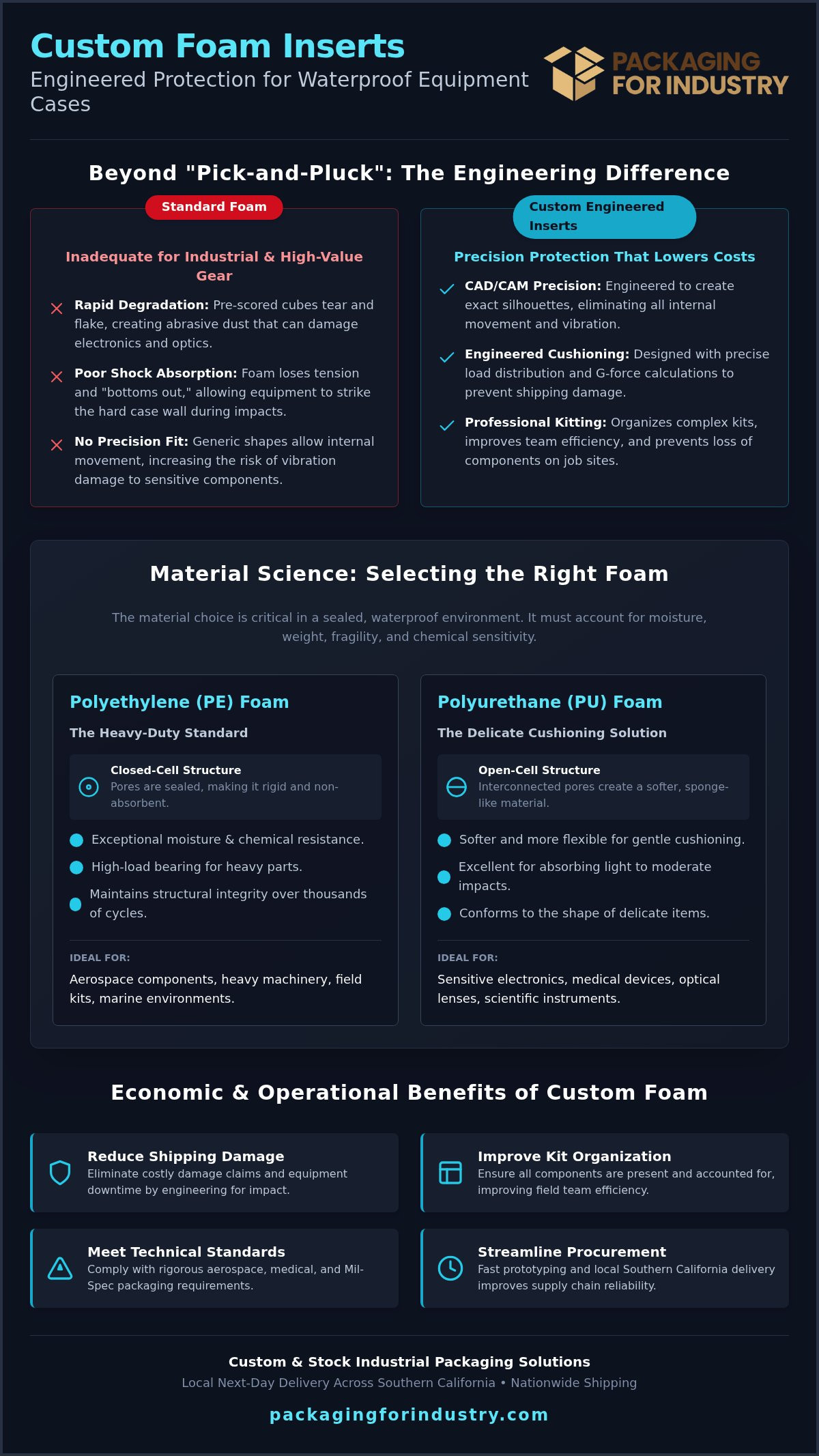
Standard pick-and-pluck or convoluted foam solutions are designed for convenience, not durability. In an industrial environment, these materials suffer from rapid structural fatigue. The pre-scored cubes eventually lose their tension, leading to “bottoming out” where the equipment strikes the case’s hard interior wall. This is especially dangerous for heavy tools or delicate electronics that require consistent support across their entire surface area. Beyond that, low-grade foam often degrades into a fine dust that can infiltrate lenses or electronic connectors, leading to expensive cleaning or repair bills. By analyzing the properties of closed-cell foam, engineers can select materials that resist moisture and maintain their shape under heavy loads. This is a critical distinction for professionals seeking custom foam inserts for waterproof equipment cases SoCal, as the regional climate and shipping demands require materials that won’t fail after a few trips.
Economic Benefits of Custom Engineering
The decision to move away from stock foam is a matter of fiscal responsibility. Custom engineering allows for precise load distribution and G-force calculations, which directly lower packaging costs by eliminating shipping damage. When gear stays in the field instead of the repair shop, operational downtime vanishes. Professional packaging kitting also improves the efficiency of your field teams. A well-organized case ensures that every component is visible at a glance. It’s immediately obvious if a part is missing before leaving a job site, saving your team from costly return trips. For Southern California businesses, partnering with a local foam packaging supplier ensures that these engineered solutions are prototyped quickly. Packaging For Industry (PFI) provides local next-day delivery across Southern California, ensuring your supply chain remains reliable and efficient.
Material Science: Selecting the Right Foam for Waterproof Environments
Selecting the right polymer is the foundation of any high-performance protective system. When engineering custom foam inserts for waterproof equipment cases SoCal, the material choice must account for the unique environment of an airtight container. Unlike standard corrugated boxes, waterproof cases create a sealed atmosphere where trapped moisture or chemical off-gassing can jeopardize sensitive sensors and electronic components. Choosing between polyethylene and polyurethane depends entirely on the weight, fragility, and chemical sensitivity of your gear.
Polyethylene (PE) Foam: The Heavy-Duty Standard
Polyethylene is a closed-cell foam, meaning its pores are sealed off from one another. This structure provides exceptional moisture resistance, making it the ideal choice for field kits exposed to marine environments or heavy rain. Because it doesn’t absorb liquids, it also resists oils and industrial chemicals. This density is necessary for high-load bearing applications, such as aerospace components or heavy machinery parts. PE foam maintains its structural integrity over thousands of cycles, ensuring your equipment doesn’t shift or “bottom out” during rough handling in the field.
Polyurethane (PU) Foam: Delicate Cushioning
Polyurethane is an open-cell material that offers a softer, more flexible level of protection. It’s the preferred option for fragile optics, medical instruments, and lightweight electronics. While it’s less moisture-resistant than PE, its superior vibration damping makes it indispensable for delicate gear. For electronics manufacturers, we often specify ESD foam packaging variants to prevent static discharge from damaging semiconductors. PU foam is also available in convoluted shapes, often used in the lids of waterproof cases to provide a gentle “nesting” effect that secures items of varying heights without applying excessive pressure.
Density and Energy Management
The effectiveness of your insert relies on matching the foam’s density to the equipment’s fragility. Engineering research into foam for energy absorption applications shows that the right polymer density can reduce peak G-forces by significant margins during a drop. In a sealed case, you must also consider off-gassing. Lower-quality foams can release chemical vapors that cloud lenses or corrode metal over time. PFI engineers use high-grade materials that meet military packaging standards to ensure your gear remains pristine. If you’re unsure which material fits your specific requirements, you can request a packaging quote to consult with our design team in Anaheim.
Engineering for Impact: Custom Inserts vs. Standard Case Foam
Effective protection goes beyond material choice; it requires precise spatial engineering. Many organizations already own a fleet of rugged shells from manufacturers like Pelican, Storm, or SKB. You don’t need to replace the entire system to upgrade your protection. Retrofitting your current inventory with high-performance custom foam inserts for waterproof equipment cases SoCal is a pragmatic way to lower packaging costs while improving equipment safety. This approach maximizes your previous capital investments while upgrading your gear’s security to modern industrial standards.
CAD Design and Precision Cutting
The engineering process starts by digitizing your equipment’s exact dimensions. We use CAD/CAM software to create silhouettes with sub-millimeter accuracy. This ensures a snug fit that eliminates lateral movement during high-vibration transit or flight. For complex geometries, CNC routing provides the highest level of precision. Die-cutting remains a cost-effective path for bulk packaging supplies when designs are standardized. We also integrate ergonomic features like finger-pulls and specialized accessory compartments. These details improve field efficiency and ensure that your technicians can access tools quickly without fumbling.
Prototyping: The “Fit-Check” Phase
Precision engineering is only as good as its real-world performance. PFI offers free prototyping to ensure every cutout aligns perfectly with your hardware. This step is essential for aerospace and medical firms where minor misalignments can lead to equipment stress or failure. During this phase, we test load distribution to confirm the design meets your specific G-force requirements. You can learn about our custom design packaging services to see how we manage these engineering challenges from our Anaheim facility. Once the prototype is approved, our local Southern California presence allows for fast production and next-day delivery on recurring orders.
Multi-Layer Assemblies and Organization
Complex kits often require more than a single layer of foam. We design multi-layer assemblies that allow you to stack components vertically within deep waterproof cases. This organization method improves kitting efficiency and ensures a professional presentation for sales kits or field instruments. By distributing the load across multiple tiers, we provide better shock absorption for the entire assembly. This level of detail is why industrial leaders choose custom foam inserts for waterproof equipment cases SoCal over generic foam blocks that lack structural integrity.
Specifying Your Project: A Guide for SoCal Procurement Teams
Procurement teams must align complex engineering requirements with fiscal targets to ensure long-term supply reliability. When sourcing custom foam inserts for waterproof equipment cases SoCal, the procurement process involves more than just selecting a material; it requires a detailed understanding of the equipment’s lifecycle and the specific environmental stressors it will face. Accuracy in your initial specifications determines the performance of the protection system and the precision of your quote. Whether you’re supporting a field sales team or a military deployment, the details provided during the bidding phase impact your total cost of ownership.
Gathering Technical Specifications
Start by documenting the critical data points for your quote. You’ll need the exact weight and dimensions of each component, along with its fragility rating, often expressed as a G-rating. If you’re retrofitting existing cases, provide the internal dimensions or the specific model numbers from manufacturers like Pelican or SKB. With custom sizes available for any configuration, we can engineer inserts for non-standard instruments that off-the-shelf catalog suppliers can’t accommodate. Environmental factors are equally vital. Consider if the gear will face extreme temperature swings during air transport or exposure to industrial solvents. For specialized applications, identify if you require military packaging standards such as A-A-59136 for closed-cell foam or ESD-safe materials for sensitive electronics.
The Procurement Process in Southern California
Working with a local Anaheim packaging supplier offers distinct advantages in lead times and design accuracy. While the industry average for custom foam prototypes is typically 2 to 3 weeks, being local allows for faster physical “fit-checks” and face-to-face consulting. This proximity is critical when you need to compare packaging pricing for different foam grades, densities, or assembly methods. For recurring needs, you can explore our VMI services for industrial packaging to ensure you never run out of inserts. Packaging For Industry (PFI) manages inventory levels based on your production schedule, providing local next-day delivery across Southern California. When you need bulk packaging pricing for large-scale fleet deployments, our local facility provides the scalability and supply reliability that national distributors often lack.
Partnering with PFI for Custom Foam Solutions in Southern California
Selecting the right partner is about more than just a product; it’s about supply reliability and technical oversight. For businesses searching for an industrial packaging supplier near me in Southern California, Packaging For Industry (PFI) offers a streamlined design-to-delivery process that bridges the gap between engineering and economics. We act as a seasoned industrial consultant, focusing on tangible real-world outcomes to ensure your high-value gear remains protected while your total operational costs remain low. Our Anaheim headquarters serves as a hub for innovation, providing the scalable support required by the region’s largest manufacturers.
The PFI Advantage: Local Expertise and Fast Delivery
Our regional focus allows us to provide service levels that national catalog companies cannot match. We serve as a high-touch packaging distributor near me for operations in Orange County, Los Angeles, and the Inland Empire, offering local packaging delivery that includes next-day service for all recurring custom programs. This proximity allows our engineers to work directly with your production teams, ensuring that your custom foam inserts for waterproof equipment cases SoCal meet every technical requirement before full-scale production begins. We specialize in supporting the aerospace, medical device, and defense industries, where precision and compliance with standards like Mil-Spec or ISO 844:2026 are non-negotiable.
Integrated Packaging Solutions for Manufacturers
Packaging For Industry (PFI) excels at combining multiple materials to create a total protection system. As a leading bulk packaging supplier, we integrate custom foam with heavy-duty corrugated boxes, custom wood crates, and specialized edge protection. This single-source capability simplifies your purchasing process and ensures all components of your kit work in unison to reduce shipping damage. Whether you require a short run of foam-lined crates for heavy industrial machinery or high-volume ESD foam for electronics, we provide the scalability your operations demand. By centralizing your procurement with a local custom packaging supplier, you streamline your logistics and improve your overall supply reliability. Our team is ready to perform a cost-reduction analysis on your current inventory to identify where you can lower packaging costs without sacrificing gear safety.
Secure Your Precision Gear with Engineered Protection
Precision-engineered protection is the difference between a successful field operation and a costly equipment failure. By selecting the right polymer densities and leveraging CAD/CAM design, you transform standard rugged shells into mission-critical assets. This approach doesn’t just reduce shipping damage; it streamlines your entire logistical flow. For manufacturers and aerospace firms across the region, sourcing custom foam inserts for waterproof equipment cases SoCal is a direct path to fiscal responsibility and operational reliability.
PFI provides free prototyping for Southern California businesses to ensure a perfect fit before production begins. Our local next-day delivery across Anaheim, Los Angeles, and the Inland Empire ensures your supply chain remains uninterrupted. We bring expert engineering to every project, whether you’re protecting delicate medical devices or heavy-duty aerospace components. Our team is ready to help you lower packaging costs and improve the reliability of your field kits.
Let’s build a more reliable protection system for your high-value equipment today.
Frequently Asked Questions
How much do custom foam inserts for waterproof cases cost?
Pricing for custom foam inserts for waterproof equipment cases SoCal is determined by project complexity, material volume, and production quantity. Unlike generic catalog solutions, custom engineering ensures you don’t overpay for unnecessary material. We analyze your specific protection requirements to provide a competitive quote that balances durability with your budget. This tailored approach typically results in lower total costs by significantly reducing product damage and returns.
What is the best foam material for protecting heavy industrial equipment?
Polyethylene (PE) foam is the most effective material for heavy industrial components and aerospace parts. Its closed-cell structure provides the rigidity needed to prevent heavy items from “bottoming out” during high-impact transit. PE foam also offers excellent chemical and moisture resistance, making it ideal for the sealed environments of waterproof cases. For lighter, more fragile items, we often recommend polyurethane (PU) for its superior vibration damping properties.
Can you design foam inserts for cases I already own, like Pelican or Storm cases?
We frequently design custom inserts for existing fleets of Pelican, Storm, and SKB cases. Retrofitting your current rugged shells is a cost-effective way to upgrade your protection without the capital expense of buying new equipment cases. Our engineering team uses CAD software to digitize your equipment dimensions, ensuring the new foam fits perfectly within the internal footprint of your existing inventory. This service is ideal for organizations looking to standardize their field kits.
Do you provide anti-static (ESD) foam for electronics?
PFI provides a comprehensive selection of ESD foam packaging designed specifically for the electronics and semiconductor industries. We offer both pink anti-static and black conductive foam options in various densities. These specialized materials prevent the buildup of static electricity that can destroy sensitive circuits during shipping. Using ESD-safe inserts in a waterproof case provides a dual layer of protection against both environmental moisture and electrostatic discharge.
What is the lead time for a custom foam prototype in Southern California?
The lead time for a custom foam prototype in Southern California generally aligns with the industry standard of 2 to 3 weeks. However, our Anaheim headquarters allows us to accelerate this process for local manufacturers through direct communication and physical “fit-checks.” We offer free prototyping to verify the design before you commit to a full production run. This local partnership ensures that any necessary design iterations happen quickly to keep your project on schedule.
Do I need to send my equipment to your Anaheim facility for design?
You don’t always need to ship your equipment to our Anaheim facility. While physical access allows for the highest precision, we can engineer custom inserts using your existing CAD files or detailed technical drawings. For high-value aerospace or medical gear, our local team can often coordinate on-site reviews. This flexibility allows us to start the design process immediately while ensuring the final foam assembly meets your sub-millimeter accuracy requirements.
What industries do you serve in Los Angeles and Orange County?
We support a wide range of industrial sectors across Los Angeles, Orange County, and the Inland Empire. Our primary clients include aerospace suppliers, medical device manufacturers, electronics firms, and defense contractors. Our local next-day delivery network ensures that businesses in cities like Irvine, Torrance, and Brea have a reliable source for custom foam and bulk packaging supplies. We focus on B2B relationships that require recurring, high-performance protection solutions.
How do custom foam inserts help reduce UPS or FedEx shipping surcharges?
Custom foam inserts for waterproof equipment cases SoCal allow you to use the smallest possible waterproof case that safely fits your gear. By optimizing the internal layout, you can often move to a smaller case size that avoids expensive “Large Package” surcharges from UPS and FedEx. Reducing the exterior dimensions also lowers the dimensional weight of your shipments. This engineering-led approach helps lower packaging costs and recurring freight expenses for your entire distribution network.