
Relying on a high-end hard case without precision-engineered interior protection is like putting a high-performance engine in a car with no suspension. If the internal cushioning fails, the outer shell is just an expensive container that facilitates damage rather than preventing it. Most operations managers and logistics professionals in Southern California have dealt with the frustration of standard pick-and-pluck foam disintegrating under heavy use or discovering that improper foam density led to critical equipment failure during transit.
We understand that off-the-shelf solutions often fall short of industrial requirements, especially when dealing with the tight tolerances of aerospace or medical electronics. This guide provides a comprehensive framework to help you specify, select, and source high-performance foam inserts for hard cases Los Angeles manufacturers use to safeguard their most valuable assets. You’ll learn how to choose between polyethylene and anti-static materials, the economic advantages of local prototyping, and how to reduce shipping damage rates. We’ll also examine how local support can eliminate the long lead times associated with national catalog suppliers. By the end of this article, you’ll know exactly how to transform standard hard cases into professional-grade protection systems that support your bottom line and improve supply chain reliability.
Key Takeaways
- Learn why switching from generic pick-and-pluck to engineered polyethylene or polyurethane foam is essential for high-vibration industrial shipping environments.
- Discover how to source custom foam inserts for hard cases Los Angeles manufacturers rely on to protect sensitive aerospace instruments and medical devices.
- Understand the technical design process, including how CAD/CAM engineering and free prototyping ensure a precise fit for complex parts before you commit to production.
- Explore strategies to lower packaging costs and eliminate lead-time surprises through vendor-managed inventory (VMI) and stocking programs for bulk orders.
- Identify the specific foam densities and ESD properties required to meet strict military and medical-grade specifications for protective kitting.
Beyond Pick-and-Pluck: Why Industrial Gear Needs Custom Foam Inserts
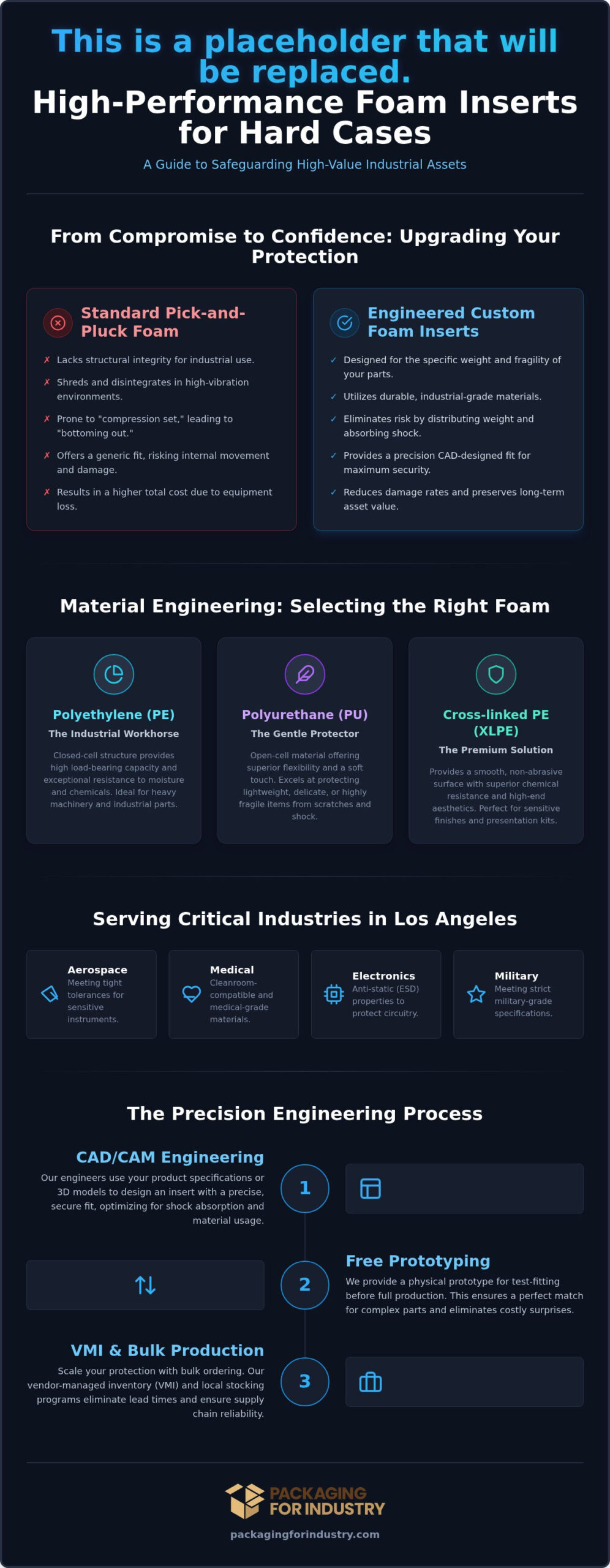
Standard pick-and-pluck foam is often a compromise that fails under the rigors of industrial logistics. While it offers a quick solution for consumer electronics, it lacks the structural integrity required for high-vibration shipping environments. In the Los Angeles manufacturing sector, equipment often travels through complex supply chains where constant movement can cause generic foam to shred or lose its shape. Custom foam packaging solutions solve this by utilizing materials designed specifically for the weight and fragility of the part. Beyond protection, these inserts create a professional presentation that reflects the quality of your brand. This is especially critical for client-facing field equipment or sales demonstration kits where first impressions matter as much as hardware performance.
The Hidden Costs of Improper Cushioning
The true cost of poor cushioning isn’t just the price of the foam; it’s the total loss of the equipment plus the logistical overhead of replacement. When calculating the ROI of custom foam, businesses must consider the reduction in shipping damage rates and the preservation of long-term asset value. Standard foam often suffers from compression set, leading to “bottoming out” where the item strikes the interior wall of the case during a drop. Precision-engineered transit cases with custom inserts eliminate these risks by distributing weight evenly across the foam surface. Because these cavities are cut to exact dimensions, custom inserts eliminate the need for secondary void fill like bubble wrap or loose fill. This streamlined approach significantly reduces the time warehouse staff spends packing each unit, allowing for higher throughput during peak demand.
Industrial Standards vs. Consumer Grade
Retail case foam is typically designed for occasional use and light handling. In contrast, industrial foam inserts for hard cases Los Angeles engineers specify are built for repeat-use transit and harsh environments. Durable materials like closed-cell polyethylene offer superior resistance to chemicals, moisture, and long-term wear compared to disposable open-cell options. For the aerospace and medical sectors, meeting these higher standards isn’t optional. These industries require exact tolerances and often specify anti-static or cleanroom-compatible materials. Investing in industrial-grade inserts ensures your operations remain compliant with sector-specific requirements while maintaining a steady logistical flow. This level of precision is what separates a standard container from a professional logistics tool that protects your bottom line.
Material Engineering: Selecting the Right Foam for Your Hard Case
Selecting the right material for foam inserts for hard cases Los Angeles manufacturers utilize requires an understanding of polymer science and logistical hazards. Polyethylene (PE) foam serves as the industrial workhorse. Its closed-cell structure provides high-load bearing capacity and exceptional moisture resistance. In contrast, Polyurethane (PU) foam is an open-cell material offering superior flexibility. It excels at protecting lightweight or highly fragile items that require a soft touch. For applications requiring high-end aesthetics or superior chemical resistance, cross-linked polyethylene (XLPE) provides a smooth, non-abrasive surface that won’t scratch sensitive finishes or react with industrial lubricants.
Density and ILD: The Science of Shock Absorption
Performance in protective packaging is dictated by density and Indentation Load Deflection (ILD). Density, measured in pounds per cubic foot, determines how much weight the foam can support before it compresses fully. ILD measures the firmness or “feel” of the foam, which is critical for fine-tuning the deceleration of a falling object. In cushioning packaging applications, the cell structure’s ability to undergo elastic deformation and subsequent recovery is what prevents equipment from experiencing peak G-force impacts. For heavy machinery parts, a higher density PE foam is required to prevent the payload from crushing the material. Conversely, lighter electronics benefit from a low-density PU foam that absorbs energy through gradual compression without transferring excessive force to the component.
Specialized Foam Additives
Industrial environments often present hazards beyond physical impact. For Los Angeles electronics manufacturers, Electrostatic Discharge (ESD) is a primary concern during transit and assembly. ESD foam is treated with chemical additives that dissipate static charges, preventing catastrophic failure of sensitive circuit boards. Similarly, military and aerospace applications often specify fire-retardant foam to meet strict safety and compliance standards. Learn more about our protective foam packaging options to see how these specialized materials integrate into a comprehensive logistics strategy. Choosing the correct additive ensures your foam inserts for hard cases Los Angeles operations remain compliant with both industry standards and California’s evolving packaging regulations. If you’re ready to optimize your protection levels while maintaining fiscal responsibility, you can request a packaging quote to consult with our engineering team.
Industry-Specific Foam Solutions in the Los Angeles Market
Los Angeles serves as a global hub for high-stakes manufacturing, requiring protection levels that far exceed standard consumer offerings. While retail suppliers often focus on basic cushioning for photography gear, industrial operations in Southern California demand specialized foam inserts for hard cases Los Angeles engineers trust for mission-critical logistics. From the high-altitude requirements of aerospace components to the sterile environments of medical device production, your choice of foam must align with rigorous regulatory and operational standards. Each sector presents unique hazards, ranging from electrostatic discharge to chemical outgassing, making a one-size-fits-all approach a liability to your bottom line.
Aerospace Packaging Excellence in Southern California
When shipping flight-critical hardware between Los Angeles manufacturing hubs, the margin for error is non-existent. Aerospace and defense contractors require Mil-Spec foam inserts designed to secure sensitive flight instruments and satellite components. These inserts often utilize high-density polyethylene to prevent movement during high-G transport scenarios. We specialize in custom kitting for complex assembly kits, which ensures zero-loss inventory by providing a dedicated, labeled cavity for every tool and part. This organization reduces the risk of Foreign Object Damage (FOD) and streamlines the inspection process. You can explore our aerospace packaging solutions to see how we help manufacturers maintain compliance while improving logistical flow.
Medical and Cleanroom Requirements
Medical device manufacturers face a different set of challenges, primarily focused on contamination control and kit precision. Protecting surgical instruments or diagnostic hardware requires non-outgassing foams that won’t release particles or chemicals in sensitive environments. Flexible polyurethane foam (FPF) is frequently specified for these applications due to its ability to cradle delicate glass and plastic components without causing surface abrasions. Precision die-cutting allows for multi-component surgical kits that remain organized and accessible, even during rapid emergency response transit. Ensuring compliance with healthcare shipping regulations starts with selecting materials that are both durable and chemically inert.
Beyond these specialized sectors, the Los Angeles market supports a massive electronics and automotive supply chain. For semiconductor manufacturers, ESD-safe foam is mandatory to prevent static damage to high-value circuit boards. Similarly, Tier 1 automotive suppliers in the Inland Empire and San Pedro areas utilize heavy-duty polyethylene inserts to transport machined engine components. These industrial-grade solutions allow for high-density packing without compromising the safety of the parts, ultimately helping you lower packaging costs by reducing the total footprint of your shipments.
The Design and Prototyping Process for Custom Hard Case Inserts
Designing high-performance foam inserts for hard cases Los Angeles operations require starts with digital precision rather than manual guesswork. Our engineering team utilizes CAD/CAM software to map your equipment’s exact geometry, ensuring that every recess provides the specific deceleration required for sensitive payloads. With custom sizes available for any hard-sided container, we eliminate the internal movement that leads to transit damage. This engineering-first approach allows for complex internal layouts that maximize case density while maintaining structural integrity, allowing you to ship more units in less space without compromising protection.
From CAD Design to Physical Prototype
PFI engineers translate physical parts or digital files into optimized foam cavities using advanced modeling software. We prioritize user ergonomics by integrating finger wells and dedicated cable management channels directly into the design, which reduces pack time on the warehouse floor. For manufacturers in Los Angeles and San Diego, our rapid prototyping cycle often produces a physical sample within 48 to 72 hours. This speed allows your team to test the fit and function in real-world conditions before committing to a full production run, protecting your bottom line from costly design errors and ensuring a perfect fit.
Fabrication Methods Explained
The choice between CNC Routing and Die-Cutting depends on your specific volume and precision requirements. CNC Waterjet and routing are ideal for low-volume precision work or parts that need multi-level, deep cavities without the cost of custom tooling. These methods allow for rapid design iterations if your hardware specifications change during the development phase. Conversely, die-cutting is the preferred method for high-volume industrial runs, helping you lower packaging costs through high-speed fabrication. We also offer multi-layered protection, laminating different foam densities to provide a cushioned top layer over a rigid, load-bearing base.
Local Support and Delivery
Working with an Anaheim-based supplier provides a strategic advantage for Southern California businesses. Our central proximity allows us to offer hands-on design support and local next-day delivery to facilities across Orange County, Los Angeles, San Diego, and the Inland Empire. This local presence eliminates the long lead times and high freight costs associated with national catalog suppliers. By acting as a proactive partner, we ensure your supply chain remains resilient and responsive to shifting production demands, providing a scalable alternative for manufacturers who require precision at volume.
Scaling Your Protection: Bulk Ordering and VMI for LA Manufacturers
Transitioning from a successful prototype to full-scale production requires a logistical strategy that accounts for both storage costs and supply chain stability. For high-volume manufacturers, the physical bulk of foam inserts for hard cases Los Angeles operations use can create significant warehouse congestion. Industrial lease rates in Los Angeles County reached approximately $19.47 per square foot annually in 2026, making on-site storage of secondary packaging materials an expensive inefficiency. We address this by offering scalable procurement models that prioritize fiscal responsibility and operational flow.
Vendor Managed Inventory (VMI) for Packaging
Managing recurring foam needs through a Vendor Managed Inventory (VMI) program eliminates the risk of stockouts while freeing up your warehouse floor. PFI acts as your off-site annex, storing your custom inserts and delivering them on a just-in-time basis. Our team conducts scheduled inventory reviews for Los Angeles manufacturing plants to ensure stock levels align with current production forecasts. This proactive oversight removes the burden of manual reordering from your purchasing department and eliminates the lead-time surprises often associated with national catalog suppliers. Optimize your supply chain with our VMI programs to maintain a steady logistical rhythm without the overhead of excess safety stock.
Integrated Packaging Solutions
Efficiency is often found in vendor consolidation. Rather than sourcing protection components from multiple suppliers, you can simplify procurement by bundling your custom foam with heavy-duty corrugated or wooden crates. We design our foam inserts for hard cases Los Angeles clients order to integrate seamlessly with our custom corrugated boxes for industrial use. This holistic design approach ensures that the outer container and the internal cushioning work in tandem to absorb shock and vibration.
Sourcing all protective materials from a single vendor reduces administrative costs and ensures material compatibility. Whether you require double-wall RSC boxes for heavy automotive parts or ESD-shielded containers for electronics, an integrated solution provides a unified system of protection. This end-to-end oversight allows for better quality control and a more reliable delivery schedule, directly supporting your goal of reducing shipping damage and lowering total packaging costs.
Secure Your High-Value Logistics Today
Transitioning from generic cushioning to engineered protection is an investment in your operational reliability. By selecting the correct material density and leveraging CAD/CAM precision, you eliminate the risks of transit damage and the high costs of equipment failure. we’ve explored how specialized foam inserts for hard cases Los Angeles manufacturers rely on can be scaled through VMI programs to reduce warehouse footprint and ensure supply reliability. Whether you’re navigating the strict requirements of the aerospace sector or the delicate needs of medical device shipping, local expertise remains your strongest asset.
Our Anaheim-based team provides free prototyping for all custom designs to ensure a perfect fit before production begins. We specialize in aerospace and ESD-safe materials, providing local Southern California next-day delivery to keep your production lines moving. Choosing an integrated approach to your protective packaging doesn’t just safeguard your gear; it optimizes your entire supply chain for efficiency and fiscal responsibility.
We look forward to helping you build a more resilient and cost-effective shipping strategy.
Frequently Asked Questions
What is the best foam for heavy industrial equipment in hard cases?
High-density polyethylene (PE) foam is the superior choice for heavy equipment. Its closed-cell structure prevents the payload from compressing the material fully during high-impact transit. This ensures that heavy machined parts or industrial tools remain suspended and protected. For lighter, more fragile items, we often recommend open-cell polyurethane (PU) foam to provide a softer deceleration, which is essential for maintaining equipment integrity during long-distance shipping.
Can you provide ESD-safe foam inserts for Los Angeles electronics manufacturers?
Yes, we provide specialized anti-static and ESD-safe foam inserts for hard cases Los Angeles electronics firms require. These materials are chemically treated to dissipate static charges that can destroy sensitive circuit boards. Our engineering team helps you select the correct electrical resistance levels to ensure your high-value components remain protected throughout the Southern California supply chain, supporting your goal to lower packaging costs by reducing damage.
How long does it take to get a custom foam prototype in LA?
Our rapid prototyping cycle typically delivers a physical sample within 48 to 72 hours of design approval. Because we are based locally in Anaheim, we can quickly translate your CAD files or physical parts into precision-cut prototypes. This fast turnaround allows you to verify the fit and function of your foam inserts for hard cases Los Angeles projects before committing to a full production run, ensuring your protection system is optimized.
Do you offer foam inserts for Pelican, SKB, and Nanuk cases?
We engineer custom inserts for all professional-grade transit cases, including Pelican, SKB, and Nanuk. While these cases come with standard foam, our custom-engineered inserts provide a level of protection and organization that off-the-shelf options cannot match. We can design multi-layered kits that maximize the internal volume of your specific case model, allowing you to fit more components safely within a single footprint.
Is it more cost-effective to die-cut or CNC-route my foam inserts?
Die-cutting is the most economical choice for high-volume industrial orders because it offers a lower per-piece price once the initial tooling is created. For low-volume precision or complex designs, CNC routing and waterjet cutting are more cost-effective. These methods eliminate the need for custom dies and allow for rapid adjustments to the design without extra tooling fees, making them ideal for specialized manufacturing needs and prototyping.
Can you help with Mil-Spec foam requirements for aerospace contracts?
We specialize in meeting rigorous Mil-Spec and aerospace packaging requirements. Our foam solutions comply with military standards for density, chemical resistance, and durability. We frequently work with defense contractors in the Los Angeles and Inland Empire areas to provide kitting solutions that ensure zero-loss inventory and protection for mission-critical flight instruments. This expertise ensures your shipments meet all contractual obligations while maintaining the highest safety standards.
What information do I need to provide for a custom foam quote?
To provide an accurate quote, we need the dimensions of your equipment, the internal dimensions of your case, and your estimated order volume. Providing a CAD file or physical sample allows us to engineer a more precise fit. You should also specify if you require additives like fire retardancy or ESD protection to meet industry-specific compliance standards. This information helps us compare packaging pricing and offer the most efficient solution.
Do you offer local delivery for foam inserts in Orange County and Los Angeles?
We provide local next-day delivery for businesses throughout Los Angeles, Orange County, and the Inland Empire. Our Southern California logistics network is designed to support just-in-time manufacturing and VMI programs. This proximity allows us to lower your shipping costs and provide more reliable supply timelines compared to national catalog suppliers. Our local support ensures that any design changes or urgent restocks are handled with immediate priority.