
What if the highest cost in your supply chain isn’t the freight rate, but the hidden expense of replacements and lost customer trust? For manufacturers across Los Angeles and Orange County, high damage rates during LTL shipping often feel like an unavoidable cost of doing business. Settling for generic protection often leads to inflated freight costs and wasted warehouse space. Utilizing precision-engineered custom foam inserts Southern California manufacturers rely on can transform your logistics from a liability into a competitive advantage.
You likely already know that standard bubble wrap or loose-fill isn’t sufficient for high-value aerospace components or sensitive medical devices. We agree that your packaging should reflect the quality of the product inside while protecting your margins. In this guide, you’ll discover how engineered foam solutions reduce shipping damage to near zero and lower your total landed costs through better volume efficiency. We will examine the specific materials that meet California’s strict regulatory standards and how just-in-time delivery models can reclaim your valuable floor space.
Key Takeaways
- Identify why off-the-shelf cushioning often fails high-value industrial components and how engineered foam reduces the total cost of shipping damage.
- Compare the structural benefits of polyethylene and polyurethane foams to match the right protection level with your product’s specific weight and fragility.
- Streamline your design phase by leveraging CAD/CAM blueprints for the custom foam inserts Southern California manufacturers utilize to ensure a precision fit.
- Explore industry-specific applications, including mil-spec foam for aerospace defense and cleanroom-compatible solutions for medical device manufacturing.
- Optimize your operations with localized logistics services like Vendor Managed Inventory (VMI) and next-day delivery across Los Angeles, Orange County, and San Diego.
The Role of Custom Foam Inserts in Southern California Manufacturing
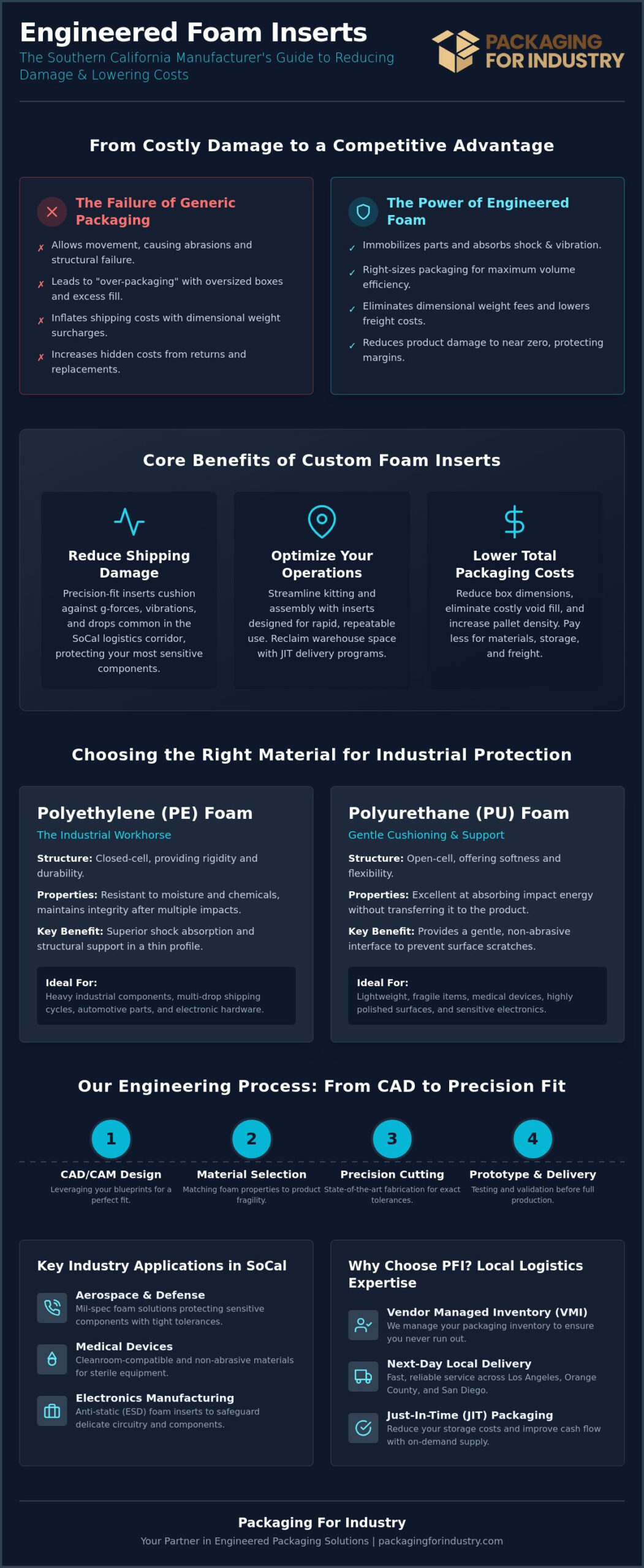
Off-the-shelf solutions like bubble wrap or packing peanuts often fail when protecting high-value industrial components. These generic materials allow for movement within the box, leading to surface abrasions or structural failure during transit. In sectors like aerospace and electronics, where tolerances are measured in microns, even minor shifts can result in a total loss. Integrating custom foam inserts Southern California manufacturers rely on ensures that every part is immobilized and cushioned against the specific g-forces encountered during transport. This precision-engineered approach moves beyond simple cushioning to provide a comprehensive structural support system for your most sensitive items.
Reducing Product Damage in the SoCal Supply Chain
The Southern California logistics corridor, particularly around the Port of Los Angeles and high-traffic LTL hubs, presents unique challenges. Frequent stops, heavy vibration, and rough handling are standard in regional freight. For Anaheim and Orange County manufacturers, the cost of “hidden” damage is often higher than the product itself. This includes the administrative burden of processing returns, the cost of expedited replacements, and the long-term erosion of your brand reputation. Precision-fit inserts mitigate these risks by providing a tailored interface between the product and the outer corrugated box, absorbing the energy of a drop before it reaches the sensitive internal components.
Lowering Total Packaging Costs Through Design
Many businesses mistakenly believe that more packaging always equals better protection. This “over-packaging” trap leads to oversized boxes and excessive use of polymeric foam, which significantly inflates shipping budgets. Major carriers like UPS and FedEx apply dimensional weight surcharges that penalize inefficient packaging volume. By transitioning from generic void fill to engineered custom foam packaging, you can reduce the outer dimensions of your shipping containers while actually increasing the level of protection.
Right-sizing your packaging through custom foam inserts Southern California services allows for higher pallet density and lower freight costs. It’s a strategic shift that prioritizes material density and geometry over sheer bulk. High-density foams can provide superior shock absorption in a thinner profile, allowing for smaller boxes that fit more units per pallet. This approach doesn’t just protect the product; it optimizes your entire logistical footprint through several key factors:
- Eliminate dimensional weight surcharges by reducing total box volume.
- Lower storage costs by using less warehouse space for bulky packaging materials.
- Reduce labor time with inserts that allow for rapid, repeatable kitting and assembly.
- Improve professional presentation for end-users in San Diego and Los Angeles.
By focusing on the intersection of engineering and economics, manufacturers can turn their packaging from a recurring expense into a tool for operational efficiency. When every millimeter of space is accounted for, your shipping reliability increases while your total landed costs decrease.
Common Foam Materials for Industrial Protection
Selecting the appropriate polymer is the first critical decision in the engineering process. The performance of custom foam inserts Southern California manufacturers deploy depends entirely on matching material properties to the product’s weight, fragility, and shipping environment. Scientific research into the materials, technology, and applications of polymeric foams highlights how different cell structures respond to impact energy. For industrial procurement, this means choosing between the durability of polyethylene or the delicate cushioning of polyurethane.
- Polyethylene (PE) Foam: Known as the industrial workhorse, PE is a closed-cell material that excels at protecting heavy parts. It is resistant to moisture and chemicals, making it ideal for multi-drop shipping cycles where the packaging must maintain its structural integrity after multiple impacts.
- Polyurethane (PU) Foam: This open-cell material is significantly softer than PE. It provides optimal cushioning for lightweight, fragile, or highly polished items that require a gentle interface to prevent surface scratches.
- Cross-Linked Polyethylene (XLPE): When aesthetics and chemical resistance are paramount, XLPE offers a fine-celled, smooth surface. It’s frequently used in medical and high-end electronics applications where a non-abrasive, premium presentation is required.
If you’re unsure which polymer density best suits your application, you can request a packaging quote to speak with a design specialist.
Choosing Between Open-Cell and Closed-Cell Foam
The technical distinction between open and closed-cell structures dictates how the foam handles loads and environmental factors. Closed-cell PE foam is buoyant and non-absorbent, which is vital for heavy-duty aerospace packaging where parts may be exposed to varying humidity or fluids. Conversely, the open-cell structure of PU foam allows air to flow through the material. This provides a “spring-like” recovery that is perfect for delicate medical device instrumentation that requires repetitive, soft deceleration during transit.
Specialized ESD Protection for Electronics
For Southern California’s semiconductor and electronics sectors, standard foam is often a liability due to triboelectric charging. Anti-static foam is treated with chemical additives to prevent the buildup of static electricity, typically identified by its pink color. For more sensitive components, black conductive foam provides a higher level of protection by actively dissipating charges. ESD foam serves as the primary defense for sensitive circuit boards in Los Angeles tech hubs. By utilizing these specialized materials, manufacturers eliminate the risk of latent component failure that generic packaging cannot address. We ensure your custom foam inserts Southern California deliveries arrive with their electronic integrity fully intact.
The PFI Engineering Process: From CAD to Prototype
Engineering a high-performance protective solution requires a methodical workflow that balances physical protection with logistical efficiency. For the custom foam inserts Southern California manufacturers rely on, this process starts with an initial consultation to map out the specific vulnerabilities of a component. We analyze the center of gravity, fragile protrusion points, and the expected shock levels of the shipping route. This data informs the CAD/CAM design phase, where we create a digital blueprint that accounts for every millimeter of the product’s surface. Unlike catalog suppliers who sell standalone foam sheets, we design the insert to integrate perfectly with your outer corrugated boxes or crates. This holistic engineering ensures there’s no shifting during transit, which is a common failure point in multi-component shipments.
Prototyping: Eliminating Risk for Manufacturers
The transition from a digital design to a physical part is the most critical stage for risk mitigation. We provide physical prototypes so your team can perform fit-tests with actual production parts before committing to a full manufacturing run. This step is essential for identifying minor adjustments that could lead to expensive tooling errors or assembly delays later. The Polyurethane Foam Association notes that flexible foam’s ability to absorb energy is highly dependent on its cell structure and compression sets, which we verify during this stage. Our commitment to accuracy in custom design packaging means you don’t have to guess if the protection will hold up under real-world LTL shipping conditions.
Precision Cutting Methods
Once the prototype is approved, we select the most efficient cutting method based on your volume and the complexity of the design. We utilize several advanced technologies to maintain tight tolerances:
- Die-Cutting: This method is ideal for high-volume orders with relatively simple geometries. It offers rapid production speeds and consistent repeatability across thousands of units.
- CNC Routing: For complex, multi-depth designs or low-volume specialized runs, CNC routing provides extreme precision without the need for custom tooling. This is often the preferred choice for aerospace and medical kitting.
- Shadow Foam Assemblies: We can create multi-layer, multi-color inserts that provide visual inventory management, helping your end-users quickly identify if a component is missing from a kit.
By leveraging these precise cutting methods, we ensure that every custom foam inserts Southern California delivery meets the rigorous standards of your industry. Whether you need a single specialized insert for a satellite component or ten thousand kits for a medical device rollout, our engineering process guarantees that the final product matches the approved blueprint exactly. This level of oversight reduces assembly labor and eliminates the variability that leads to shipping damage.
Applications for Custom Foam Inserts Across SoCal Industries
Southern California serves as a global hub for high-tech manufacturing, ranging from the satellite labs in El Segundo to the medical device corridors of Orange County. Each sector requires a distinct set of performance characteristics from their protective packaging. Utilizing custom foam inserts Southern California manufacturers can ensure compliance with industry-specific regulations while optimizing their logistical flow. Whether you are shipping sensitive semiconductors or heavy automotive drivetrain components, the geometry and material density of your foam must be tailored to the specific hazards of your supply chain.
- Electronics and Semiconductor: Orange County tech firms require ESD-safe trays that prevent latent component failure. These inserts are often designed for automated assembly lines, requiring extreme dimensional stability and consistent surface resistivity.
- Automotive and EV: Tier 1 suppliers in the Inland Empire utilize high-density polyethylene dunnage for heavy-duty protection. This foam is engineered for returnable shipping programs, providing years of service in closed-loop logistics for electric vehicle battery components and drivetrain parts.
Mil-Spec Foam and Aerospace Compliance
The aerospace sector operates under the most rigorous standards for durability and flame retardancy. Custom foam inserts for aerospace logistics must often meet specific military specifications (Mil-Spec) to ensure long-term storage stability and resistance to aviation fluids. In San Diego, where the aerospace and defense industries added approximately 11,000 jobs between 2022 and 2024, we provide solutions for high-value avionics that require multi-layer kitting. These engineered solutions provide the peace of mind necessary when transporting mission-critical flight components that cannot tolerate even the slightest vibration or impact.
Medical and Healthcare Packaging
Medical device manufacturers face unique challenges regarding sterilization and component organization. Inserts used in medical device packaging must often be cleanroom-compatible and designed for rapid identification during surgical procedures. We focus on “presentation-grade” quality, ensuring that the packaging reflects the high-end nature of the medical equipment it protects. This includes using non-dusting, cross-linked foams that provide a professional, clinical appearance while keeping delicate diagnostic tools securely immobilized. Organizing complex kits with custom-cut foam reduces the risk of missing parts and improves the end-user experience for healthcare professionals.
If your industry requires specialized compliance or high-precision protection, you can request a packaging quote to review your specific requirements with our engineering team.
Why Choose PFI for Your Custom Foam in Southern California?
Selecting a partner for custom foam inserts Southern California manufacturers can depend on requires more than just finding a material fabricator. It demands a logistical partner that understands the pressure of production deadlines and the high cost of regional floor space. Unlike large catalog suppliers who prioritize high-volume stock items, PFI focuses on the specific operational hurdles of local manufacturers. We don’t just provide foam; we provide integrated protection systems. By combining engineered foam with custom corrugated boxes, we ensure your components fit perfectly within their outer containers. This unified approach eliminates the common “fitment gap” that leads to internal movement and shipping damage.
Streamlining Operations with VMI and JIT
Warehouse space in Southern California is a premium asset that shouldn’t be wasted on bulky packaging inventory. Our Vendor Managed Inventory (VMI) program allows you to reclaim your floor space by storing your custom foam inserts off-site at our facility. We monitor your stock levels and trigger replenishments automatically, ensuring you never face a production shutdown due to a packaging stockout. This system supports just-in-time (JIT) delivery models, where we coordinate drop-offs to match your daily manufacturing schedule. By moving the storage burden to us, you improve your facility’s throughput and reduce the overhead associated with inventory management.
The PFI Advantage: Local Expertise and Reliability
Based in Anaheim, PFI provides local next-day delivery to facilities across Los Angeles, Orange County, and San Diego. This regional focus isn’t just about speed; it’s about accessibility. When you’re facing a design change for a new aerospace component or medical device, you have direct access to our engineering team for rapid prototyping and revisions. You won’t have to wait weeks for a sample from a national distributor’s catalog. We understand the local shipping environment, from the vibration profiles of regional LTL carriers to the humidity concerns at the Port of Long Beach.
We’ve built our reputation on being proactive problem-solvers who value long-term reliability over flashy innovation. Whether you need to reduce your current damage rates or optimize your freight volume to lower costs, our team is ready to engineer a solution that fits your bottom line. You can request a packaging quote today to see how our localized support and precision engineering can streamline your entire supply chain. Stop settling for generic protection and start utilizing a system designed for the specific needs of Southern California industry.
Secure Your Supply Chain with Precision Engineering
Transitioning from generic cushioning to engineered protection is a strategic move that addresses the core challenges of modern manufacturing. By aligning specific material densities with precise CAD designs, you eliminate the variability that leads to shipping damage and inflated freight costs. We’ve explored how localized expertise and managed inventory programs can reclaim your warehouse floor space while ensuring your production lines never face a stockout. High-performance custom foam inserts Southern California manufacturers rely on are more than just protective layers; they are vital components of a cost-effective logistical strategy.
Our team provides the technical oversight needed to meet the strict compliance standards of the aerospace and medical sectors. As specialists in aerospace and medical compliance, we ensure your components arrive within specification every time. With direct access to Free CAD Prototyping & Samples and the reliability of Local Next-Day Delivery in SoCal, you can implement design changes quickly and confidently. We invite you to Request a Custom Foam Packaging Quote to see how our engineering-first approach can lower your total packaging costs. Let’s work together to build a more resilient and efficient shipping operation for your business.
Frequently Asked Questions
What is the best foam material for protecting heavy industrial parts?
Polyethylene (PE) foam is the superior choice for protecting heavy industrial components and large machinery parts. This closed-cell material maintains its structural integrity under significant weight and provides excellent shock absorption for multi-drop shipping cycles. Its resistance to chemicals and moisture makes it a reliable option for long-term storage or international freight. Using PE ensures that your heaviest products don’t bottom out during rough transit.
Do you offer free prototyping for custom foam inserts?
We provide physical prototypes for all custom foam inserts Southern California projects to ensure a precision fit and total part immobilization. This step allows your team to perform real-world fit-testing with actual production parts before we initiate a full manufacturing run. Prototyping eliminates the risk of costly tooling errors and assembly delays. It’s a critical part of our engineering process that guarantees your satisfaction with the final product.
Can you provide ESD-safe foam for electronics in Southern California?
We offer a complete range of ESD-safe materials, including anti-static pink foam and black conductive foam for sensitive electronics. These specialized polymers are essential for protecting semiconductors and aerospace avionics from triboelectric charging during the shipping process. Our local inventory ensures rapid fulfillment for tech hubs across Los Angeles, Orange County, and San Diego. Utilizing ESD-safe foam prevents latent component failure and protects your brand’s reputation for quality.
What information do I need to provide for a custom foam quote?
To provide an accurate quote, we require your part dimensions, weight, and a description of its fragility. Providing a CAD file in .STEP or .DXF format allows our engineers to design the most efficient protection with tight tolerances. We also consider your shipping environment and annual volume to optimize the per-unit cost. This detailed information helps us recommend the right foam density to lower your total packaging expenses.
How does custom foam help reduce UPS and FedEx shipping surcharges?
Engineered foam allows for tighter tolerances, which reduces the required volume of the outer corrugated box or crate. By minimizing the box dimensions, you lower the dimensional weight used by carriers like UPS and FedEx to calculate shipping rates. This optimization directly reduces freight surcharges and lowers your total packaging costs. Precision inserts ensure you aren’t paying to ship empty space or unnecessary void fill.
Do you provide local next-day delivery in Orange County and Los Angeles?
PFI provides local next-day delivery for the custom foam inserts Southern California manufacturers depend on from our Anaheim headquarters. We also serve the San Diego region and offer nationwide shipping for larger industrial orders. Our local fleet ensures your production line stays on schedule with reliable, just-in-time delivery. This proximity allows us to be more responsive to your changing operational needs than national catalog suppliers.
What is your minimum order quantity for custom-cut foam?
Our production facility is optimized for industrial and commercial volumes rather than small consumer orders. We don’t have a rigid minimum order quantity; instead, we evaluate each project based on material usage and design complexity. Our services are most cost-effective for manufacturers and distributors who require bulk quantities or recurring production runs. We focus on providing scalable value that supports your long-term operational growth and reliability.
Can you integrate foam inserts into custom wood crates or corrugated boxes?
We specialize in integrated packaging solutions that combine foam with custom corrugated boxes or heavy-duty wood crates. Designing the insert and the outer container simultaneously ensures a seamless fit and superior protection for your high-value goods. This holistic approach prevents internal movement, which is the primary cause of product damage during LTL transit. It also streamlines your assembly process by providing a complete, ready-to-use packaging kit.