
An industrial paper tube is a precision-engineered structural component, not just a commodity mailing container. If you’ve dealt with production stops due to inconsistent supply or product damage from low-quality cores, you know that the wrong tube is a costly operational liability. High freight expenses often stem from improper sizing, while non-industrial tubes frequently fail under the weight of heavy-duty materials. It’s frustrating to manage a supply chain when your core components lack the durability your manufacturing process demands.
This guide will show you how to specify, source, and optimize custom paper tubes for industrial applications to eliminate these headaches and lower packaging costs. You’ll learn how to identify the correct wall thickness to reduce shipping damage and how to implement a stocking program for constant availability. We’ll examine the technical differences between standard mailing tubes and heavy duty industrial cores, providing the insights you need to compare packaging pricing and choose a reliable local packaging supplier for your warehouse or distribution center.
Key Takeaways
- Distinguish between standard mailing tubes and heavy-duty industrial cores to ensure your packaging meets the structural crush resistance required for manufacturing environments.
- Learn how to specify the exact wall thickness and inside diameter for custom paper tubes for industrial applications to eliminate product damage and reduce shipping waste.
- Identify how local Southern California sourcing and vendor-managed inventory (VMI) programs prevent costly production stops and significantly lower freight expenses.
- Explore integrated protection strategies by combining custom tubes with precision-engineered foam inserts for sensitive aerospace, medical, and electronic components.
- Streamline your procurement process by leveraging bulk packaging pricing and next-day delivery to maintain a reliable supply chain without overstocking your warehouse.
Beyond the Mailing Tube: Defining Industrial-Grade Paper Tubes
Retail mailing tubes often prioritize shelf appeal and simple unboxing experiences. For manufacturers and warehouses, these standard options usually fail under the structural demands of a busy supply chain. Custom paper tubes for industrial applications are engineered as structural tools rather than simple containers. They act as heavy-duty industrial cores for winding film, foil, and textiles, or as protective shields for precision-machined parts. The strength of these components begins with the papermaking process, where high-grade Kraft paper is selected for its density and ply-bonding capabilities.
The Anatomy of an Industrial Paper Tube
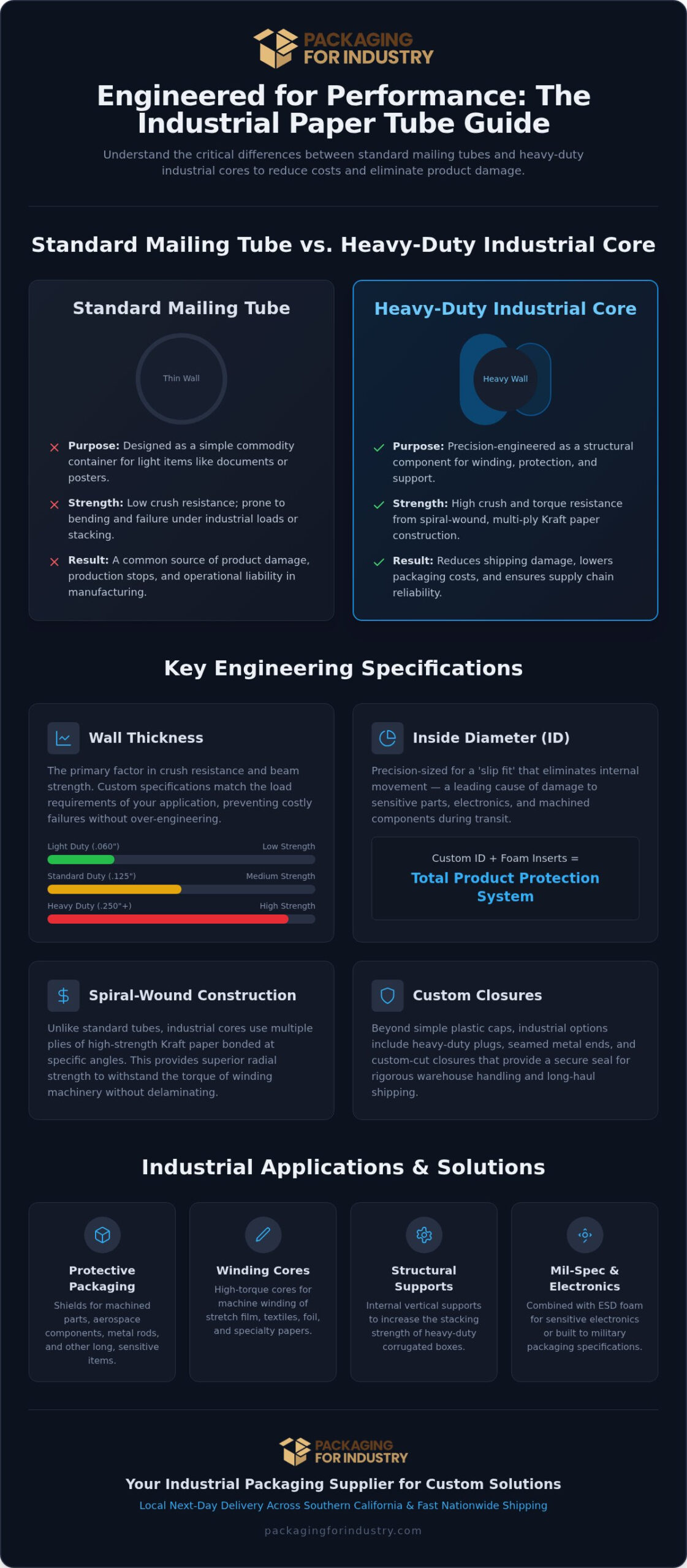
Spiral-wound construction defines the radial strength of an industrial tube. Unlike retail versions, these are built using high-strength Kraft paper plies bonded at specific angles. This engineering ensures the tube survives the torque of winding machinery without delaminating. Closure options like heavy-duty plastic plugs or metal crimps provide a secure seal that stands up to rigorous warehouse handling and long-haul transit. You aren’t just buying a cardboard cylinder; you’re investing in a specified level of beam strength.
Why Custom Sizing Matters for Protection
Custom sizing prevents internal movement, a leading cause of shipping damage. When the inside diameter (ID) matches the product perfectly, impact forces are neutralized. Additionally, optimizing tube length eliminates weak points in pallet stacks. This precision allows you to lower packaging costs by reducing material waste and preventing the buckling that occurs with oversized, stock tubes. In specialized sectors like aerospace, these tubes are often paired with custom foam inserts to create a comprehensive protection system.
By moving beyond standard catalog items, manufacturers can address specific pain points like inconsistent core sizes and high freight costs. Procuring custom paper tubes for industrial applications from a local partner ensures that the specs match your machinery and your budget. This proactive approach to procurement ensures that your production line remains steady and your finished goods arrive without a scratch. When you eliminate the “one size fits all” mentality, you gain better control over both your inventory and your bottom line.
Engineering Specs: Wall Thickness, ID, and Crush Resistance
Specifying custom paper tubes for industrial applications requires a balance between material volume and required structural performance. The two most critical dimensions are the Inside Diameter (ID) and the wall thickness. While the ID determines how your product fits inside the tube, the wall thickness dictates the tube’s ability to resist bending and crushing. Engineering these specs correctly ensures your components remain secure without paying for excess material weight. In many high-stakes environments, these tubes also serve as internal vertical supports within heavy duty corrugated boxes to increase pallet stacking strength.
Calculating Required Wall Thickness
Wall thickness is the distance between the ID and the Outside Diameter (OD). For lightweight parts or simple protective sleeves, a standard .060″ wall might suffice. However, heavy-duty manufacturing cores or aerospace components often require walls of .125″, .250″, or even greater to handle the torque of winding machinery or the weight of stacked metal rods. You must factor in the total weight of the product and the height of your warehouse stacks. Professional testing often references standards like ISO 12192:2011 to evaluate the compressive strength of the paperboard used in production. Choosing a thickness that is too light leads to structural failure, while over-engineering increases your freight costs.
Measuring for a Precision Fit
A “slip fit” is the ideal tolerance for industrial parts. It allows for easy insertion and removal on the assembly line while preventing the product from rattling during transit. When measuring your parts, don’t forget to account for secondary layers. If you use poly bags or protective foam packaging, the tube’s ID must be slightly larger than the total diameter of the wrapped part. Precision engineering prevents internal movement that causes surface abrasion or impact damage. Crush resistance is the maximum pressure a tube can withstand before structural failure.
Optimizing these specifications is one of the fastest ways to lower packaging costs across your supply chain. When the dimensions are exact, you reduce the need for excessive dunnage and filler materials. You can request a packaging quote to see how optimized wall thicknesses and custom IDs can improve your shipping reliability and warehouse efficiency. By focusing on these technical details, you ensure that your industrial cores and tubes perform consistently under real-world pressure.
Industrial Applications: From Aerospace to Manufacturing
Industrial sectors rely on high-performance packaging to protect precision assets and facilitate high-speed production. While retail tubes focus on aesthetics, custom paper tubes for industrial applications serve as critical infrastructure for aerospace, electronics, and heavy manufacturing. These tubes are engineered to withstand axial loads and radial pressure, ensuring that high-value components remain pristine from the assembly line to the final destination. Using the right tube isn’t just about protection; it’s about maintaining operational flow and supply reliability.
Aerospace and Defense Requirements
Aerospace manufacturers often deal with long, fragile components like fuselage sensors, hydraulic rods, and specialized landing gear parts. These items require more than a simple box. Meeting mil-spec packaging standards often involves integrating heavy-duty tubes with custom foam inserts for ultimate protection. This combination creates a shock-absorbent cradle that prevents surface contact and vibration damage during transit. For instance, long-form fuselage components benefit from the rigid beam strength of a custom tube, which prevents the bending or warping that can occur in less structural packaging. Choosing specialized aerospace packaging solutions ensures compliance with strict industry regulations and protects your bottom line from costly replacements.
Manufacturing and Supply Chain Utility
In high-volume manufacturing, the quality of an industrial core directly impacts production uptime. Heavy-duty cores are essential for winding machine-grade stretch film, metallic foils, and industrial textiles. If a core fails or collapses under the tension of a high-speed winder, the entire roll becomes scrap. Beyond winding, protective tubes safeguard precision-ground shafts and expensive tooling from environmental exposure and physical impact. Automotive suppliers also utilize these tubes to transport delicate drive shafts or exhaust components, ensuring that parts arrive ready for immediate installation. Reliable manufacturing packaging solutions help maintain a consistent supply chain and reduce the risk of equipment downtime caused by core failure.
Specialized Electronics and Engineering Storage
Electronics companies require packaging that mitigates the risk of electrostatic discharge. Anti-static and ESD-shielded tube options provide a safe environment for shipping sensitive cylindrical electronics and circuit board components. Similarly, engineering and architectural firms use archival-quality tubes to preserve blueprints and technical drawings. These tubes prevent creasing and chemical degradation, ensuring that critical documentation remains legible for decades. By choosing a packaging materials supplier that understands these niche requirements, businesses can lower packaging costs while significantly reducing product damage.
Procurement Strategy: Managing Inventory and Lead Times
Procuring custom paper tubes for industrial applications is often treated as a minor line item until a stockout halts a million-dollar production line. If your warehouse runs out of winding cores, your machinery stops. If you don’t have protective tubes for high-value aerospace components, your shipping department freezes. These delays represent significant hidden costs that far outweigh the unit price of the tube itself. By transitioning from transactional buying to a managed supply program, you ensure that your operations remain fluid and predictable.
Local Southern California sourcing is a strategic advantage for businesses in Orange County and Los Angeles. Since paper tubes are essentially “shipping air,” freight costs from out-of-state suppliers can be astronomical. Working with an Anaheim packaging supplier allows for local next-day delivery, which slashes lead times and reduces the environmental impact of your supply chain. This proximity allows for a more agile response to sudden shifts in your production schedule.
Implementing a VMI Program for Tubes and Cores
A Vendor Managed Inventory (VMI) program removes the burden of tracking packaging levels from your operations team. We begin with a usage analysis to determine your min/max stocking levels based on your historical production data. This approach allows you to free up valuable warehouse floor space because you no longer need to store months of safety stock on-site. Instead, we manage scheduled replenishment to ensure you have exactly what you need for today’s production run. It’s a proactive approach that eliminates the stress of last-minute ordering and prevents production downtime.
Custom vs. Stock: Finding the ROI
Many purchasing managers opt for “off-the-shelf” tubes from catalog giants to save time, but these stock options often cost more in the long run. If a tube is slightly too large, your product will shift during transit, leading to surface abrasion and shipping damage. Custom-engineered tubes provide a precision fit that eliminates the need for excessive dunnage. Additionally, you can achieve better shipping efficiency by combining your tube orders with corrugated boxes or other supplies like stretch film. Bulk pricing for custom production runs often rivals stock pricing when you factor in the total cost of ownership, including reduced damage claims and lower freight expenses.
Sourcing Custom Paper Tubes in Southern California
Shipping bulky, hollow items across state lines is a logistical inefficiency. When you order custom paper tubes for industrial applications from out-of-state distributors, a significant portion of your invoice covers the cost of transporting air. By partnering with a local Anaheim packaging supplier, you eliminate these inflated freight charges and gain a level of responsiveness that national catalogs cannot match. Local sourcing isn’t just about price; it’s about the agility to modify specs on the fly and receive next-day delivery when production demands spike.
Local Support for Southern California Hubs
Southern California is home to some of the most demanding industrial clusters in the world. We provide specialized support for the aerospace hubs in Irvine, Huntington Beach, and Carson, where precision and material certification are non-negotiable. Manufacturers in the industrial parks of Santa Ana and Torrance rely on our ability to deliver heavy-duty cores and protective tubes that integrate perfectly with their existing machinery. By utilizing a localized distribution network, you also reduce the carbon footprint of your supply chain, fulfilling corporate sustainability goals while improving your bottom line. Our fleet provides reliable packaging delivery in Santa Fe Springs, Los Angeles, and the Inland Empire, ensuring your warehouse never waits for critical supplies.
Why Choose Packaging For Industry (PFI)?
PFI functions as more than a mere distributor; we act as an extension of your engineering team. We offer free prototyping for custom designs, allowing you to test the fit and crush resistance of a tube before committing to a bulk production run. Our local CAD/CAM support ensures that every dimension is accurate to the thousandth of an inch, which is vital for high-value components. By consolidating your tube and core requirements with other essentials like stretch film and edge protectors, you streamline your procurement process and maximize shipping efficiency.
Reliability is built through our just-in-time delivery model. This system ensures that your warehouse floor remains clear for production while your packaging arrives exactly when it is needed. You don’t have to settle for the limited sizes and high markups of big-box catalogs. We encourage manufacturers to request a custom packaging quote to compare our engineered solutions against generic pricing. Whether you need a custom packaging supplier for a one-time project or a long-term VMI partner, PFI delivers the stability your operations require. Our focus remains on helping you lower packaging costs and reduce shipping damage through superior engineering and local logistical expertise.
Optimize Your Industrial Packaging Strategy
Effective procurement for custom paper tubes for industrial applications requires a shift from viewing packaging as a commodity to treating it as a precision engineering component. By specifying exact wall thicknesses and inside diameters, you eliminate the structural failures and internal movement that lead to shipping damage. Transitioning to a local Southern California supplier further enhances this strategy by providing the agility of next-day delivery and the fiscal benefit of significantly reduced freight costs.
PFI supports your operations with free custom prototyping and specialized expertise in aerospace and manufacturing standards. Implementing a vendor-managed inventory program ensures your production lines never stall due to core stockouts. This proactive approach to industrial packaging lowers your total cost of ownership while maintaining the highest reliability across your supply chain. Our team understands the intersection of engineering and economics, so you don’t have to settle for one-size-fits-all catalog options that overlook your specific technical needs.
We look forward to helping you streamline your fulfillment and protect your high-value assets with engineered solutions that fit your specific operational requirements.
Frequently Asked Questions
What is the maximum wall thickness available for custom paper tubes?
PFI manufactures paper tubes with wall thicknesses ranging from standard .060″ to heavy-duty industrial specs like .125″, .250″, and beyond. The specific thickness depends on your crush resistance requirements and the weight of the materials being wound or shipped. We engineer these dimensions to provide structural integrity for aerospace and manufacturing applications without adding unnecessary freight weight to your shipments.
How do I determine the right inside diameter (ID) for my product?
To determine the correct inside diameter, measure the widest point of your product and add a tolerance for a “slip fit.” If you’re using protective foam packaging or poly bags, you must measure the product while it is fully wrapped. A precision-engineered ID prevents internal movement during transit, which significantly reduces the risk of surface abrasion and impact damage for high-value industrial components.
Can custom paper tubes be used for heavy-duty aerospace components?
Yes, custom paper tubes for industrial applications are frequently used in the aerospace sector to protect sensors, hydraulic rods, and fuselage components. These tubes meet rigorous structural standards and are often integrated with custom foam inserts to create a mil-spec compliant packaging solution. Their high beam strength ensures that long, fragile parts remain straight and protected from the vibrations and shocks common in transport.
What are the benefits of using a local Southern California packaging supplier?
Partnering with a local Southern California packaging supplier like PFI eliminates the high cost of shipping bulky tubes from out-of-state. We provide next-day delivery across Orange County, Los Angeles, and the Inland Empire, ensuring your production line never stalls. Local access also means you benefit from on-site CAD/CAM support and free prototyping, allowing for faster design iterations and more accurate fitment for your parts.
Do you offer VMI or stocking programs for industrial paper tubes?
PFI offers comprehensive Vendor Managed Inventory (VMI) programs specifically for industrial paper tubes and cores. We conduct regular on-site reviews of your inventory levels and replenish stock based on your actual production usage. This program frees up valuable warehouse floor space and eliminates the need for emergency rush orders, providing your operations team with a dependable and predictable supply of critical packaging materials.
Are heavy-duty paper tubes more cost-effective than plastic alternatives?
Heavy-duty paper tubes are often more cost-effective than plastic alternatives for industrial winding and protection. They provide comparable crush resistance and radial strength at a lower unit price and reduced weight, which helps lower your overall freight expenses. Additionally, paper tubes are fully recyclable, helping your business comply with sustainability mandates and reduce the environmental impact associated with single-use plastic industrial components.
What end-closure options are best for secure industrial shipping?
The best end-closure depends on the weight of your product and the level of security required. Heavy-duty plastic plugs are the standard for most industrial applications because they provide a secure friction fit that resists popping out during handling. For high-security or export requirements, metal crimped ends or stapled caps offer additional structural reinforcement, ensuring that heavy components remain contained within the tube throughout the distribution cycle.
How can I lower my packaging costs for bulk tube orders?
You can lower packaging costs by optimizing the tube dimensions to match your product precisely, which eliminates the need for excess dunnage. Consolidating your tube orders with other supplies like corrugated boxes and stretch film also improves shipping efficiency and qualifies your business for bulk pricing tiers. Implementing a VMI program further reduces costs by preventing expensive stockouts and minimizing the capital tied up in excess inventory.