
A medical device package can fit precisely and still be unsuitable for its intended environment. Custom packaging for medical device manufacturing means matching the materials and design to the device, sterilization method, and packaging process. Material selection may need to account for ethylene oxide, gamma irradiation, or electron beam sterilization, so one material will not suit every application.
Protection, visibility, and production fit all matter. This guide explains how to assess materials, what influences minimum order quantities, and how features such as foam inserts and seals can secure devices. It also covers cleanroom workflows and thermoformed options, including transparent PETG trays that keep a device visible and in place. Use these factors to narrow the design to packaging that supports both the device and your manufacturing process.
Key Takeaways
- Match packaging materials to the device, protection needs, and sterilization method rather than relying on one material for every application.
- Assess minimum order quantities in light of design complexity, material choices, and production requirements.
- Explore custom inserts, seals, printing, and thermoformed trays to improve fit, protection, and device visibility.
- Account for cleanroom and white-room requirements, including ISO Class 8 assembly needs, when planning packaging operations.
- Learn how packaging design, foam solutions, stretch film, and inventory management can support more reliable supply and help reduce damage.
Products
Medical device packaging starts with the device’s dimensions, protection needs, and packaging environment. A workable design connects material choice and structural fit with the steps involved in production.
Choose a custom packaging supplier by assessing its ability to develop a design around your device, materials, and shipping conditions. Provide product dimensions, handling needs, sterile-barrier requirements, and packaging-line constraints so the design can reflect your specifications. These details connect the package to your manufacturing process.
There is no single material or design that suits every device. Before choosing packaging, specify the device’s intended use, whether the package must maintain a sterile barrier, and what labeling it requires.
ISO 11607-1 focuses on medical device packaging materials and sterile barrier design, according to the International Organization for Standardization. Use it as a reference point when defining materials and package structure. Sterile packaging materials should also be non-toxic.
Material Compatibility with Sterilization
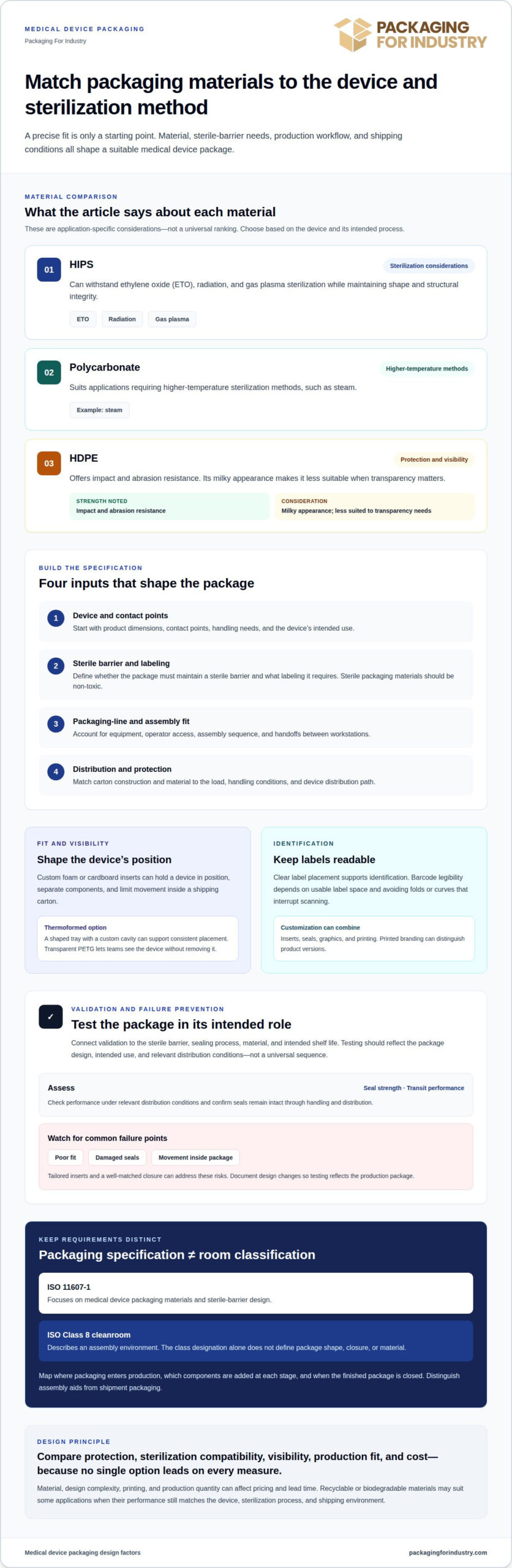
Material selection must account for the sterilization method, including ethylene oxide, gamma irradiation, or electron beam. HIPS can withstand ETO, radiation, and gas plasma sterilization while maintaining its shape and structural integrity. Polycarbonate suits applications requiring higher-temperature methods such as steam. HDPE offers impact and abrasion resistance, but its milky appearance makes it less suitable when transparency matters.
Packaging tests depend on the design and its intended use. A test plan can assess seal strength and transit performance under relevant distribution conditions, rather than treating one test sequence as universal. Testing should reflect the package’s role and the device’s distribution path.
Sterility, Shelf Life, and Failure Prevention
Validation should connect the sterile barrier, sealing process, material, and intended shelf life. Assess whether seals remain intact and the packaging protects the device through handling and distribution. Common failure points include poor fit, damaged seals, and movement inside the package. Tailored inserts and a well-matched closure can address these risks. Document design changes so testing reflects the production package.
Structural design begins with product dimensions and contact points. A custom insert can hold a device in position, separate components, and limit movement inside a shipping carton. Foam or cardboard inserts suit different packaging needs. Heavy-duty cartons can protect sensitive or high-value equipment during transport. Manufacturers can also use packaging solutions for manufacturing operations to align the package with production and shipping workflows.
Thermoformed packaging offers a precise option for devices that need a shaped tray. Transparent PETG lets teams see the packaged device without removing it. A custom cavity can match the device’s outline and support consistent placement. Define fit and visibility requirements before selecting tray material or tooling.
Customization can combine foam inserts, seals, graphics, and printing. Printed branding can distinguish product versions, while clear label placement supports identification. Barcode legibility depends on enough usable label space and avoiding folds or curves that interrupt scanning. Match paper thickness and carton construction to the load and handling conditions, not just the exterior dimensions.
Recyclable or biodegradable materials may suit some packaging applications, but their performance must still match the device, sterilization process, and shipping environment. Compare protection, sterilization compatibility, and cost by considering material, design complexity, printing, and production quantity. These factors affect pricing and lead time, and no single option leads on every measure.
Industries Served
Medical device production can involve component handling, assembly, packaging, inspection, storage, and shipment. Each stage places different demands on the packaging workflow. A cleanroom package may support assembly, while an outer carton must suit later handling and transport. In Orange County, Los Angeles, and San Diego, manufacturers can map these stages to see where packaging enters the process and how it moves through production.
ISO 11607-1 focuses on packaging materials and sterile barrier design, according to the International Organization for Standardization. This is distinct from an ISO Class 8 cleanroom classification, which describes an assembly environment. Keep package specifications separate from room requirements. For custom packaging for medical device manufacturing, document which requirements address the packaging and which govern the production space.
A cleanroom or white-room workflow affects how packaging components move through production. Map where the device is assembled, where packaging enters, and which steps happen before closure. For example, a tray used during assembly may differ in size from the outer carton used later. This process map helps show whether packaging interferes with component placement, operator access, or handoffs between workstations.
For ISO Class 8 cleanroom assembly, define the packaging task around the room and production process. Identify the component being packed, the assembly sequence, and how operators handle each package. The class designation alone does not describe the package’s shape, closure, or material. Those details depend on the product and workflow. A clear specification distinguishes packaging used during assembly from packaging prepared for shipment.
White-room operations may require clear separation between packaging stages. Specify which components arrive at assembly, which are added during production, and when the finished package is closed. A kit with a component tray and a separate outer package shows how packaging can serve distinct stages. Defining each component’s place helps distinguish an assembly aid from the shipment package.
Packaging design should account for device dimensions and the equipment used at assembly. An oversized insert can take up needed work-surface space, while a tight cavity can make placement or removal difficult. Drawings or representative components help align design decisions with contact points, access needs, and handling steps. These workflow details connect the package to how manufacturing teams build and move the product.
For devices with multiple components, arrange parts in assembly order. A compartmented tray can separate pieces, and labels can identify their intended positions. Document each compartment and component in the packaging specification rather than relying on appearance alone. Also map movement beyond the cleanroom boundary, including inspection, storage, and shipment. Packaging for one stage may not suit every stage equally well.
Medical manufacturers across Orange County, Los Angeles, and San Diego can use a workflow-based design process to connect package dimensions, component arrangement, assembly sequence, and handoffs. That information gives production and purchasing teams a shared reference when packaging needs change. To discuss requirements for your manufacturing workflow, request a packaging quote.
Benefits
Packaging affects purchasing, production, and shipping, not just the moment a product leaves the facility. A plan built around recurring operational needs can help teams coordinate specifications, ordering, and replenishment. This can reduce avoidable purchasing work and make packaging decisions easier to manage across departments. For manufacturers handling multiple product lines, consistent processes also clarify which materials belong to each operation.
PFI’s foam packaging can support product protection and component organization. A planned foam configuration can help keep parts in assigned positions and make packing steps more repeatable. This is useful for production teams that need to place components in a consistent order. Defined packaging instructions can also make handoffs between packing and warehouse staff clearer.
Packaging kitting and assembly can bring related items together for a specific task. Rather than collecting separate materials at each packing station, teams can work from a prepared set aligned with their process. This can simplify coordination, especially when packaging involves several components or steps. The kit’s contents and arrangement should reflect the operation, so staff can identify what belongs together and where each item is used.
Recurring packaging purchases can create avoidable administrative work when teams repeatedly source the same materials. Vendor Managed Inventory for Packaging helps businesses organize replenishment around the supplies they use. Just-In-Time inventory management can coordinate packaging flow with planned operational demand. These programs support purchasing teams seeking a more structured way to maintain packaging availability.
Inventory planning also affects warehouse capacity and purchasing decisions. Excess packaging can take up space needed for production or finished goods, while unplanned shortages can disrupt packing tasks. A managed supply approach can align replenishment with usage and storage conditions. This gives operations teams a clearer basis for balancing availability with warehouse limits, rather than treating every packaging item as an isolated purchase.
Packaging reviews can reveal where current materials or processes create unnecessary handling or expense. Teams can examine how many separate items a packing station needs, whether packaging changes between product versions, and how often purchasing repeats the same order process. These observations offer a practical starting point for improving packaging efficiency. Any cost effect depends on the design, usage patterns, and purchasing requirements.
Reliable packaging supply can support steadier production and shipping schedules. With a defined process for packaging specifications and replenishment, teams can coordinate purchasing and operations around shared information. This can reduce last-minute substitutions and help maintain consistency between packing runs. The operational benefit is clarity: staff know which materials to use, and purchasing teams have a more organized way to manage recurring needs.
For medical manufacturers, match the improvement to the actual constraint. A product-protection concern calls for a packaging review; repeated purchasing tasks may point to inventory management; a complicated packing sequence may benefit from kitting. PFI’s design, foam, VMI, JIT, and kitting services address these different operational needs. Start with the issue your team wants to resolve.
Why Choose PFI
Packaging For Industry (PFI) helps medical manufacturers address packaging design, product protection, and supply coordination with services suited to their operations. Turn to PFI when a device needs packaging designed around its handling process, foam protection needs review, or replenishment creates purchasing or warehouse pressure.
Custom Packaging Design Services connect packaging decisions with production and distribution requirements. PFI can develop a design around the product, its packaging components, and how teams handle it. Useful project details include product dimensions, contact points, assembly steps, and shipping conditions. This gives the design process a practical basis instead of relying on a generic package configuration.
Design input also helps purchasing and operations teams assess how packaging choices affect workflow. Changing an insert, for example, can alter how a device is placed or removed. A packaging design discussion can consider these handling steps alongside protection needs. PFI’s custom packaging design services help manufacturers align packaging with their specific operation.
Foam Packaging can help protect and organize components inside an outer package. The right layout depends on the parts, their arrangement, and how staff handle the package. PFI provides foam packaging for product protection, including custom configurations suited to defined packaging needs. It is a practical option when components need separation or the package requires a tailored fit.
Stretch Film addresses another stage: securing palletized loads for storage or shipment. A consistent wrapping approach can help keep cartons together during routine warehouse handling. Manufacturers can consider stretch film as part of the outer packaging system rather than treating load containment as a separate purchasing decision. PFI offers stretch film as part of its packaging supply capabilities.
Packaging availability matters as much as design when production depends on a steady supply. Vendor Managed Inventory for Packaging helps coordinate replenishment around the materials a business uses. It suits teams seeking a more organized way to manage recurring packaging needs and reduce repeated purchasing tasks. The inventory program should reflect actual usage, storage capacity, and production requirements.
These services address different problems, so the best starting point depends on the pressure point. A fit or handling issue points to design work. A component-protection need may call for foam. Palletized shipments may require stretch film. Repeated replenishment demands may make VMI relevant. Keeping the scope focused helps teams assess packaging needs without adding unrelated changes.
For medical manufacturers, PFI supports packaging design and supply decisions, while the manufacturer remains responsible for product-specific requirements and packaging validation. Share the packaging challenge, relevant product details, and production or shipping context. This helps define a practical next step and keeps the discussion centered on your operation.
Contact Packaging For Industry (PFI) to discuss packaging needs for your medical manufacturing operation.
Put Your Packaging Plan Into Motion
The next step is to turn your packaging requirements into a clear project scope. Define the device, handling needs, packaging workflow, and supply priorities so the design discussion stays focused on your operation. A well-scoped request connects custom packaging for medical device manufacturing with practical decisions about protection, production, and replenishment.
Packaging For Industry (PFI) offers Foam Packaging, Stretch Film, and Vendor Managed Inventory (VMI) for Packaging. These offerings support distinct needs, from protecting products to securing loads and coordinating packaging supply. Share the challenge you want to address, whether it involves product handling, shipping, or recurring inventory needs.
A focused conversation can identify which packaging requirements deserve attention first and what information will help move the project forward. Start with the details that matter to your team, then shape a solution around your manufacturing process.
With a clear scope, your team can make its next packaging decision with confidence.
Frequently Asked Questions
Are these boxes suitable for sterile products?
Boxes can form part of a sterile packaging system when their material, design, and sealing process suit the device and sterilization method. A shipping carton alone does not establish or maintain sterility. Define whether the box serves as an outer protective layer or part of the sterile barrier, then ensure the design and validation address that role. This distinction helps separate transport protection from sterile product packaging.
Can I print high-resolution barcodes on these boxes?
Custom printed corrugated boxes support up to four colors, but barcode performance depends on the final artwork, print area, and placement. Keep the code clear of seams, folds, and areas likely to be damaged during handling. Provide barcode artwork and placement specifications during design so the printed layout can be reviewed before production. For labels, plan a flat, accessible scanning surface.
Can you provide internal inserts for delicate instruments?
Yes. Foam inserts can be designed to hold delicate instruments and organize related components inside a box. A useful design accounts for the instrument’s shape, the points needing support, and how staff will place or remove it. Match foam material and insert layout to the handling task. For a set of instruments, separate cavities can keep each item in its assigned position.
How do these boxes improve logistics?
Boxes designed around a product can use space more effectively than an unsuitable stock size, helping teams plan storage and shipment. A consistent box configuration also helps warehouse staff identify packaging needs and prepare repeat orders. For palletized shipments, pairing cartons with stretch film can contain the load during handling. The practical gains depend on dimensions, order patterns, and shipping methods.
What types of custom packaging are used for medical devices?
Common configurations include corrugated boxes, foam inserts, foam-lined boxes, partitions, pads, and protective cushioning. A device shipped with multiple components may need separate compartments, while a larger or fragile item may call for a custom box and foam supports. Stretch film can secure palletized cartons for shipment. The package should reflect the product’s handling path through assembly, storage, and distribution.
What materials are suitable for sterile medical device packaging?
Suitable materials depend on the sterilization method and package function. HIPS is used for certain sterilization methods, polycarbonate can suit higher-temperature applications such as steam, and transparent PETG can support visibility in formed trays. Materials used to maintain sterility must be non-toxic. ISO 11607-1 focuses on medical device packaging materials and sterile barrier design, according to the International Organization for Standardization.
What are the steps to design and manufacture custom medical device packaging?
Start by defining the device, packaging function, shipping conditions, and production workflow. Document product dimensions and component arrangement, then develop a design and select suitable materials. CAD/CAM support can help develop box, crate, or foam concepts; prototypes and samples allow a fit review before production. Once the design is settled, coordinate manufacturing with the required supply plan.
How much does custom medical device packaging cost, and what affects the price?
The project scope determines the price, which is provided after a quote request. Key factors include design complexity, material selection, package dimensions, production volume, and whether the project requires custom foam or other engineered components. A straightforward box and a multi-part protective assembly have different design and production needs. Share the packaging scope and expected order quantities to receive project-specific pricing.