
The convenience of a massive stock catalog is often the most expensive mistake an industrial manufacturer can make. While big-box suppliers offer speed for office supplies, they frequently fail when it comes to protecting high-value aerospace components or sensitive medical devices. Many procurement managers are realizing that stock boxes lead to excessive dimensional weight surcharges and unacceptable damage rates, prompting a search for custom packaging companies better than Uline. Relying on a one-size-fits-all approach doesn’t just waste material; it erodes your bottom line through hidden freight costs and the logistical headache of processing returns.
You likely understand that your product deserves more than a “close enough” fit, especially when shipping fragile or heavy-duty equipment. This article will demonstrate how moving toward custom-engineered solutions can drastically reduce transit damage while optimizing your warehouse footprint through Vendor Managed Inventory (VMI). We’ll examine why a strategic partnership beats a catalog transaction, covering everything from CAD-designed protective foam to the specific cost benefits of localized, industrial-grade supply chains.
Key Takeaways
- Learn how to transition from stock catalogs to custom-engineered solutions that significantly reduce shipping damage and hidden freight surcharges.
- Discover why custom packaging companies better than Uline provide superior protection for high-value products through technical CAD design and free prototyping.
- Understand the Total Cost of Ownership (TCO) by evaluating how custom-fit boxes and inserts reduce labor time and eliminate the need for expensive void fill.
- Explore the operational advantages of Vendor Managed Inventory (VMI) to optimize warehouse space and ensure consistent supply for your production line.
- Identify the critical technical capabilities required for specialized sectors, including aerospace, medical, and military-spec packaging compliance.
The Uline Trap: When Stock Catalogs Fail Industrial Manufacturers
The convenience of a 40,000-item catalog is a powerful marketing tool, but for industrial manufacturers, it’s often a financial drain. Big-box catalog suppliers excel at selling commodities like tape and office supplies; however, they struggle to provide the specialized protection required for complex machinery or high-precision parts. When you rely on stock sizes, you’re forced to adapt your product to the packaging, rather than the other way around. This fundamental mismatch is why many operations managers are searching for custom packaging companies better than Uline to stabilize their shipping budgets.
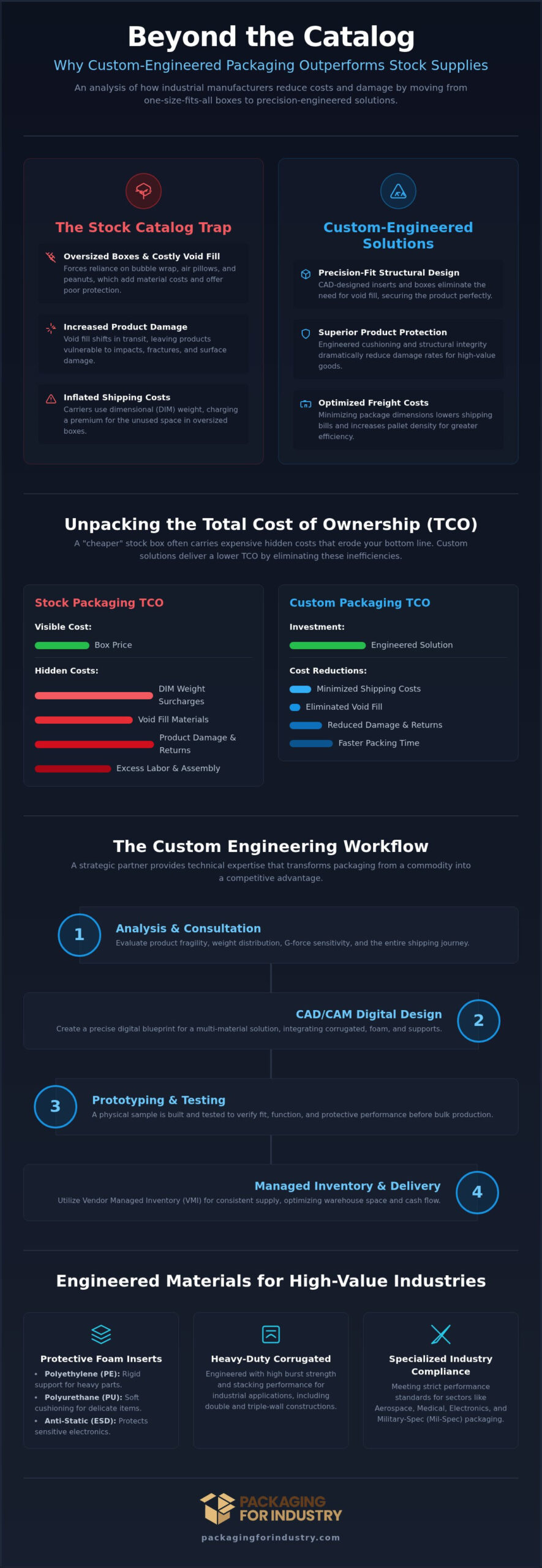
A stock box rarely fits an industrial product perfectly. This creates a reliance on void fill materials like bubble wrap, air pillows, or packing peanuts. While these items seem inexpensive individually, their cumulative cost over thousands of shipments is substantial. More importantly, void fill is a poor substitute for structural engineering. It shifts during transit, leaving your product vulnerable to impacts that lead to unacceptable damage rates. A strategic partner doesn’t just sell you a container; they analyze your product’s fragility and design a solution that eliminates the need for excess filler.
Dimensional Weight and Shipping Surcharges
Oversized stock boxes are a primary driver of ballooning freight costs. Carriers like UPS and FedEx use dimensional (DIM) weight formulas to charge based on the space a package occupies rather than its actual weight. If you ship a lightweight part in a standard catalog box that’s two inches too large in every direction, you’re paying for “air” at a premium rate. Custom-fit packaging solves this by optimizing the exterior dimensions to the smallest possible footprint. This precision reduces freight costs by optimizing pallet density, allowing you to fit more units into every shipment.
The Limits of Catalog Protection
Standard corrugated material found in most catalogs often lacks the burst strength or stacking performance required for heavy-duty industrial applications. For sectors like aerospace or medical manufacturing, a generic box is a liability. These industries require technical support to ensure that custom corrugated boxes are paired with the right internal cushioning, such as anti-static foam or custom-cut inserts. Catalog suppliers offer transactions, not technical consultations. They can’t provide the CAD/CAM design support needed to prevent a $10,000 component from arriving with a hairline fracture. Transitioning to a specialized supplier ensures that your packaging is an engineered asset, not just a recurring expense.
Custom Engineering vs. Stock Supplies: The Value of Design
Industrial packaging engineering is the difference between a box that simply holds a product and a system that protects it. Catalog suppliers provide a list of dimensions; however, custom packaging companies better than Uline utilize CAD/CAM design to build protective environments around specific parts. This process starts with a digital blueprint that accounts for G-force sensitivity, weight distribution, and surface finish. It’s a proactive approach to logistics that stock supplies simply can’t match.
Prototyping plays a critical role in this workflow. Before you commit to a bulk order, a physical sample is created to verify fit and function. This step prevents the costly shipping failures that occur when stock supplies fail to secure a heavy or fragile item. By testing the design early, you eliminate the risk of product damage and the subsequent costs of replacement and expedited freight. It’s about getting the design right the first time to ensure your supply chain remains reliable.
A strategic partner also excels at material integration. An industrial shipment might require a heavy-duty corrugated outer shell, custom-cut foam for internal bracing, and a reinforced wood pallet for base stability. Specialized sectors like aerospace and defense rely on these complex assemblies to meet strict performance standards. These multi-material solutions are engineered to work as a single unit, providing a level of security that a generic cardboard box cannot offer.
Precision Foam and Protective Inserts
Choosing the right material is vital for impact resistance. Polyethylene (PE) foam provides rigid, durable support for heavy items, while Polyurethane (PU) foam offers softer cushioning for lighter, delicate products. Using custom foam inserts ensures your product doesn’t move during transit, which is far more effective than generic bubble wrap or loose fill. For the electronics and semiconductor sectors, anti-static (ESD) foam is mandatory to prevent latent damage from electrostatic discharge during shipping.
Heavy-Duty and Mil-Spec Requirements
Standard double-wall boxes often fail under the weight of industrial machinery or dense metal parts. In these cases, moving to triple-wall corrugated or custom wood crates becomes a functional necessity. Military-spec packaging adds another layer of complexity, requiring specific materials and labeling that catalog suppliers aren’t equipped to handle. If your current supplier can’t provide a custom packaging quote for mil-spec or heavy-duty needs, you’re likely outgrowing their catalog-based capabilities.
Total Cost Comparison: Uline vs. Industrial Packaging Partners
Evaluating a supplier solely on the sticker price of a box is a tactical error. Industrial procurement requires an analysis of the Total Cost of Ownership (TCO), which accounts for labor, storage, and the high cost of transit failures. While big-box catalogs compete on unit price, custom packaging companies better than Uline focus on reducing the total expenditure of your supply chain. When you factor in the time spent assembling complex stock packaging or the square footage wasted on bulk inventory, the “cheap” catalog option often becomes the more expensive choice.
Labor efficiency is a significant component of this cost. In a high-volume manufacturing environment, every second spent on the pack-out line adds up. If your team has to manually wrap components in bubble film and tape oversized boxes, your throughput drops. Custom-engineered packaging, such as pre-configured kits or drop-in foam inserts, streamlines the process. This shift allows your workers to move faster with fewer errors, effectively lowering your labor cost per unit shipped. It’s about designing out the waste that stock supplies force into your workflow.
We must also consider the financial fallout of shipping damage. Beyond the direct cost of the lost product, you face the administrative burden of filing claims, the freight cost of shipping replacements, and the long-term damage to your brand’s reputation. Industrial partners design for the “worst-case” scenario in the shipping environment. By investing in a more robust, custom-tailored solution, you eliminate the recurring expenses associated with stock packaging failures that generic catalogs simply can’t prevent.
Inventory Management: VMI vs. Bulk Ordering
Tying up capital in massive catalog orders is an inefficient use of resources. Many companies over-order stock sizes to reach a price break, only to have that inventory sit in a warehouse for months. A partnership focused on Vendor Managed Inventory (VMI) solves this by keeping only what you need on hand. This approach ensures your production line never stops due to a stockout while freeing up valuable warehouse space for revenue-generating activities. It replaces the “just in case” mindset with a reliable, data-driven replenishment system.
Freight and Logistics Optimization
Freight costs often exceed the value of the packaging itself. National suppliers ship from distant hubs, passing those high freight rates on to you. Working with Southern California packaging suppliers provides a logistical edge through localized delivery networks and optimized palletization. Utilizing local next-day delivery services typically costs significantly less than standard LTL freight while providing more reliable arrival windows. By maximizing pallet density through custom sizing, you reduce the total number of shipments required, further lowering your freight spend and improving overall supply chain reliability.
How to Evaluate Your Next Packaging Company
Selecting a new industrial supplier requires more than checking stock levels. You need to verify that their technical infrastructure can support your production volume and quality standards. Most custom packaging companies better than Uline distinguish themselves by offering in-house CAD design and free prototyping. These tools are non-negotiable when you’re developing aerospace packaging or protective systems for sensitive medical devices. A supplier that can’t provide a physical sample of a custom insert before you order is a liability to your supply chain.
Efficiency also depends on the breadth of their material range and service model. A strategic partner should simplify your procurement by providing corrugated boxes, foam, and stretch film in a single delivery. This consolidated approach reduces administrative overhead and ensures all components of your packaging system are compatible. Additionally, investigate their service capabilities; look for providers that offer just-in-time (JIT) delivery and kitting services to keep your assembly line moving without excess clutter.
Location remains a critical factor for Southern California manufacturers. Proximity to your facility in Orange County or Los Angeles means shorter lead times and the ability to receive on-site support when design challenges arise. A local supplier can respond to urgent production changes in hours, whereas a national catalog supplier is limited by standard shipping windows and high-volume freight queues.
Questions to Ask a Potential Supplier
Before signing a contract, push for specific answers regarding their problem-solving process. Ask how they intend to reduce your current shipping damage rates through structural changes rather than just adding more bubble wrap. Request a cost-reduction analysis for your highest-volume items to see where they can optimize material usage. Finally, inquire about their method for designing corner and edge protection. These small components are often the difference between a successful delivery and a total loss.
The Importance of Prototyping and Testing
A custom design is only a theory until it’s physically tested. You should never roll out a new packaging solution without a physical prototype. Professional engineers use these samples to conduct drop and vibration testing, simulating the harsh conditions of the LTL shipping environment. This testing phase allows you to refine the design, removing unnecessary material to lower costs while maximizing protection for your product’s most vulnerable points. It’s a methodical way to ensure your packaging performs exactly as expected when it leaves the dock.
Why PFI is the Strategic Alternative for Southern California
Big-box suppliers prioritize volume and catalog variety, which often leaves specialized manufacturers without the technical support they need. PFI operates as an engineering-minded partner, positioning us among the custom packaging companies better than Uline for those who require more than just a box. We focus on the intersection of logistics and economics, ensuring that every material choice contributes to your operational efficiency. By consolidating your custom corrugated, protective foam, and heavy-duty pallets into a single order, we eliminate the fragmentation that complicates many industrial supply chains.
This single-source capability directly simplifies your purchasing process and improves cash flow. Instead of managing multiple vendors and disparate lead times, you gain a partner that oversees the entire protection system. This holistic oversight reduces the administrative burden on your procurement team and allows for more aggressive inventory strategies. We help you move away from the “just in case” bulk ordering that ties up capital, replacing it with a streamlined flow of materials that matches your actual production schedule.
Custom Design and Prototyping Services
We utilize advanced CAD/CAM support to address complex protection challenges that a standard catalog cannot solve. Our custom design packaging services include free prototyping, which allows you to verify the fit and structural integrity of your packaging before the first production run begins. This physical verification step is essential for high-value items where a fraction of an inch can be the difference between a secure shipment and a damaged component. Our engineers refine each design to minimize material waste while maximizing the strength of the final unit, ensuring you don’t pay for unnecessary weight or volume.
Reliable Supply for Southern California Manufacturers
Logistical reliability is the foundation of our partnership, particularly for local operations in Anaheim, Orange County, and Los Angeles. We provide next-day delivery across Southern California and the Inland Empire, ensuring your production line never stalls due to a packaging stockout. This localized presence allows us to offer more than just delivery; we provide on-site consultations to troubleshoot shipping failures and optimize your warehouse footprint. For aerospace and defense contractors, we maintain strict mil-spec compliance, providing the specialized crates and protective materials required for government and high-security contracts.
When you need a partner who understands the nuances of industrial engineering and local logistics, PFI is the clear choice. We don’t just sell supplies; we build the systems that keep your supply chain moving reliably.
Optimize Your Industrial Supply Chain Through Strategic Engineering
Moving away from stock catalogs isn’t just about finding a different box; it’s about adopting a design-first approach that eliminates operational waste. By prioritizing custom-engineered solutions, you address the root causes of transit damage and dimensional weight surcharges. This shift ensures that high-value components, particularly in specialized sectors like aerospace and medical manufacturing, receive the precise protection they require to arrive intact. You gain more than a supplier; you gain a technical partner focused on your bottom line.
Professional procurement managers are identifying custom packaging companies better than Uline to access free prototyping and CAD design support. These capabilities, paired with specialized industrial expertise and local next-day delivery in Southern California, provide a level of responsiveness that national catalog suppliers can’t match. Transitioning to a local, engineering-focused model helps you reclaim warehouse space through VMI and ensures your packaging system is as advanced as the products inside it.
Your packaging should be a reliable asset that supports your production goals and protects your professional reputation. We look forward to helping you streamline your operations and achieve a more resilient, cost-effective supply chain.
Frequently Asked Questions
Why is custom packaging better than buying stock boxes from Uline?
Custom packaging provides an engineered fit that eliminates the need for excessive void fill and significantly reduces shipping damage. While stock boxes are convenient for general office supplies, they lack the structural precision required for high-value industrial components. Custom solutions focus on the total cost of ownership; they prioritize product protection and logistical efficiency over the simple per-unit price of a catalog item.
How can custom-sized boxes reduce my shipping costs?
Custom-sized boxes lower your expenses by minimizing dimensional (DIM) weight surcharges from carriers like UPS and FedEx. When you use a box engineered to your product’s exact dimensions, you avoid paying to ship unnecessary air. This optimization also improves pallet density, allowing you to fit more units into every shipment and effectively reducing your total freight spend over time.
What are the advantages of using a local packaging supplier in Southern California?
Working with a local supplier in Orange County, Los Angeles, or the Inland Empire provides next-day delivery and immediate on-site technical support. Local partners eliminate the high freight costs associated with shipping bulky packaging materials from distant national hubs. This proximity also allows for faster design iterations and a more responsive supply chain that can adapt to your shifting production schedules.
Does PFI provide free prototypes for custom box designs?
Yes, PFI provides free prototyping so you can verify the fit and protection of your design before committing to a production run. Our CAD design team creates physical samples that allow your operations team to test assembly speed and structural integrity. This engineering support is a primary reason why manufacturers seek out custom packaging companies better than Uline for their specialized industrial requirements.
How does a Vendor Managed Inventory (VMI) program work for packaging?
In a VMI program, your packaging partner monitors your stock levels and automatically replenishes inventory based on your actual production usage. This system prevents stockouts and eliminates the need for expensive emergency rush orders. It also frees up valuable warehouse space and improves your cash flow by ensuring you don’t tie up capital in massive catalog orders that sit idle for months.
Can custom packaging companies help with mil-spec or aerospace requirements?
Specialized custom suppliers are equipped to manage the rigorous military and aerospace standards that standard catalogs simply cannot support. This includes providing specialized materials like anti-static foam, heavy-duty triple-wall corrugated, and mil-spec crates. We ensure your packaging meets all compliance and durability requirements for government contracts and high-precision aviation components, protecting you from costly contract penalties or transit failures.
Is it more expensive to order custom foam inserts than generic void fill?
While custom foam inserts may have a higher initial price than loose fill or bubble wrap, they are often more cost-effective when analyzing labor and damage rates. Custom inserts allow your team to pack products significantly faster and provide a level of impact resistance that generic materials can’t match. Reducing shipping damage and labor hours typically results in a much lower total cost per unit shipped.
What industries benefit most from switching to a custom packaging partner?
Industries shipping high-value, fragile, or heavy products see the greatest return on investment from a custom partnership. This includes aerospace, medical device manufacturing, electronics, and automotive sectors. These businesses require engineered protection and a reliable, localized supply chain that generic catalog suppliers aren’t designed to provide. Transitioning to a strategic partner ensures your packaging keeps pace with your technical manufacturing standards.