
Packing time is often lost in small, repeated tasks: finding the right carton, adding loose cushioning, and taping awkward packages. A custom packaging design to reduce packing time can address those steps with right-sized cartons, fitted inserts, and simpler assembly, while still supporting products in transit.
It makes sense to focus on labor, but an efficient package can also help reduce excess material, improve packing consistency, and use storage and shipping space more effectively. This article explains how to identify design changes that can streamline packing without overlooking product protection. You’ll see where carton sizing, insert design, and easier-to-assemble structures can help, and how to assess a redesign across packing operations and the supply chain.
Key Takeaways
- Review packaging across the full supply chain so protection, handling, storage, and delivery work together.
- Match carton dimensions to the product and shipping needs to use space more effectively and limit unnecessary cushioning.
- Look for assembly steps that a simpler structure can remove, such as repeated folding, positioning, or taping.
- Use fitted inserts to keep products securely positioned and make packing more consistent.
- Define product, handling, and inventory requirements before design begins; Just-In-Time packaging management can help align packaging supply with operating needs.
1. Supply-chain efficiency and damage prevention
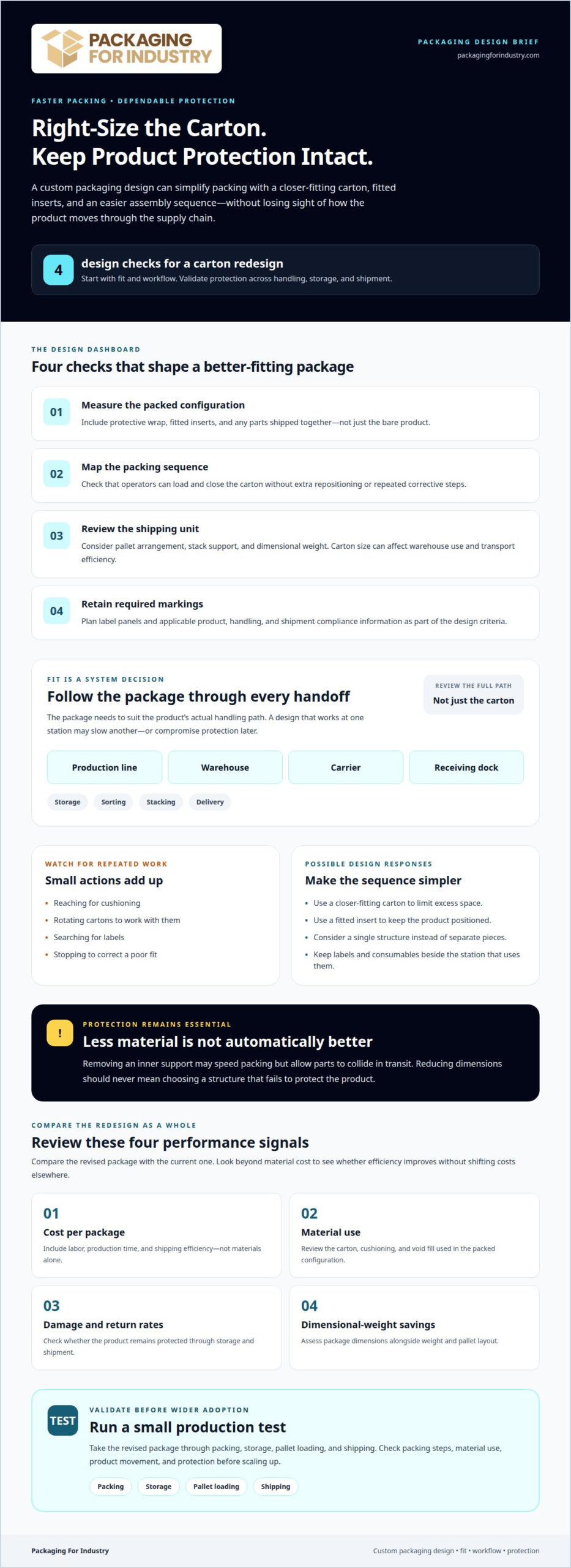
Packaging affects every handoff, from the production line to the warehouse, carrier, and receiving dock. A carton sized for its product can limit movement in transit, while a clear opening and closing method helps operators pack consistently. If a component arrives at the station in a loose carton, the packer may need to add cushioning and reposition it. A fitted package can simplify that sequence and support consistent handling through distribution.
Protection still matters when a design removes steps. The package must suit the product’s actual handling path, including storage, sorting, stacking, and delivery. Removing an inner support might speed packing but allow parts to collide in transit. Review the full packing and handling method before adopting a design, then test it through storage and shipment to identify damage risks before scaling up.
On the packing line, repeated actions add labor and interrupt workflow. Watch for operators reaching for cushioning, rotating cartons, searching for labels, or stopping to correct a poor fit. A practical redesign might put the label panel in a consistent position or replace separate pieces with a single structure. Storing labels and other consumables beside the station that uses them can also reduce material movement and keep the sequence organized.
Carton dimensions also affect pallet and trailer loading. Oversized packages can leave unusable gaps, while right-sized cartons may improve cube use and fit more cases on a pallet. That can make storage and transport more efficient. Unnecessarily large or heavy packaging may also increase shipping charges, but reducing dimensions should never mean choosing a structure that fails to protect the product.
In the US, packaging requirements depend on the product and shipment, so no single specification applies to every custom package. Include applicable product-labeling, handling, and transportation requirements in the design criteria.
Redesign risks include weaker protection, inconsistent packing, or a package that works at one station but slows another. Test a small production run through packing, storage, pallet loading, and shipping before wider adoption. Compare packing steps, material use, damage, and returns with the current package to see whether the change improves efficiency without shifting costs elsewhere.
Custom packaging that fits the product can help reduce damage, delays, and confusion in the supply chain. Packaging costs include labor, production time, and shipping efficiency as well as materials, so comparing material costs alone may miss the full effect. Standardizing box sizes where practical and improving workflows can make packaging operations more efficient.
Replacing a multi-piece container with a single-piece design may save material and labor while simplifying inventory and storage. Avoid moving materials or products unnecessarily along the packaging line, since extra travel can slow work and increase strain. Assess performance by tracking cost per package, material use, damage and return rates, and dimensional-weight savings. Reviewing these measures together helps show whether a redesign improves handling as well as protection.
2. Right-sizing cartons and eliminating void space
A carton with excess space needs more fill and gives the product room to shift. When a component ships in an oversized stock box, operators may have to add cushioning, position the item, and check that it stays centered. A closer-fitting carton can remove some of those steps and make the package easier to handle. The goal is not the smallest possible box, but one that fits the product, protective materials, and packing method.
Measure the packed product, not just the bare item. Include protective wrap, fitted inserts, and any parts shipped together. Then review how operators load and close the carton. A box that fits the product but leaves no room for an insert or closure can slow the line. A packaging designer can use these measurements to develop a carton that reduces empty space while preserving a repeatable packing sequence.
Box dimensions affect shipping and warehouse use. Carriers consider package size as well as weight, so an oversized carton can incur dimensional-weight charges even if the product is light. On a pallet, smaller, consistent cartons can reduce gaps and improve cube utilization. Depending on carton orientation and stacking requirements, that can allow a warehouse to load more product into the same footprint.
Right-sizing can also support more sustainable material use. A smaller carton may need less corrugated material and less void fill, while compact loads can use transport space more efficiently. These outcomes depend on the product and route. A fragile assembly may need added cushioning, while a durable component may fit securely with less. Removing material without evaluating protection can increase product movement and damage risk.
- Measure the packed configuration: Include inserts, cushioning, and bundled components.
- Map the packing sequence: Confirm operators can load and close the carton without extra repositioning.
- Review the shipping unit: Consider pallet arrangement, stack support, and dimensional weight.
- Retain required markings: Plan label panels and any applicable product or shipment compliance information.
Compare a revised package with the current one by reviewing material use, packing effort, product movement, and pallet layout. For example, recurring orders packed in several inconsistent carton sizes may benefit from a standardized size range, provided each carton suits its product. This can simplify packaging supply and storage without forcing every item into one box.
If carton dimensions are driving excess void fill or awkward pallet patterns, a custom packaging quote can help start a design discussion around product fit, protection, and packing needs.
3. Packaging designs that reduce assembly time and labor
Every manual fold, strip of tape, and adjustment adds a task to the packing cycle. A box that needs several folds or careful alignment can slow operators, especially when orders repeat. Review how the carton moves from flat blank to sealed package. If workers must hold flaps in place while taping, a self-locking design or simpler closure may eliminate an unnecessary motion.
Easy-to-assemble designs can help operators prepare cartons with fewer actions. A box that opens into shape and locks securely, for example, can reduce time spent forming and taping each package. The right structure depends on the product, shipping method, and packing station. Test it using the actual work sequence, including loading, closing, labeling, and moving the carton to the next station.
Manual assembly costs involve more than operator time. Extra steps can lead to inconsistent closures, require more tape, and interrupt work when cartons need rework. Map the process from carton retrieval through sealing. Note where operators pause, rotate the box, or ask for help. Then compare the proposed design with the current process using the same product configuration and a consistent set of tasks.
When selecting a packaging supplier for custom designs in the United States, look for one that can translate product dimensions and packing steps into a practical structure. The design process should consider assembly, protection, and production use. Assess a prototype on the actual line before adopting it.
Custom packaging is faster and more cost-effective when its design removes repeat work without adding material or handling problems. Standard packaging may be more efficient for products that already fit available cartons; custom designs can make sense when standard boxes require repeated adjustment, extra cushioning, or complex assembly.
Custom packaging design can reduce packing time by making the correct sequence easier to repeat. A carton that folds into place, a closure that needs less tape, or a clearly positioned label panel can each remove a handling step. Useful features include accessible openings, secure self-locking flaps, and inserts that hold components in consistent positions.
- Observe: Record each fold, tape application, repositioning, and correction.
- Redesign: Remove unnecessary actions while maintaining product support.
- Trial: Run the revised package through a representative packing sequence.
- Compare: Review assembly effort, closure consistency, and rework needs.
Packaging For Industry’s custom packaging design services address structures and packing steps that need to work together. If a carton redesign could simplify your line, request a packaging quote with your product and packing requirements.
4. Using fitted structural designs and custom inserts
A fitted insert can locate a product in one position, reducing repeated adjustments by the packer. A shaped cavity, for example, can hold a machined component while the operator closes the carton. Openings in the insert can provide clear hand access for loading and removal. This makes the sequence more consistent and helps prevent parts from shifting inside the package.
Structural design determines how a carton opens, supports the product, and closes around its contents. An integrated support in a corrugated box may replace loose pieces that packers currently position by hand. A self-locking flap or fold-in panel can reduce taping and alignment. The right structure depends on product shape, handling, and the sequence used at the packing station.
Choose insert geometry based on the product’s contact points and how it enters the package. A component with projecting edges may need shaped clearance, while a set of parts may need separate pockets to prevent contact. Inserts that install quickly can hold items securely during loading. Their design should also make the correct orientation clear, without repeated trial and adjustment.
Prototyping lets a design team assess fit and packing performance before regular production. A physical sample can show whether an insert catches on the product, flaps interfere with loading, or the package closes cleanly. Test the prototype using the actual packing method, then assess product movement during handling and shipping. Revise the structure if the trial reveals unnecessary motions or inadequate support.
- Fit: Position the product securely and make loading access clear.
- Assemble: Reduce separate pieces, difficult folds, and repeated tape application.
- Protect: Support contact points and prevent components from shifting.
- Trial: Run a sample through packing, closure, and handling.
For products with several components, a fitted design can guide each item into its intended position. An equipment kit, for example, can have separate insert locations for the main unit and accompanying parts. This helps the packer spot missing items before closing the carton and can reduce confusion when different configurations move through the same work area.
A custom structure needs to balance fast assembly with protection and repeatable fit. A design that saves a fold but allows movement may create damage and rework downstream. Packaging design support can bring product dimensions, insert layout, and packing steps into one review. A custom packaging design process can assess those factors before the package is used routinely.
Packaging design brings product fit and packing steps into the same review. Quick-install inserts can help hold products securely during packing, while custom inserts can keep a product in a consistent position. Consider how the insert will be placed and how the product will sit, then confirm that the arrangement works with the intended packing sequence.
5. Aligning packaging requirements before design begins
Packaging design starts with the product and the work it must perform. Record product dimensions, weight, fragile areas, and components shipped together. For example, a device with a protruding connector needs clearance around that feature. Identify the current carton, protective materials, and packing steps. These details give the design team a practical starting point instead of relying on assumptions.
Next, define how operators will pack the item. Note whether the line handles one product or several configurations, and how each moves through the station. A package for a single assembly may need a different insert layout from a kit with accessories. Record the sequence for loading, closing, labeling, and staging so the design reflects actual labor and equipment needs.
Document what happens after packing. A package may move through a warehouse, onto a pallet, into a trailer, and through the customer’s receiving area. Each handoff can affect the required support and closure. A product stacked with other cases, for example, needs a structure suited to that loading pattern. Include storage limits, shipping methods, and delivery conditions in the design brief.
Individual retail and e-commerce orders may have different handling needs from bulk industrial shipments. A warehouse shipping single orders may need packages that workers can identify and close quickly. A distribution center shipping full cases may prioritize stable stacking and efficient pallet patterns. Identify order types and destinations before choosing one design for every shipment.
- Product: Dimensions, weight, orientation, and components.
- Process: Packing sequence, equipment, and operator handling.
- Distribution: Storage, pallet loading, transport, and receiving.
- Supply: Required packaging quantities, storage space, and replenishment needs.
Use these requirements to set testing criteria before approving a design. Run a sample through the intended packing steps, then assess product fit, closure, handling, and storage. Record where operators pause, reposition components, or need extra materials. If an insert complicates loading or a closure needs repeated adjustment, revise the design before routine use.
Evaluate the trial against the existing package using practical observations. Compare packing steps, material use, product movement, and damage during handling. Keep the product configuration and packing method consistent in both trials. This makes it easier to see whether the change improves workflow or merely shifts labor to another station.
Finally, align packaging requirements with purchasing and inventory planning. A design that relies on several separate components can add storage and replenishment tasks. Document the approved configuration and share it with the teams ordering and using the packaging. This supports consistent supply as production schedules or order mixes change.
PFI: Just-In-Time Inventory Management for Packaging
Packaging For Industry (PFI) supports manufacturers and warehouses with Just-In-Time (JIT) inventory management for packaging. This service aligns recurring packaging supply with operating needs and supports reliable replenishment and efforts to reduce packaging costs.
For industrial teams reviewing packing-line materials, PFI also offers custom packaging design, foam packaging, and stretch film. These products and services can support product protection as part of a coordinated packaging plan. PFI serves businesses in Orange County, Los Angeles, and San Diego, with local next-day delivery across these Southern California counties.
Contact Packaging For Industry to discuss packaging requirements for your operation.
Build the next packaging improvement into your operation
A packaging change should solve more than today’s bottleneck. Treat it as an operating decision that can adapt as product configurations, order patterns, and production demands shift. A custom packaging design to reduce packing time works best when the intended workflow remains clear to the teams that pack, replenish, and ship the product.
Set a practical baseline before making a change. Track the steps that require operator attention, the materials each package uses, and the issues that cause rework. Revisit those measures when the product mix changes or a shipping route is added. This helps teams identify when packaging no longer fits current operations.
Packaging For Industry can discuss a packaging approach based on your products, packing process, and supply needs. Share the operational challenge you want to address, whether it is a difficult packing sequence or a packaging supply plan that needs closer alignment.
A focused next step can help your team move toward a more manageable packing operation.
Frequently Asked Questions
How do you measure packing time before and after a packaging redesign?
Track interruptions separately from active packing so delays do not disappear inside a single cycle-time figure. Log supply waits, equipment pauses, order changes, and corrections at the station, then note their causes. Compare equivalent shifts or order types using the same method. Ask operators which steps feel less awkward and whether new handling issues have appeared. Their observations can explain why a time change occurred, not just whether it did.
What materials and box styles are easiest to assemble and pack?
Choose an option operators can handle safely and consistently at the actual workstation. Assess blank storage, how materials move to the line, and whether components are easy to distinguish during a shift. Corrugated styles and foam materials serve different needs, so select them to suit the product and process. A short operator trial can reveal hard-to-grip pieces, confusing material variations, or awkward staging.
How can packaging be designed to reduce void fill, tape, and packing steps?
Review packaging use across a product family and identify orders that share dimensions or components. A documented packaging specification can define approved materials for each configuration and prevent packers from adding supplies out of habit. During a trial, record tape use, void-fill consumption, and exceptions by order type. If one variation repeatedly needs extra material, treat it as a separate configuration rather than disrupting the standard workflow.