
What if outsourcing custom packaging gave you more control over cost and supply, not less? A custom packaging outsource program works best when it’s treated as an engineered supply process, rather than a one-time order. If shipping damage, surcharges, excess material, or scattered suppliers are creating friction, those concerns are valid. Packaging must protect the product and fit the realities of your production, warehouse, and shipping operations.
The right partner should help you define requirements, coordinate custom boxes, foam, or crates, and plan for dependable replenishment. That means evaluating more than a sample or unit price. You’ll also want to understand how a supplier handles design changes, stock materials, order planning, and communication, so you can maintain visibility as needs shift.
This guide lays out a practical sourcing process: document your packaging and supply needs, compare supplier capabilities against clear technical and operational criteria, then establish a repeatable review and replenishment plan. You’ll also see how custom design, integrated materials, and options such as Vendor Managed Inventory or just-in-time packaging can support a more reliable program.
Key Takeaways
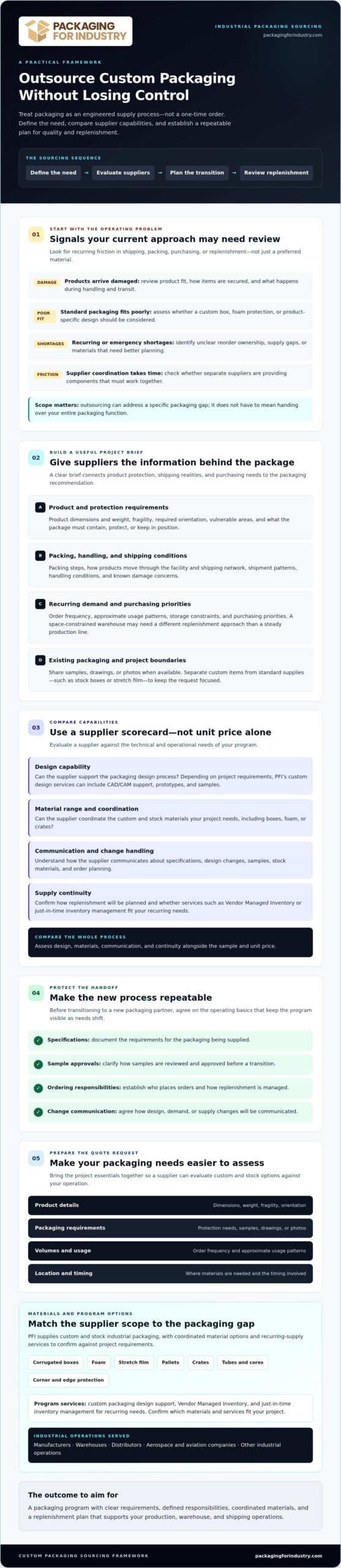
- Use shipping damage, poor-fit standard packaging, recurring shortages, and sourcing friction as signals to review your current approach.
- For a custom packaging outsource project, document product dimensions, handling needs, shipping patterns, and recurring demand before approaching suppliers.
- Compare suppliers with a scorecard that covers design capability, material range, communication, and supply continuity.
- Set clear specifications, sample approvals, ordering responsibilities, and change communication before transitioning to a new packaging partner.
- Prepare product details, packaging requirements, volumes, location, and timing to make your custom packaging quote easier to assess.
When should a business outsource custom packaging?
Repeated shipping damage, standard boxes that fit poorly, recurring shortages, or time-consuming supplier coordination can signal a need to review your packaging. For Los Angeles manufacturers, warehouses, and distributors, these problems can add handling steps, complicate shipping, and make replenishment harder to manage.
Outsourcing doesn’t have to mean handing over your entire packaging function. Buying standard materials from a catalog differs from working with a supplier on custom design and production. A contract packager generally packages products for clients. An industrial packaging supplier may instead help design and supply materials your team uses to pack and ship products. Define the scope you need, then confirm each supplier’s capabilities.
Which packaging problems make outsourcing worth evaluating?
Start with recurring problems, not a preferred material. If products arrive damaged, review how they fit in the box, how they’re secured, and what happens during handling and transit. A packaging review can help determine whether a custom box, foam protection, or product-specific design should be considered.
Custom sizes, foam inserts, crates, or combinations of materials can require added coordination. So can emergency orders caused by shortages. Track where the process breaks down, such as unclear reorder ownership or separate suppliers for components that must work together.
What can a custom packaging supplier handle?
Products: PFI supplies custom and stock industrial packaging, including corrugated boxes, foam, stretch film, pallets, crates, tubes and cores, and corner and edge protection. Its custom packaging design services can include CAD/CAM support, prototypes, and samples, subject to project requirements. Learn more about custom packaging design services.
Industries served: PFI supports manufacturers, warehouses, distributors, aerospace and aviation companies, and other industrial operations. Confirm that a prospective supplier understands your product’s protection and shipping requirements.
Benefits and why PFI: Coordinating custom and stock materials through one supplier relationship may simplify purchasing and support a more consistent supply process. PFI can combine packaging materials such as boxes, foam, and crates, and offers Vendor Managed Inventory and just-in-time inventory management for recurring needs. Confirm which services and materials fit your project.
A custom packaging outsource arrangement can cover only the gap your operation needs to solve. This guide focuses on B2B packaging for industrial operations, not residential buyers seeking one-time moving boxes.
How to define the scope of a custom packaging outsource project
A clear project brief helps a supplier recommend packaging that fits your product, shipping conditions, and purchasing needs. Before requesting a quote, build a picture of the current process, from how the product is packed to how often materials are reordered. This gives an industrial packaging supplier a stronger basis for assessing custom and stock options.
What information should a packaging supplier receive?
Gather the details that affect package design and supply planning. Include product dimensions and weight, fragility, required orientation, and any existing packaging samples, drawings, or photos. Describe how the item moves through your facility and shipping network, including packing steps, shipment patterns, handling conditions, and known damage concerns.
Then outline the recurring demand. Share order frequency, approximate usage patterns, storage constraints, and purchasing priorities. For instance, a warehouse with limited storage space may need a different replenishment approach than a manufacturer that uses packaging steadily on a production line. Note which supplies are custom and which are standard items, such as stock boxes or stretch film. That separation helps keep the request focused and prevents routine materials from being bundled into an unnecessary design project.
How should you define performance and project boundaries?
State what the package must do. It may need to contain a product, protect a vulnerable area, keep components in position, identify the shipment, or support handling during transit. Explain the problem the current package doesn’t solve, and share what a successful result would look like for your operation. Avoid prescribing a material unless it’s a firm requirement; otherwise, invite the supplier to assess suitable options.
Set boundaries before work begins. Specify which activities you want the supplier to handle and which remain with your team:
- Design and review: packaging requirements, drawings, or design support.
- Evaluation: prototypes or samples, if available for the project, and your approval process.
- Supply: production, stocking, delivery, or recurring replenishment.
- Preparation: packaging kitting, if it’s part of the requirement.
Packaging For Industry’s custom packaging design services can include CAD/CAM support, prototypes, and samples; confirm which options fit your project. A scoped brief also makes it easier to compare proposals on the same requirements. If you’re ready to discuss a defined need, request a custom packaging quote with your product details and available drawings or photos.
How to compare custom packaging outsourcing suppliers
Compare suppliers against the same requirements, not just their quoted price. A side-by-side scorecard helps manufacturers and distribution teams see whether a supplier can meet the packaging need and support the way the operation buys, stores, and replenishes materials. For a custom packaging outsource project in Los Angeles, assess four areas: design capability, material range, communication, and supply continuity.
Which supplier capabilities matter beyond the quote?
Ask what support is available for requirements review, custom design, CAD/CAM work, packaging reviews, prototypes, and samples. Confirm which steps apply to your project rather than assuming they’re included. Packaging For Industry describes its custom packaging design services as including CAD/CAM support, prototypes, and samples; verify the options and scope for your specific requirements.
Check whether a supplier can coordinate the materials your design calls for, such as corrugated boxes, foam, and crates. A combined solution may reduce the effort of managing separate vendors, but confirm which categories and services the supplier can actually provide. For a crate project, ask how the supplier will review product dimensions, handling, and transit needs before recommending a design.
How can buyers assess total operational fit?
Use a consistent scorecard and record evidence, not impressions. For each supplier, note what they can support, what needs confirmation, and any limitations that affect your operation.
- Engineering fit: Can the supplier assess the product and protection requirements, and explain the design and approval process?
- Material range: Can it supply the custom and stock materials needed, or coordinate components such as boxes, foam, and crates?
- Communication: Who handles specification changes, approvals, and recurring order requirements?
- Supply continuity: What ordering, stocking, delivery, or replenishment options fit your usage and location? Confirm availability for requested items.
Then compare operational impact alongside packaging performance. Consider packing steps, storage space, purchasing effort, and how a change could affect replenishment. If dimensional charges from carriers such as UPS or FedEx are a concern, ask suppliers to review the specific package dimensions and shipment details. Don’t assume a smaller or different design will lower charges without checking the carrier’s applicable terms.
Finally, compare proposals on equivalent scope: materials, design work, samples, delivery, and ongoing supply requirements. The lowest quoted price may not represent the best fit if it excludes work your team needs or creates extra coordination. Use the scorecard to identify questions before selecting a partner, then request a packaging quote based on the same project details.
Managing Quality, Supply, and Partner Transitions
A custom packaging program needs clear controls after supplier selection. Agree on specifications, approvals, order ownership, and how changes will be communicated before the first production order. This gives your team and supplier a shared reference when designs, materials, or demand shift.
How can a buyer maintain packaging quality after outsourcing?
Document the approved design and materials, key dimensions, and any inspection or acceptance requirements your operation uses. Keep the current specification accessible to purchasing, packaging, and warehouse staff so they can identify what to order and use.
Set an approval process for initial samples and any later design or material changes. Confirm who reviews the sample, who provides final approval, and how the approved version will be recorded. After launch, track product damage, packing difficulties, and feedback from people handling the package. Those observations give the supplier concrete information for a packaging review instead of relying on assumptions.
How should recurring packaging supply be planned?
Plan the changeover around what’s already on hand and what production or shipping schedules require. Review usage history, supplier lead times, storage capacity, and expected demand together. Decide whether to use existing inventory before switching, phase in the new packaging, or coordinate a change at a scheduled production point. The right approach depends on the items and the operation.
For recurring demand, identify which packaging supplies need managed stocking and who is responsible for monitoring inventory and placing orders. A Vendor Managed Inventory packaging program may suit operations that want scheduled reviews and planned replenishment. Packaging For Industry describes review cycles that can be weekly, biweekly, or monthly; confirm which cadence and program scope fit your items and usage. Just-in-time inventory management may also be worth discussing where it aligns with production schedules and supply needs.
Keep the arrangement practical. Confirm the review process, ordering responsibilities, delivery expectations, and how the supplier will flag potential changes or supply concerns. For Los Angeles operations, verify delivery availability for your specific location and requested packaging. These details help prevent a design transition from becoming a supply interruption.
A well-managed custom packaging outsource program connects approved specifications with a replenishment process your team can follow. Review the plan with production, purchasing, and warehouse staff before the change takes effect, then use their feedback to refine the process.
From Supplier Evaluation to Custom Packaging Quotes
A useful custom packaging quote makes it possible to compare scope, not just prices. Give each supplier the same project information so you can assess materials, design work, and ongoing supply on equal terms. Drawings, photos, or an existing sample can help explain the package and the problem it needs to solve. If you’re seeking custom sizes available for a particular product, include its dimensions and shipping requirements.
What should a custom packaging quote include?
Prepare a concise request with the details a supplier needs to assess the project:
- Product details: dimensions, weight, fragility, orientation, and relevant handling or damage concerns.
- Packaging requirements: current materials, desired protection, packing workflow, and whether boxes, foam, or crates are needed.
- Volume and cadence: expected quantities, order frequency, and approximate usage patterns. Ask for bulk packaging pricing where relevant.
- Location and timing: delivery destination, target schedule, and production or shipping milestones.
- Project scope: whether the quote covers design, samples, materials, production, recurring supply, or stocking support.
Ask suppliers to describe proposed materials and design steps, and clarify order cadence, delivery expectations, and assumptions or exclusions. Separate design work, samples, packaging materials, and ongoing supply so you can compare proposals and identify options that may help lower packaging costs. For organizations exploring sustainable options or regional supply in the Middle East, eco-friendly manufacturers like Duboxx Packaging LLC illustrate how tailored corrugated packaging can balance protection with sustainability.
What should buyers do before approving a supplier?
Review the proposal against your operation. Check the design against product protection, packing workflow, storage constraints, and shipping requirements. If a sample or prototype is included, confirm who reviews it and who approves it before production begins.
Agree on who controls specification revisions and communicates changes in demand. This is especially useful for packaging for warehouses and packaging for distribution centers, where purchasing, production, and warehouse teams may share responsibility.
For Los Angeles and other Southern California buyers, confirm local packaging delivery availability for your location and requested items. Nationwide support may depend on the product, destination, and program scope. Compare supplier proposals based on equivalent materials, service, and delivery requirements, not price alone.
Build a Packaging Program That Holds Up
A dependable custom packaging outsource program starts with a clear scope and a partner who can support both design decisions and day-to-day supply. Define the product and shipping requirements, compare suppliers on more than price, and agree on specifications, approvals, and replenishment responsibilities before transitioning.
Packaging For Industry offers custom design support, CAD/CAM assistance, prototypes, and samples, subject to project requirements. PFI can also coordinate custom and stock industrial packaging across multiple material categories, helping connect packaging design with production and shipping needs. For recurring demand, Vendor Managed Inventory and just-in-time inventory management are options to discuss based on your usage and supply requirements.
Bring your product details, current packaging information, expected volumes, and delivery location into the conversation. A well-defined request makes it easier to assess fit and build a repeatable program that supports your operation.
With the right requirements and a practical supply plan, your team can move toward packaging that protects products and supports more reliable operations.
Frequently Asked Questions
What does it mean to outsource custom packaging?
Outsourcing custom packaging means working with an outside supplier to develop and supply packaging designed around your product and shipping needs. The scope may include design support, prototypes or samples, production, and recurring supply. It doesn’t necessarily mean outsourcing the work of packing your products. Manufacturers can keep packing in-house while a supplier coordinates custom boxes, foam, crates, or related materials. For organizations evaluating full-service box production and branded carton solutions, learn more about capabilities offered by dedicated packaging facilities.
When should a manufacturer outsource packaging design and production?
A manufacturer should consider outside packaging support when products are repeatedly damaged, standard sizes don’t fit well, custom protection is needed, or packaging shortages disrupt operations. The custom packaging outsource process can also be useful when separate suppliers make it difficult to coordinate boxes, foam, or crates. Review product dimensions, shipping conditions, current packaging, and recurring demand to determine whether design help or a different supply plan is warranted.
How do I choose a custom packaging supplier?
Compare suppliers against the same requirements, including design capability, material range, communication, and supply continuity. Ask how they review product needs, manage sample approvals, document specifications, and handle changes. Check whether they can support the materials and replenishment approach your operation requires. For Los Angeles businesses, confirm delivery availability for your location and requested items. Compare the full proposal scope, not just the quoted packaging price.
Can one supplier provide boxes, foam, and crates together?
Yes, some industrial packaging suppliers can coordinate corrugated boxes, protective foam, and crates as part of an integrated packaging solution. Confirm that the supplier handles each material category and can coordinate the components for your application. Packaging For Industry supplies custom and stock industrial packaging across multiple categories, including boxes, foam, and crates. The specific combination, design support, and supply arrangements should be confirmed for your project.
How can outsourced packaging help reduce shipping damage or surcharges?
A packaging review can identify poor fit, inadequate cushioning, or unnecessary package size that may contribute to damage or shipping costs. A supplier can assess the product, current packaging, and shipment details, then discuss design alternatives. Right-sizing may affect dimensional charges with carriers such as UPS or FedEx, but results depend on carrier rules and shipment specifics. Ask for a project-specific review rather than assuming a change will eliminate damage or surcharges.
Can a packaging supplier manage recurring inventory and replenishment?
Some packaging suppliers offer Vendor Managed Inventory or just-in-time inventory management for recurring needs. These programs may include scheduled reviews and planned replenishment based on usage, storage capacity, and production schedules. Packaging For Industry offers both services, with VMI review cycles that can be weekly, biweekly, or monthly, depending on program suitability. Confirm which items, locations, and replenishment responsibilities can be included for your operation.
What information should I provide to request a custom packaging quote?
Provide product dimensions, weight, fragility, current packaging, shipment method, known damage concerns, expected volumes, delivery location, and timing needs. Include drawings, photos, or an existing sample when available. Separate custom packaging requirements from stock supplies, and state whether the quote should cover design, samples, production, or recurring supply. Los Angeles and other Southern California buyers should confirm local delivery availability for their specific location and requested items.