
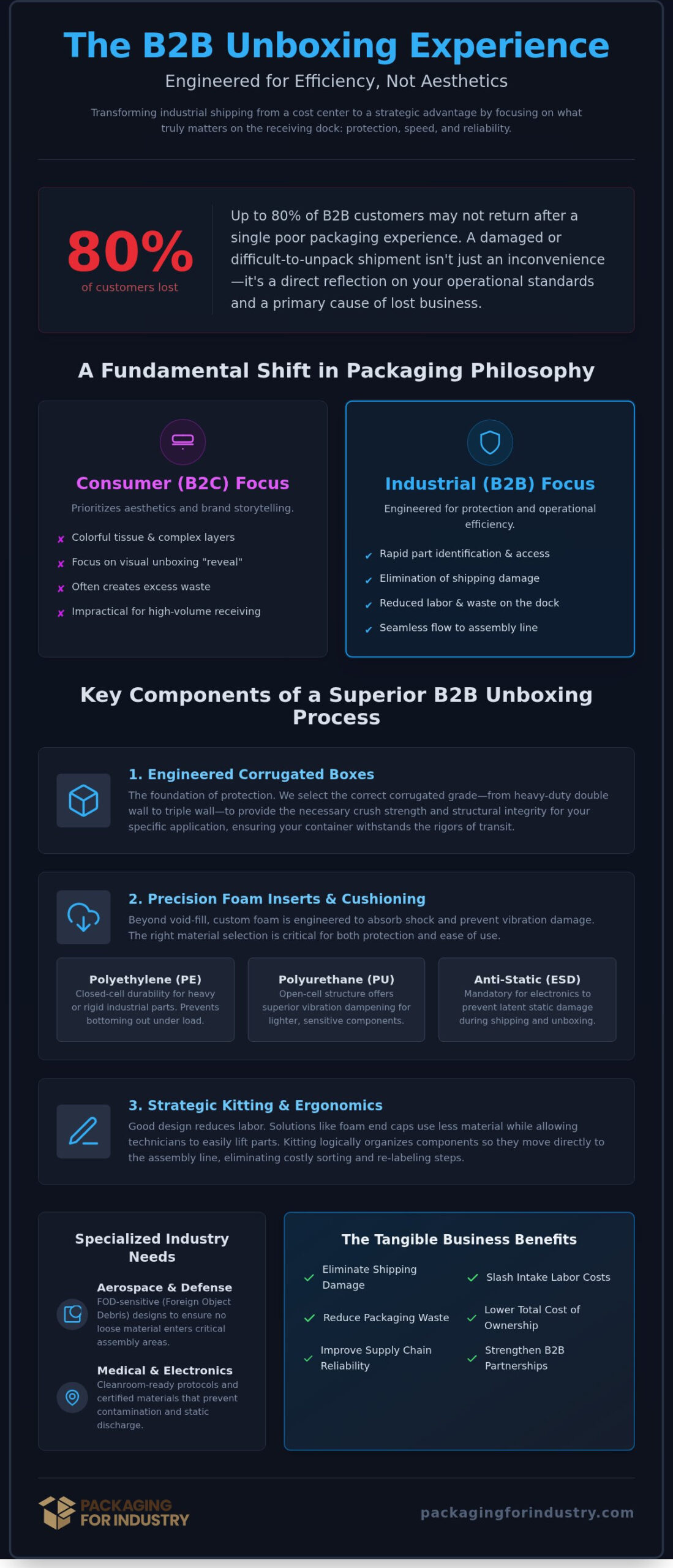
Research indicates that up to 80% of customers won’t return to a supplier after a poor packaging experience, even if the product itself meets every technical specification. In the industrial sector, your client’s first impression doesn’t happen at a retail counter; it happens on the receiving dock. If your shipments arrive with crushed corners or require twenty minutes of labor to unpack, you’re losing the trust of your procurement partners. Implementing custom packaging to improve B2B unboxing experience is no longer a luxury for high-end electronics. It’s a fundamental requirement for maintaining operational flow and reducing the total cost of ownership for your customers.
You can transform your shipping department from a cost center into a strategic advantage by focusing on engineering over aesthetics. This guide explains how to optimize industrial packaging to eliminate shipping damage, slash labor costs during the intake process, and meet strict new regulatory standards like the EU’s 2026 packaging waste requirements. We’ll examine the specific roles of custom corrugated boxes, protective foam inserts, and specialized kitting in creating a seamless transition from the pallet to the assembly line. You’ll learn how a more efficient unboxing process directly improves your bottom line and strengthens your B2B partnerships.
Key Takeaways
- Shift your focus from aesthetic appeal to operational efficiency and part protection to meet the specific needs of industrial receiving docks.
- Learn to select the correct corrugated grades and custom foam inserts to eliminate shipping damage and reduce your total cost of ownership.
- Discover how custom packaging to improve B2B unboxing experience can significantly lower labor costs and packaging waste for your clients.
- Understand the specialized unboxing requirements for aerospace and medical sectors, including FOD-sensitive and cleanroom-ready protocols.
- Optimize your supply chain reliability using Vendor Managed Inventory and local Southern California delivery from an Anaheim-based supplier.
Redefining the B2B Unboxing Experience for Industrial Logistics
In the industrial sector, the unboxing experience is often misunderstood as a marketing exercise. While a consumer might appreciate colorful tissue paper and branding, a warehouse manager in Anaheim or Los Angeles values a shipment that arrives intact and can be processed in minutes. For B2B companies, the unboxing process is the first physical interaction a client has with your operational standards. It’s a critical touchpoint where your commitment to quality is either confirmed or called into question by the personnel on the receiving dock.
Operational Efficiency vs. Aesthetic Branding
In a manufacturing environment, unboxing represents the time elapsed from the moment a pallet hits the dock to when a part is ready for deployment. True custom packaging to improve B2B unboxing experience focuses on removing obstacles for the end user. Technicians don’t want complex retail-style layers; they want easy-access designs that facilitate rapid part identification. This involves a strategic approach to packaging and labeling that prioritizes information transmission over visual flair. Clear, high-contrast labels and intuitive opening mechanisms allow receiving teams to verify contents without searching for buried packing slips or struggling with excessive stretch film. When parts are logically organized within the container, they move directly to the assembly line, eliminating the need for sorting and re-labeling.
The Cost of a Poor First Impression in Manufacturing
Poorly engineered packaging creates a cascade of hidden expenses that affect your bottom line and your client’s productivity. If a shipment of custom corrugated boxes lacks the proper internal support, transit vibration can lead to micro-fractures or surface abrasions. Research indicates that 60-80% of customers won’t return to a brand after experiencing poor packaging, even if the product itself is functional. Beyond the risk of lost business, difficult-to-handle crates and excessive void-fill frustrate warehouse teams and inflate your client’s waste management costs. This is especially true as new regulations, like the EU’s 2026 packaging waste laws, put more pressure on companies to reduce excessive material use.
When you optimize the unboxing journey, you do more than protect a product. You’re reducing the labor-intensive processes that lead to bottlenecks on the factory floor. Every minute a technician spends wrestling with heavy staples or disposing of oversized foam is a minute of lost productivity. By partnering with a custom design packaging specialist, you can engineer solutions that arrive ready for the workstation. This proactive approach significantly lowers the total cost of ownership for your customers and reduces the frequency of costly returns and warranty claims.
Engineering Protection: The Core of Industrial Unboxing
The technical foundation of a shipment determines whether the receiving process is a success or a logistical failure. Protection isn’t just about over-packing; it’s about engineering a container that balances structural integrity with the speed of part retrieval. By focusing on the physical mechanics of the container, manufacturers can utilize custom packaging to improve B2B unboxing experience through reduced transit damage and streamlined part retrieval. Achieving this balance requires a deep understanding of material science, from the crush strength of corrugated walls to the G-force ratings of internal cushioning.
Custom Foam Inserts for Sensitive B2B Goods
Selecting the right foam material is a critical decision that impacts both protection and the client’s ease of use. For heavy or rigid industrial parts, Polyethylene (PE) foam provides the closed-cell durability needed to support significant weight without bottoming out. Conversely, Polyurethane (PU) foam is an open-cell alternative that offers superior vibration dampening for lighter, highly sensitive sensors or medical instruments. When shipping electronics, the use of anti-static or ESD foam is mandatory to prevent latent static damage during the unboxing reveal. We often design foam end caps rather than full enclosures. This suspended design uses less material while allowing a technician to easily lift the component out of the box, which significantly reduces the time spent on the assembly line. You can compare custom foam packaging options to see how different densities affect your specific part protection needs.
Heavy-Duty Corrugated and Structural Integrity
The outer shell of your shipment must withstand the rigors of LTL shipping and warehouse stacking. While single-wall boxes suit lighter goods, industrial loads often require double-wall or even triple-wall corrugated board to ensure the stack doesn’t collapse in transit. Integrating internal partitions and dividers within these custom corrugated boxes allows for the organized shipment of multi-part kits. This organization ensures that when the client opens the box, every component is visible and accounted for, preventing the “hidden part” syndrome that leads to unnecessary support calls. We use CAD/CAM prototyping to create precise samples before full production begins. This ensures a perfect fit, which eliminates the need for messy void-fill and makes the unboxing process cleaner and more professional for your customers. If you’re looking to optimize your current design, you can compare packaging pricing for high-durability corrugated solutions that match your specific load requirements.
How to Design a Superior B2B Unboxing Process
Creating a streamlined receiving process requires more than just a sturdy box. It demands a systematic evaluation of how your product moves through your client’s facility. Designing custom packaging to improve B2B unboxing experience is a multi-step engineering task that aligns your shipping standards with your customer’s operational needs. By following a structured design process, you can transform a chaotic receiving dock into a high-efficiency intake zone.
- Audit current failure points: Start by reviewing shipping damage reports and direct client feedback. Identify if parts are arriving scuffed, if boxes are collapsing, or if technicians are complaining about the time it takes to remove staples and tape.
- Map the physical journey: Track the package from the initial delivery at the dock to the final workstation. Consider environmental factors like humidity in a warehouse or the use of forklifts, which might necessitate heavier corner and edge protection.
- Eliminate over-packaging: Excessive layers of plastic wrap and oversized boxes don’t just increase material costs; they create a labor burden for the client’s waste management team. Engineering a “right-sized” container reduces this friction.
- Implement kitting: Grouping related components into a single organized unit prevents the end user from searching through multiple boxes for a single bracket or fastener.
- Conduct real-world testing: Don’t rely on theory. Send prototypes through actual shipping cycles via UPS, FedEx, or LTL freight to ensure the design holds up under stress.
Optimizing the ‘Reveal’ with Packaging Kitting
The moment a technician opens a shipment, they should see exactly what they need in the order they need it. Implementing packaging kitting allows you to organize hardware, instructions, and primary components in a logical sequence. This setup eliminates the “search time” that often plagues assembly lines. When a worker in an Anaheim manufacturing plant opens a kit and finds every part nested in a custom foam insert, they can move directly to assembly without double-checking the packing slip. This level of organization reinforces your reputation as a proactive, professional partner.
Sustainability and Waste Reduction in Industrial B2B
Modern B2B clients are increasingly focused on ESG goals and the costs associated with waste disposal. With the enforcement of the EU’s 2026 packaging waste regulations and various U.S. state EPR laws, reducing material volume is a financial necessity. Designing for “Right-Sizing” eliminates the need for excessive void fill, which directly lowers your freight costs by optimizing box dimensions for dimensional weight (DIM weight). Using recyclable corrugated materials and engineered foam ensures that your client isn’t left with a mountain of non-recyclable trash. This approach doesn’t just save money; it shows your clients that you understand their fiscal and environmental responsibilities.
Industry-Specific Unboxing Requirements
Standardized shipping solutions rarely meet the technical demands of specialized industrial sectors. While a general manufacturer might prioritize bulk efficiency, industries like aerospace, medical, and electronics require a much higher degree of precision. Utilizing custom packaging to improve B2B unboxing experience in these fields means adhering to strict regulatory standards while maintaining operational flow on the receiving dock. Each industry faces unique hurdles, from preventing electrostatic discharge to ensuring cleanroom compatibility.
Aerospace and Defense Unboxing Standards
Aerospace components are frequently high-value, oversized, and sensitive to Foreign Object Debris (FOD). A standard corrugated box isn’t enough for a turbine blade or an avionics suite; you need custom crates engineered for long-term storage and mil-spec compliance. The unboxing process must allow for immediate inspection without introducing contaminants into the assembly environment. We design these solutions to be accessible yet incredibly durable, ensuring that sensitive parts remain secure during every stage of the journey. You can review our specific aerospace packaging solutions to see how we meet these rigorous technical specifications for Southern California manufacturers.
Medical and Electronics Precision
In the medical and electronics sectors, the unboxing reveal is focused on maintaining sterility and preventing electrostatic discharge (ESD). Medical devices often require cleanroom-ready materials that don’t shed particulates when the box is opened. For semiconductors and sensitive circuit boards, moisture barrier bags and desiccants are essential components of the protective layer. The packaging must be engineered so that quality control teams can quickly open, inspect, and reseal the unit without compromising the integrity of the components. This precision reduces the risk of latent damage that often goes unnoticed until the part is already on the assembly line.
Automotive Tier 1 suppliers face a different set of challenges centered on high-volume durability and stackability. When parts arrive at an assembly plant in Anaheim or Riverside, they must move from the pallet directly to the workstation in crates that are easy to access. Custom partitions and heavy-duty double-wall corrugated board ensure that parts stay organized and protected, even when stacked multiple units high in a warehouse. By engineering the unboxing process for these specific needs, you eliminate the bottlenecks that lead to production delays and increased labor costs for your clients.
Optimizing Your Supply Chain with PFI’s Custom Solutions
A high-quality custom packaging to improve B2B unboxing experience is only effective if the materials are available when your production line needs them. Many manufacturers struggle with the logistical burden of storing bulky custom boxes or waiting weeks for specialized foam inserts. At Packaging For Industry (PFI), we function as a proactive partner by integrating our production with your operational flow. By utilizing Vendor Managed Inventory (VMI), we ensure that your custom-engineered solutions are always in stock without cluttering your warehouse floor. We manage the inventory levels, so you don’t have to worry about stockouts or lead-time delays.
Solving Lead-Time Issues for Custom Packaging
Custom foam and heavy-duty corrugated board often come with extended lead times from large catalog suppliers who prioritize stock items. We solve this by offering just-in-time (JIT) delivery, which frees up valuable floor space in your facility for manufacturing rather than storage. This responsiveness is critical when you’re refining a custom design packaging solution to address a sudden spike in shipping damage. Our engineering team provides free prototyping for custom designs, allowing you to validate the unboxing process and protection levels before committing to a full production run. This iterative process ensures the final design meets both your protection requirements and your client’s labor efficiency goals.
Your Southern California Packaging Partner
Working with an Anaheim-based manufacturer provides a distinct advantage for companies in Los Angeles, Orange County, and the Inland Empire. Local proximity means faster iterations and the ability to receive next-day delivery on critical supplies. While we have nationwide shipping capabilities to support multi-location manufacturers, our Southern California roots make us the preferred industrial packaging supplier near me for local aerospace, medical, and electronics firms. We compete directly with large catalog suppliers by offering more competitive pricing on custom orders and specialized materials that stock distributors simply don’t carry. Whether you need a bulk packaging supplier for double-wall corrugated or a specialized partner for ESD foam, we provide the technical expertise and logistical reliability required to keep your supply chain moving.
If you’re ready to lower your total cost of ownership and eliminate shipping damage, our team is here to help. We’ll audit your current process and engineer a solution that protects your product and your reputation.
Streamline Your Industrial Logistics with Engineered Packaging
Optimizing your receiving process requires a shift from standard containers to engineered solutions that prioritize part safety and operational speed. By focusing on the intersection of material science and logistical flow, you can eliminate shipping damage and reduce the labor hours spent on your client’s warehouse floor. Implementing custom packaging to improve B2B unboxing experience is a strategic investment that pays for itself through a lower total cost of ownership and strengthened professional partnerships.
Packaging For Industry (PFI) provides the technical expertise and local responsiveness needed to transform your supply chain. Our Anaheim headquarters allows for local Southern California next-day delivery and free prototyping with CAD design support to ensure your designs are validated before full production. We specialize in the rigorous standards of aerospace and industrial manufacturing, ensuring your shipments meet every regulatory and protection requirement.
We’re ready to help you solve your most complex logistical challenges. Let’s work together to build a more reliable and efficient shipping process for your business.
Frequently Asked Questions
How does custom packaging reduce B2B shipping costs?
Custom packaging reduces shipping costs by optimizing the dimensional weight of your shipments and eliminating the need for expensive, excessive void fill. By engineering a container to the exact specifications of your product, you avoid paying to ship empty space. It also lowers the total cost of ownership by significantly reducing the frequency of shipping damage and the labor intensive process of managing returns and replacements.
What is the difference between B2B and B2C unboxing experiences?
B2C unboxing focuses on brand storytelling and emotional delight, while B2B unboxing is strictly about operational efficiency and part protection. Utilizing custom packaging to improve B2B unboxing experience means designing for rapid part identification and easy material disposal at the receiving dock. Technicians value a process that allows them to move a component directly to the assembly line without wrestling with complex retail style layers.
Can I get a prototype of my custom box before ordering in bulk?
Yes, PFI offers free prototyping and CAD design support for all custom engineered solutions. This allows your team to validate the fit, structural integrity, and unboxing flow with your actual components before committing to a full production run. Testing a physical sample ensures that the final product meets your protection standards and integrates seamlessly into your client’s intake process.
What types of foam are best for protecting heavy industrial parts?
Polyethylene (PE) foam is the preferred choice for heavy or rigid industrial parts because it’s a closed cell material with high load-bearing capacity. It provides the durability needed to support significant weight without bottoming out during transit. For lighter, highly sensitive electronics that require superior vibration dampening, Polyurethane (PU) foam is often used due to its softer, open cell structure.
How does right-sizing packaging help with UPS or FedEx surcharges?
Right-sizing eliminates the wasted space that triggers high dimensional (DIM) weight surcharges from carriers like UPS and FedEx. Carriers calculate shipping rates based on either actual weight or volume, whichever is greater. By engineering your custom corrugated boxes to the smallest possible footprint that still ensures part safety, you ensure you’re only paying for the protection you actually need.
Do you offer local delivery for businesses in Orange County and Los Angeles?
Yes, our Anaheim headquarters allows us to provide local next-day delivery for manufacturers and warehouses throughout Orange County, Los Angeles, and the Inland Empire. This proximity enables faster iterations during the design phase and supports just-in-time inventory needs. We also maintain nationwide shipping capabilities to serve clients with distribution centers across the country.
How can I incorporate sustainable materials into my industrial packaging?
You can improve sustainability by utilizing high recycled content corrugated board and engineered foam inserts that are easier for clients to recycle. Right-sizing is also a critical component of sustainability, as it reduces the total volume of material your customer has to manage. These choices help your clients meet strict new waste regulations, such as the 2026 EU packaging standards, while lowering their disposal labor costs.