
Your pallet choice for international shipping from Los Angeles International Airport is no longer a minor logistical detail; it’s a direct driver of your bottom line. With air freight rates for 2026 reaching up to $8.00 per kilogram on major trade lanes, every ounce of unnecessary tare weight becomes a liability. You’ve likely felt the sting of high dimensional weight surcharges or the stress of a shipment held at the terminal due to non-compliant wood markings. Sourcing custom pallets for air freight from LAX requires a precise balance between lightweight engineering and the rugged durability needed for multi-modal transit.
We understand that navigating the 67th Edition of the IATA Dangerous Goods Regulations and the new ISPM-15 hyphen enforcement can be complex. This 2026 buying guide will teach you how to specify and source custom pallets that minimize air freight costs and meet strict LAX export standards without compromising product safety. We’ll preview the latest regulatory changes, explore materials that reduce chargeable weight, and explain how a local Southern California partner can provide the next-day delivery your operations demand. By the end of this guide, you’ll have a clear framework for optimizing your export packaging for both compliance and fiscal efficiency.
Key Takeaways
- Learn how precision engineering reduces pallet tare weight to lower your total chargeable weight and avoid expensive dimensional weight surcharges.
- Understand the 2026 ISPM-15 hyphen enforcement and TSA screening protocols to ensure your international shipments pass through LAX without compliance delays.
- Discover how to select the optimal wood species or hybrid material designs to balance structural load capacity with the strict height limits of wide-body aircraft.
- Identify how to secure custom pallets for air freight from LAX with next-day delivery to Carson and Torrance by partnering with a local Southern California manufacturer.
- Explore the benefits of free prototyping and CAD design to create bespoke packaging solutions tailored specifically for high-value aerospace and medical cargo.
Navigating Air Cargo Pallet Requirements for LAX Exports
Air freight requires a departure from standard domestic shipping logic. While the 48″ x 40″ GMA pallet is the backbone of American warehousing, it’s often an inefficient choice for the belly-hold of a wide-body aircraft. Standard pallets are designed for warehouse racking; air freight pallets must be designed for the aircraft’s Unit Load Device (ULD). When you source custom pallets for air freight from LAX, you’re essentially engineering a solution that accounts for the unique geometry of cargo holds and the high cost of every added kilogram.
In Southern California, the logistical journey often begins in industrial hubs like Carson or Torrance. From these points, freight moves through heavy traffic before reaching the tarmac at LAX. This multi-modal path demands a pallet that’s light enough to keep fuel surcharges low but strong enough to survive repeated forklift handling during rapid ground operations. Since commercial air freight in 2026 can cost between $2.50 and $8.00 per kilogram, reducing pallet tare weight by even five pounds can lead to significant cost avoidance over a large production run.
Standard vs. Custom Pallet Footprints for Aviation
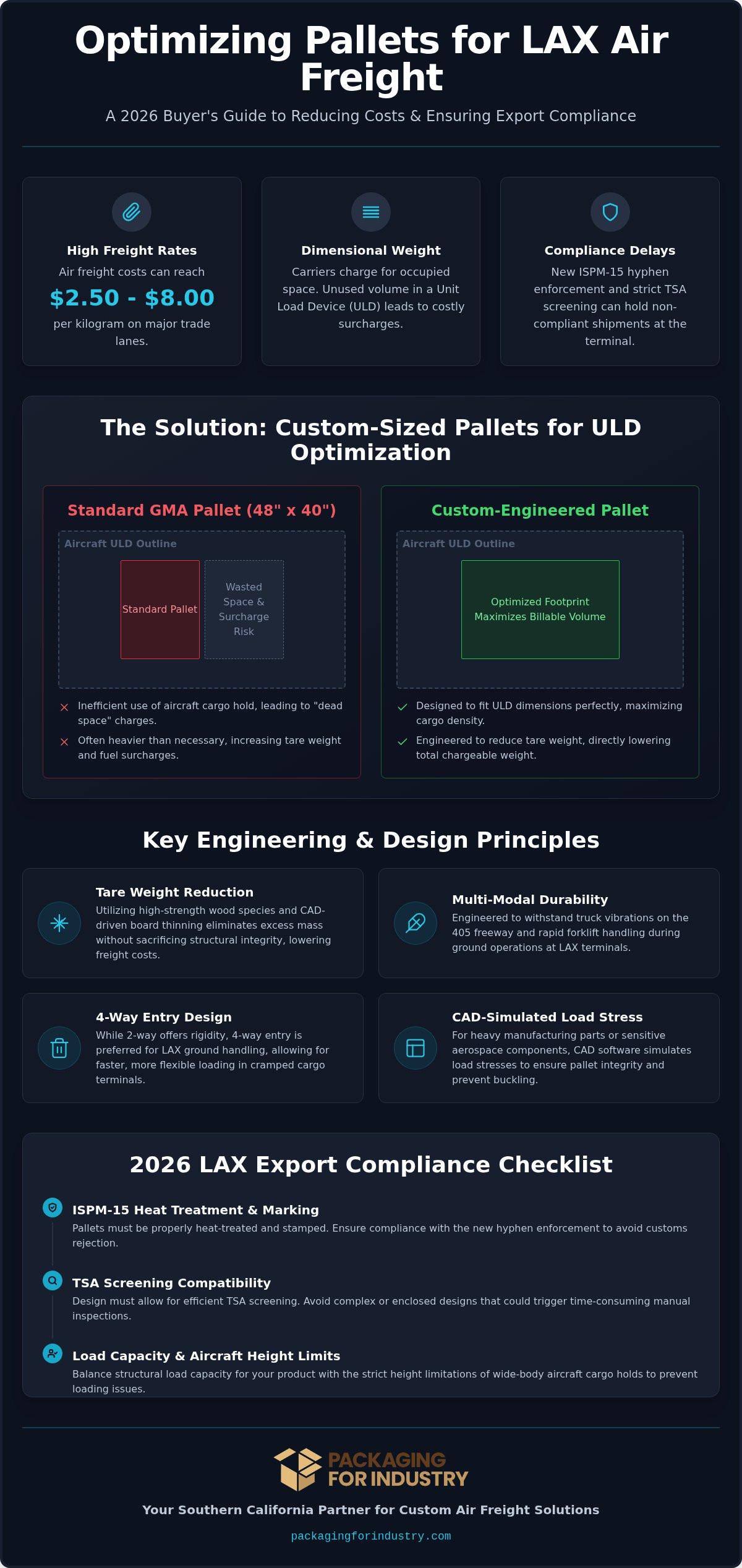
Using a “standard” pallet in an air cargo environment often results in “dead space” surcharges. Carriers charge based on the volume your shipment occupies. If your pallet footprint doesn’t sit flush within an LD3 or LD8 container, you’re essentially paying to ship air. Custom sizing allows you to maximize every square inch of the aircraft’s interior. We design footprints that match specific aircraft belly-hold dimensions, ensuring your cargo is stable and your billable volume is optimized. This precision is why manufacturers increasingly choose to compare packaging pricing for bespoke sizes rather than settling for stock options that don’t fit the ULD profile.
The Role of Multi-Modal Transit in Pallet Design
Air freight doesn’t exist in a vacuum. Your pallets must endure the vibration of a truck on the 405 freeway and the high-speed sorting at an LAX terminal. Designing for this transition requires a focus on forklift safety and structural integrity. For sensitive sectors, integrating custom design packaging into the pallet base ensures that high-value aerospace or medical components remain stationary during flight. A well-engineered pallet acts as the foundation for the entire protective system. It prevents the shifting and impact damage that often occurs during the frantic pace of international ground handling at major hubs.
Engineering Custom Pallets for Weight Reduction and Durability
Engineering custom pallets for air freight from LAX is a technical discipline that bridges the gap between industrial durability and aviation economics. Unlike standard pallets that rely on sheer mass for stability, air cargo solutions must be engineered to remove every unnecessary ounce. We analyze the specific center of gravity for your equipment to determine where reinforcement is mandatory and where we can reduce material. This often involves choosing between 2-way and 4-way entry designs. While 2-way pallets offer slightly more rigid stringer support, 4-way entry is often preferred for LAX ground handling because it allows for faster, more flexible loading in the cramped environments of a cargo terminal. For heavy manufacturing parts, we utilize CAD software to simulate load stresses, ensuring the pallet won’t buckle under the pressure of multi-modal transit.
Reducing Tare Weight to Lower Freight Costs
The financial incentive for lightweighting is undeniable. If you’re shipping weekly, the cumulative cost of heavy pallets can erode your margins. We help you calculate the ROI of shifting to a custom-engineered solution by comparing the initial pallet cost against the projected fuel surcharge savings over a year. PFI reduces tare weight for LAX exporters by utilizing high-strength wood species and precision CAD-driven board thinning to eliminate excess mass without compromising structural integrity. Our Anaheim facility provides free prototyping, allowing us to build and test physical models of your custom pallets for air freight from LAX. This ensures the weight-to-strength ratio is perfectly tuned for your specific cargo. Before you settle for a heavy catalog option, you should request a packaging quote to see how an optimized design impacts your bottom line.
Load Distribution and Shock Absorption
Protecting high-value cargo during flight requires more than just a sturdy base. Air turbulence and rapid descent can create significant vertical G-forces that lead to “point loading” damage. We mitigate this by integrating foam packaging directly into the pallet’s structure to act as a vibration dampener. This is particularly critical for aerospace components and medical devices that cannot tolerate high-frequency vibrations. Additionally, we use heavy-duty corrugated inserts to stabilize internal loads and prevent shifting. All our wood materials are treated to meet ISPM-15 standards, ensuring your shipment is compliant for international export. This holistic engineering approach ensures your freight is TSA-ready and protected from the moment it leaves your warehouse until it reaches its final destination.
Material Selection: Balancing Tare Weight and Load Capacity
Material choice is the final step in balancing the weight-to-strength equation for international shipping. For aerospace components and sensitive electronics, the goal is to minimize tare weight without sacrificing the structural integrity needed for high-altitude transit. Softwood remains the industry standard for custom pallets for air freight from LAX because it offers a superior strength-to-weight ratio compared to dense hardwoods. However, we are seeing a significant rise in hybrid designs. These combine a heat-treated wood frame with heavy-duty triple-wall corrugated decks. This hybrid approach provides the rigidity required for airline conveyor systems while stripping away unnecessary pounds that would otherwise inflate your air freight bill.
For ultra-light shipments, specifically in the medical or electronics sectors, a full corrugated pallet can be an effective solution. These are constructed from heavy-duty triple-wall corrugated material, capable of supporting substantial static loads while weighing a fraction of a traditional wood pallet. When you compare packaging pricing, the reduced fuel surcharges often offset the cost of these specialized materials. We find that many clients moving high-volume, low-weight goods can realize immediate cost avoidance by switching from standard GMA pallets to these bespoke, lightweight alternatives.
Heat-Treated Wood and International Standards
International air cargo departing from LAX must strictly adhere to ISPM-15 regulations. We exclusively use heat-treated (HT) lumber to ensure your shipments are never quarantined or rejected at destination ports. While plastic pallets are an alternative, they are often heavier and more expensive for one-way international air lanes. We typically recommend HT softwood for its recyclability and cost-effectiveness. Consider these primary material types for your next shipment:
- HT Softwood: Best for standard air freight; light, compliant, and cost-effective.
- Hardwood: Reserved for oversized industrial machinery; provides maximum durability but higher tare weight.
- Hybrid: Ideal for high-value components; balances weight and protection with multi-material engineering.
- Triple-Wall Corrugated: Best for e-commerce and light electronics; provides the lowest possible tare weight.
Specialized Protection for High-Value Goods
Securing the load to the pallet is as critical as the pallet itself. We utilize corner and edge protection to stabilize palletized loads and prevent strap damage during the rapid acceleration and deceleration of flight. For electronics, we incorporate anti-static (ESD) materials to prevent discharge during transit. This focus on TSA-Ready Packaging ensures that your freight remains stable and secure through the mandatory 100% cargo screening process at LAX. For oversized industrial parts, we design custom skids that provide the necessary clearance for specialized ground handling equipment, ensuring your cargo is handled safely from the warehouse to the tarmac.
Compliance and Safety: ISPM-15 and TSA-Ready Packaging
Ensuring your custom pallets for air freight from LAX meet regulatory standards is just as critical as their weight-bearing capacity. If a shipment arrives at the terminal with non-compliant wood packaging, it becomes “frustrated cargo.” This means your goods are pulled from the flight queue, leading to missed deadlines and expensive terminal storage fees. Compliance isn’t just about the physical pallet; it’s about the verifiable documentation and markings that allow your cargo to move through international customs without friction. We focus on these details so your operations team doesn’t have to manage terminal rejections.
International Export Regulations for Wood Packaging
The International Standards for Phytosanitary Measures No. 15 (ISPM-15) are strictly enforced for all outbound air cargo from the US. Effective January 1, 2026, the USDA has resumed full enforcement of the hyphen requirement in the ISPM-15 mark, which separates the country code from the facility code. We ensure that every custom export pallet we manufacture features the official IPPC stamp on at least two opposite sides. This mark must be clear, legible, and permanent. It cannot be red or orange. Our process utilizes heat-treated lumber that has reached a core temperature of 56°C for 30 continuous minutes, eliminating the risk of pest transfer. Using non-HT pallets for international air freight leads to immediate quarantine, potential destruction of the wood packaging, and thousands of dollars in terminal storage fees and delayed delivery penalties.
Security-Friendly Pallet Design
TSA screening protocols at LAX are rigorous. Every palletized load must undergo 100% cargo screening, which typically involves high-capacity X-ray systems or K9 explosive detection teams. We design our pallets to be “security-friendly,” ensuring that the structure doesn’t interfere with the clarity of X-ray imaging. This includes optimizing the density of the wood and the placement of fasteners. To maintain the integrity of the shipment after it has been cleared, we recommend the application of tamper-evident stretch film. This provides a visual indicator of any unauthorized access and helps secure the load during the high-speed handling common in LAX ground operations. By combining these security features with our ISPM-15 expertise, we help you avoid the logistical bottlenecks that plague non-compliant exporters.
PFI: Your Local Partner for Custom Air Freight Solutions in Southern California
PFI serves as more than a supplier; we act as a seasoned industrial consultant for Southern California’s manufacturing core. From our Anaheim headquarters, we provide the engineering oversight and logistical speed required to keep high-value supply chains moving through LAX. Choosing custom pallets for air freight from LAX shouldn’t involve the long lead times of national catalogs or the uncertainty of distant manufacturers. Our local presence allows us to offer free prototyping and CAD design, ensuring your pallet is optimized for weight and strength before you commit to a bulk order. We focus on the intersection of engineering and economics to ensure your freight is protected while your shipping costs remain controlled.
Local Expertise in Southern California Logistics
Proximity to the port of exit is a strategic advantage for just-in-time operations. We understand the specific pressures of the Carson and Torrance industrial corridors. Because we manufacture locally, we can offer next-day delivery to LAX-adjacent facilities, preventing the bottlenecks that occur when stock pallets run low. This local focus extends across the Inland Empire and Orange County, supporting aerospace and electronics hubs with “no fluff” industrial-grade solutions. We prioritize stability and reliability, ensuring that your operational challenges are met with pragmatic, engineering-minded responses that stabilize your logistical flow.
Streamlining Procurement with Integrated Solutions
Procurement efficiency is as vital as pallet durability. We offer integrated packaging kitting that allows you to source custom pallets for air freight from LAX alongside heavy-duty corrugated boxes and precision foam inserts in a single order. This holistic approach reduces your total cost of ownership by eliminating the administrative burden of managing multiple vendors. To ensure you never face a stockout, we offer Vendor Managed Inventory (VMI) programs. We monitor your usage levels and replenish your supply automatically, providing peace of mind and allowing your team to focus on production rather than packaging shortages. When you’re ready to optimize your export workflow, you can request a quote to compare packaging pricing and explore our recurring stocking programs.
Optimizing Your 2026 LAX Export Operations
Optimizing your air cargo logistics requires a move away from standard warehouse pallets and toward precision-engineered solutions. By selecting custom pallets for air freight from LAX, you directly address the intersection of engineering and economics. You reduce total chargeable weight through strategic material selection and ensure 100% compliance with the latest ISPM-15 and TSA standards. This transition eliminates the risk of frustrated cargo and terminal rejections while lowering your long-term fuel surcharges.
PFI specializes in supporting the aerospace and industrial manufacturing sectors with high-performance packaging. Our Anaheim facility provides free custom prototyping to verify weight-to-strength ratios before production begins. This ensures your high-value cargo remains protected during the rigors of multi-modal transit. With local next-day delivery to LAX, Carson, and Torrance, we act as a dependable partner for your most critical international shipments. Our team understands the urgency of Southern California logistics and is ready to help you streamline your procurement while stabilizing your supply chain.
Let’s work together to build a more efficient and reliable export strategy for your business today.
Frequently Asked Questions
What is the standard size for an air freight pallet?
There’s no single standard size for the cargo itself, but the industry often refers to PMC or PAG base dimensions of 318 cm by 244 cm. Most shippers use custom dimensions to maximize the 163 cm height limit for lower-deck wide-body aircraft. We design custom footprints that prevent dead space and ensure stability within the carrier’s equipment, allowing you to lower packaging costs by optimizing every cubic inch of volume.
Do custom pallets for international air freight need to be heat treated?
Yes, all solid wood packaging must be heat treated and marked with the official IPPC stamp to meet ISPM-15 standards. Effective January 1, 2026, the USDA has resumed full enforcement of the hyphen requirement within the facility code. We exclusively use heat-treated softwood for our custom pallets for air freight from LAX to ensure your shipments pass through international customs without the risk of quarantine or expensive terminal rejections.
How does pallet weight affect the cost of air freight from LAX?
Pallet weight directly increases the chargeable weight of your shipment, which is the higher of actual weight or volumetric weight. With 2026 air freight rates reaching up to $8.00 per kilogram, every pound of tare weight adds significant expense. Our engineering team utilizes precision board thinning and high-strength softwood to reduce tare weight. This provides a pragmatic way to lower packaging costs over high-frequency shipping cycles without sacrificing structural integrity.
Can PFI design pallets for oversized aerospace components?
We specialize in custom skids and support structures for oversized aerospace and industrial manufacturing parts. Our Anaheim facility uses CAD design to create bespoke footprints that distribute heavy loads evenly, preventing damage during high-G maneuvers in flight. These custom sizes available through our prototyping service ensure that even complex, high-value components meet airline handling requirements. This precision keeps your freight secure throughout the entire multi-modal transit process to the LAX terminal.
What is the lead time for custom air freight pallets in Southern California?
Our standard lead times support just-in-time manufacturing schedules. For established customers, we offer local next-day delivery for recurring pallet designs. New custom projects typically begin with free prototyping at our Anaheim headquarters, followed by rapid production once the design is finalized. Our local presence allows us to bypass the delays associated with national suppliers. This ensures your export timeline remains stable and predictable while you compare packaging pricing for your specific shipping lanes.
Does PFI offer delivery to the LAX freight forwarding district?
We provide consistent next-day delivery services to the entire LAX freight forwarding district, including hubs in Carson and Torrance. Our local delivery fleet is optimized for Southern California traffic patterns, ensuring your pallets arrive before your cargo is staged for the tarmac. This localized service model supports your warehouse operations by reducing the need for on-site storage. It also allows for more flexible, responsive shipping schedules when your production demands change suddenly.
What materials are best for reducing air cargo tare weight?
Heat-treated softwood and triple-wall corrugated materials offer the best strength-to-weight ratios for modern air cargo. While hardwood is durable, its high density often leads to excessive tare weight surcharges. We frequently engineer hybrid solutions that combine a wood base for structural rigidity with corrugated decks to shed unnecessary pounds. These specialized material choices allow you to request a packaging quote that prioritizes fiscal responsibility and load safety for your specific international air lanes.
Is ISPM-15 compliance required for domestic air freight within the US?
ISPM-15 compliance isn’t required for domestic air freight between the 48 contiguous United States. However, shipments to US territories or international destinations via a domestic hub still require heat-treated wood. We recommend using compliant materials for all air cargo to maintain operational flexibility. This approach ensures your custom pallets for air freight from LAX are ready for any destination. It prevents the need for repackaging if your logistics team changes a shipment’s final destination.