
A standard 48×40 pallet is often the most expensive component in your supply chain. This isn’t due to the unit price, but because of the shipping damage and freight surcharges it invites when your product doesn’t fit its dimensions. You likely already know that product overhang is a recipe for disaster in a high-velocity warehouse, yet finding a reliable source for custom pallets for non-standard product footprints Orange County can feel like a logistical hurdle in itself. Using the wrong base for a heavy or oversized load doesn’t just risk the inventory; it compromises your operational efficiency and bottom line.
We understand that your specialized equipment or aerospace components require more than a one-size-fits-all solution. This article will teach you how to engineer custom pallets that eliminate shipping damage, reduce freight costs, and fit your unique product footprints perfectly. We’ll explore the benefits of precision-built skids and how a local, engineering-minded supplier can help you optimize warehouse racking space while ensuring your loads remain secure from the assembly line to the final destination.
Key Takeaways
- Identify why product overhang on standard 48×40 pallets is the leading cause of transit damage and how custom sizing eliminates this risk.
- Learn how engineering custom pallets for non-standard product footprints Orange County ensures structural integrity for heavy or non-uniform industrial loads.
- Discover how optimizing pallet dimensions can increase warehouse storage density by 15-20% and reduce total freight costs.
- Follow a two-step process for accurately specifying dimensions and center-of-gravity requirements to ensure a perfect product fit.
- Understand the operational advantages of partnering with a local Southern California supplier that offers Vendor Managed Inventory (VMI) to prevent supply chain disruptions.
The Risks of Using Standard Pallets for Non-Standard Product Footprints
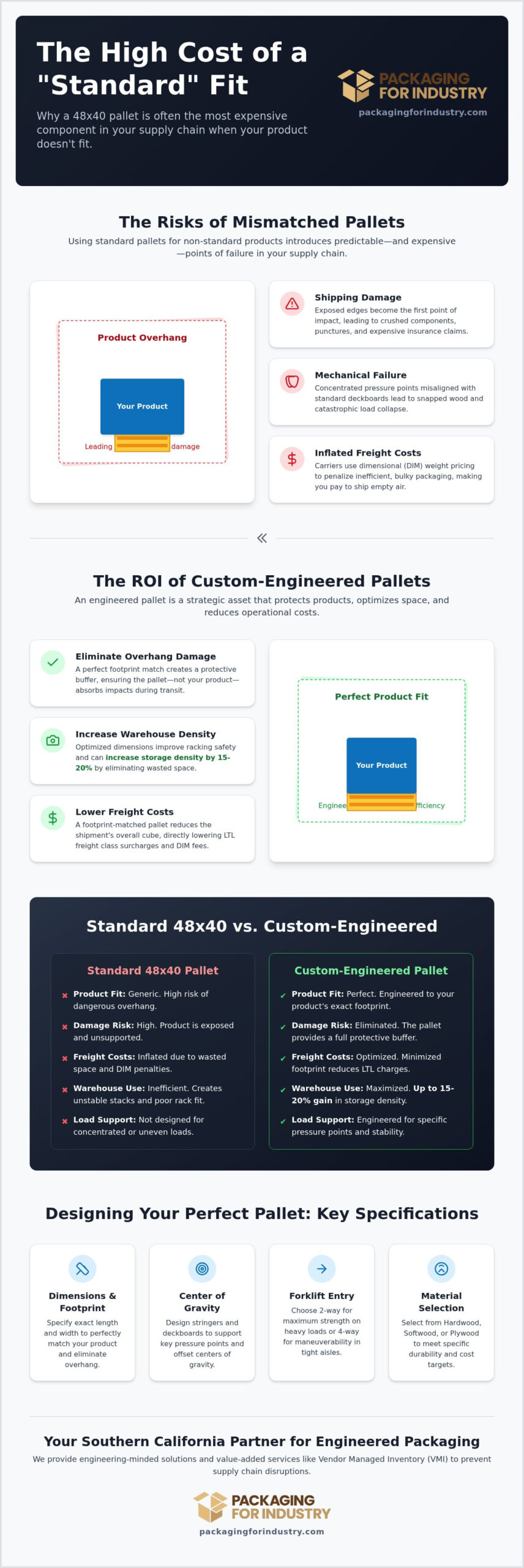
Logistical efficiency begins at the base of your shipment. While standard pallet designs and materials are effective for uniform consumer goods, they often become a liability in industrial environments. Product overhang is the leading cause of transit damage in Less-Than-Truckload (LTL) shipping. A pallet is designed to act as a protective buffer; however, when a product extends beyond the wood’s edge, that buffer disappears. The inventory itself becomes the first point of impact for forklift tines or shifting cargo in a crowded trailer, leading to punctured housings, crushed corners, and expensive insurance claims.
Mechanical failure is another significant risk when the pallet doesn’t match the load. Standard GMA pallets are engineered for evenly distributed weight. Industrial components often have concentrated pressure points or heavy internal motors that don’t align with standard deckboard spacing. This leads to deckboard snapping or stringer collapse during transit. Beyond the physical damage, using oversized pallets for smaller, heavy items creates a “wasted cube” problem. You end up paying to ship empty air because freight carriers bill based on the floor space occupied in the trailer. Footprint-matching resolves this by ensuring the pallet is exactly as large as it needs to be, improving warehouse racking safety by providing a stable, square base that sits securely on rack beams.
Identifying Non-Standard Shipping Challenges
Industrial products frequently feature offset centers of gravity or irregular bases that make standard palletizing impossible. Many operations attempt to solve this with make-shift bracing, using scrap wood or loose blocks to level a load. These temporary fixes are prone to shifting during the vibrations of transit, which can cause the entire shipment to tip. For high-stakes manufacturing packaging solutions, the pallet must be engineered as a custom interface between the product and the transport vehicle to ensure stability.
The Financial Impact of Poor Pallet Fit
The cost of a pallet is only a small fraction of the total cost of ownership. Carriers utilize dimensional (DIM) weight pricing to penalize shippers who use inefficient, bulky packaging. If your pallet is six inches wider than necessary, you’re paying a premium for that footprint on every mile of the journey. The administrative burden of processing damage claims and the lost opportunity cost of replacement shipments further drain your resources. Utilizing custom pallets for non-standard product footprints Orange County directly lowers LTL freight class surcharges by optimizing the shipment’s density and reducing the carrier’s risk of handling damage.
Engineering Custom Pallets: Materials and Design Specs for Industrial Loads
A custom pallet is more than just a wooden platform with unique dimensions. It’s a load-bearing structure engineered specifically for a product’s unique weight distribution and center of gravity. When you’re dealing with oversized machinery or delicate aerospace components, the structural integrity of the base determines the safety of the entire shipment. Adhering to OSHA safety regulations for material handling requires a stable base that prevents shifting or collapse during high-velocity warehouse movements. Engineering custom pallets for non-standard product footprints Orange County involves analyzing how the load interacts with the wood, ensuring that stringers are placed directly under the product’s primary pressure points rather than in a generic grid.
Entry requirements also dictate design. For oversized footprints, a 2-way entry design often provides superior strength because the solid stringers run the full length of the pallet without being notched for forklift tines. This is ideal for heavy, long items like industrial piping or structural steel. Conversely, 4-way entry designs utilize blocks or notched stringers to allow forklift access from any side, which is critical for maneuvering large loads in tight warehouse aisles. For machinery that lacks a uniform flat base, we specify heavy-duty skids. These lack bottom deckboards, allowing the product to sit lower to the ground or be bolted directly to the frame for maximum stability.
Material Selection: Hardwood, Softwood, and Plywood
The choice of lumber impacts both durability and cost. Hardwood is specified for high-density, small-footprint items that exert extreme pressure on small areas. Softwood is the standard for most industrial applications, offering a balance of strength and weight. For products requiring a completely smooth, gap-free surface, such as medical devices or electronics, plywood deck options eliminate the risk of items falling through gaps or being snagged by wood grain. For international shipments, ISPM-15 heat treatment is mandatory. As of January 1, 2026, USDA APHIS has resumed full enforcement of these marking requirements, including the mandatory hyphen separating the country and producer codes.
Structural Design: Stringer vs. Block Pallet Configurations
Stringer pallets are the workhorse for long, narrow products, providing rigid support along the length of the load. Block pallets offer multi-directional handling, which is helpful for complex distribution routes. If you need to maximize surface area without increasing the base footprint, “wing” pallets allow the deckboards to extend beyond the stringers. This provides extra space for protective foam or corrugated shrouds. When designing your solution, we specify deckboard thickness based on whether the product presents a point-load or a distributed-load. If you aren’t sure which configuration fits your needs, you can request a custom packaging quote to review your specs with an engineer.
Cost-Benefit Analysis: Standard 48×40 vs. Custom-Engineered Pallets
Procurement managers often find that looking only at the unit price of a standard 48×40 GMA pallet obscures the Total Cost of Ownership (TCO). While a stock pallet may seem cheaper upfront, it frequently introduces hidden expenses that erode your margins. When you invest in custom pallets for non-standard product footprints Orange County, you’re paying for an engineered solution that eliminates the secondary costs of transit damage and inefficient labor. It’s essential to compare packaging pricing through the lens of operational throughput rather than just material cost. According to academic research on pallet performance, matching structural stiffness to the specific load prevents mechanical failure during the dynamic stresses of shipping.
Operational efficiency also improves through better space utilization. By sizing the pallet to the product, you can often increase your warehouse storage density by 15-20%. This allows you to store more inventory in the same square footage without expanding your facility. Custom designs offer significant labor savings because your team won’t need to spend time on manual blocking and bracing to secure a small item on a large pallet. A “drop-in” fit simplifies the packing process, allowing for faster throughput. You’ll also see a measurable reduction in the consumption of stretch film and corner protection, as a properly sized base provides inherent stability that doesn’t require excessive secondary packaging to maintain.
Reducing Freight Costs and Surcharges
Common carriers are increasingly aggressive with “overhang” fees and dimensional weight surcharges. Custom footprints ensure your load stays within the pallet’s perimeter, maximizing trailer “floor spots” and allowing for more efficient loading patterns. This type of optimization is a core component of how we help you lower packaging costs and reduce shipping damage simultaneously. By eliminating wasted space in the trailer, you reduce the total number of shipments required to move your inventory.
Improving Safety and Racking Compliance
Safety is a non-negotiable industrial requirement. Standard pallets used for non-standard loads can lead to “rack-through” accidents, where an unstable base slips between the racking beams. Custom engineering ensures uniform load distribution, which is vital for forklift safety during high-reach maneuvers. By eliminating top-heavy or unbalanced loads, you reduce worker compensation risks and create a more predictable, secure environment for your warehouse personnel. If you’re ready to evaluate your current setup, you can request a packaging quote to see the potential ROI on a custom design.
Specifying Your Custom Pallet Requirements in Orange County
Transitioning from a standard GMA pallet to an engineered solution requires a precise transfer of data. To secure an optimized quote for custom pallets for non-standard product footprints Orange County, you must provide specific data points that go beyond basic dimensions. This information allows our team to calculate the necessary lumber grades and structural reinforcements needed to protect your inventory. Follow these five steps to define your requirements:
- Step 1: Provide accurate product dimensions. Measure the total Length, Width, and Height of the item as it will sit on the pallet.
- Step 2: Define total weight and center of gravity. Heavily offset loads require specific stringer placement to prevent the pallet from tipping during forklift maneuvers.
- Step 3: Specify the handling environment. Identify if the pallet will be moved by a standard forklift, a narrow-aisle pallet jack, or an automated conveyor system.
- Step 4: Determine international export compliance. Confirm if the wood must be ISPM-15 heat-treated for international transit.
- Step 5: Request a prototype. Physical fit testing is the only way to ensure that your non-standard footprint integrates perfectly with the pallet base before committing to a bulk order.
Measuring for a Precise Footprint Fit
When measuring your equipment, we recommend adding a 1-inch safety buffer to the pallet dimensions. This small margin prevents the product from sitting flush against the edge, which reduces the risk of impact damage from adjacent cargo. You must also account for any protruding parts, such as valves, handles, or delicate hardware, that could be snapped off if they extend past the deckboards. It is vital to distinguish between your static and dynamic load capacity requirements; the static load refers to the weight the pallet supports while sitting on a flat floor or racked, while the dynamic load is the weight it must support while being moved by a forklift.
Local Logistics: Anaheim and Southern California Delivery
Sourcing your wood packaging from an Anaheim-based manufacturer provides a distinct competitive advantage. Our proximity to major industrial hubs allows us to offer next-day local delivery for many production lines in Orange County. This localized service reduces lead times and eliminates the high shipping costs associated with transporting bulky, empty pallets from out-of-state suppliers. Additionally, our location near the Port of Long Beach ensures that export-ready wood packaging can be delivered to your facility or the terminal with minimal transit time, keeping your international supply chain moving without delay.
Why Packaging For Industry (PFI) is the Preferred Pallet Partner
PFI operates as an engineering-minded consultant rather than a simple commodity vendor. As a leading bulk packaging supplier, we understand that your supply chain reliability depends on the structural integrity of your shipping base. If you’re searching for an industrial packaging supplier near me or specifically an Orange County packaging supplier, we provide localized support that larger catalog companies can’t match. When you require custom pallets for non-standard product footprints Orange County, our Vendor Managed Inventory (VMI) programs ensure your production lines never stall due to a shortage, while our free prototyping service guarantees every design works perfectly before a full rollout.
Beyond wood packaging, we provide a single point of contact for complex industrial needs. We specialize in integrated kits that combine pallets with protective foam packaging and heavy-duty custom corrugated boxes to streamline your receiving process. For manufacturers requiring custom boxes in Anaheim or specialized aerospace packaging, we offer total oversight of the protection system. Our inventory also includes high-performance stretch wrap supplier options and wholesale packaging supplies, allowing you to consolidate your procurement and reduce administrative overhead.
Request a Custom Pallet Quote Today
Requesting a custom packaging quote is a direct process focused on your specific operational constraints. We serve businesses across Southern California with Anaheim-based manufacturing that ensures fast turnaround times and reliable local delivery. Our team is ready to help you optimize your shipping footprint and lower your total packaging costs through precision engineering and logistical optimization.
Optimize Your Industrial Shipping Footprint
Standard pallets are a compromise your high-value inventory can’t afford. Switching to an engineered base eliminates the mechanical failures and freight surcharges associated with product overhang. Our Anaheim-based manufacturing ensures your team receives fast, reliable delivery without the lead-time delays of out-of-state suppliers. We specialize in mil-spec and aerospace compliance; this provides the technical expertise required for complex Southern California logistics. Investing in custom pallets for non-standard product footprints Orange County is a strategic move to improve warehouse density and reduce your total cost of ownership.
We offer free prototyping for custom engineering projects to guarantee a perfect fit before your first shipment leaves the dock. Our team is ready to help you build a more reliable and cost-effective supply chain today.
Frequently Asked Questions
What is the difference between a custom pallet and a custom skid?
A custom pallet includes bottom deckboards to provide structural stability for racking and stacking, while a custom skid is built without a bottom deck. Skids are often preferred for heavy machinery because they allow for bolting equipment directly to the frame and provide a lower profile for transport. However, skids are less stable for stacking and may not be compatible with all warehouse racking systems. Choosing the right structure depends on your specific handling environment and storage requirements.
How much does a custom wood pallet cost in Orange County?
Pricing for custom pallets for non-standard product footprints Orange County depends on three primary factors: dimensions, lumber grade, and order volume. While standard GMA pallets have fixed market rates, a custom solution is priced based on the specific engineering and material requirements of your load. We focus on reducing your total cost of ownership by eliminating shipping damage and freight surcharges, which often provides a higher return on investment than purchasing stock pallets.
Can you build pallets for extremely heavy loads, such as 5,000+ lbs?
Yes, we engineer heavy-duty pallets and skids specifically designed to support industrial loads exceeding 5,000 lbs. Supporting these weights requires selecting high-density hardwoods and increasing the number or thickness of the stringers to prevent deckboard deflection. We analyze the pressure points of your equipment to ensure the pallet doesn’t fail under non-uniform loads. This engineering-first approach is vital for the safe transport of heavy machinery, aerospace components, and large-scale manufacturing equipment.
Do you offer heat-treated (ISPM-15) pallets for international shipping from Anaheim?
We provide fully compliant ISPM-15 heat-treated pallets for all international exports from our Anaheim facility. Our wood packaging meets the latest USDA APHIS enforcement standards, which include specific marking requirements to ensure your shipments aren’t detained at customs. This is a critical requirement for aerospace, medical, and electronics companies in Orange County that ship products globally. Using certified heat-treated wood prevents the spread of wood-borne pests and ensures seamless international transit.
What information do I need to provide for a custom pallet quote?
To receive an accurate custom packaging quote, you should provide the product’s length, width, and height, along with the total weight. It’s also helpful to identify the center of gravity and specify if the load is static or dynamic. Knowing your handling method, such as whether you use a forklift or a pallet jack, allows us to design the entry points correctly. This data ensures the engineered solution fits your footprint and warehouse equipment perfectly.
Do you have a minimum order quantity for custom-sized pallets?
We primarily focus on bulk packaging for industrial, manufacturing, and warehouse operations in Southern California. While we don’t typically fulfill single-unit orders, we provide free prototyping for custom engineering projects to ensure the design meets your specifications before moving into bulk production. This approach helps procurement managers verify the product fit and structural integrity, which reduces the risk of costly errors during a full-scale rollout of new product lines.
How quickly can I get custom pallets delivered in Southern California?
Local businesses in Anaheim and Orange County can benefit from next-day delivery once a custom pallet design is finalized and in production. Our proximity to major Southern California industrial hubs allows us to maintain a highly responsive supply chain that catalog suppliers can’t match. By manufacturing locally, we reduce the lead times and shipping costs associated with transporting bulky pallets, helping you maintain a just-in-time inventory model for your production facility.
Can you integrate foam inserts or cushioning directly onto the pallet?
PFI specializes in integrated packaging solutions that combine custom foam packaging with engineered wood pallets. We can bolt or glue protective foam inserts directly onto the pallet deck to create a secure nest for delicate or irregular parts. This is an ideal solution for aerospace and medical device manufacturers who need to protect sensitive hardware from vibration and impact. Ordering an integrated kit under a single SKU simplifies your procurement and ensures total component protection.