
What if the cushioning around your part allows the movement that causes shipping damage? For unusual shapes or sensitive components, standard packaging may leave gaps, put pressure on the wrong areas, or slow down pack-out. Polyethylene custom foam packaging inserts can be shaped around the product and its shipping needs instead of forcing the product to fit a standard insert.
If parts arrive damaged despite existing cushioning, adding more material is not always the answer. Fit, handling conditions, and the outer package all affect how well an insert protects a shipment. For manufacturers in Los Angeles, the design and repeat supply also need to fit purchasing schedules and warehouse operations.
This article explains how to specify polyethylene foam inserts using product dimensions, handling, and shipping information. You’ll learn what details help guide the design, how prototypes and samples support evaluation, and how foam can work with corrugated boxes or wood crates. The goal is a practical packaging solution that holds parts securely, supports efficient pack-out, and can be planned for recurring orders.
Key Takeaways
- Assess whether polyethylene custom foam packaging inserts suit parts with unusual geometry, fragile features, or repeat-shipping needs.
- Prepare useful design inputs by recording product dimensions, weight, orientation, accessories, handling, and contact points.
- Compare insert styles, general cushioning, foam-lined boxes, and foam-lined crates against your pack-out process and protection needs.
- Organize quote details, including damage history, current packaging components, shipment destinations, order quantities, and dimensional constraints.
- PFI supports custom foam projects with CAD/CAM, foam design, prototypes, and samples to help develop a production-ready approach.
When Do Polyethylene Custom Foam Packaging Inserts Make Sense?
A custom polyethylene foam insert is a shaped protective component designed around a product and its package. It can locate a part, separate components, and help limit movement during handling and shipment. Polyethylene (PE) is the base polymer used to make this foam; learn more about the material in this overview of polyethylene. The right material and insert layout depend on the product, shipping application, and packaging system, so one design will not suit every shipment.
Consider polyethylene custom foam packaging inserts when general cushioning leaves parts shifting, unusual geometry is difficult to secure, or recurring shipments need a consistent pack-out. A product-specific fit gives each item a defined position and can help employees follow the same packing process from shipment to shipment. This supports efforts to reduce shipping damage while making pack-out more repeatable.
What Makes a Polyethylene Foam Insert Custom?
The layout follows the product’s dimensions, contact points, orientation, and access requirements. Depending on the pack-out, cavities can locate individual parts, supports can hold specific areas in place, and compartments can keep accessories organized. The design also needs to fit inside the selected box or crate, with enough room for staff to load and remove the product during routine packing.
General cushioning can work when products vary or a flexible pack-out is useful. However, it may require packers to arrange material by hand each time, and it may not hold an unusual shape in a consistent position. PFI’s foam design capabilities include CAD/CAM support, prototypes, and samples to help teams evaluate fit and pack-out before production. Explore PFI’s foam packaging solutions for custom industrial applications.
Which Industrial Products Benefit from a Tailored Fit?
Electronics with protruding features, medical devices with specific handling needs, aerospace components with irregular profiles, and industrial equipment parts that travel repeatedly may benefit from a tailored insert. The decision depends on the part’s value, fragility, shape, handling, and shipping history. If a component arrives with marks, shifts inside its package, or needs careful positioning each time, review the fit and contact points before choosing an insert approach.
Industrial packaging also needs to work for production and distribution, not just protect an item once. Repeat shipments call for a pack-out that employees can reproduce and purchasing teams can plan to replenish. For manufacturers, distributors, and warehouses, insert design should support the full packaging process, including the outer box or crate and recurring supply needs. PFI serves industrial operations across Los Angeles, Orange County, San Diego, and Riverside with custom packaging solutions for repeat shipments.
How to Specify Polyethylene Foam Inserts for Your Product and Shipping Route
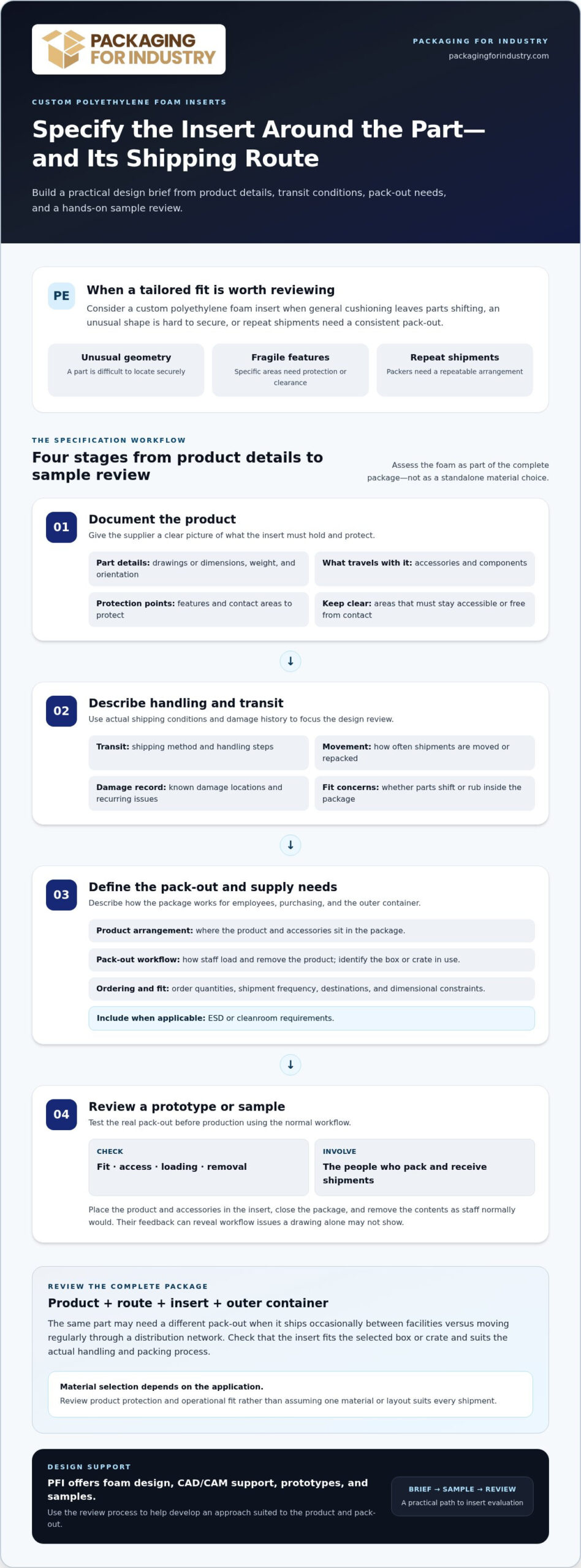
A useful insert brief connects the part to the way it moves through your operation and shipping network. Assess polyethylene custom foam packaging inserts as part of the complete package, including the box or crate, rather than as a standalone material choice. Share these details with your packaging supplier before finalizing the design:
- 1. Document the product. Provide part drawings or dimensions, weight, orientation, accessories, and the features or contact points that need protection. Identify areas that must remain accessible or free from contact.
- 2. Describe handling and transit. Outline the shipping method, handling steps, and how often shipments are moved or repacked. Note known damage locations and whether parts shift, rub, or arrive with recurring damage. This history helps focus the design review on actual shipping conditions.
- 3. Define the pack-out. Explain how the product and accessories should sit in the package, how staff load and remove them, and what outer packaging is in use. Include order quantities, shipment frequency, destinations, and dimensional constraints. If the application has ESD or cleanroom requirements, include those in the project brief.
- 4. Review a prototype or sample. Use it to assess fit, access, loading, and removal before production. Include the people who pack and receive shipments in the review, since they can identify workflow issues that a drawing alone may not reveal.
Review the Product and Route Together
The same part may need a different pack-out depending on whether it ships occasionally between facilities or moves regularly through a distribution network. Handling frequency, shipment method, damage patterns, and the outer container all inform insert design. Reviewing the complete package can show whether the foam layout fits the available box or crate and works with the actual packing process.
Choose materials based on the application rather than a universal assumption about performance. If environmental impacts are part of your material review, Michigan State University’s environmental life cycle assessments provide research on polyethylene packaging and alternatives. Consider this alongside product protection and operational fit.
Use the Sample to Check the Pack-Out
During a sample review, have packers place the product and accessories into the insert, close the package, and remove the contents using the normal workflow. Record fit concerns, difficult access, unwanted movement, or steps that could slow packing. PFI’s custom packaging design services include foam design, CAD/CAM support, prototypes, and samples to help develop and evaluate a project-specific approach.
Once you have assembled the product and route details, request a foam packaging quote to discuss a design that fits your shipping and repeat-order needs.
Polyethylene Foam Inserts Compared with Other Packaging Approaches
The right format depends on the product’s shape, shipping conditions, and packing workflow. A tailored insert gives each component a defined position, while general cushioning offers a more flexible approach. Foam-lined boxes and crates combine cushioning with an outer package. Compare the options against your protection needs and pack-out process rather than assuming one format suits every shipment.
| Approach | Fit | Pack-out repeatability | Package integration | Consider when |
|---|---|---|---|---|
| Tailored polyethylene insert | Shaped around a specific product or set of components | Can provide defined placement for recurring shipments | Designed to work inside a selected box or crate | Unusual geometry, fragile features, or a consistent pack-out matter |
| General cushioning | Flexible; typically arranged around the product during packing | May depend more on packer technique | Can be used with different outer packages | Products or pack-outs vary and flexibility is useful |
| Foam-lined box | Foam and corrugated box are considered together | Can support a repeatable box-based pack-out | Combines interior cushioning with a corrugated outer package | The shipment needs coordinated foam and box dimensions |
| Foam-lined crate | Foam layout is planned for the product within a crate | Can organize a recurring crate pack-out | Pairs interior foam with a wood crate | The product and shipping plan call for a crate-based solution |
When Is a Custom Insert Preferable to General Cushioning?
A shaped insert can make product placement more consistent across repeat shipments because the packer has designated locations for the part and its accessories. Loose fill or general-purpose cushioning can be rearranged for different items, but may require more judgment during each pack-out. For an electronics assembly, medical device, aerospace component, or industrial equipment part, consider whether the shape and handling process call for defined support or adaptable cushioning. Choose based on the product and shipping application, not an assumed protection level.
Should the Insert Be Paired with a Box or Crate?
Assess the insert alongside the outer package. A foam layout that suits a part still needs to fit the selected corrugated box or wood crate and work with how staff pack and handle it. Coordinating both can align product placement with the package format. Review PFI’s foam packaging options as part of that planning.
For a quote, share the product, shipping route, and outer-package requirements for your polyethylene custom foam packaging inserts. Request a foam packaging quote to discuss an integrated packaging approach.
A Practical Checklist for Custom Polyethylene Foam Insert Projects
A clear project brief helps your packaging supplier assess insert design, prototype needs, and whether foam should be coordinated with a box or crate. Use this checklist to prepare a quote request for polyethylene custom foam packaging inserts and recurring industrial shipments.
What to Include in a Foam Packaging Quote Request
- Product details: Provide drawings or dimensions, product weight, photographs, orientation, accessories, and features that need protection or access.
- Shipping conditions: Describe handling steps, shipping methods, shipment destinations, and any known damage locations. Note whether parts shift, rub, or arrive with a recurring issue.
- Current pack-out: List packaging components already in use, such as cushioning, corrugated boxes, crates, or foam-lined assemblies. Include known dimensional constraints for the insert and outer package.
- Order requirements: Estimate order volumes and shipment frequency. Include expected replenishment patterns and any planned changes to the product, quantities, or packaging.
These details give the design team practical context. For example, an insert for a part packed with accessories needs to account for those components as well as the main product. Existing boxes or crates also affect available space and how the complete package is handled. A packaging review can help determine whether the project calls for a custom insert, a coordinated foam-and-box solution, or another pack-out approach.
Assess Readiness for Repeat Orders
Repeat supply depends on more than approving an insert shape. Review the design for consistency, test a sample in the actual packing process, and identify production quantities and likely replenishment patterns. Include employees who pack and receive shipments so they can flag practical issues before the design moves into recurring use.
PFI supports custom foam design, CAD/CAM, prototypes, and samples, as well as packaging solutions that coordinate foam with boxes or crates. Sharing expected order volumes and demand patterns helps frame a supply approach for ongoing industrial needs. It also gives purchasing teams useful information to compare packaging pricing and plan repeat orders.
Before submitting your project, check that the product information, damage history, shipping route, current packaging, and demand details are included. A clear brief makes it easier to evaluate insert fit and the full pack-out.
How PFI Develops Custom Polyethylene Foam Packaging Inserts
PFI develops polyethylene custom foam packaging inserts around the product, shipping conditions, and pack-out requirements. The process starts with the issue your team needs to address, such as product movement, a difficult fit, or an inconsistent packing routine. Product and shipping details then guide design, review, and production planning.
From Packaging Problem to Reviewed Prototype
Share the product information and route details that shape the application. PFI’s foam design and CAD/CAM support translate those requirements into a custom insert concept. A prototype or sample lets your team assess fit and workflow before production. Feedback from employees who pack and receive shipments can help identify practical adjustments.
PFI’s development process follows four practical steps:
- Define the issue: Describe the fit, handling, or pack-out concern.
- Share requirements: Provide product details, shipping conditions, and outer-package information.
- Develop and review: Evaluate the design with a prototype or sample.
- Plan production: Align the reviewed approach with expected quantities and repeat demand.
Plan Production and Supply for Industrial Needs
For ongoing orders, consider how custom sizes, bulk quantities, and replenishment patterns fit purchasing and warehouse needs. PFI can coordinate foam with corrugated boxes, crates, and other packaging components when the application calls for a complete package.
PFI is an industrial packaging supplier that connects custom design with the wider packaging and supply process. Its practical, industrial-focused approach supports manufacturers and operations teams managing custom projects and recurring orders. PFI serves customers in Los Angeles, Orange County, San Diego, and Riverside, and supports nationwide customers through distribution and manufacturing partners.
Share your product and shipping requirements to start planning an insert and supply approach that fits your operation.
Build a Packaging Plan Around Your Product
A dependable insert starts with the details: product dimensions, fragile areas, handling steps, shipping route, and how the team packs each order. Use that information to compare a tailored insert with general cushioning, then assess the design as part of the complete box or crate. For repeat shipments, consider whether the approved pack-out will be practical for staff and align with purchasing needs.
PFI supplies polyethylene foam and other protective foam packaging for industrial customers, with custom foam design, CAD/CAM support, prototypes, and samples to help move a project from packaging challenge to reviewed design. PFI can also coordinate foam with corrugated boxes, crates, and other packaging components for manufacturers and distribution operations in Los Angeles and throughout Orange County, San Diego, and Riverside.
Bring your product and shipping requirements together to plan fit, pack-out, and recurring supply.
A clear brief and product-specific plan give your team a practical starting point for a more consistent shipping process.
Frequently Asked Questions
What is polyethylene foam packaging used for in industrial shipping?
Polyethylene foam packaging cushions and organizes industrial products within a shipping package. A shaped insert can help locate a part, separate components, and reduce unwanted movement during handling and transit. Manufacturers may use it for electronics, medical devices, aerospace components, or industrial equipment. The appropriate design depends on the product, shipping conditions, and outer package, rather than a universal material or insert specification.
How do I specify custom polyethylene foam packaging inserts?
Specify polyethylene custom foam packaging inserts by documenting the part and how it will be shipped. Provide drawings or dimensions, product weight, orientation, fragile areas, accessories, and contact points. Describe handling steps, shipment frequency, destinations, and known damage patterns. Include details about the current box or crate and the intended pack-out. These inputs help guide a design review, sample evaluation, and planning for recurring orders.
Can polyethylene foam inserts be designed for irregularly shaped parts?
Yes. A custom insert layout can be developed around an irregular part’s dimensions, contours, contact points, and required access. The design may use shaped cavities, supports, or compartments to position the product and organize related components. Provide clear drawings, measurements, or photographs, along with the orientation used during packing. A prototype or sample can help your team review how the part fits and is loaded or removed.
Can custom foam inserts be combined with corrugated boxes or crates?
Yes. Foam inserts can be planned as part of a complete package with corrugated boxes or wood crates. Coordinating the insert with the outer container accounts for available space, product placement, and the pack-out process together. PFI supplies custom protective foam packaging and integrates foam with boxes or crates for industrial applications. The right combination depends on the product, shipping route, and handling requirements.
How can a prototype help evaluate a custom foam insert?
A prototype or sample lets your team assess fit and workflow before production. Use it to check whether the product and accessories load and come out as intended, whether the insert fits the outer package, and whether the pack-out is practical for employees. Involve staff who prepare and receive shipments. Their feedback can identify design or handling issues that drawings alone may not reveal.
What information should I provide when requesting a foam packaging quote?
Provide product drawings or dimensions, weight, photographs, orientation, fragile features, and accessories. Include the shipping method, destinations, handling steps, known damage history, and current packaging components. Add estimated quantities, shipment frequency, expected repeat demand, and any planned changes to the product or pack-out. If you need foam coordinated with a corrugated box or crate, include those requirements too. A complete brief helps focus the design and quote discussion.
Can polyethylene foam inserts support repeat production packaging?
Yes. A reviewed custom insert can support a consistent pack-out for recurring industrial shipments. Share expected order volumes, shipment frequency, and replenishment patterns so the design and supply plan can account for repeat demand. PFI provides custom foam design, CAD/CAM support, prototypes, and samples, and serves customers in Los Angeles, Orange County, San Diego, and Riverside. Nationwide support is provided through distribution and manufacturing partners.