
A shipping box can look right and still slow packing, increase shipping costs, or leave a product vulnerable in transit. For teams sourcing custom printed boxes for industrial e-commerce SoCal, appearance is only one part of the specification. Box size, corrugated construction, product protection, and clear identification all need to work together through fulfillment and parcel handling.
Choosing a carton is harder when products vary and supplier quotes use different specifications. A box that fits the packed product can reduce excess packaging and help reduce shipping damage, while consistent dimensions support efficient packing and repeat orders. PFI supplies custom and stock corrugated boxes, custom packaging design, free prototypes and samples, and printing up to four colors.
This guide explains how to match box design and print to your products and workflow, what details to prepare when comparing packaging pricing, and when stock cartons may suit the job. It also covers sourcing for Southern California businesses, including local next-day delivery across Orange, Los Angeles, San Diego, Riverside, and Ventura counties.
Key Takeaways
- Assess custom printed boxes for industrial e-commerce SoCal as a combined fit, protection, identification, and fulfillment decision.
- Build carton specifications in sequence: product, packed dimensions, shipping path, construction, then print.
- Compare custom and stock cartons against product consistency, storage capacity, and day-to-day packing needs.
- Prepare dimensions, construction preferences, print requirements, order volume, and delivery location before requesting a quote.
- Use order frequency and available storage space to plan replenishment for repeat shipments.
Why Custom Printed Boxes Matter for Industrial E-Commerce in SoCal
An industrial e-commerce carton has two jobs: protect the product during packing and shipment, and make the order easy to identify at each handoff. A manufacturer shipping replacement components directly to customers has different requirements from a distributor consolidating orders across several product lines. In both cases, a carton that fits the product and communicates useful information can support a more organized process, from warehouse pick to delivery.
A printed shipping carton is a working part of industrial e-commerce fulfillment. It contains the product and gives the people packing, handling, and receiving the shipment clear information.
Custom printed boxes for industrial e-commerce SoCal are designed around shipping work, not gift presentation. Corrugated construction forms the carton, while print can identify the sender, product, or handling requirements. A basic overview of corrugated fiberboard explains the material’s layered structure and common packaging uses. PFI’s corrugated box options help businesses specify cartons for shipping and fulfillment.
What printed cartons can do beyond displaying a logo
Consistent graphics can help warehouse teams distinguish a sender, product family, or shipment type. Depending on the workflow, printed areas can show a product name or item reference, order information, or handling notes. If the operation uses barcodes, reserve a clear, consistent area for them and verify that the printed design works with the scanning process. Printed details support identification, but they do not replace warehouse scanning or verification procedures.
Readability matters throughout the route. At packing, clear markings can help staff match a carton to an order. At receiving, they give the customer a visible reference for sorting incoming goods. Consistent placement and wording also make repeat shipments easier to recognize. Keep the print practical: prioritize information that supports the operation, and avoid adding graphics that complicate packing or obscure essential details.
When custom printed boxes fit an e-commerce operation
Consider custom cartons when orders recur, products come in distinct sizes, or shipments need consistent identification across product lines. A stock carton can work well for standardized products and stable shipping needs. But an ill-fitting stock substitute may leave excess space, make packing less consistent, or require additional materials to hold the item in place. The right choice depends on the product and shipment, not print alone.
Start with the packed product, including the protective materials used in the normal workflow. Then consider how the carton moves through packing, carrier handling, and customer receiving. A custom size and print layout may suit repeat orders; stock corrugated boxes may be practical when a standard size already fits. For Los Angeles manufacturers and distributors, compare protection, identification, and ordering patterns against day-to-day fulfillment needs.
How to Specify Custom Printed Boxes for Products and Fulfillment
A useful box specification connects the item being shipped to the way your team packs, identifies, and dispatches it. For custom printed boxes for industrial e-commerce SoCal, document the requirements in sequence before requesting a quote. This gives your corrugated box supplier a clear basis for comparing size, construction, and print options, and makes repeat orders easier to specify.
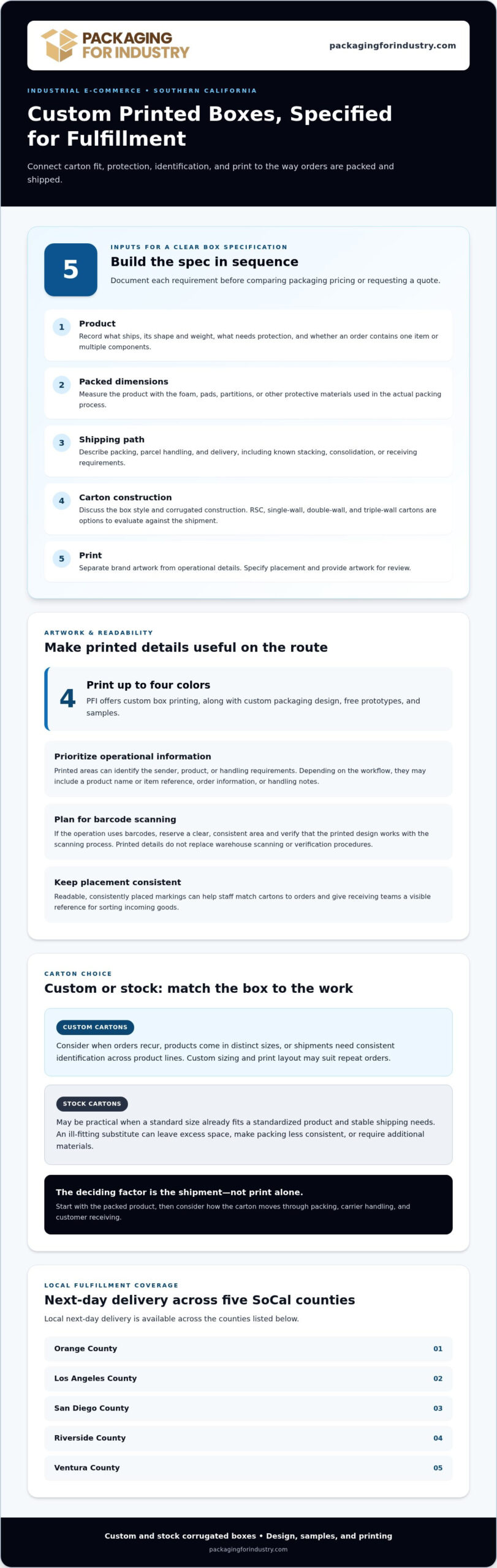
Work through these five inputs:
- Product: Record what ships, its shape and weight, and any features that need protection or separation. Note whether orders contain one item or multiple components.
- Packed dimensions: Measure the product with the protective materials used in your actual packing process. The bare item dimensions are not the final carton dimensions.
- Shipping path: Describe how orders move through packing, parcel handling, and delivery. Include known stacking, consolidation, or receiving requirements.
- Carton construction: Identify the box style and evaluate the corrugated construction against the product and handling needs. RSC, single-wall, double-wall, and triple-wall cartons are options to discuss, not automatic performance guarantees.
- Print: Separate brand artwork from the operational details staff or receivers need to read. Specify placement and provide artwork for review.
Match carton dimensions and construction to the shipment
Measure the product’s length, width, and height at its widest points. Then measure again after adding the foam, pads, partitions, or other protective materials used during packing. The second set of measurements reflects the packed item the carton needs to accommodate. For multi-part orders, consider whether partitions or inserts would keep components separated and organized more effectively than extra empty space.
Choose construction based on the shipment’s requirements. A single-wall carton may suit one product and route, while double-wall or triple-wall options may be worth evaluating for other loads and handling conditions. An RSC is a common carton style to specify alongside the construction. PFI’s custom packaging design can align the box with the item and fulfillment process; corrugated box construction and printing are part of that specification.
Set print priorities for warehouse and customer use
Keep brand graphics distinct from operational identification. A logo and sender details serve a different purpose from a product reference, order identifier, handling note, or designated barcode area. Make essential text easy to distinguish and keep its position consistent across repeat orders so staff know where to find it. The e-commerce packaging market trends provide broader context for considering corrugated materials and customized print.
PFI supplies custom printed corrugated boxes with print options up to four colors, along with free samples to review the proposed packaging. Share your artwork files and the information that must appear on the carton. A custom printed box quote can then reflect the product, packed dimensions, construction, and print priorities your operation has defined.
Custom Printed Boxes vs. Stock Cartons for E-Commerce Orders
Stock corrugated cartons can be practical when products share standard dimensions and shipments need little or no carton-specific printing. Custom printed boxes may be worth evaluating when products have distinct shapes or sizes, orders recur, or warehouse and customer teams need consistent shipment identification. Neither option is automatically better. Compare how each fits your products, packing routine, storage space, and order pattern.
| Decision factor | Stock cartons | Custom printed cartons |
|---|---|---|
| Fit | Uses available sizes; one carton may not closely fit every product. | Can be designed around a product or packed configuration. |
| May suit orders with limited carton-specific print needs. | Allows planned graphics and shipment identification. | |
| Order consistency | Works for stable orders using a standard size. | Can support a repeatable carton and print layout for recurring shipments. |
| Storage | Available sizes may require storing several cartons to cover different products. | Dedicated sizes may align with repeat product needs, while still requiring storage space. |
| Fulfillment use | Can suit straightforward packing with standardized products. | May fit distinct products or workflows with specific identification requirements. |
When stock corrugated boxes may be sufficient
Consider stock cartons if products have standardized dimensions, packed items fit available sizes, and print requirements are limited. They can also work well when order patterns are stable and the same cartons serve routine shipments. Review the sizes your operation actually uses: carrying more sizes can cover more products, but it can also affect storage organization. PFI offers corrugated cardboard boxes for businesses comparing stock and custom options.
When custom printed cartons offer a better operational fit
Evaluate custom cartons for products that do not fit available sizes well, recurring shipments that benefit from a consistent format, or orders that need distinct identification. Assess the carton alongside the product’s protection needs and shipping frequency. If added cushioning is needed, foam inserts can complement the box. Custom sizing and print may improve workflow fit, but do not automatically lower freight or packaging costs.
For a Los Angeles e-commerce operation, compare the options against actual orders rather than choosing by print alone. Note which products share a carton, where staff spend time adapting stock boxes, and whether storage can accommodate dedicated sizes. Then compare packaging pricing using the same requirements for fit, protection, print, and order frequency. This gives purchasing and fulfillment teams a clearer basis for choosing stock cartons, custom printed boxes, or a mix of both.
Plan a SoCal Box Quote Around Fulfillment and Delivery
A useful quote request gives a packaging supplier enough context to evaluate the carton as part of your e-commerce workflow, not as an isolated box. For custom printed boxes for industrial e-commerce SoCal, include product and packed dimensions, construction, print priorities, expected quantities, and delivery locations. These details help your team compare pricing against the same requirements and plan repeat supply with fewer assumptions.
What to include in a custom box quote request
Prepare the following details before requesting a corrugated box quote. If you ship more than one product, note which items share a carton and which need a separate size or print layout.
- Product and packed dimensions: Identify what ships and provide the final dimensions after adding protective materials.
- Intended use and construction: Describe the shipment and specify the carton style or construction you want evaluated.
- Print priorities: Provide artwork and identify the information needed for branding, warehouse identification, or customer receiving.
- Volume and order pattern: Estimate order quantities and explain how often you expect to reorder, including seasonal or uneven demand.
- Delivery and fulfillment locations: List receiving addresses or warehouse locations, along with packing or delivery considerations that affect replenishment.
For multiple facilities, separate quantities by location. This helps frame the quote and supply discussion around where cartons are used, not just the total order volume.
Coordinate Southern California delivery with replenishment
Order frequency and storage capacity should guide replenishment planning. A high-use carton with limited warehouse space may call for a different delivery rhythm than a slower-moving size that can be stored in greater quantities. Share typical usage and available storage to balance continuity of supply with the space your operation can allocate.
PFI offers next-day delivery in Orange, Los Angeles, San Diego, Riverside, and Ventura counties. Nationwide shipping is available separately and does not mean next-day delivery throughout the country. For an Anaheim or broader Orange County operation, include the receiving location and carton usage in your quote request so delivery and replenishment can be considered together.
Compare like-for-like requirements, then align recurring orders with demand and storage rather than relying on last-minute replenishment. That gives purchasing and warehouse teams a clearer basis for planning printed cartons across fulfillment locations in Orange County, Los Angeles, San Diego, and Riverside.
Get Custom Printed E-Commerce Boxes from PFI
For industrial e-commerce teams, the box has to suit both the product and the work around it. PFI supplies custom printed corrugated boxes and supports projects with CAD-engineered design, free prototypes and samples, and print options up to four colors. Custom and stock corrugated options help Southern California businesses match carton choices to each product and order pattern instead of defaulting to one format for every shipment.
How PFI supports a custom box project
A project starts with the packaging requirements: what ships, how it is packed, how the carton moves through fulfillment, and what information the print needs to carry. PFI’s custom packaging design and CAD/CAM support help develop a box concept around those inputs. A prototype or sample lets your team review the proposed format against its packing workflow before moving into production.
This sequence keeps design decisions connected. A change to the carton can affect product fit, protective materials, print placement, and how staff handle repeat orders. PFI’s custom packaging design support brings those considerations into box development, shaping the specification around the shipment rather than applying artwork to a generic carton.
Move from requirements to a quote
Before requesting a quote, gather the information that connects the box to actual e-commerce orders. Product dimensions alone are not enough if packing materials change the final fit. A print concept is also more useful when the required identification information is clear. Include repeat-order patterns and fulfillment needs so the sourcing discussion reflects how cartons will be used and replenished.
- Product and packed dimensions: Include the item and its packed size with the protective materials used in fulfillment.
- Construction and protection needs: Describe the carton construction to evaluate and how the shipment will be handled.
- Print priorities: Share usable artwork and identify essential brand and operational information.
- Order pattern: Outline expected quantities, reorder frequency, and differences among products or order types.
These details frame a quote around fit, protection, fulfillment, and supply requirements. They also make it easier to compare custom packaging solutions with stock cartons when a standard option may work. For businesses sourcing custom printed boxes for industrial e-commerce SoCal, PFI supports the process from design and sample review through recurring packaging needs.
Prepare your product dimensions, construction requirements, print priorities, and order pattern, then request a custom printed box quote.
Build a Box Program That Can Adapt
As your product mix and order patterns change, keep the packaging specification connected to the way your team fulfills orders. Maintain a clear reference for carton requirements and approved print so purchasing, warehouse, and fulfillment teams work from the same expectations as new orders are planned. That consistency makes future packaging decisions easier to evaluate.
For custom printed boxes for industrial e-commerce SoCal, turn current needs into a practical sourcing plan. Decide which requirements should stay consistent across repeat shipments and where different products or workflows call for a distinct carton. This gives your packaging program a useful foundation for adapting while keeping protection and identification in view.
Start with your product, packing process, and order pattern. PFI can help you develop a custom or stock carton specification around those requirements.
Frequently Asked Questions
How much do custom printed industrial e-commerce boxes cost?
Pricing depends on box specifications, including dimensions, construction, print requirements, materials, and order volume. For a project-specific quote, provide expected quantities by box size and note whether the order is a first run or a recurring requirement. This makes supplier comparisons more relevant. PFI’s stated cost savings are 15%–40% versus national competitors; individual pricing depends on the project. Request a quote based on your requirements.
Can custom printed boxes include partitions or inserts?
Yes. Corrugated packaging can include partitions, pads, sheets, or inserts to organize contents or separate products within an order. The right arrangement depends on the items being shipped and how your team prepares the package. If the product needs added cushioning, protective foam can be considered as a separate material. Review the complete package configuration to choose components suited to the shipment.
Does PFI provide samples before a custom box order?
Yes. PFI provides free prototypes and samples for custom packaging design. A sample lets purchasing, fulfillment, and receiving teams review the proposed design together and identify workflow concerns before a wider rollout. Share the intended packing setup and have the staff who handle orders assess how the package fits their process.
Can custom printed corrugated boxes be printed in more than four colors?
PFI’s custom printed corrugated boxes support printing up to four colors. Prioritize the brand elements and identification details that need to stand out, then organize secondary information so the design remains clear within that limit. Include the intended artwork with your quote request so print requirements can be considered alongside the carton specification.
Does PFI offer next-day delivery for custom printed boxes across the United States?
No. Next-day delivery is available in Orange, Los Angeles, San Diego, Riverside, and Ventura counties. PFI also provides nationwide shipping, which is separate from local next-day delivery. If your operation receives boxes at multiple facilities, include each destination in your purchasing plan so deliveries can be coordinated around actual usage.
Are corrugated boxes a recyclable packaging option?
Yes. PFI lists recyclable corrugated boxes among its sustainability options. Assess the complete package, not only the box, when planning disposal, since other materials may have different handling requirements. Review local recycling practices for the components in your shipment and consider how packing choices affect separation at the receiving site.