
What if a crate protects your product from impact but doesn’t address the shipment’s temperature requirements? For buyers evaluating custom shipping crates Orange County, that distinction matters. Crate design should reflect the product, route, and handling risks. Temperature control needs to be specified and verified separately.
A well-planned packaging request can help reduce damage and keep purchasing and shipping coordination manageable. But a crate alone isn’t proof that a temperature-sensitive shipment will stay within its required conditions. Start by documenting what’s being shipped, how it will move, and what protection it needs.
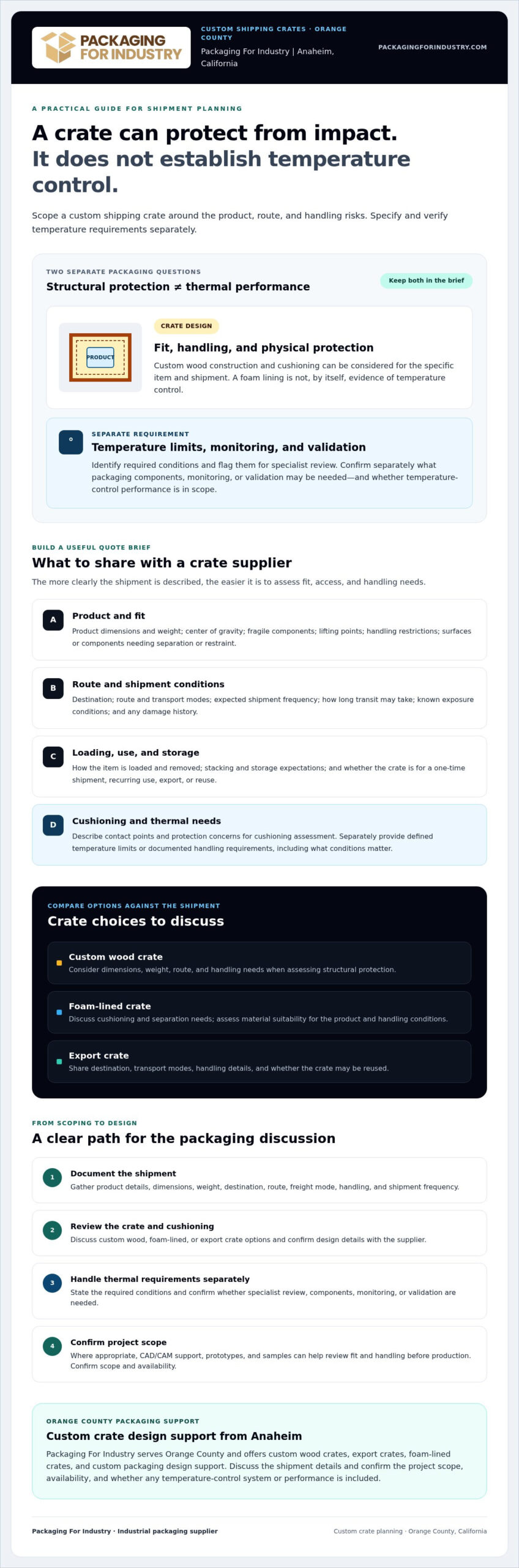
This article explains what to gather for a practical crate quote, including product dimensions, route, handling, and cushioning needs. It also covers when temperature requirements may call for additional packaging expertise. Packaging For Industry, an Anaheim-based industrial packaging supplier serving Orange County, offers custom wood crates, export crates, foam-lined crates, and custom packaging design support. Use the guidance below to scope the request and coordinate next steps without assuming the crate provides temperature control.
Key Takeaways
- For custom shipping crates Orange County, share product dimensions, weight, route, freight mode, and handling conditions so the crate can be assessed for the shipment.
- Compare custom wood, foam-lined, and export crate options against the shipment’s needs, then confirm design details with your supplier.
- Specify temperature requirements separately. Structural protection from a crate doesn’t establish or verify temperature control.
- Make a quote request more useful by including shipment frequency, destination, product details, and any thermal requirements.
- Packaging For Industry serves Orange County from Anaheim and offers custom crate design support, including prototypes and samples. Confirm project scope and availability when requesting a quote.
Custom shipping crates in Orange County: start with the shipment risks
A shipment can arrive damaged even when its crate looks intact. Unusual dimensions, heavy weight, fragile components, awkward lifting points, and transfers between transport modes can all affect packaging needs. For manufacturers and industrial buyers in Orange County and nearby areas, custom shipping crates Orange County sourcing should begin with the shipment’s actual risks, not a standard crate size.
A custom wood shipping crate is designed around a product’s dimensions and handling needs to provide structural protection during storage and transit. Temperature control is a separate requirement. A wood crate, including one with foam lining, shouldn’t be assumed to maintain a required temperature. Packaging For Industry offers custom wooden crates as part of its industrial packaging options.
What should an Orange County buyer tell a crate supplier?
These details help a supplier assess fit, access, and handling before preparing a design or quote:
- Product dimensions and weight, plus details about fragile components, lifting points, and handling restrictions.
- Destination, transport modes, expected shipment frequency, and any known damage history.
- Whether the crate is for a one-time shipment, recurring use, export, or reuse.
Also describe how the product is loaded and removed, if known. Sharing this information early helps surface design questions and can reduce avoidable revisions during coordination.
When does a shipment need temperature-controlled packaging?
Check whether the product has defined temperature limits or documented handling requirements. Ask the product team or shipper what conditions matter, how long transit may take, and what exposure the shipment could encounter. These requirements help determine whether the project needs expertise beyond structural crate design.
A cold chain is a temperature-controlled supply chain in which maintaining specified conditions may matter for goods such as certain foods or pharmaceuticals. The crate itself doesn’t establish that those conditions will be maintained. Flag thermal requirements for specialist review, and confirm separately what packaging components, monitoring, or validation the shipment may require. PFI offers crates and protective packaging, but buyers should confirm whether any temperature-control system or performance is in scope.
How custom crate design addresses fit, handling, and protection
Crate design involves more than the product’s outside dimensions. The packaging team needs to understand how the item will be positioned, lifted, moved, and secured, along with its route and protection needs. These details help shape a practical design around the product rather than forcing it into a standard configuration.
For buyers comparing custom shipping crates Orange County options, Packaging For Industry offers custom wood crates and foam-lined crates. The right approach depends on the shipment. Foam lining may be considered for cushioning or separation, but its suitability should be assessed for the specific product and handling conditions. Review the available custom wooden crates and discuss the application with the supplier.
Which crate and cushioning details belong in the specification?
Record the product’s dimensions, weight, and center of gravity. Identify surfaces or components that need separation or restraint, and describe how the item will be loaded and removed. Include known stacking and storage expectations, and say whether you may reuse the crate. These details help the design team consider product fit as well as the steps warehouse staff or carriers will take to handle the shipment.
If foam lining or other cushioning may be needed, describe the contact points and protection concerns, then ask the supplier to assess material suitability. Don’t assume a material is appropriate based on appearance alone. Packaging For Industry’s custom packaging design services include CAD/CAM support, prototypes, and samples. Where appropriate for the project, a prototype or sample can help the team review fit and handling before production.
How does temperature control change the packaging brief?
Protecting a product from ordinary ambient exposure is different from maintaining a defined temperature throughout transit. Ask the product owner for temperature limits and acceptance criteria, or consult a qualified thermal-packaging specialist if those requirements need to be established. The route and expected transit duration may also inform the review.
For food shipments, consult the FDA’s Sanitary Transportation of Human and Animal Food rule for applicable transportation requirements. A crate alone doesn’t demonstrate temperature control or compliance. Before approving a proposed thermal system, request written confirmation of its scope, any validation basis, and which supplier is responsible for each element. PFI offers crates and protective packaging; confirm separately whether thermal systems or temperature performance are included in a proposed project.
For a project-specific review, submit your crate and shipment requirements for a quote discussion.
Compare crate options for Orange County shipments and operating needs
Choose a crate by matching its use to the shipment, rather than assuming one style suits every product. Packaging For Industry offers custom wood crates, foam-lined crates, and export crates. The right choice depends on product fit, cushioning needs, handling, and route. For international transit, include the route and transfer points in the design discussion, then confirm the intended use with the supplier.
| Shipment need | Packaging question | Detail to confirm with the supplier |
|---|---|---|
| Unusual dimensions, heavy equipment, or specific handling needs | Would a custom wood crate suit the product and how it will be moved? | Product measurements, weight, lifting method, loading access, and handling restrictions |
| Product needs cushioning or separation inside the crate | Could a foam-lined crate address the identified contact or movement concerns? | Points needing cushioning, material suitability, and how the product will be positioned |
| Shipment is traveling internationally | What packaging is appropriate for the route and transit plan? | Destination, transport modes, transfer points, shipment frequency, and any requirements the buyer needs the supplier to review |
| Product has defined temperature limits | Is a separate thermal packaging solution required? | Documented thermal capabilities, acceptance criteria, validation, and supplier responsibility, all confirmed before approval |
When should a buyer consider a custom wood crate?
Request a design review if a product’s size, weight, shape, or handling needs make standard packaging a poor fit. Compare one-time shipments with recurring orders: repeat use may change how you assess storage, handling, and possible crate reuse. Avoid prescribing construction details before the supplier has product and route information. For international transit, use the route and expected handling sequence to guide the discussion, then confirm which design considerations apply to the shipment.
What should buyers compare beyond the crate itself?
Review the complete packaging process, not just the crate category. Cushioning, loading and unloading, storage footprint, and coordination with freight handling can all affect daily operations. Ask whether the supplier can review the full packaging brief and whether prototypes or samples may be available for the project. The International Safe Transit Association (ISTA) provides information about transport packaging testing and practices. Discuss any applicable testing needs with qualified project stakeholders.
Temperature-sensitive freight needs a separate review. Compare documented thermal capabilities only after verifying them with the proposed provider. A crate option alone doesn’t establish temperature performance. To discuss crate requirements and request pricing, submit a custom crate quote request with the shipment details.
How to request a custom shipping crate quote in Orange County
A clear quote request gives the supplier context to review the crate, protective packaging, and shipment requirements together. For custom shipping crates Orange County buyers, product and route details help clarify the scope and make it easier to compare quotes. If you expect recurring orders, include expected quantities and ask about bulk packaging pricing.
What information helps a supplier scope the crate?
Gather available product and shipment details before requesting pricing. Drawings, measurements, and images can help explain unusual shapes or access points. Ask whether custom sizes are available for your product, and flag unknown specifications for follow-up rather than guessing.
- Step 1: Share product data. Provide drawings or dimensions, product weight, quantity, and images where available. Note fragile areas, damage concerns, and handling limits.
- Step 2: Describe the shipment. Include destination, freight mode, expected handling steps, and known damage history. State whether the order is one-time or recurring, and whether reuse is being considered.
- Step 3: Separate thermal requirements. Provide documented temperature limits and any required evidence. If acceptance criteria aren’t defined, flag them for follow-up with the product owner or a qualified thermal-packaging specialist.
- Step 4: Review the design and scope. Discuss the proposed crate and related protective packaging with the supplier. Ask whether prototypes or samples are available and what design-approval steps apply.
- Step 5: Confirm order details. Check that the quote reflects the agreed design scope, materials, quantity, and delivery destination. Confirm production timing and delivery availability for your specific order.
What should a quote confirm before approval?
Review the quote against the shipment brief. Confirm the product and quantity, destination, listed materials, and design scope. Clarify assumptions or exclusions before authorizing production. If samples or prototypes are part of the review, confirm their availability and approval steps directly with the supplier.
Temperature control needs a separate scope check. Ask whether thermal packaging is included, sourced separately, or outside the supplier’s capabilities. Request written confirmation of proposed components, any validation evidence, and responsibility for each element. A crate quote alone shouldn’t be treated as confirmation that temperature requirements will be met.
Why Orange County businesses can work with PFI on custom crate packaging
Packaging For Industry (PFI) is an Anaheim-based industrial packaging supplier serving Orange County and Southern California. Its crate options include custom wood crates, export crates, and foam-lined crates, supported by custom packaging design, prototypes, and samples. Confirm prototype and sample availability for your specific project.
What makes PFI relevant to industrial crate buyers?
PFI serves manufacturers, warehouses, aerospace companies, medical and electronics businesses, and other industrial operations. Its design-focused approach gives buyers a chance to discuss product and shipment requirements with a supplier that also offers protective packaging. Specifying a crate around the product and route can help address damage risks, while clear design and order discussions can support more coordinated purchasing and supply planning. PFI aims to help customers reduce packaging costs without sacrificing quality, but savings depend on the specific project.
Local next-day delivery is available throughout Southern California, but timing and destination coverage depend on the specific order. Confirm availability directly with PFI.
How should buyers proceed with temperature-sensitive shipments?
Include the product’s temperature specification and shipment conditions with your crate request. Ask PFI to confirm what falls within its scope before assuming thermal packaging is included. PFI offers crate and protective packaging options, but buyers should confirm directly whether temperature-control systems, validated thermal performance, or temperature guarantees are part of a proposed project.
If specialist thermal support is required, clarify who will supply each component, define performance criteria, and confirm the proposed approach and required documentation. Keep these responsibilities clear alongside the crate design scope.
Plan the next crate around your shipment
A well-scoped crate request starts with the product, route, handling conditions, and protection needs. For custom shipping crates Orange County, compare options based on how the shipment will move and whether the crate is for one shipment or recurring use. Structural protection and temperature control are separate requirements. If the product has defined temperature limits, include them in the brief and confirm thermal packaging scope with the appropriate supplier or specialist.
Packaging For Industry is an Anaheim-based industrial packaging supplier serving Orange County and Southern California. Its options include custom wood crates, foam-lined crates, export crates, and custom packaging design. Share product details, destination, freight mode, order frequency, and thermal requirements to clarify the project scope. Confirm prototype availability, production timing, and delivery for your specific order.
Clear requirements and responsibilities help your team move toward a practical packaging plan.
Frequently Asked Questions
Can a custom shipping crate keep a product at a controlled temperature?
No. A wood crate provides a structural packaging format, but it doesn’t by itself establish temperature control. Temperature-sensitive shipments may need a separately specified thermal packaging system. Confirm the product’s acceptable temperature range, transit conditions, and required evidence with the product team or a qualified specialist. Before treating thermal packaging as part of a crate quote, get written confirmation of the system’s scope and which supplier is responsible for it.
How do I choose a custom shipping crate in Orange County?
Choose a crate based on the product and its handling requirements during shipment. Give the supplier the product’s dimensions and weight, fragile areas, lifting or loading needs, destination, freight mode, and shipment frequency. Include known damage concerns and storage constraints. Orange County buyers should state temperature requirements separately and ask which capabilities are confirmed. With these details, the supplier can assess whether a custom wood crate, foam-lined crate, or another approach suits the request.
What information do I need to request a custom crate quote?
Prepare product dimensions or drawings, weight, quantity, and photos if available. Add the destination, freight mode, expected handling conditions, shipment frequency, and whether you expect to reuse the crate. State any temperature limits and documentation needs separately. If a specification is unknown, flag it for follow-up rather than estimating. A complete brief helps the supplier clarify design scope, sample or prototype availability, production timing, delivery details, and requirements that need specialist review.
Does PFI offer temperature-controlled shipping crates?
PFI offers custom wood crates, export crates, foam-lined crates, and packaging design support. Ask PFI whether a temperature-control system or validated thermal performance is included in the scope of your project. Share the product’s temperature requirements and shipment conditions before ordering, and don’t assume a crate or foam lining will maintain a defined temperature. Confirm in writing who will provide any thermal system and what evidence or documentation is included.
Can PFI provide custom wood crates in Orange County?
Yes. Packaging For Industry is headquartered in Anaheim, serves Southern California, and offers custom wood crates. To discuss an Orange County shipment, provide product and route details for a project-specific scope review and quote. Confirm production timing and delivery availability directly with PFI. This is especially useful if the shipment has a deadline, requires recurring supply, or has temperature requirements that need separate review.
What is the difference between a wood crate and a foam-lined crate?
A wood crate is the outer packaging structure; a foam-lined crate adds cushioning inside that structure. Whether lining is suitable depends on the product’s dimensions, weight, fragile areas, and handling conditions. Ask the supplier to review material suitability and confirm the crate’s design scope for your shipment. Foam lining isn’t proof of temperature control. If temperature matters, specify that requirement separately and request clear confirmation of thermal capabilities.
For a custom crate review, send Packaging For Industry your product details, destination, handling needs, and any temperature requirements.