
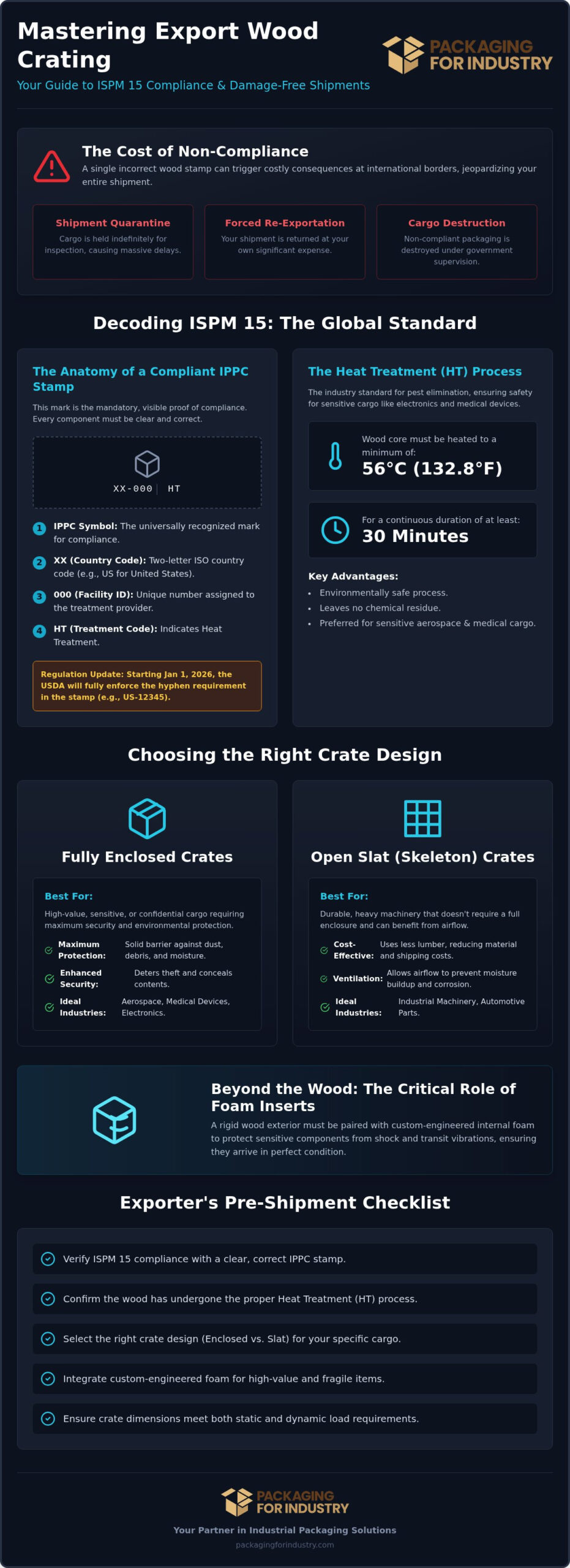
A single non-compliant wood stamp can force an entire international shipment to be quarantined or destroyed at your expense. When you’re sourcing custom wood crates for export Long Beach, the difference between a seamless delivery and a costly logistical nightmare often comes down to technical engineering and strict regulatory adherence. You’ve likely felt the pressure of tight lead times and the constant fear that a customs inspector might reject your wood packaging due to minor marking errors. It’s a valid concern, especially since the USDA will resume full enforcement of the ISPM 15 hyphen requirement starting January 1, 2026.
We understand that your priority is maintaining a reliable supply chain while protecting high-value assets like aerospace components or medical equipment. This reference guide will help you master the technical requirements and engineering standards needed for export-compliant wood crating. You’ll learn how to ensure 100 percent ISPM 15 compliance and use advanced internal bracing and foam to eliminate transit damage. We will also examine how local, custom-engineered solutions can reduce your lead times and lower overall logistics costs compared to generic catalog options.
Key Takeaways
- Master the strict ISPM 15 heat-treatment and marking standards required to prevent costly customs delays and re-exportation fees at international borders.
- Identify whether your cargo requires the ventilation of open slat designs or the maximum protection of fully enclosed custom wood crates for export Long Beach.
- Learn why rigid wood exteriors must be paired with custom-engineered foam inserts to protect sensitive aerospace and medical equipment from transit vibrations.
- Utilize a professional checklist for internal and external dimensions to ensure your crate specifications meet both static and dynamic load requirements.
- Discover how local prototyping and Vendor Managed Inventory (VMI) services from a Southern California supplier can significantly reduce your packaging lead times.
Navigating ISPM 15 Compliance for Long Beach Export Shipments
Exporting from the Port of Long Beach involves navigating a complex web of international regulations. The most critical of these is Navigating ISPM 15 Compliance. This global standard prevents the spread of wood-boring pests across borders. If you are procuring custom wood crates for export Long Beach, every piece of wood must be debarked and treated to meet these rigorous standards. Compliance isn’t optional; it’s a mandatory requirement for entry into over 180 member countries. Without the proper treatment and marking, your shipment faces significant risks, including being held for inspection or immediate re-exportation at your expense.
The visible proof of compliance is the IPPC stamp. This mark must include the IPPC symbol, the ISO country code, a unique facility number, and the treatment code (HT for Heat Treatment). Missing or illegible marks lead to immediate shipment rejection. U.S. Customs and APHIS have announced that full enforcement of the hyphen requirement in these marks begins January 1, 2026. Failing to meet this standard isn’t just a minor paperwork error. It can lead to the costly destruction of the non-compliant wood packaging under government supervision, causing catastrophic delays for your customers.
The Heat Treatment (HT) Process Explained
While methyl bromide fumigation was once common, Heat Treatment (HT) is now the primary industry standard because it’s environmentally safe and leaves no chemical residue. The technical process requires heating the core of the wood to a minimum of 56°C (132.8°F) for at least 30 continuous minutes. This method is specifically preferred for aerospace packaging solutions and sensitive medical devices. At PFI, we provide the necessary heat-treatment certificates to ensure your documentation clears customs in major trade hubs like the EU, China, and Australia without friction.
Destination Country Specifics
Regulations vary by region, and some “high-risk” countries require additional declarations beyond the standard IPPC stamp. For instance, shipments to Australia or New Zealand often face stricter biosecurity audits that require specific timber declarations. Our team understands these nuances and ensures every crate is verified for compliance before it leaves our warehouse. This proactive approach eliminates the professional stress of having high-value cargo held in quarantine. By choosing a partner who understands the intersection of engineering and international law, you protect your bottom line and your company’s reputation with global clients.
Choosing the Right Crate Design: Open Slat, Fully Enclosed, or Heavy-Duty Skids
Selecting the optimal structure for custom wood crates for export Long Beach is a decision that impacts both your bottom line and your equipment’s safety. A one-size-fits-all approach leads to either unnecessary lumber costs or insufficient protection. Your choice should be driven by the cargo’s fragility, weight distribution, and the specific hazards of ocean or air transit. While durable industrial parts may only require a skeleton frame, sensitive electronic components demand a fully enclosed environment to survive the journey. With the Port of Long Beach processing over 770,000 TEUs in a single month, your packaging must be built for rapid, industrial-scale handling.
Fully Enclosed vs. Open Slat Crates
Fully enclosed crates use solid heat-treated panels to provide a complete barrier against dust, debris, and opportunistic theft. This design is the gold standard for high-value exports where surface finish and internal cleanliness are non-negotiable. However, if you’re shipping heavy machinery that is less sensitive to the elements, open slat or skeleton crates offer a pragmatic, cost-effective alternative. These designs use significantly less lumber, which reduces the overall weight and shipping fees. They also provide essential ventilation. When cargo crosses multiple climate zones, trapped moisture can lead to corrosion. Slat designs allow for airflow, mitigating condensation risks while still adhering to international wood packaging regulations for heat treatment and marking.
Custom Bases and Heavy-Duty Skids
The engineering of the crate base is the most critical factor for heavy industrial equipment. A well-engineered base ensures that custom wood crates for export Long Beach remain stable during the rolling motions of a container ship. Our team focuses on the “Center of Gravity” to prevent tipping accidents, especially for top-heavy machinery. We utilize reinforced decking and heavy-duty skids designed to withstand the dynamic forces of crane lifting and forklift transport. To improve port efficiency, we integrate 4-way forklift entry points into every large-scale design. This allows terminal operators to move your cargo safely from any angle, reducing the risk of accidental drops. If you are unsure which base thickness your equipment requires, you can request a packaging quote to get a technical assessment based on your specific weight requirements.
Beyond the Wood: Integrating Custom Foam Inserts for High-Value Exports
A rigid wooden exterior is only half of the protection equation. For sensitive electronics, medical devices, and aerospace components, the internal environment of the crate is where the real engineering happens. While the wood provides structural defense against external impacts, it does very little to mitigate the constant vibration and G-force shocks inherent in long-haul ocean transit. This is why the synergy of custom foam packaging and rigid wood exteriors is standard for professional-grade custom wood crates for export Long Beach. Without a properly engineered interior, your product is essentially a loose object inside a heavy box, vulnerable to every wave and crane movement.
Selecting the correct foam density is a technical requirement based on your cargo’s weight and fragility. Polyethylene (PE) foam is a closed-cell material ideal for heavier industrial parts that require high load-bearing capacity and shock absorption. In contrast, Polyurethane (PU) is an open-cell, softer foam designed to cushion lighter, more delicate instruments. We calculate the required G-force protection to determine the exact thickness and density needed to prevent “bottoming out” during rough handling. This methodical approach ensures that your high-value assets remain suspended in a stable environment throughout the supply chain.
Precision Protection with Foam Inserts
For complex industrial shapes, we utilize precision die-cutting to create a custom-fitted nest for every component. This eliminates internal movement, which is the primary cause of cosmetic damage and mechanical failure. When shipping semiconductors or sensitive electronics, we integrate anti-static (ESD) foam to prevent electrostatic discharge from damaging internal circuitry. Whether you need a simple foam lining or a complex multi-layered kitting solution, the goal is a “snug fit” that locks the product in place. This level of detail is what separates a standard shipping box from a professional export crating system.
Corrosion Prevention and Moisture Barriers
Ocean freight presents a unique challenge known as “container rain,” where humidity inside a shipping container condenses and drips onto the cargo. To combat this, we often supplement our custom wood crates for export Long Beach with Vapor Corrosion Inhibitor (VCI) bags and desiccant packs. The VCI technology creates a molecular layer of protection on metal surfaces, preventing rust without the need for messy grease or oils. By combining heat-treated wood, custom foam inserts, and moisture barriers, PFI engineers a multi-layered defense system that ensures your equipment arrives in the same condition it left your facility.
Specifying Your Crate: A Checklist for Procurement and Logistics Managers
Procuring industrial packaging requires a shift from viewing a crate as a commodity to viewing it as an engineered asset. For logistics managers coordinating custom wood crates for export Long Beach, the accuracy of your initial specifications determines both the final cost and the safety of the cargo. A minor error in internal clearance or a misunderstanding of dynamic load requirements can lead to structural failure during crane operations at the terminal. Precision at the quoting stage is the most effective way to eliminate professional stress and prevent unexpected surcharges.
Dimensions must be clearly defined as either internal or external. External dimensions are critical for calculating container cube utilization and port drayage fees, while internal dimensions must account for the custom foam cushioning and any required clearance zones. You must also specify the weight capacity in two distinct categories: static load for warehouse stacking and dynamic load for when the crate is in motion. Specialized handling indicators, such as Tip-N-Tell or ShockWatch sensors, should be specified early to ensure they are integrated into the final labeling and design. Finally, verify if your destination port has specialized labeling needs, such as weight markings in kilograms or specific pictorial handling instructions.
The Procurement Checklist
To expedite your order and ensure technical accuracy, our engineering team recommends following these three steps before finalizing your request:
- Step 1: Define the exact weight and the center of gravity. This is vital for determining where forklift pockets and reinforced skids should be placed.
- Step 2: Identify any fragile points, sensitive finishes, or protruding parts that require extra clearance or specialized foam bracing.
- Step 3: Determine the mode of transport. Ocean freight allows for heavier, more robust lumber, while air freight requires weight-optimized designs to lower fuel surcharges and total landed costs.
Streamlining the Quote Process
Providing CAD drawings allows our engineering team to create a precise digital model of your packaging, which significantly reduces the time spent on manual measurements and design iterations. This technical approach ensures that when you are requesting a packaging quote, the pricing is accurate and the lead times are minimized. PFI also offers free prototyping for recurring export programs. This allows your team to verify the fit and function of the design before committing to a full production run, ensuring long-term reliability for your supply chain.
Custom Export Crating Solutions in Long Beach with Packaging For Industry (PFI)
Choosing a local partner for custom wood crates for export Long Beach provides a distinct logistical advantage. Our facility in Anaheim is strategically located to serve the ports of Long Beach and San Pedro, allowing us to respond to your shifting production schedules with speed that national catalog suppliers cannot match. We provide comprehensive manufacturing packaging solutions that go beyond the crate itself. Our focus is on reducing your total cost of ownership by optimizing wood usage and engineering internal protection that eliminates the financial drain of shipping damage.
Reliability in the supply chain is maintained through proactive services like Vendor Managed Inventory (VMI). Instead of reacting to a crate shortage that halts your export line, our VMI program ensures you always have the necessary crating and cushioning materials on hand. This level of oversight turns your packaging from a bottleneck into a seamless part of your logistical flow. We understand that for Southern California manufacturers, every hour saved in the warehouse is a direct contribution to the bottom line.
Why Long Beach Manufacturers Choose PFI
Our proximity to the Port of Long Beach enables next-day delivery for stock packaging and rapid turnaround times for custom-engineered crates. We have deep expertise in specialized sectors, particularly aerospace and medical device manufacturing, where precision and clean-room standards are paramount. Our team understands the nuances of the Southern California logistics landscape, from port drayage requirements to local traffic patterns. This local insight allows us to provide a level of personalized service that ensures your high-value cargo is always ready for its scheduled departure.
A Partner in Your Export Growth
PFI moves beyond the limitations of a standard catalog. We specialize in engineering solutions for your most difficult shipping challenges, whether you’re moving oversized heavy machinery or fragile electronic arrays. Our commitment to 100 percent ISPM 15 compliance and rigorous damage reduction standards means you can export with confidence. We act as a seasoned industrial consultant, focusing on the intersection of engineering and economics to help you scale your international operations. If you’re ready to optimize your export packaging, we’re here to provide the expertise you need.
Contact PFI for an export crating consultation
Secure Your Global Supply Chain with Engineered Crating
Successfully navigating international logistics requires a partner that treats packaging as a technical discipline rather than a commodity. You don’t just need a wooden box; you need a verified system that guarantees 100 percent ISPM 15 compliance and eliminates the risk of product damage. By integrating custom wood crates for export Long Beach with precision-engineered foam inserts and robust base designs, you protect your company’s bottom line from the high costs of customs rejections and transit failures.
PFI provides the specialized aerospace and industrial expertise needed to handle your most complex shipping challenges. Our Anaheim facility offers free design prototyping to ensure a perfect fit before production begins. This proactive approach, combined with our use of fully heat-treated materials, gives you the peace of mind that your cargo is ready for any international destination. We’re committed to helping you reduce shipping damage through better internal bracing and optimized crate structures.
We’re ready to help you lower packaging costs and improve your supply chain reliability. Let’s build a protection system that moves your business forward.
Frequently Asked Questions
What is the difference between a crate and a pallet for export?
A pallet is a flat transport structure used for unitizing and moving goods with a forklift; however, a crate is a fully enclosed or slatted box that provides structural protection. While pallets are cost-effective for stacking boxes, crates are engineered for heavy or fragile equipment that requires defense against impacts. For international transit, both must adhere to the same heat-treatment standards to pass customs inspections.
Do all wood crates exported from Long Beach need to be heat treated?
Yes, all wood packaging materials destined for international export must be heat treated and stamped according to ISPM 15 standards. This requirement applies to every component of your custom wood crates for export Long Beach. Failure to provide treated wood results in immediate shipment rejection, fines, or the costly destruction of your packaging under government supervision at the destination port.
How much weight can a custom wood crate safely hold?
Weight capacity depends on the engineering of the base and the thickness of the lumber used. PFI designs crates capable of safely holding weights ranging from 500 pounds to over 50,000 pounds. We calculate both static and dynamic load requirements to ensure the structure remains stable while being hoisted by cranes or handled by heavy-duty forklifts at the Long Beach terminal.
Can PFI design crates that are reusable for multiple international trips?
We can engineer crates with heavy-duty hardware, such as link locks or bolted panels, specifically for multi-trip use. These designs are ideal for recurring trade shows or rotating equipment programs. Reusable crates help lower your long-term packaging costs by amortizing the initial engineering investment over dozens of shipments, provided the wood remains dry and the ISPM 15 marks stay legible.
What documentation do I need to provide for ISPM 15 compliance?
The primary requirement is the IPPC stamp applied directly to the wood; however, you should also maintain a Heat Treatment (HT) certificate provided by your supplier. This certificate serves as secondary proof of compliance for customs officials. Keeping these digital records organized helps prevent logistical delays when your cargo undergoes biosecurity audits in regions with strict wood packaging regulations.
How long does it take to manufacture a custom wood crate for export?
Standard custom crates typically have a lead time of three to five business days, depending on design complexity. Because our facility is located in Anaheim, we can often expedite production for urgent shipments heading to the Port of Long Beach. Providing CAD drawings during the quote phase is the most effective way to move from the engineering stage to final delivery.
Does PFI offer on-site crating services in Long Beach?
We manufacture and kit crates at our Anaheim facility for rapid delivery to your warehouse or the port. While we don’t provide on-site labor crews, we offer pre-fabricated “knock-down” crates that your team can easily assemble around heavy machinery. This method reduces your lead times and minimizes the physical footprint of packaging materials in your production area.
How do I prevent rust on machinery inside a wood crate during ocean transit?
The most effective method is using Vapor Corrosion Inhibitor (VCI) poly bags in combination with desiccant packs inside your custom wood crates for export Long Beach. These materials create a protective environment that prevents salt air and humidity from causing oxidation. This multi-layered defense ensures your metal components arrive in pristine condition despite the moisture challenges of long-haul ocean freight.