
A single dropped server rack can result in hundreds of thousands of dollars in hardware losses and weeks of missed deployment deadlines. You likely already know that standard pallets and generic boxes aren’t enough for high-density compute clusters. Shipping fully populated racks involves managing extreme weight distributions and sensitive electronics that don’t tolerate vibration. Finding reliable custom packaging for networking equipment Southern California is often the difference between a successful data center expansion and a costly insurance claim.
We understand the pressure to maintain zero-damage delivery while managing tight project timelines. This guide explains how to specify and source engineered crating solutions that protect your high-value assets throughout the Southern California logistics corridor. You’ll learn how to optimize crate dimensions to lower freight costs and ensure international compliance with ISPM-15 standards. We also explore how local CAD/CAM design support and free prototyping can eliminate lead time delays. By the end of this article, you’ll have a clear framework for streamlining your procurement with a local partner who understands the intersection of engineering and economics.
Key Takeaways
- Custom-engineered crates provide the structural integrity required to transport fully populated server racks safely, preventing damage from extreme weight and transit vibration.
- Precision-cut ESD foam and moisture barrier packaging ensure sensitive electronic components remain protected from static and environmental factors during long-haul or international transit.
- Strategically sourcing custom packaging for networking equipment Southern California allows for local next-day delivery and streamlined logistics across Los Angeles, Orange County, and the Inland Empire.
- Ergonomic crate designs, including ramp-style loading options, improve data center deployment efficiency and reduce the risk of injury when handling heavy networking gear.
- Utilizing CAD/CAM design support and free prototyping from a local partner helps lower packaging costs while ensuring a perfect fit for specialized hardware.
Engineering Custom Shipping Crates for Data Center Server Racks
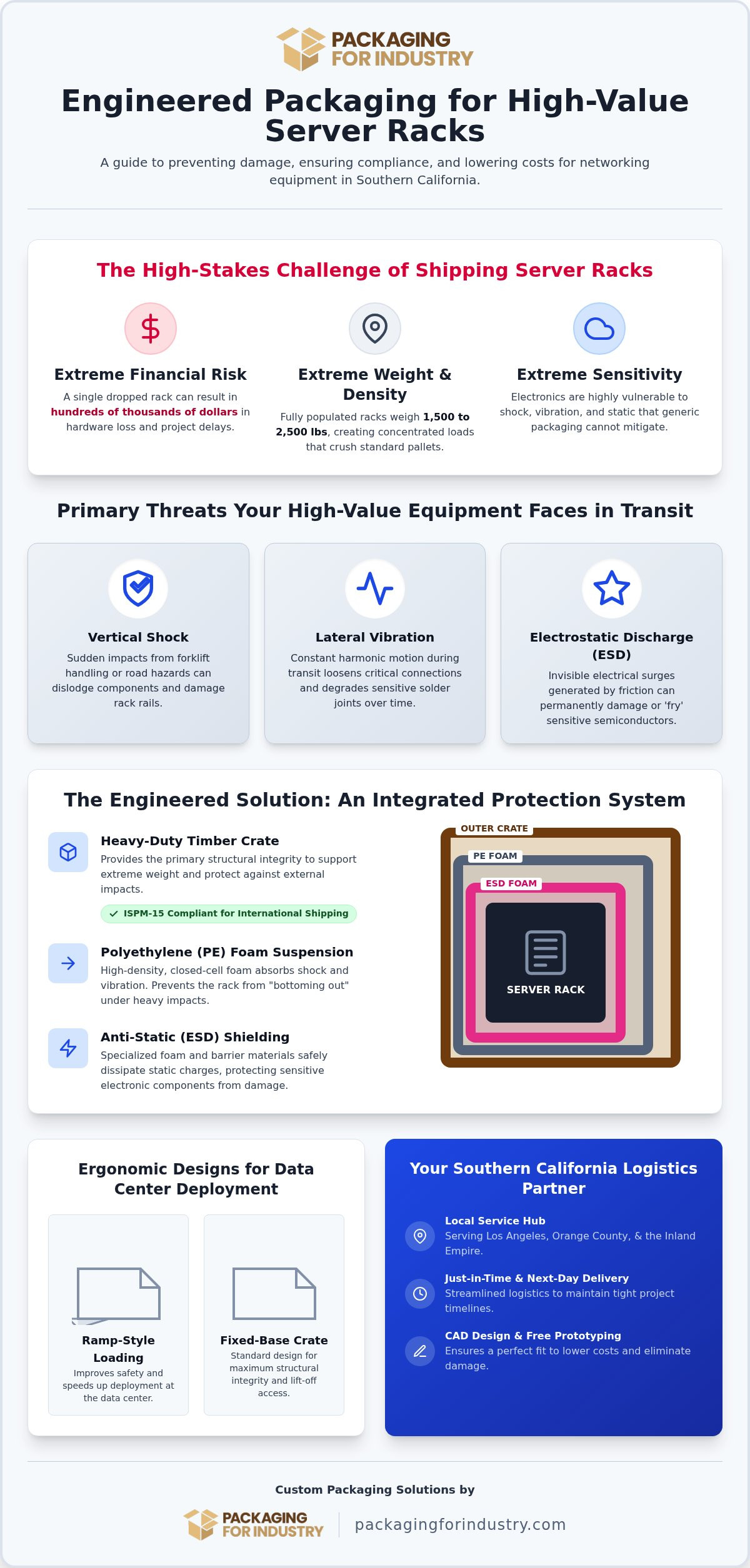
Shipping a fully populated server rack is a complex logistical challenge. These units often weigh between 1,500 and 2,500 pounds, creating concentrated point loads that standard pallets simply cannot support. When you rely on generic shipping materials, you risk structural failure before the equipment even leaves the loading dock. Effective custom packaging for networking equipment Southern California must account for the unique center of gravity and fragility of high-density compute clusters.
Standard logistics environments expose your hardware to three primary threats:
- Vertical Shock: Sudden impacts from road hazards or forklift handling that can dislodge internal components or damage rack rails.
- Lateral Vibration: Constant harmonic motion during transit that loosens connections and degrades sensitive solder joints over time.
- Electrostatic Discharge (ESD): Invisible surges that can fry semiconductors if the packaging doesn’t provide adequate shielding or a path to ground.
We solve these problems through integrated packaging. This isn’t just a wooden box; it’s a synchronized system where heavy-duty timber provides structural integrity, precision-cut foam manages vibration, and anti-static barriers neutralize electrical risks.
The High Cost of Transit Damage in Networking
Hardware replacement costs are only the beginning of the financial impact. If a rack arrives damaged at a Los Angeles or Irvine data center, the resulting downtime can stall entire project deployments. Insurance claims for high-value electronics are notoriously complex and rarely cover the full scope of lost productivity. By utilizing Packaging For Industry CAD/CAM design support, your team can ensure a precision fit that eliminates movement within the crate. This proactive approach reduces the likelihood of damage and simplifies the audit trail for high-value shipments.
Compliance and Standards for Industrial Crating
International deployments require adherence to strict phytosanitary regulations. When sourcing custom packaging for networking equipment Southern California for export, your crates must meet ISPM-15 standards. This involves using heat-treated wood to prevent the spread of pests across borders. Failing to comply can lead to seized shipments, fines, and significant customs delays. Our engineering team ensures every custom crate is built with compliant materials, providing the necessary documentation for seamless global logistics. This level of oversight protects both your timeline and your bottom line.
Internal Protection Features: Foam Inserts and ESD Shielding
While the wooden exterior of a crate provides the necessary structural shell, the internal engineering determines whether your hardware survives the physics of transit. High-value server racks require a suspension system that can neutralize harmonic vibrations and sudden G-force impacts. Effective custom packaging for networking equipment Southern California relies on a combination of material science and precision cutting to keep sensitive electronics isolated from the rigors of the road.
We primarily utilize Polyethylene (PE) foam for heavy networking applications. This closed-cell material is ideal for server racks because it maintains its structural integrity under significant weight. Unlike Polyurethane (PU) foam, which is often too soft and prone to “bottoming out” during a hard shock, PE foam provides consistent resistance. By using foam end caps and corner pads, we create a floating environment for the rack, ensuring that no part of the metal chassis makes direct contact with the wooden crate walls.
Static control is equally vital. Networking components are highly susceptible to triboelectric charging, where movement during transit generates static electricity. We integrate anti-static (ESD) foam, usually identified by its distinct pink color, to dissipate these charges before they can reach sensitive motherboards or line cards. This multi-layered approach ensures your equipment isn’t just physically secure, but electronically protected as well.
Selecting the Right Foam Density for Heavy Equipment
Matching foam density to the specific weight of your rack is a critical engineering step. If the foam is too dense, it acts as a solid and transfers shock directly to the hardware. If it’s too light, the weight of the rack will crush the cells, rendering the protection useless. Foam density serves as the primary factor in shock absorption for networking gear. We utilize die-cut foam inserts to ensure consistency across every unit. This precision allows for repeatable results, which is essential for recurring production lines in the aerospace and tech sectors. If you’re uncertain about the specifications required for your specific hardware, you can request a packaging quote to receive a professional assessment.
ESD and Moisture Barrier Protection
Environmental factors like humidity can be just as damaging as physical impacts, especially for shipments passing through the Southern California logistics corridor toward coastal ports. We employ moisture barrier packaging and static shielding bags to create a hermetically sealed environment for the equipment. These thick, multi-layered films prevent oxidation on gold-plated connectors and sensitive solder joints. When combined with desiccant packs, this system manages the internal atmosphere of the crate throughout long-haul journeys. Using engineered protective foam packaging ensures these barrier bags remain intact and aren’t compromised by the sharp edges of the server rack during handling.
Crate Design Options: Fixed Base vs. Ramp-Style Loading
Choosing the right crate architecture is a balance between deployment speed and total cost of ownership. For many data centers, the decision centers on how the equipment will be extracted at its destination. Fixed-base crates are a standard solution for hardware that’ll be handled by overhead cranes or specialized rack lifts. However, for fully populated cabinets, ramp-style crates are often the superior choice for custom packaging for networking equipment Southern California. These integrated ramps allow a single technician to roll a 2,000-pound rack directly onto the data center floor, eliminating the need for heavy lifting equipment and significantly reducing the risk of tipping.
Structural integrity also depends on the specific material selection. While solid wood or plywood offers maximum puncture resistance for long-haul transit, high-performance triple-wall corrugated can be an effective alternative for lighter networking components. Triple-wall provides impressive stacking strength while reducing the overall tare weight of the shipment. This helps lower packaging costs and freight expenses, especially for local deliveries within the Inland Empire or San Diego. The choice between wood and corrugated often depends on the transit distance and the number of handling touchpoints in your supply chain.
Reusable vs. Single-Use Crating Systems
If your operations involve recurring equipment rotations, such as hardware being sent back for repair, recalibration, or lease returns, a single-use crate is an inefficient investment. Reusable crating systems utilize heavy-duty hardware like recessed handles and link-locks to withstand multiple transit cycles. These systems provide a much higher ROI over the long term compared to standard one-way packaging. Our custom design services focus on creating durable, multi-trip solutions that simplify the return logistics process. By investing in a reusable system, you ensure the same level of protection is maintained for the hardware’s entire lifecycle.
Skid and Pallet Integration
Server racks are notoriously top-heavy, making them prone to instability during abrupt stops or sharp turns. To mitigate this risk, we design crates with oversized, heavy-duty skids that provide a wider footprint for better stability. These skids feature 4-way forklift entry, allowing for easier maneuverability in the tight aisles common in Los Angeles and Orange County data centers. Ensuring compatibility with standard data center lift equipment is a core part of our engineering process. This integration prevents bottlenecks at the loading dock, allowing your team to move equipment from the truck to the server room with minimal friction.
Sourcing Logistics in Southern California Data Center Hubs
Southern California’s data center density requires a packaging partner that can keep pace with rapid deployment cycles. Sourcing from an Anaheim-based supplier provides a strategic advantage for firms operating across the Southland. Because server crates are inherently bulky, long-distance freight costs can quickly erode your project margins. Local sourcing dramatically reduces these expenses and lowers the carbon footprint of your logistics chain. PFI offers local next-day delivery across the region, supporting just-in-time production schedules that national catalog suppliers simply can’t match. This proximity ensures that high-quality custom packaging for networking equipment Southern California is available exactly when your racks are ready to move. We serve all primary regional hubs, including the Inland Empire, ensuring your supply chain remains fluid and responsive.
Serving the Irvine and Orange County Tech Corridor
Irvine and Anaheim are the primary hubs for networking OEMs and cloud service providers. Our proximity to the Irvine tech corridor allows us to perform on-site packaging reviews. These consultations help identify potential failure points in your current workflow before they lead to transit damage. We also provide dedicated support to businesses in Costa Mesa and Huntington Beach. By choosing a local partner, you gain access to CAD/CAM design support that can be executed in hours rather than weeks. This level of responsiveness is critical for maintaining custom packaging for networking equipment Southern California standards during peak production periods.
Logistics Support for Los Angeles and San Diego
Moving north into Los Angeles, we manage crate distribution for critical data centers in Carson and Torrance. These areas serve as vital gateways for international transit and coastal logistics. For high-growth tech companies in San Diego, we offer Vendor Managed Inventory (VMI) programs. VMI allows you to maintain a buffer of custom crates without consuming valuable warehouse space. It’s a pragmatic solution for manufacturers who need to scale quickly without increasing overhead. Our team handles the replenishment, so you always have the necessary protection for large-scale deployments without the stress of managing inventory levels yourself.
Partnering with PFI for Custom Networking Packaging
Choosing a packaging partner for high-value electronics requires more than just finding a vendor who can build a crate. It demands an engineering mindset that understands the intersection of material science and logistical efficiency. At PFI, we provide a single-source solution that integrates heavy-duty wood, precision-cut foam, and specialized corrugated materials into a unified protective system. This holistic approach ensures that every component of the custom packaging for networking equipment Southern California works in sync to eliminate transit damage. We offer a comprehensive packaging analysis for new clients, identifying opportunities to lower packaging costs by optimizing material usage and reducing crate dimensions without compromising safety.
Reliability is the foundation of a successful production line. A delay in receiving custom crates can halt an entire data center deployment, leading to cascading costs and missed deadlines. We prevent these production stops through a dependable, recurring supply chain backed by local manufacturing. By partnering with us, you move away from the “one-size-fits-all” limitations of large catalog suppliers and gain a dedicated industrial consultant focused on your specific operational goals. We encourage you to request a packaging quote to see how an engineered approach can improve your bottom line.
From Prototype to Full Production
Our design process begins with a deep dive into your hardware’s specifications. We utilize CAD/CAM support to create precision-fit interiors that account for every protrusion and sensitive port on your server racks. Unlike generic suppliers, our industrial focus allows us to handle the complexities of 1,000lb+ networking gear with ease. PFI provides free prototyping to ensure product fit before full rollout. This step is vital for verifying that the suspension system and ESD shielding perform as expected under real-world conditions. Once the prototype is approved, we transition seamlessly into full-scale production, maintaining tight tolerances across every unit we build.
Simplifying Your Packaging Procurement
Managing the physical space required for bulky server crates can be a significant warehouse challenge. We solve this through Just-In-Time (JIT) inventory management. JIT allows your team to reduce warehouse clutter by stocking only the packaging needed for immediate production runs. We integrate directly with your shipping schedules, delivering the exact number of crates required for your daily or weekly deployments. This streamlined procurement process ensures that custom packaging for networking equipment Southern California is always available when needed, allowing your operations team to focus on deployment rather than inventory tracking. By shifting the burden of storage and replenishment to us, you gain a more agile and cost-effective supply chain.
Secure Your Next Data Center Deployment
Protecting high-value networking infrastructure requires a departure from standard logistical practices. You’ve seen how integrating structural wood with specialized ESD foam protection and ergonomic ramps can eliminate the risk of transit damage and technician injury. By shifting to a localized supply chain, you don’t just protect your equipment; you optimize your entire procurement cycle for speed and fiscal responsibility.
PFI stands ready to support your operations with free prototyping and CAD design support to ensure a precision fit for every rack. Our local next-day delivery in SoCal means your production line never stalls due to packaging shortages. Investing in engineered custom packaging for networking equipment Southern California is a strategic decision that pays dividends in reliability and professional peace of mind.
We look forward to helping you streamline your logistics and secure your hardware for the road ahead.
Frequently Asked Questions
What is the best foam for shipping heavy server racks?
Polyethylene (PE) foam is the industry standard for protecting heavy server racks due to its high load-bearing capacity. Unlike softer materials, PE foam doesn’t bottom out under the weight of a 2,000-pound cabinet. We match the foam density to your specific hardware weight to ensure maximum shock absorption. This precision engineering is a core part of providing reliable custom packaging for networking equipment Southern California, keeping sensitive internal components safe from transit vibration.
Do custom shipping crates for networking equipment need to be ISPM-15 certified?
Every custom crate intended for international transit must be ISPM-15 certified. This regulation requires that all wood packaging materials be heat-treated to eliminate pests before crossing borders. Our crates carry the required IPPC stamp to ensure your equipment passes through customs without delays. We manage the compliance documentation and material sourcing so your global data center deployments remain on schedule while meeting all legal export requirements and environmental standards.
Can I get a custom crate with a built-in ramp for server racks?
We design and manufacture custom crates with integrated ramp systems specifically for fully populated server racks. These ramps are engineered to support the extreme weight of compute clusters while maintaining a safe incline for technicians during extraction. This ergonomic feature often eliminates the need for expensive forklift rentals at the destination data center. It’s a pragmatic solution that simplifies the deployment process and reduces the physical risk associated with moving top-heavy gear.
What is the typical lead time for custom networking crates in Southern California?
Lead times for custom crates depend on the complexity of the design and the volume of the order. Because we offer CAD/CAM design support and local manufacturing, we can typically move from a prototype to a finished batch much faster than national catalog suppliers. Our proximity to tech hubs in Irvine and Los Angeles allows us to provide highly responsive service. You can request a packaging quote to get a specific timeline based on your project requirements.
How does anti-static foam differ from standard packaging foam?
Anti-static foam contains specialized chemical additives that prevent the buildup of triboelectric charges. While standard packaging foam can generate static electricity during transit, ESD foam dissipates it safely. This is critical for custom packaging for networking equipment Southern California because even a small discharge can damage motherboards or line cards. We use high-grade ESD foam to provide a safe electrical environment for your most sensitive data center components during every stage of transit.
How can I reduce the cost of custom crates for high-volume networking gear?
You can lower packaging costs by utilizing our comprehensive packaging analysis. We examine your current crate dimensions and material usage to find efficiencies that reduce both tare weight and freight expenses. Implementing a Vendor Managed Inventory (VMI) program also helps high-volume manufacturers save money by streamlining the supply chain. By optimizing the design for your specific rack dimensions, we ensure you aren’t paying for excess material or wasted shipping space in the logistics corridor.
Does PFI offer local next-day delivery in Orange County?
We provide local next-day delivery for stock and recurring custom orders throughout Orange County and the surrounding regions. Our Anaheim facility is strategically located to serve the tech corridors in Irvine, Brea, and Costa Mesa. This rapid delivery capability supports just-in-time production schedules and helps you avoid warehouse clutter. You don’t have to wait for long-distance freight when your server racks are ready to ship to their final data center destination or coastal port.
Can custom crates be designed for reusable equipment rotations?
Custom crates can be engineered for reusable equipment rotations by using heavy-duty, multi-trip hardware. We integrate recessed link-locks, reinforced corners, and durable handles that withstand the rigors of multiple transit cycles. This is an excellent solution for hardware that needs to be returned for recalibration, repair, or lease expiration. While the initial investment is higher, the long-term ROI is significant because it eliminates the need for constant one-way packaging replacement and reduces total material waste.