
Is the lowest unit price on your packaging quote actually costing you more in hidden freight and damage claims? Most procurement managers in Southern California, from Los Angeles to San Diego, prioritize upfront costs, yet it’s frustrating when those perceived savings are wiped out by high product damage rates or oversized containers that bloat your shipping fees. You likely feel the constant pressure to optimize the bottom line while keeping production lines moving without a hitch.
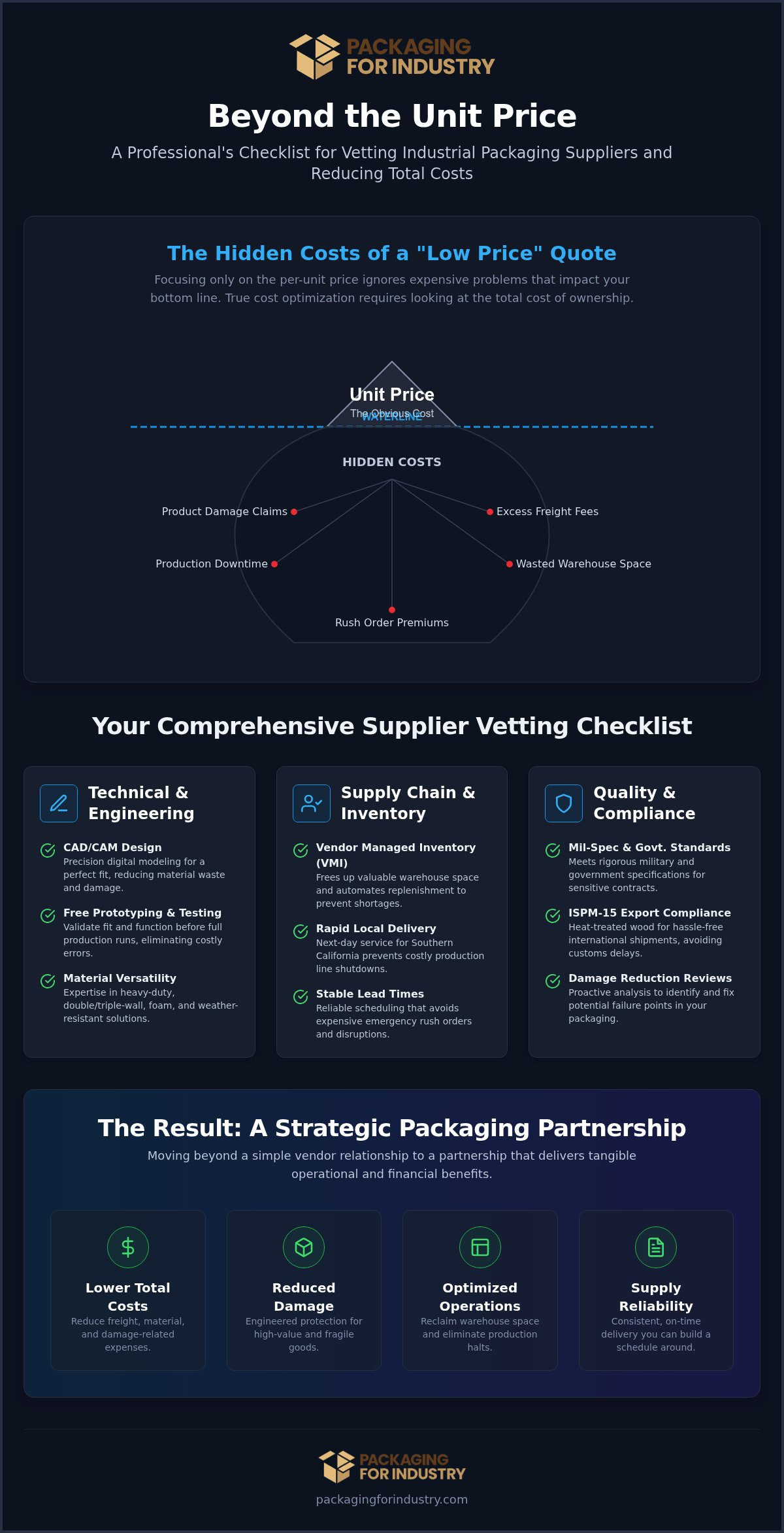
This guide provides a professional checklist to vet suppliers on the technical and logistical capabilities that actually move the needle. By using a comprehensive custom packaging RFQ template Southern California manufacturers can rely on, you’ll identify partners who offer more than just materials. You’ll find “fixers” who engineer protection and manage your inventory flow. We will explore how to evaluate engineering expertise, supply chain reliability, and total cost reduction strategies like Vendor Managed Inventory (VMI) to free up your warehouse space and eliminate professional stress.
Key Takeaways
- Stop shipping damage at the source by prioritizing suppliers with CAD/CAM design and free prototyping capabilities.
- Learn to look beyond unit costs to uncover how engineering-led packaging reduces freight surcharges and total cost of ownership.
- Discover how VMI programs with regular review cycles can stabilize your supply chain and optimize warehouse floor space.
- Ensure your shipments meet rigorous industrial standards by vetting partners for Mil-Spec and ISPM-15 export compliance.
- Streamline your procurement process by leveraging our custom packaging RFQ template Southern California manufacturers use to secure accurate, competitive bids.
Why Evaluating Packaging Supplier Capabilities Matters for Operations
Operational efficiency depends on the seamless integration of logistics and material protection. While it’s tempting to treat a Request for Proposal (RFP) as a simple price-matching exercise, industrial manufacturers face risks that a standard catalog cannot mitigate. Relying on “off-the-shelf” boxes often results in poor engineering, leading to excessive shipping damage and unexpected freight surcharges due to inefficient sizing. Moving beyond a basic distributor to a partner with custom production capabilities ensures that your packaging is designed for your specific product rather than forced into a generic container.
Lead times significantly impact your production schedule and overall warehouse efficiency. A national giant might offer a wide inventory, but they often lack the agility required for emergency replenishment. Local partners in Southern California cities like Anaheim, Brea, or Santa Fe Springs can provide next-day delivery, preventing production line shutdowns. When you utilize a custom packaging RFQ template Southern California manufacturers trust, you can specifically vet suppliers on their ability to handle these rapid turnarounds and technical requirements.
The True Cost of Packaging Shortages
Shortages are more than a nuisance; they are a threat to your profit margins. Emergency rush orders often carry premium freight costs and disrupt the logical flow of your warehouse. Many managers fall into the “substitution trap,” using an incorrect box or a different grade of foam just to keep shipping. This compromise inevitably increases damage rates and customer dissatisfaction. Operational reliability is the ability to maintain a consistent supply chain without shortages, ensuring that your manufacturing output never waits on a pallet or a crate.
Price vs. Total Cost of Ownership (TCO)
A low unit price is often a decoy for higher long-term expenses. Expert supplier engineering can lower packaging costs by optimizing container dimensions to fit the exact footprint of your product. This reduction in size directly lowers freight costs and minimizes the need for excessive cushioning materials. By assessing a supplier’s CAD/CAM support during the initial design phase, you ensure that every component is precision-engineered. This proactive approach reduces the frequency of costly product returns and optimizes your total cost of ownership. When finalizing your custom packaging RFQ template Southern California operations should prioritize these engineering-led savings over raw material costs.
Technical Design and Custom Engineering Checklist
Precision in packaging begins with a technical assessment of your product’s physical properties. For manufacturers handling sensitive electronics or heavy machinery, a supplier’s ability to provide CAD/CAM support is essential. This technology ensures that bespoke industrial components are perfectly protected by creating exact digital models before a single sheet of board is cut. When evaluating potential partners, your custom packaging RFQ template Southern California should specifically ask about the integration of custom corrugated boxes with precision-cut protective foam packaging.
Material versatility is another critical benchmark for operational success. A capable supplier shouldn’t just offer standard boxes; they must demonstrate expertise in heavy-duty requirements like double-wall and triple-wall board or weather-resistant materials. This level of durability is non-negotiable for outdoor storage or long-distance industrial shipping where environmental factors can compromise structural integrity. Ensuring your supplier can handle these technical specifications upfront prevents the “substitution trap” mentioned previously.
Prototyping and Performance Testing
Physical samples are a mandatory step for high-value industrial gear. Free prototyping allows your team to validate fit and function before committing to a full production rollout. These prototypes serve as the basis for damage-reduction packaging reviews, identifying potential failure points in the cushioning or structural integrity. Additionally, a “right-sized” design helps you avoid the excessive dimensional weight surcharges frequently applied by UPS and FedEx. If you’re unsure if your current design is optimized, you can request a technical review to identify potential cost-saving adjustments through better engineering.
Specialized Material Expertise
Beyond standard cardboard, industrial suppliers must understand the nuances of specialized protection. For the semiconductor industry, this includes vetting for ESD (Electrostatic Discharge) and cleanroom-compliant materials. Foam density evaluation is equally important; you must decide between the durability of Polyethylene and the soft, non-abrasive protection of Polyurethane for your custom inserts. When your shipments involve heavy items, your supplier must have the capacity to engineer custom wood crates and heavy-duty skids. These specialized capabilities ensure that your most challenging logistical hurdles are solved through engineering rather than guesswork, providing peace of mind for your most critical shipments.
Supply Chain and Inventory Management Capabilities
A precision-engineered box provides no value if it isn’t on your warehouse floor when the production line starts. While design expertise is vital, a supplier’s logistical infrastructure determines your long-term operational stability. When you evaluate potential partners using a custom packaging RFQ template Southern California operations rely on, you must prioritize their ability to manage inventory flow. A supplier should act as a proactive partner, not just a vendor, by offering integrated solutions that prevent stockouts and reduce the administrative burden on your procurement team.
VMI vs. Traditional Purchasing Models
The primary drawback of traditional purchasing is the “bullwhip effect,” where small fluctuations in demand lead to massive overstocking or critical shortages. Transitioning to a Vendor Managed Inventory (VMI) program solves this by aligning supply directly with your actual consumption. This model significantly reduces the capital tied up in slow-moving stock and frees up valuable warehouse floor space for your core manufacturing activities.
To ensure the success of a VMI program, you must evaluate the supplier’s review cycles. A “fixer” persona in this industry doesn’t just wait for an order; they perform weekly or biweekly assessments to adjust stock levels based on real-time usage. This planned replenishment eliminates the need for expensive emergency rush orders and the logistical stress that follows them. By stocking your custom-engineered items at their facility, the supplier provides a buffer against supply chain volatility, ensuring just-in-time delivery for even the most complex bespoke packaging components.
Local Delivery and Southern California Support
For manufacturers in Anaheim, Irvine, or Torrance, logistical proximity is a strategic asset. National catalog distributors often struggle with the “last mile” of industrial delivery, resulting in delays that stall production. A local partner with a dedicated fleet can offer next-day delivery across Southern California, providing a level of responsiveness that national giants cannot match.
Localized distribution also offers a significant economic advantage. You can drastically reduce freight costs by choosing a supplier with a strong footprint in the Inland Empire or Los Angeles County. Reducing freight costs through localized distribution in the Inland Empire allows for a leaner supply chain that is less susceptible to the rising costs of long-haul transportation. When vetting a supplier, confirm their ability to maintain consistent quality standards across multiple regional locations, ensuring that your secondary sites receive the same level of precision and reliability as your primary facility.
Quality Control and Industry Compliance Standards
Compliance in industrial packaging is a matter of legal necessity and asset protection. When you evaluate a partner using a custom packaging RFQ template Southern California manufacturers trust, you must look for specific certifications that match your industry’s rigors. A supplier’s failure to meet Military Packaging (Mil-Spec) standards can lead to contract violations and rejected shipments. Similarly, if your operation involves international shipping, your supplier must demonstrate a deep understanding of ISPM-15 heat-treatment requirements for export crates and pallets. These standards ensure that your wood packaging is pest-free and compliant with global agricultural regulations.
Consistency across bulk quantities is where many suppliers fail. It’s easy to build a high-quality prototype, but maintaining those tolerances across a run of several thousand units requires disciplined quality control. You should vet your supplier on their ability to ensure the 1,000th box matches the prototype’s structural integrity and fit exactly. This level of precision prevents production line disruptions and ensures that your automated packing equipment operates without frequent jams or errors. Using a custom packaging RFQ template Southern California operations rely on helps you set these quality expectations from the very first bid.
Aerospace and Defense Compliance
Aerospace hubs in Southern California cities like Huntington Beach, Long Beach, and Carson require specialized aerospace packaging for high-value components. These parts often require Mil-Spec labeling, moisture-vapor barrier bags, and specialized cushioning to prevent vibration damage during transit. Traceability and meticulous documentation are essential in military-grade packaging to ensure every material meets the required defense specifications. This level of oversight provides the peace of mind that your most sensitive industrial assets are fully protected according to federal mandates.
Material Durability and Load Stabilization
Protecting the product inside the box is only half the battle; you also have to stabilize the entire pallet for the journey. You should evaluate the technical performance of stretch film based on its puncture resistance and load containment capabilities. For manufacturers shipping cylindrical or long industrial parts, the crush strength of mailing tubes and cores is a vital metric for part protection. Additionally, the strategic use of corner and edge protection is critical for maintaining palletized load stability. These components prevent the straps from crushing your corrugated boxes while ensuring the load remains upright and secure through every transfer point in the supply chain.
The Final Evaluation: ROI and Structuring Your RFQ
The success of your procurement process depends on the quality of your initial inquiry. To receive an accurate custom packaging quote, you must move beyond simple dimensions and quantities. A comprehensive custom packaging RFQ template Southern California manufacturers use should demand specific details on engineering support, material certifications, and inventory management programs. This structured approach ensures that potential partners are evaluated on their ability to solve operational pains rather than just their ability to provide a commodity box.
A true partner demonstrates their value by performing a comprehensive cost-reduction analysis during the bidding stage. They should proactively identify opportunities where “right-sizing” or material substitutions can lower your total cost of ownership. Your final evaluation should weigh three critical pillars:
- Technical: CAD/CAM capabilities, free prototyping, and specialized material expertise.
- Logistical: VMI programs, local next-day delivery in Southern California, and supply chain reliability.
- Financial: Long-term ROI through damage reduction and freight optimization.
Comparing Packaging Pricing Effectively
Industrial buyers often fall into the trap of comparing individual unit costs. While a unit price might look attractive on a spreadsheet, large catalog suppliers frequently hide the true expense in oversized packaging that triggers dimensional weight freight surcharges. You should prioritize bulk packaging pricing that reflects the total logistical impact. Integrated solutions that combine corrugated boxes, foam inserts, and pallets from a single source simplify your administrative workflow and ensure that every component is engineered to work together perfectly.
Making the Switch to a New Supplier
Transitioning to a new partner doesn’t have to disrupt your production lines. A smooth handover involves a phased approach where the new supplier manages long lead-time custom items while you bleed down existing inventory. Packaging For Industry (PFI) acts as a seasoned consultant during this process, ensuring that your custom-engineered protection is ready for deployment before your old stock runs out. This proactive management eliminates the risk of shortages during the transition period, providing the stability your manufacturing operation requires.
Securing Your Industrial Supply Chain
Selecting a packaging partner is a strategic decision that impacts your entire logistical flow. By shifting your focus from unit price to total cost of ownership, you eliminate the hidden expenses of shipping damage and warehouse inefficiencies. Utilizing a custom packaging RFQ template Southern California manufacturers trust allows you to vet suppliers on the technical and logistical capabilities that actually protect your bottom line.
PFI provides the engineering-minded support you need through free prototyping and precision CAD/CAM design. Our specialized expertise in aerospace and military packaging ensures your high-value assets meet every rigorous compliance standard. With local next-day delivery across Southern California, we act as the proactive problem-solver your production line requires to stay on schedule and under budget.
Take the first step toward a more reliable and cost-effective packaging system that gives you total peace of mind and operational stability.
Frequently Asked Questions
What should I look for in a custom packaging RFQ template?
A comprehensive custom packaging RFQ template Southern California manufacturers use should require details on CAD/CAM design, prototyping, and inventory management. You must ask for more than just unit costs; look for evidence of engineering expertise and the ability to combine multiple materials into one solution. This structure ensures you receive a quote that reflects the total cost of protection rather than just the price of a commodity box.
How can a packaging supplier help me reduce shipping damage?
A supplier acts as a “fixer” by conducting technical packaging reviews to identify failure points in your current design. They use custom-engineered foam inserts and high-strength corrugated board to secure high-value industrial components. By creating physical prototypes and conducting fit tests before production, they ensure your products withstand the rigors of the supply chain, significantly lowering your overall damage rates and associated return costs.
What are the benefits of a Vendor Managed Inventory (VMI) program for packaging?
VMI programs eliminate the risk of production stops by aligning your packaging supply with actual consumption. Instead of guessing your needs, a supplier performs scheduled reviews to replenish stock based on agreed-upon levels. This approach improves your cash flow by reducing capital tied up in excess inventory. It also frees up valuable warehouse floor space, allowing your team to focus on core manufacturing activities rather than managing box counts.
How do I evaluate a supplier’s capability for Mil-Spec or aerospace packaging?
Evaluation begins with checking for specific certifications and experience with moisture-vapor barrier bags and Mil-Spec labeling. For aerospace applications, traceability and meticulous documentation are non-negotiable requirements. You should ask for case studies or examples where the supplier has successfully navigated defense contract specifications. A capable partner will understand the technical nuances of specialized cushioning and high-value component protection required for these sensitive industrial sectors.
Why is local delivery in Southern California important for warehouse operations?
Local support in cities like Anaheim, Irvine, and Long Beach is critical for maintaining a lean supply chain. National distributors often struggle with the “last mile,” leading to delays that can stall your production lines. A local partner with a dedicated fleet provides next-day delivery throughout Southern California, offering a level of responsiveness that catalog giants cannot match. This proximity also reduces freight costs by leveraging localized distribution networks in the Inland Empire.
Can a packaging manufacturer help me lower my freight and UPS/FedEx costs?
Expert suppliers help you avoid expensive dimensional weight surcharges by “right-sizing” your containers. Many catalog boxes are unnecessarily large, leading to wasted space and higher UPS or FedEx fees. By engineering a box that fits your product footprint exactly, a manufacturer reduces the overall shipping volume. This technical approach lowers your freight expenses while often reducing the amount of cushioning material required, providing a double-sided financial benefit for your operation.
What is the difference between a packaging distributor and a custom packaging engineer?
A distributor typically sells off-the-shelf items from a catalog, which often forces your product into a generic fit. In contrast, a custom packaging engineer uses CAD/CAM technology to design bespoke solutions tailored to your specific industrial components. They provide integrated protection, such as combining custom crates with precision-cut foam, rather than just selling individual supplies. This engineering-led approach focuses on total cost reduction and product safety rather than just order fulfillment.
How often should I review my packaging supplier’s performance and capabilities?
You should integrate performance reviews into your standard VMI review cycles, which often occur weekly, biweekly, or monthly. These regular touchpoints allow you to adjust stock levels and identify any consistency issues early. Additionally, a comprehensive technical review should be conducted annually to ensure your current packaging designs still meet your production requirements. This proactive oversight ensures your supplier remains a reliable partner that evolves alongside your manufacturing needs.