
A low unit price on a corrugated box is a liability if the engineering behind it fails during transit. While procurement teams often focus on the cost per piece, the true expense of a supplier is found in hidden variables like oversized boxes driving up freight costs or shipping damage that requires costly RMAs. You’ve likely felt the frustration of a production line grinding to a halt because of a sudden lead time surprise or a pallet of custom foam that doesn’t meet specifications.
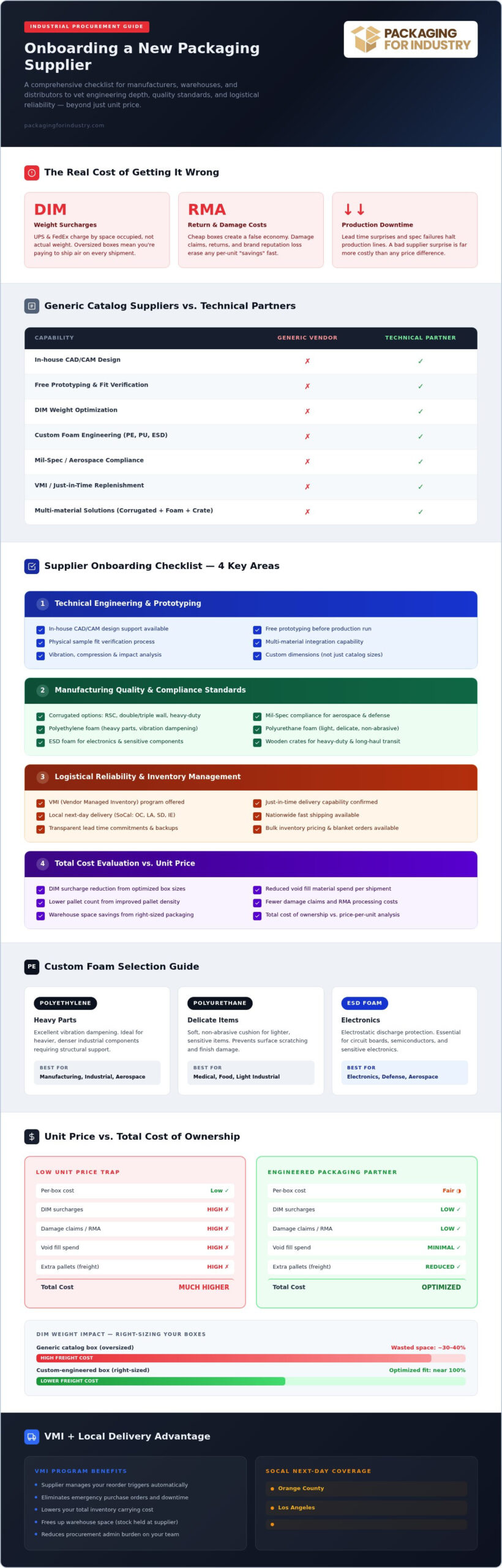
It’s clear that industrial packaging requires a technical partner rather than a simple commodity vendor. To help you secure this partnership, we’ve developed a comprehensive onboarding a new packaging supplier checklist. This resource allows you to master the selection process by vetting engineering depth, manufacturing quality, and logistical reliability. We’ll preview the essential markers of a reliable supplier, from VMI programs that lower your total cost of ownership to the benefits of finding a local Southern California partner in Anaheim or Los Angeles who can deliver next-day results.
Key Takeaways
- Learn why in-house CAD design and free prototyping are essential for ensuring precision fit before finalizing any custom order.
- Apply a comprehensive onboarding a new packaging supplier checklist to identify technical gaps that often lead to excessive freight surcharges and warehouse waste.
- Evaluate manufacturing capabilities beyond basic boxes, focusing on industrial-grade corrugated options and specialized Mil-Spec compliance for aerospace and defense.
- Explore how Vendor Managed Inventory (VMI) and local next-day delivery in Southern California can streamline your logistical flow and prevent costly downtime.
- Master the financial side of procurement by comparing total operational costs rather than just the upfront unit price of materials.
Why Generic Catalog Suppliers Fail Industrial Requirements
Many procurement teams fall into the “Catalog Trap” by sourcing from massive, one-size-fits-all vendors. While these suppliers offer convenience, their inventory is designed for general retail or light-duty shipping rather than the rigorous demands of industrial logistics. When you use an off-the-shelf box for a high-value component, you aren’t just buying cardboard; you’re often buying unnecessary risk. This is why a formal Supplier evaluation process is critical for manufacturers who need more than just a transaction. A checklist that prioritizes engineering over inventory helps you avoid the pitfalls of generic sourcing.
Generic packaging frequently results in wasted warehouse space and excessive spending on void fill materials. If a box is three inches too large in every direction, you’re paying to store, ship, and protect empty air. This inefficiency scales quickly across thousands of shipments. Pallet density also suffers when boxes don’t fit perfectly, leading to more pallets and higher freight costs. Transitioning from a transaction-based vendor to a strategic partner ensures that your packaging is engineered for your specific product dimensions. This shift is a core component of any effective onboarding a new packaging supplier checklist, as it moves the focus from the price per unit to the total cost of ownership.
The True Cost of Shipping Damage
Cheap boxes are a false economy. If a supplier lacks a history in damage reduction for manufacturers, the “savings” on material costs are quickly erased by expensive returns and damage to your brand reputation. Industrial operations involve heavy, fragile, or precision-engineered parts that require specific cushioning. A strategic partner evaluates your entire supply chain to prevent structural failures during transit. They look at vibration, compression, and impact points rather than just box strength. You can find more detail on how these failures impact your bottom line in our packaging cost-reduction analysis.
Freight and Surcharge Optimization
Logistics budgets are often decimated by dimensional weight (DIM) surcharges. Carriers like UPS and FedEx charge based on the space a package occupies, not just its actual weight. If your supplier only offers standard sizes, you’re likely paying avoidable surcharges on every shipment. A technical partner conducts a thorough packaging review to optimize dimensions, ensuring your corrugated cardboard boxes are as compact as possible without sacrificing protection. This optimization is a vital step in your onboarding a new packaging supplier checklist. By eliminating the “air” in your shipments, you reduce freight costs and improve overall supply chain efficiency.
Technical Engineering & Prototyping Capabilities Checklist
Industrial packaging isn’t a commodity; it’s an engineering discipline. A rigorous onboarding a new packaging supplier checklist must prioritize technical depth over simple warehouse capacity. If your vendor lacks in-house CAD/CAM design support, they can’t effectively manage complex custom projects that require precision tolerances. High-value components, especially in aerospace and aviation packaging, demand a supplier who can engineer multi-material solutions. This often involves integrating corrugated outer shells with custom foam inserts or heavy-duty wooden crates to ensure total product protection during long-haul transit.
Testing the fit of your product within its housing is a non-negotiable step in procurement. You should never commit to a production run without first reviewing a physical sample. Reliable partners offer free prototyping to verify fit assurance. This process identifies potential failure points before they become expensive liabilities on your production line. Using a technical onboarding a new packaging supplier checklist ensures that your vendor can move seamlessly from a digital design to a physical prototype, reducing the risk of shipping damage and optimizing your packaging footprint.
Custom Foam Engineering Standards
Don’t guess on material density when protecting sensitive gear. Your supplier needs to differentiate between Polyethylene and Polyurethane foam based on the fragility and weight of your product. Polyethylene offers excellent vibration dampening for heavier parts, while Polyurethane provides a softer, non-abrasive cushion for lighter items. For electronic components, verify that the supplier offers ESD (Electrostatic Discharge) foam and cleanroom-compliant materials to prevent static damage or contamination. Evaluating these custom foam packaging capabilities is essential for maintaining the integrity of high-stakes industrial equipment.
Prototyping and Fit Testing
Physical samples play a critical role in preventing production rollout errors. While CAD support speeds up the initial design cycle for custom crates and boxes, the physical prototype reveals how the materials interact under stress. A well-engineered insert might look perfect on a screen but fail when subjected to real-world compression. By ensuring your supplier provides comprehensive custom design packaging services, you gain the confidence that every millimeter of void space is accounted for. This precision reduces material waste and lowers your total cost of ownership. If you’re ready to see how custom engineering can protect your bottom line, you can request a technical quote for your next project.
Manufacturing Standards: Quality, Compliance, and Material Durability
Material integrity is the foundation of industrial logistics. A supplier’s ability to manufacture durable, compliant packaging determines whether your high-value components arrive at their destination intact or as an expensive liability. When building your onboarding a new packaging supplier checklist, you must verify that the vendor can provide more than just standard board grades. Industrial applications often require reinforced materials that can withstand stacking pressures, moisture, and long-term storage in varied climates. Assessing these manufacturing standards early prevents the catastrophic failure of packaging during the most critical phases of your supply chain.
Durability also extends to the secondary supplies that secure your load. High-performance stretch film, for example, must offer consistent load containment to prevent shifting on pallets. If a supplier provides low-gauge film that tears under tension, your entire shipment is at risk. Your checklist should include a review of the supplier’s full range of industrial supplies, ensuring that every component, from corner protection to heavy-duty tape, meets the same rigorous quality standards as the primary containers.
Industrial Corrugated and Heavy-Duty Boxes
Standard single-wall boxes are rarely sufficient for heavy machinery or precision electronics. You need to specify when heavy-duty double-wall or triple-wall corrugated is required based on the weight and fragility of the contents. Triple-wall board provides the structural rigidity necessary to replace heavy wooden crates in some scenarios, offering a lighter alternative that reduces freight costs without compromising protection. Ensure your partner can manufacture custom corrugated boxes in non-standard sizes to eliminate excess void fill and optimize pallet density. For international transit, ask about weather-resistant coatings and reinforced board options that maintain their strength in high-humidity environments.
Material quality for wood is another critical compliance area. If you’re shipping globally, your supplier must provide heat-treated pallets and crates that meet ISPM-15 standards. This certification is mandatory for export to prevent the spread of pests. A reliable partner manages this documentation seamlessly, ensuring your shipments aren’t quarantined at international borders due to non-compliant timber.
Military and Defense Compliance
Defense contracts introduce a layer of complexity that standard vendors cannot handle. Identifying military packaging expertise is a vital part of the onboarding a new packaging supplier checklist for any manufacturer serving government agencies. These projects require strict adherence to MIL-STD-2073, which dictates specific preservation methods, barrier materials, and labeling requirements. Your supplier must demonstrate a deep understanding of these regulations to avoid contract penalties or rejected shipments. Verify that they can provide the necessary specialized materials, such as greaseproof wraps and water-vapor-proof bags, to ensure long-term preservation in tactical environments.
Logistical Reliability and Inventory Management Capabilities
Logistics are the pulse of any industrial operation. Even a perfectly engineered box is useless if it isn’t on the assembly line exactly when needed. Your onboarding a new packaging supplier checklist must evaluate a vendor’s ability to manage inventory and deliver with precision. Reliability in this area prevents production stops and eliminates the need for expensive, last-minute rush orders. A strategic partner doesn’t just ship materials; they integrate into your supply chain to ensure constant availability of critical supplies like stretch film and pallets.
Inventory management is particularly vital for custom items with long lead times, such as custom foam inserts or printed corrugated. A capable supplier maintains stocking programs that keep these specific components ready for immediate dispatch. This foresight allows you to scale production without waiting weeks for specialized packaging to be manufactured. While some national vendors struggle with the nuances of local demand, a partner with regional distribution capabilities can support both your local facility and your national shipping requirements through a network of distribution partners.
Vendor Managed Inventory (VMI) Benefits
Scheduled inventory reviews are the backbone of a successful VMI program. Instead of your procurement team manually checking stock levels, the supplier performs weekly or monthly audits on-site. This proactive approach simplifies the purchasing process and ensures you never face a stockout. By leveraging Vendor Managed Inventory services, you can significantly reduce the amount of warehouse floor space dedicated to packaging. You only stock what you need for the immediate cycle, while the supplier maintains the safety stock at their facility. This system improves cash flow by reducing capital tied up in sitting inventory.
Regional Support and Delivery Speed
Proximity is a major factor in logistical efficiency. Partnering with a Southern California packaging supplier provides a distinct advantage for manufacturers in Anaheim and Los Angeles. Local presence means next-day delivery is a standard expectation rather than a logistical hurdle. This proximity also improves response times for custom box and crate design; an engineer can be at your facility quickly to measure a new part or troubleshoot a shipping issue.
Reducing emergency rush order costs is easier when your partner is in Orange County or LA. You don’t have to worry about cross-country freight delays or the high surcharges associated with overnight long-haul shipping. A local partner understands the regional traffic patterns and dock requirements, ensuring that your deliveries arrive on time and without incident. This regional reliability is a core pillar of a robust onboarding a new packaging supplier checklist.
Finalizing the Selection: Comparing Quotes and Total Value
The final stage of the onboarding a new packaging supplier checklist involves moving from technical vetting to a rigorous financial comparison. It’s easy to focus solely on the price per unit. However, industrial procurement requires a deeper look at the total operational cost (TCO). A lower box price is irrelevant if poor foam engineering leads to high damage rates or if oversized dimensions trigger carrier surcharges. You must evaluate the supplier’s willingness to act as a technical consultant. Scheduling a comprehensive packaging review is a critical next step to identify these hidden cost-saving opportunities before signing a long-term contract.
Pragmatic decision-makers look for stability and accountability. When you compare quotes, look for transparency in how the supplier handles material fluctuations and lead times. A partner who offers a grounded, matter-of-fact delivery of their capabilities is often more reliable than one promising hyper-inflated savings. This phase of the onboarding a new packaging supplier checklist ensures that your chosen partner can sustain your production rhythm without constant oversight or professional stress.
Structuring Your RFQ
To get an accurate comparison, your Request for Quote (RFQ) must be structured with precise data. Vague descriptions lead to vague pricing. Include exact product dimensions, total weight, and specific fragility requirements for every custom project. If you’re sourcing high-volume items like shipping boxes, ask for tiered pricing based on bulk volume orders. This transparency allows you to see where the real savings occur as your production scales. You can directly request a packaging quote to begin this data-driven comparison and see how specialized engineering impacts your bottom line.
The Value of Integrated Solutions
Consolidation is a major driver of administrative and logistical efficiency. Buying your boxes, foam, and stretch film from a single vendor reduces the overhead of managing multiple POs and disparate delivery schedules. Beyond simple procurement, check for packaging kitting capabilities. Suppliers who can pre-assemble complex kits, such as combining a custom crate with precision-cut foam inserts, save your team hours on the assembly line. This integrated approach ensures that every component fits perfectly, which reduces material waste and labor costs. Finalize your partnership based on this trifecta: engineering depth, logistical reliability, and local Southern California support.
Optimizing Your Supply Chain Through Strategic Partnership
Transitioning from a transaction-based vendor to a strategic partner requires a shift in focus from unit price to total operational efficiency. By prioritizing engineering depth and manufacturing compliance, you protect your bottom line from the hidden costs of shipping damage and freight surcharges. Utilizing a comprehensive onboarding a new packaging supplier checklist ensures that your chosen vendor provides the specialized aerospace and Mil-Spec expertise required for high-stakes industrial projects.
Effective logistical management through Vendor Managed Inventory (VMI) and local next-day delivery in Southern California eliminates production-stopping stockouts and reduces emergency rush costs. With free prototyping for custom designs, you can verify fit and durability before committing to a full production cycle. This methodical approach secures your supply chain; it provides the professional peace of mind that comes from a reliable, engineering-minded partnership. You’re now equipped to move forward with a vendor that values long-term stability and fiscal responsibility.
Frequently Asked Questions
What should I look for in an industrial packaging supplier?
Look for engineering depth, custom design capabilities, and logistical reliability. A true industrial partner offers more than a catalog; they provide multi-material solutions like foam-lined crates and specialized corrugated board. Your onboarding a new packaging supplier checklist should prioritize vendors who understand total cost of ownership rather than just unit price. Ensure they have experience in your specific sector, such as aerospace or medical device manufacturing.
How can a packaging supplier help reduce my shipping costs?
Suppliers reduce costs by optimizing package dimensions to eliminate dimensional weight surcharges from carriers like UPS and FedEx. Custom-engineered boxes reduce the need for excessive void fill and improve pallet density, allowing you to ship more product in less space. Strategic design also lowers the frequency of shipping damage. This reduces the administrative and financial burden of processing returns and replacement orders for high-value industrial components.
Do you offer custom sizing for corrugated boxes and foam inserts?
Yes, we specialize in manufacturing custom corrugated boxes and precision-cut foam inserts tailored to your specific product requirements. We provide a wide range of materials, including double-wall and triple-wall corrugated for heavy-duty applications. Our foam solutions include polyethylene, polyurethane, and anti-static options. This ensures that every item, from sensitive electronics to heavy machinery, receives an exact fit for maximum protection during transit.
What are the benefits of a Vendor Managed Inventory (VMI) program for packaging?
A VMI program eliminates production stops by ensuring your packaging supplies are always in stock based on actual usage. We perform scheduled inventory reviews at your facility, which simplifies the purchasing process and reduces the need for emergency rush orders. This program frees up valuable warehouse floor space and improves your cash flow by preventing over-ordering. It is an essential component to verify on any onboarding a new packaging supplier checklist.
Can you provide Mil-Spec compliant packaging for defense contracts?
We provide specialized military packaging that meets strict MIL-STD-2073 requirements and other government regulations. Our team understands the complexities of preservation methods, barrier materials, and specific labeling standards necessary for defense contracts. We ensure that your components are protected against environmental hazards and are fully compliant for government acceptance. This expertise is critical for contractors in the aerospace and defense sectors who require documented regulatory adherence.
Do you offer local next-day delivery in Southern California?
We offer local next-day delivery throughout Southern California, including Anaheim, Orange County, Los Angeles, and the Inland Empire. Our regional presence allows us to respond quickly to your production needs and minimize lead-time surprises. By maintaining our own fleet and local distribution, we provide a level of reliability that national catalog vendors often struggle to match. This proximity is a major advantage for manufacturers with recurring packaging needs.
How do I request a custom packaging quote for my business?
You can request a custom packaging quote by visiting our website and providing details about your project, such as dimensions, weight, and volume requirements. Our engineering team reviews your data to provide a technical solution that balances protection with cost-efficiency. For complex industrial projects, we may suggest a packaging review to identify specific areas where custom designs can reduce your total operational costs. We respond promptly to all B2B inquiries.
What is the benefit of free prototyping for custom industrial crates?
Free prototyping allows you to verify the fit and structural integrity of a custom design before committing to a full production run. This process identifies potential failure points and ensures that your high-value gear is properly secured. Physical samples are essential for custom crates and foam assemblies where precision is non-negotiable. Testing a prototype prevents expensive rollout errors and provides peace of mind that your packaging will perform in real-world shipping conditions.