
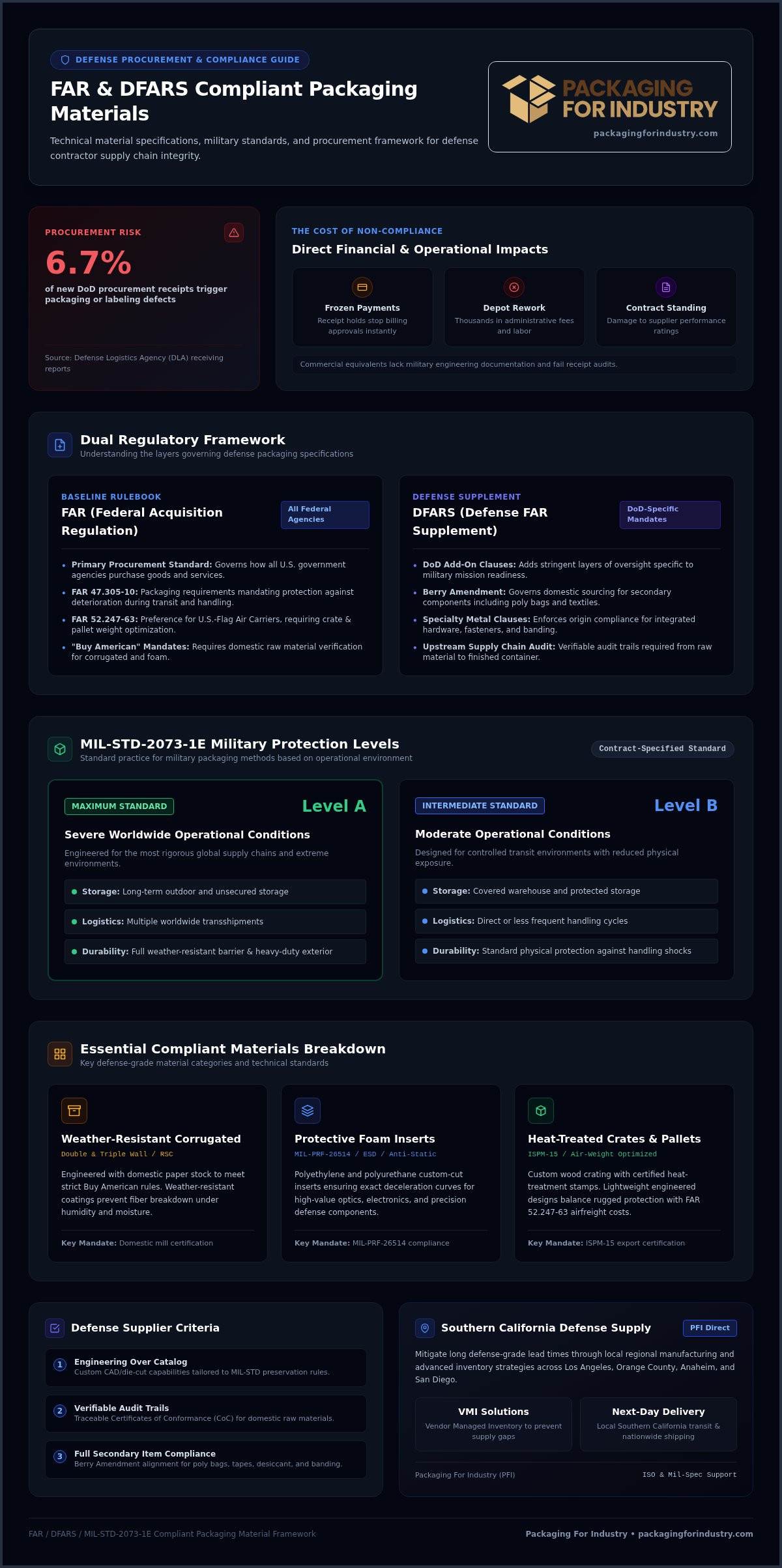
Did you know that approximately 6.7% of new procurement receipts entering DoD distribution centers trigger a packaging or labeling defect? For defense contractors, this isn’t just a minor logistical hiccup; it’s a direct threat to your contract standing and your cash flow. Sourcing the correct FAR and DFARS compliant packaging materials is often the difference between a seamless delivery and a frozen payment. You’re likely already dealing with the complexity of MIL-STD-2073-1E versus commercial standards. The pressure to protect high-value defense components from transit damage is constant.
We understand that managing these federal regulations often feels like hitting a moving target. This 2026 procurement guide is designed to simplify the process, offering clear specifications for everything from weather-resistant boxes to specialized foam inserts and heat-treated crates. You’ll learn exactly how to align your packaging strategy with current mandates to ensure total compliance. We’ll cover the essential material requirements and supplier standards you need to safeguard your products and maintain a perfect performance record.
Key Takeaways
- Distinguish between general FAR procurement rules and DoD-specific DFARS requirements to ensure your packaging strategy addresses every layer of federal oversight.
- Identify the technical specifications for FAR and DFARS compliant packaging materials, such as weather-resistant corrugated and anti-static foam, to avoid costly receiving discrepancies.
- Understand how the Berry Amendment and specialty metal clauses dictate the sourcing of secondary packaging components like poly bags and integrated hardware.
- Move beyond catalog-only suppliers by implementing a procurement strategy focused on engineering expertise and verifiable audit trails for mil-spec compliance.
- Leverage Vendor Managed Inventory (VMI) and local Southern California manufacturing to mitigate long lead times for specialized defense-grade materials.
Understanding FAR and DFARS Compliance in Industrial Packaging
The Federal Acquisition Regulation (FAR) acts as the primary rulebook for all U.S. government procurement. It establishes the baseline for how agencies buy goods and services. However, the Department of Defense (DoD) adds its own layer of requirements known as the Defense Federal Acquisition Regulation Supplement (DFARS). When sourcing FAR and DFARS compliant packaging materials, you aren’t just buying boxes. You’re ensuring the integrity of the supply chain. Packaging serves as the final barrier protecting critical defense assets. A “commercial equivalent” might look similar, but it often lacks the engineering documentation or material purity required for high-stakes defense contracts. Contractors must treat these regulations as a roadmap for physical protection, not just a list of checkboxes. Following Federal Acquisition Regulation guidelines is a structural requirement. It isn’t just a paperwork exercise.
Why Packaging Compliance Matters for Defense Contracts
Non-compliance carries heavy penalties. According to DLA reports, roughly 6.7% of procurement receipts trigger packaging defects. This leads to immediate shipment rejection and frozen payments. Reworking a shipment at a depot is expensive. It often costs thousands in administrative fees and labor. Beyond the balance sheet, compliance ensures mission readiness. If a component arrives damaged because the foam didn’t meet MIL-PRF-26514 standards, the delay affects the end user in the field. Using custom design packaging ensures the material spec is right the first time. It eliminates professional stress and guarantees your product survives the logistics cycle.
The Relationship Between MIL-STD-2073 and FAR/DFARS
Contract clauses frequently point toward specific military standards for preservation and packing. The most critical of these is MIL-STD-2073-1E. This document outlines specific military packaging methods based on the expected environment. Establishing a reliable source for FAR and DFARS compliant packaging materials is the first step in protecting your reputation as a defense supplier.
- Level A Protection: This is the highest standard. It’s required for severe worldwide operational conditions, such as long-term outdoor storage or multiple transshipments.
- Level B Protection: This is intended for moderate conditions. It typically involves covered storage and less frequent handling.
Understanding these levels is vital. Your contract specifies exactly which one to follow. Mistaking a commercial standard for a military one can lead to a breach of contract, even if the goods themselves are perfect. Reliable partners help you distinguish these specs to avoid audit failures and ensure your military packaging meets every technical benchmark.
Key Regulatory Clauses Affecting Packaging Material Selection
Selecting FAR and DFARS compliant packaging materials requires a granular understanding of specific clauses that dictate material origin and performance. While Section 1 established the regulatory framework, the physical selection of materials is governed by mandates that go beyond simple durability. For instance, “Buy American” requirements significantly impact the sourcing of raw materials for corrugated boxes and foam. Contractors must verify that these materials are manufactured domestically to remain in full compliance with their prime contract flow-downs. Relying on generic documentation isn’t enough; you need a partner who validates the upstream supply chain.
Compliance also extends to logistical preferences. Under FAR 52.247-63, there is a strict preference for U.S.-Flag Air Carriers. This mandate forces engineers to optimize the weight of wooden crates and pallets to control costs while adhering to federal shipping rules. Protection must meet FAR 47.305-10 packaging requirements to prevent deterioration during transit. Balancing these competing needs is where custom engineering becomes a necessity rather than an option. Domestic content is non-negotiable.
DFARS Specialty Metals and Packaging Hardware
DFARS 252.225-7009 governs the procurement of specialty metals. This clause often catches contractors off guard because it applies to packaging hardware. If you’re utilizing heavy-duty crates or custom-reinforced boxes, you must identify the origin of every fastener, hinge, and handle. Using non-compliant steel or alloys in your packaging can trigger a rejection of the entire shipment. To maintain compliance, your supplier must provide a clear audit trail and documentation proving the domestic origin of all metal components. This level of oversight ensures your military packaging doesn’t fail an inspection due to a single non-compliant screw.
The Berry Amendment and Industrial Textiles
The Berry Amendment (USC, Title 10, Section 2533a) is equally critical for industrial textiles used in defense shipments. This regulation mandates that certain items, including specialized bags and cushioning materials, be entirely produced in the United States. When sourcing stretch film or poly bags for kitting, domestic content is non-negotiable. Many catalog suppliers provide items with mixed global origins, which creates unnecessary risk for defense-grade kitting operations. Sourcing from a partner who understands these restrictions is the most efficient way to secure a compliant supply chain and eliminate professional stress.
Essential FAR/DFARS Compliant Materials: Corrugated, Foam, and Wood
Moving from regulatory clauses to physical implementation requires a focus on material grade. Sourcing FAR and DFARS compliant packaging materials involves selecting substrates that withstand the rigors of the military distribution system. All materials must align with the Defense Logistics Agency packaging criteria, which distinguish between standard commercial protection and the higher demands of MIL-STD-2073-1. These specifications ensure that products remain functional after long-term storage in non-climate-controlled environments. Failure to match the material to the contract level results in immediate discrepancy reports.
Heavy-Duty Corrugated for Military Applications
Standard boxes won’t suffice for long-term depot storage. Military-grade corrugated boxes often utilize weather-resistant fiberboard such as W5c or V3c grades. Double-wall construction provides sufficient protection for most lightweight components, but heavy-duty triple-wall fiberboard is necessary for items exceeding 100 pounds or those requiring extreme stack strength. Engineering custom sizes is a critical cost-saving measure. By reducing excess “air” in the container, contractors significantly lower freight costs and minimize the need for additional void fill. This precision reflects a commitment to both product protection and fiscal responsibility.
Engineered Foam Inserts for High-Value Components
Sensitive electronics and aerospace parts require precise shock absorption. Custom foam packaging typically involves two primary materials: polyethylene and polyurethane. Polyethylene is a closed-cell foam known for its durability and resistance to chemicals. It’s ideal for heavy components or those exposed to industrial fluids. Polyurethane is an open-cell foam that offers softer cushioning for delicate instruments. For defense electronics, sourcing anti-static (ESD) versions of these foams is mandatory to prevent electrostatic discharge. Combining these with moisture barrier bags creates a complete preservation system that meets strict Method 50 requirements.
Wood Crates and Export Compliance
International defense logistics demand strict adherence to ISPM-15 standards. All solid wood custom crates and pallets must be heat-treated to a core temperature of 56°C for 30 minutes. This process is verified by a permanent “HT” stamp from an accredited agency. Without this mark, shipments are subject to immediate quarantine or destruction at international ports. For heavy machinery or aerospace engines, custom-engineered crates provide the structural integrity needed for multi-modal transit. These systems ensure that high-value assets arrive ready for mission use, regardless of the destination or handling conditions.
Procurement Strategy: Evaluating Suppliers for Defense-Grade Packaging
Sourcing FAR and DFARS compliant packaging materials requires more than just a part number. It demands a supplier with a robust quality management system and a deep understanding of federal flow-down requirements. Many contractors rely on large catalog suppliers, but these vendors often fail when faced with specific engineering needs or strict domestic content mandates. A true defense-grade partner provides a clear audit trail from the raw material stage to the final delivery. This transparency is vital for maintaining your CPARS scores and avoiding the physical remediation costs associated with receiving discrepancies at DoD depots. You need a partner who acts as a consultant, not just a middleman.
Vetting Your Packaging Manufacturer
Your choice of manufacturer directly impacts your contract’s long-term success. Start by asking specific questions about their domestic material sourcing and certification processes. A reliable partner should offer CAD/CAM support and free prototyping to ensure a perfect product fit before you commit to a full production run. This proactive approach to custom design packaging reduces the risk of transit damage for high-value aerospace components. It also allows you to test the structural integrity of the container against specific MIL-STD benchmarks without the financial burden of trial-and-error procurement. If a supplier can’t provide verifiable material certifications, they aren’t equipped for defense work.
Streamlining with VMI and Just-In-Time Delivery
Defense production schedules are tight. Lead times for specialized materials like V3c board or MIL-PRF-81705 barrier film can be unpredictable. Implementing a Vendor Managed Inventory (VMI) program is the most efficient way to manage these fluctuations. By allowing your supplier to monitor and replenish your stock, you maintain a 100% fill rate for your production line without tying up capital in excessive warehouse space. This strategy shifts the logistical burden to the expert. It ensures that FAR and DFARS compliant packaging materials are always on hand when a contract reaches the shipping phase. It eliminates the professional stress of potential stockouts and keeps your supply chain lean and responsive.
PFI: Your Southern California Partner for Compliant Defense Packaging
PFI serves as a strategic extension of your manufacturing operation. We specialize in providing FAR and DFARS compliant packaging materials that meet the rigorous demands of the aerospace and defense sectors. Our approach moves beyond simply selling supplies; we engineer integrated solutions that combine heavy-duty corrugated containers, precision-cut foam inserts, and ISPM-15 certified wood crates into a single, cohesive system. This comprehensive oversight ensures that every component of your packaging kit is fully documented and audit-ready. By consolidating these requirements with a single partner, you eliminate the risk of mismatched specifications and reduce the administrative burden of managing multiple vendors.
Efficiency is central to our service model. We focus on the intersection of engineering and economics to help defense contractors lower their total packaging spend. Our team conducts detailed cost-reduction analyses, identifying ways to optimize material usage without compromising the safety of high-value assets. Whether you need custom CAD/CAM support for a new aerospace component or a reliable source for high-volume mil-spec boxes, we provide the technical expertise and logistical flow necessary to keep your contracts on track. We project a sense of reliability and partnership, aiming to reassure you that your operational challenges are solvable.
Local Expertise for Southern California Aerospace
Our proximity to major defense hubs allows us to offer unmatched responsiveness. We provide local next-day delivery to manufacturers in Anaheim, Irvine, Torrance, and across the Los Angeles and Orange County regions. This local presence enables us to perform on-site aerospace packaging reviews. During these consultations, our engineers identify specific opportunities to reduce transit damage and eliminate unnecessary material costs. We understand the unique pressures facing Southern California manufacturers and provide the steady, dependable support needed to meet mission-critical deadlines. Our nationwide shipping capabilities ensure that even recurring programs outside the local area benefit from our precision engineering.
Ready to Secure Your Defense Contract?
Compliance is a structural requirement that demands a proactive partner. PFI is equipped to handle both custom engineered designs and stock mil-spec needs, ensuring your operation remains lean and fully compliant with federal mandates. Our Anaheim-based team is ready to conduct a technical review of your specific packaging requirements to ensure every material meets current standards. Don’t let packaging discrepancies delay your payments or damage your professional standing. Sourcing FAR and DFARS compliant packaging materials from a seasoned consultant is the most direct path to logistical optimization.
Securing Your Supply Chain for 2026 and Beyond
Maintaining a perfect performance record with the DoD requires more than just meeting production deadlines. It demands a rigorous approach to physical protection and regulatory adherence. By prioritizing FAR and DFARS compliant packaging materials, you eliminate the risk of receiving discrepancies and ensure your high-value components arrive ready for mission use. We’ve explored how custom engineering, from weather-resistant corrugated to anti-static foam, provides the durability needed for the modern defense logistics network.
PFI brings specialized aerospace and defense expertise to every project. Our team utilizes custom CAD/CAM prototyping to guarantee a perfect fit, while our local Southern California next-day delivery keeps your production lines moving without interruption. We focus on the intersection of engineering and economics to safeguard your products and your bottom line.
Partnering with a seasoned industrial consultant gives you the peace of mind that your contract requirements are fully met. We’re ready to help you optimize your packaging strategy and achieve total logistical stability.
Frequently Asked Questions
What is the difference between FAR and DFARS in packaging?
FAR provides the standard rules for all U.S. government procurement. DFARS is a specific layer of requirements for the Department of Defense. While FAR covers general packaging and marking, DFARS introduces stricter mandates for specialty metals and domestic content. Sourcing FAR and DFARS compliant packaging materials ensures you meet both the general federal standards and the rigorous, defense-specific preservation levels required by the DoD for mission-critical assets.
Do I need mil-spec packaging for every defense contract?
No, not every contract requires mil-spec preservation. You must review Section D of your contract to see if it invokes MIL-STD-2073 or allows for ASTM D3951 commercial packaging. Commercial standards are typically used for items intended for immediate use within six months. However, if your product enters the defense transportation system or requires long-term depot storage, strict adherence to military preservation methods is a legal necessity to avoid shipment rejection.
What are the ISPM-15 requirements for international military shipping?
All solid wood packaging materials destined for international military distribution must comply with ISPM-15 regulations. This requires heat-treating the wood to a minimum core temperature of 56°C for at least 30 continuous minutes. Every compliant pallet or crate must bear the registered IPPC certification mark. PFI ensures all export-grade wood products meet these standards, preventing your shipments from being quarantined or destroyed at international ports of entry during the logistics cycle.
How do I know if my foam packaging is DFARS compliant?
Foam compliance is determined by its material origin and technical specifications. You must verify that the material meets MIL-PRF-26514G for cushioning and complies with domestic sourcing requirements. For electronics, anti-static foam must also meet specific static decay rates. PFI provides technical reviews and material certifications to ensure your FAR and DFARS compliant packaging materials meet the exact chemical and physical properties dictated by your contract, providing peace of mind for your team.
Can PFI provide custom sizes for heavy-duty triple-wall boxes?
PFI specializes in engineering custom-sized heavy-duty triple-wall boxes tailored to your specific product dimensions. Custom sizing is a strategic way to lower freight costs and eliminate the need for excessive void fill. These boxes provide the extreme stack strength required for heavy machinery and aerospace components. Our Anaheim-based team uses CAD/CAM support to create prototypes, ensuring that your heavy-duty corrugated solution provides maximum protection without the expense of shipping unnecessary air.
What documentation do I need to prove ‘Buy American’ compliance for packaging?
To prove compliance, you typically need a Certificate of Conformance and a formal statement of origin from your supplier. These documents must verify that the materials were manufactured in the United States using domestic raw components. For complex assemblies like custom crates, the documentation should cover every element, including fasteners and hinges. PFI maintains clear audit trails for all mil-spec orders, providing the transparent records you need to satisfy federal auditors and maintain contract standing.
Does PFI offer local delivery for aerospace companies in Orange County?
Yes, PFI provides local next-day delivery for aerospace and defense manufacturers throughout Orange County. We directly serve hubs in Anaheim, Irvine, Huntington Beach, and Costa Mesa. This local focus allows our team to perform on-site packaging reviews and deliver mission-critical supplies with minimal lead times. Our proximity to Southern California’s aerospace corridor ensures that your production line remains active and your shipping schedules stay on track without the delays of national carriers.
How can a VMI program help with recurring defense packaging needs?
A Vendor Managed Inventory program eliminates lead-time surprises for specialized mil-spec items. PFI monitors your actual usage through weekly or monthly reviews and replenishes your stock before a shortage occurs. This is particularly effective for custom boxes and engineered foam that can’t be replaced with off-the-shelf alternatives. By maintaining agreed-upon stocking levels, VMI improves your cash flow and frees up warehouse space while ensuring you always have the right materials for recurring defense contracts.