
Could the weight of your packaging be costing you as much as the damage it’s supposed to prevent? For many high-tech firms in Orange County, the hidden costs of dimensional weight surcharges and slow lead times from national suppliers are just as damaging as a shattered component. You likely agree that over-packaging is a waste of capital, yet the risk of transit damage remains a constant threat to your reputation and your bottom line. Utilizing custom foam end caps for product protection Irvine manufacturers trust allows you to secure fragile electronics or medical devices without the bulk of full foam inserts.
This guide explains how to eliminate shipping damage and reduce overall packaging costs through precision engineering. You’ll learn how to navigate the 10% plastic reduction targets mandated by California’s SB 54 and manage the recent price volatility in polyethylene and polyurethane markets. We’ll also preview how localized, just-in-time delivery can replace slow catalog suppliers, ensuring your production line never stops for lack of protective materials. By focusing on the intersection of engineering and economics, you can achieve zero-damage arrivals while optimizing your logistical flow and reducing material waste.
Key Takeaways
- Discover how custom foam end caps can reduce material usage by up to 60% compared to full foam inserts, significantly lowering your total packaging costs.
- Learn the technical differences between Polyethylene and Polyurethane foams to select the optimal cushioning for your specific product weight and fragility.
- Streamline your supply chain with foam end caps for product protection Irvine manufacturers rely on for zero-damage shipping of high-value electronics and medical devices.
- Identify the specific engineering requirements, such as G-factor and carton clearance, needed to specify the correct foam density for your production line.
- Understand how Vendor Managed Inventory (VMI) and just-in-time delivery models from a local supplier can eliminate lead-time delays and warehouse congestion.
Optimizing Product Protection with Foam End Caps in Irvine
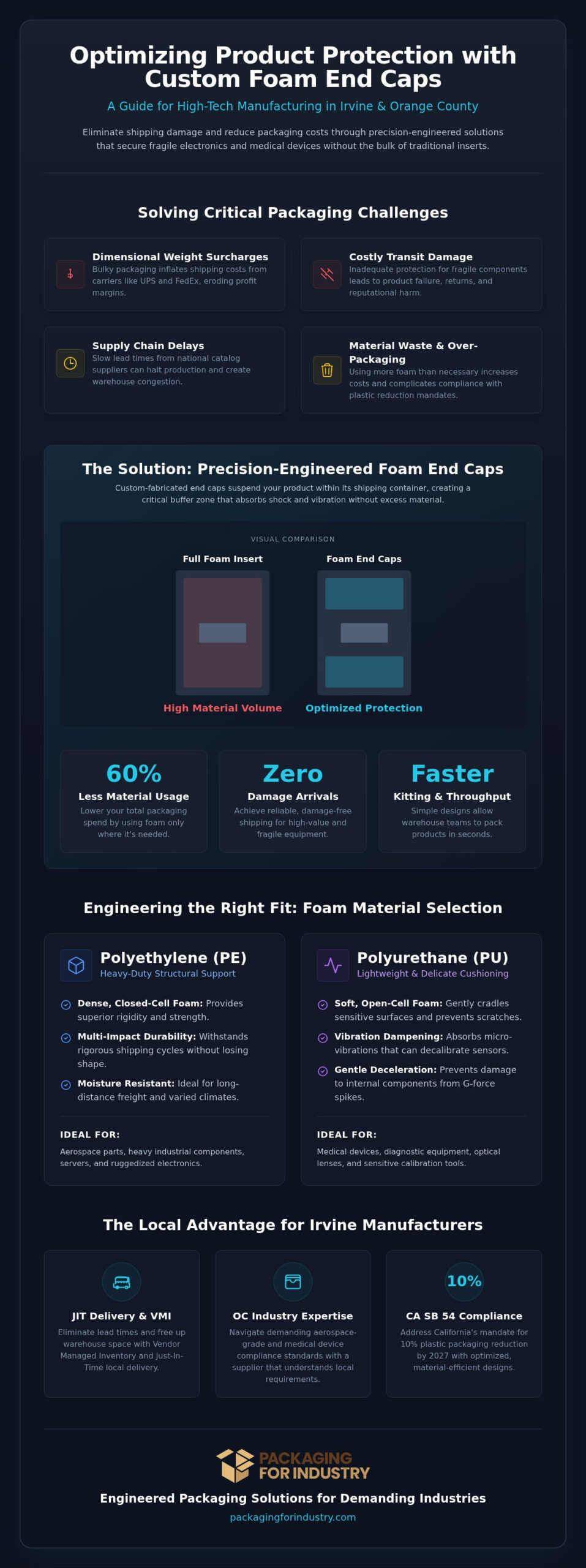
Foam end caps are custom-engineered structures designed to suspend a component within its shipping container. Unlike standard loose-fill or generic wraps, these caps are fabricated to the exact geometry of your product, ensuring it remains stationary during transit. This design utilizes foundational product protection principles to create a critical buffer zone between the item and the outer corrugated box. For manufacturers sourcing foam end caps for product protection Irvine businesses find that this suspension method is the most reliable way to prevent impact damage.
Switching from full foam blocks to engineered end caps provides several operational advantages:
- Reduced Material Volume: Using foam only where it’s needed can lower material costs by up to 60%.
- Logistical Efficiency: Lighter packaging reduces dimensional weight (DIM) surcharges from carriers like UPS and FedEx.
- Faster Kitting: Simplified designs allow warehouse teams to secure products in seconds, increasing throughput.
The Role of End Caps in Fragile Logistics
Irvine’s medical and laboratory sectors frequently ship sensitive calibration tools and diagnostic equipment that cannot tolerate even minor G-force spikes. When selecting foam end caps for product protection Irvine engineers prioritize vibration dampening during long-haul freight or air transit. Constant micro-vibrations can decalibrate internal sensors; custom foam absorbs these frequencies before they reach the hardware. Beyond protection, these caps improve the unboxing experience. Professional, clean-cut foam inserts signal quality and reliability, which is essential for high-ticket electronics. They eliminate the mess of loose-fill and the frustration of excessive tape.
Local Industry Standards in Orange County
The business community within the Irvine Spectrum and surrounding Orange County industrial parks operates under rigorous quality standards. Packaging must often meet aerospace-grade protection requirements or stringent medical device compliance. Local expertise is vital for navigating these demands while also addressing California’s SB 54 plastic reduction mandates, which require a 10% reduction in plastic packaging weight by January 1, 2027. As a local expert, Packaging For Industry understands these regional pressures. We provide the technical design and rapid prototyping required to meet local manufacturing schedules, ensuring your protective packaging is both compliant and cost-effective.
Engineering the Right Fit: Foam Materials and Design Styles
Selecting the right foam end caps for product protection Irvine manufacturers require depends on the specific G-factor and fragility of your equipment. Engineering the correct protective solution requires more than just measuring dimensions; it demands a deep understanding of material science. For manufacturers in the Irvine Spectrum, selecting the wrong foam density can lead to either catastrophic product failure or unnecessary shipping costs. By matching the foam’s mechanical properties to the product’s weight, we ensure total protection without over-engineering the package.
Polyethylene (PE) vs. Polyurethane (PU) End Caps
Polyethylene is a dense, closed-cell foam that provides superior structural support for heavier industrial components. It’s the standard for aerospace parts and heavy machinery because it resists moisture and withstands multiple impacts without losing its shape. Engineering data from foam performance testing confirms that PE foam maintains its cushioning properties through rigorous shipping cycles, making it ideal for long-distance freight. It’s the “fixer” material for heavy-duty applications where durability is non-negotiable.
Conversely, Polyurethane is a soft, open-cell foam designed for lightweight, highly fragile items. If you’re shipping delicate medical sensors or optical lenses, PU foam provides the gentle deceleration needed to prevent internal component damage. While PU doesn’t have the same memory or durability as PE for heavy loads, its ability to cradle sensitive surfaces is unmatched in the medical device sector. Choosing between these materials is a matter of balancing product weight against the required cushioning stroke.
Specialized ESD and Anti-Static Options
Irvine’s prominent semiconductor and electronics sectors require specialized protection against electrostatic discharge. Standard foam can generate static electricity during transit, which can fry sensitive circuits before the product even reaches the customer. Pink anti-static foam is a critical requirement for these firms. By utilizing specialized foam end caps for product protection Irvine electronics companies can ensure their components comply with strict shipping protocols. We offer both surface-treated and inherent ESD foam options to provide long-term reliability for recurring production needs.
For products with Class-A surfaces, such as polished metals or painted aerospace housings, we utilize cross-linked polyethylene (XLPE). This non-abrasive material prevents micro-scratching that standard foams might cause. Beyond material choice, design styles play a vital role in logistical efficiency:
- Traditional Die-Cut Sets: Best for uniform items that require high-volume production.
- Ribbed End Caps: Designed with internal ridges to allow for variable weight distribution and enhanced shock absorption.
- Hingelock Designs: Ideal for products that need to be secured quickly on a high-speed assembly line.
If you’re evaluating your current packaging’s effectiveness or looking to compare packaging pricing for a new product launch, you can request a packaging quote to receive a custom engineering assessment.
Cost-Benefit Analysis: Foam End Caps vs. Full Foam Inserts
Decisions in industrial logistics often boil down to the balance between protection and price. While full foam inserts offer comprehensive coverage, they often represent an unnecessary expense for many products. By utilizing foam end caps for product protection Irvine firms can optimize their spend by targeting protection only at the most vulnerable points of a component. This engineering-first approach ensures that you aren’t paying for material that doesn’t actively contribute to shock absorption or vibration dampening.
The economic advantages of end caps extend beyond the initial purchase price. There are four primary areas where this design style outperforms full encapsulation:
- Material Reduction: Eliminating foam from the center of the package can reduce material costs by up to 60%. This lowers the price per unit and reduces the total volume of waste generated at the destination.
- Dimensional Weight (DIM) Savings: Carriers like UPS and FedEx charge based on the box’s exterior volume. End caps allow products to fit into smaller, standard-sized corrugated boxes, directly lowering your per-unit shipping costs.
- Warehouse Footprint: End caps are stackable and take up significantly less square footage than bulky full-box inserts. In high-rent Irvine industrial parks, freeing up warehouse space for production is a tangible fiscal win.
- Kitting Speed: Assembly teams can secure end caps in seconds. This simplicity reduces labor hours and eliminates the “unboxing friction” often associated with complex, multi-piece foam assemblies.
When to Choose End Caps
End caps are the most efficient choice for rectangular or square products with uniform ends, such as server chassis or laboratory monitors. This design is particularly effective for products that require a “floating” position within the carton. By suspending the item, you ensure it avoids contact with all six sides of the box, creating a consistent buffer zone. For high-volume production runs where assembly speed is a critical KPI, the streamlined nature of end caps provides the best ROI. When you specify foam end caps for product protection Irvine operations become leaner and more predictable.
When Full Inserts are Necessary
While end caps are highly efficient, some applications require the total encapsulation provided by custom foam packaging. Irregularly shaped items with multiple fragile projection points often need support across the entire surface area to prevent snapping. Extremely high-value aerospace components or medical instruments might also require 100% encapsulation to protect against dust or to meet specific military-spec requirements. In these cases, the higher material cost is a necessary investment to guarantee the integrity of a mission-critical asset.
How to Specify Custom Foam End Caps for Your Production Line
Defining the technical requirements for foam end caps for product protection Irvine manufacturers rely on is a rigorous engineering task. Precision is mandatory for sensitive electronics and aerospace hardware. A loose fit or incorrect density leads directly to transit failures. Follow these five steps to establish your specifications before moving into full production.
- Step 1: Identify G-factor: Determine the maximum shock your product can withstand. This fragility rating dictates how much foam “stroke” is required to decelerate an impact safely.
- Step 2: Map Critical Geometries: Measure the product’s primary dimensions. Account for cables, heat sinks, or delicate ports that require specific clearance to avoid pressure points.
- Step 3: Calculate Cushioning Density: Select a foam grade based on your anticipated drop height. Heavier equipment requires higher-density polyethylene to prevent the foam from compressing completely during a fall.
- Step 4: Request a Physical Prototype: Validate your digital designs with a physical sample. This allows your assembly team to test the kitting speed and verify the secureness of the fit.
- Step 5: Select Fabrication Method: Choose die-cutting for high-volume efficiency or CNC routing for low-volume, high-precision projects.
The Importance of Prototyping
Precision engineering requires CAD support to ensure every cutout aligns perfectly with your hardware’s unique shape. Prototyping allows you to test real-world shipping scenarios, such as rough handling by regional carriers, before committing capital to a large order. It’s a vital phase for identifying assembly bottlenecks or unboxing friction. Our approach to custom design packaging includes free prototyping for product fit. This ensures the foam end caps for product protection Irvine businesses buy from us perform exactly as specified in the field.
Integrating with Corrugated Boxes
An end cap only protects as well as the carton that contains it. You must ensure the cap fits snugly within your custom corrugated boxes to prevent shifting. We calculate precise end-loading tolerances so the assembly slides into the box easily while maintaining a zero-clearance fit once sealed. This optimization eliminates unnecessary wiggle room and allows for the smallest possible outer box. By reducing the exterior volume, you effectively lower packaging costs and avoid the aggressive dimensional weight surcharges common with long-haul freight.
Why Irvine Manufacturers Choose PFI for Custom Protective Packaging
Irvine’s high-tech and aerospace sectors require more than just a catalog supplier. They need a logistical partner that understands the specific pressures of Southern California’s manufacturing landscape. By choosing PFI for foam end caps for product protection Irvine businesses gain access to a localized supply chain designed for speed and fiscal responsibility. Our proximity allows us to offer local next-day delivery across Orange County, ensuring your production line never stalls due to a packaging stockout. We’re positioned as a seasoned consultant to help you navigate the 10% plastic reduction targets mandated by California’s SB 54, providing the engineering expertise to meet these goals without increasing your damage rates.
We provide a comprehensive suite of protective materials beyond custom foam. Our integrated approach allows you to source corrugated boxes, heavy-duty crates, and stretch film from a single point of contact. This consolidation simplifies your purchasing process and ensures every component of your packaging system is engineered to work together. We don’t just sell products; we perform detailed cost-reduction analyses. Our team reviews your current shipping damage rates and material waste to identify specific areas where you can lower packaging costs. We look at the intersection of engineering and economics to find the “sweet spot” for your specific application.
Vendor Managed Inventory (VMI) in Irvine
Warehouse space in the Irvine Spectrum is a premium asset that shouldn’t be cluttered with bulky packaging supplies. Our VMI services allow you to offload your inventory management to us. We stock your custom foam end caps at our facility and deliver them on a scheduled replenishment cycle based on your actual production usage. This system eliminates warehouse clutter and ensures you have the exact amount of material needed for your daily throughput. It’s a pragmatic solution for firms looking to optimize their square footage for revenue-generating production activities rather than storage.
Just-In-Time (JIT) Logistics
Supporting a lean manufacturing environment requires a partner who can move at the speed of your business. Our JIT logistics model reduces the amount of capital tied up in excess inventory, allowing you to reallocate those funds toward R&D or equipment upgrades. We understand that in the semiconductor and medical device industries, lead times are critical. By maintaining a reliable local presence, we provide the rapid response times that national catalog suppliers can’t match. If you’re ready to optimize your logistical flow and eliminate the professional stress of supply chain disruptions, request a packaging quote today.
Secure Your Supply Chain with Engineered Foam Solutions
Engineering a resilient packaging strategy requires balancing material performance with logistical efficiency. Implementing foam end caps for product protection Irvine manufacturers can significantly reduce shipping damage while lowering their total cost of ownership. Precision material selection, such as ESD foam for electronics or high-density polyethylene for aerospace parts, ensures that your high-value assets arrive in perfect condition without the waste of over-packaging.
Our Southern California facility provides the local expertise you need to navigate California’s environmental mandates and supply chain volatility. With free prototyping and CAD support, we eliminate the guesswork from your design process. Our specialists in aerospace and medical protection are ready to help you transition to a VMI model that frees up warehouse space and ensures you never face a stockout. National suppliers can’t match the speed and precision of a local partner who understands your operational constraints.
Take the first step toward optimizing your industrial cushioning today. Our team is committed to providing local next-day delivery and the technical precision your production line demands. Let’s build a more efficient, damage-free future for your business.
Frequently Asked Questions
How much do custom foam end caps cost in bulk?
Bulk costs are determined by material volume, density, and design complexity. While setup costs for die-cutting or CNC routing are fixed, they are amortized over larger quantities, which significantly lowers the price per unit for high-volume production. To accurately compare packaging pricing for your specific inventory needs, we recommend requesting a tailored quote that accounts for your recurring usage and preferred material grade.
Can foam end caps be reused for multiple shipments?
Reusability depends primarily on the foam material selected for your application. Polyethylene (PE) foam is highly durable and maintains its structural integrity through multiple shipping cycles, making it a sustainable choice for closed-loop logistics. Polyurethane (PU) foam is softer and may degrade if subjected to repeated heavy impacts. We evaluate your specific transit environment to recommend a material that balances protection with the required lifespan.
What is the minimum order quantity for custom die-cut foam?
Minimum order quantities vary based on the specific fabrication process and material type required. While we focus on bulk industrial supply, our rapid prototyping services allow for small-batch testing before you commit to a full production run. This flexibility ensures that manufacturers in Orange County can verify their designs without excessive upfront inventory costs. Contact our specialists to discuss how we can support your specific production volumes.
How do I know if I need polyethylene or polyurethane foam?
Material selection is based on the G-factor and total weight of your product. Polyethylene is a dense, closed-cell foam engineered for heavy industrial components and aerospace parts. In contrast, polyurethane is an open-cell, soft foam designed to cradle lightweight, highly fragile medical sensors. We perform cushioning calculations to ensure your choice provides the necessary shock absorption for zero-damage arrivals while remaining cost-effective for your budget.
Do you offer anti-static foam end caps for electronics?
We offer a full range of anti-static foam options for sensitive electronics. Utilizing foam end caps for product protection Irvine firms rely on ensures that semiconductor components are safe from electrostatic discharge during transit. We provide pink anti-static materials in both surface-treated and inherent ESD foam varieties. These options help you comply with strict shipping protocols and protect your brand reputation by delivering functional products every time.
What is the typical lead time for custom foam prototypes in Irvine?
Local prototyping in Irvine typically takes only a few business days from the finalization of your CAD design. Our Southern California presence allows us to move quickly from initial engineering to a physical sample you can test in your own facility. This rapid response supports lean manufacturing environments by eliminating the long wait times common with national catalog suppliers. It’s a proactive way to accelerate your product launch.
Can you design end caps that fit into my existing shipping boxes?
We frequently design custom inserts to fit existing inventory of corrugated boxes or crates. Our engineering team measures your product and the internal dimensions of your current packaging to create a zero-clearance fit. This approach allows you to upgrade your protective cushioning without the expense of replacing your entire box stock. It is a pragmatic solution for businesses looking to improve reliability while utilizing their current warehouse assets.
How do foam end caps help reduce dimensional weight charges?
End caps reduce dimensional weight by minimizing the overall exterior volume of your shipping container. By suspending the product rather than fully encapsulating it, you can often fit the item into a smaller, standard-sized box. Using foam end caps for product protection Irvine logistics managers can effectively lower packaging costs by avoiding the aggressive dimensional weight surcharges applied by carriers like UPS and FedEx for oversized parcels.