
With the global foam packaging market projected to reach $17.10 billion in 2026, the real cost of transit isn’t the material; it’s the failure of it. Shipping sensitive industrial equipment often feels like a gamble where the stakes are your profit margins and customer reputation. You’re likely frustrated by high product damage rates and the hidden costs of using excessive, non-optimized materials that bloat your shipping spend. It’s a common operational bottleneck that many procurement teams struggle to solve without sacrificing lead times or quality.
As an experienced foam end caps manufacturer Santa Ana, we understand that effective protection is a balance of engineering and economics. You need packaging that works the first time, every time, without the wait of traditional prototyping. This article explores how custom-engineered foam end caps reduce transit damage and optimize your supply chain economics through precision design. We’ll preview how zero-damage shipping cycles and reliable Vendor Managed Inventory (VMI) integration can lower your total cost of ownership while keeping your operations lean and responsive.
Key Takeaways
- Learn how custom end caps function as a strategic suspension system to isolate sensitive equipment from vibration and impact damage.
- Compare the technical benefits of polyethylene and polyurethane to choose the right material density for your specific industrial application.
- Partner with a foam end caps manufacturer Santa Ana to streamline your packing process and reduce the labor costs associated with generic cushioning.
- Understand the engineering workflow from initial CAD blueprinting to precision production that ensures zero-damage shipping cycles.
- Optimize your supply chain reliability using Vendor Managed Inventory (VMI) to maintain stock levels without excessive warehouse overhead.
High-Performance Foam End Caps for Industrial Product Protection
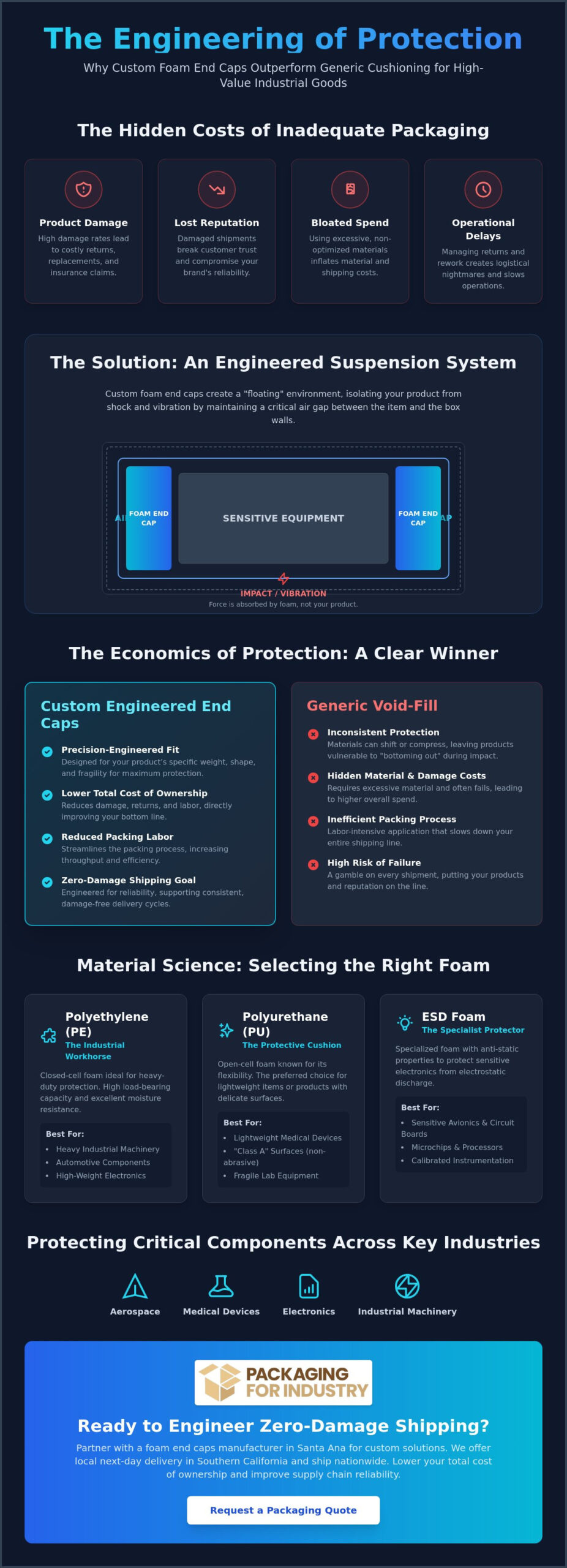
Industrial protection isn’t just about wrapping a product; it’s about engineering a suspension system that isolates high-value goods from the harsh realities of the supply chain. As a leading foam end caps manufacturer Santa Ana, we focus on creating a “floating” environment within the shipping container. By gripping only the ends or corners of your product, these custom inserts maintain a critical air gap between the item and the walls of the corrugated box. This clearance is your primary defense against external impacts.
When a pallet is jarred or a box is dropped, the end caps act as shock absorbers, catching the product and decelerating it before it hits a hard surface. This “suspension” is vital for maintaining brand reputation. Every damaged shipment represents a broken promise to your customer and a mountain of administrative work for your team. By reducing insurance claims and the logistical nightmare of returns, precision-designed packaging directly supports your bottom line and operational stability.
The Mechanics of Shock Absorption and Vibration Dampening
Effective Package cushioning relies on controlled deceleration. If the foam is too thin or the density is incorrect, the product “bottoms out” during an impact, transferring the full force of the drop to the sensitive internal components. We calculate the exact foam thickness and surface area required to survive specific drop-test heights based on your product’s weight and fragility. This scientific approach is why custom end caps consistently outperform generic void-fill materials in high-value logistics. For a deeper look at these principles, you can explore our industrial packaging solutions and engineering capabilities.
Industry-Specific Applications: Aerospace to Medical Devices
Different sectors require different levels of precision. In the aerospace industry, protecting avionics and sensitive instrumentation from micro-vibrations is a primary concern. These components often require specialized materials to prevent static discharge or calibration shifts. Medical device manufacturers face equally strict requirements. Sterile equipment must remain perfectly secure to prevent packaging breaches that could compromise safety. We also provide heavy-duty solutions for industrial machinery and electronics. These items often require high-density closed-cell foams that provide structural support while remaining light enough to keep shipping costs manageable. Whether you’re shipping across Orange County or across the globe, our designs ensure your equipment arrives in factory-perfect condition.
Material Science: Selecting Polyethylene, Polyurethane, or ESD Foam
Selecting the correct polymer is just as critical as the physical engineering of the suspension system. As a specialized foam end caps manufacturer Santa Ana, we evaluate the material’s performance against your product’s specific fragility rating. Using the wrong density can lead to “compression set,” where the foam fails to rebound after an initial impact, leaving your product vulnerable during subsequent shocks in a long-haul shipping cycle.
The choice between closed-cell and open-cell structures depends entirely on the weight and surface sensitivity of your goods. Heavy industrial components require materials that won’t bottom out under pressure, while delicate laboratory equipment needs a softer touch to prevent abrasion. If you’re unsure which material fits your current project, you can request a packaging quote to have our team perform a density analysis based on your product specs.
Polyethylene (PE) vs. Polyurethane (PU) Foam
Polyethylene is the industrial workhorse for heavy-duty protection. The technical benefits of polyethylene foam packaging include a high load-bearing capacity and excellent moisture resistance. Because it’s a closed-cell material, it doesn’t absorb water or oils, making it ideal for automotive parts or machinery that may be stored in non-climate-controlled warehouses. In contrast, polyurethane is an open-cell foam known for its extreme flexibility. It’s the preferred choice for lightweight items or products with “Class A” surfaces that are easily scratched. While PE provides rigid support, PU offers a plush environment that excels at dampening low-magnitude vibrations during short-haul transit.
Specialized Materials: Cross-linked and ESD Options
Certain sectors require advanced material properties beyond standard cushioning. Cross-linked polyethylene (XLPE) offers a finer cell structure and higher aesthetic appeal, which is often required for medical device kits or high-end electronics. For semiconductor and circuit board manufacturers, Anti-Static (ESD) foam is a non-negotiable requirement. ESD foam prevents the buildup of static electricity that can cause latent damage, a failure that isn’t always apparent until the end user powers on the device.
Modern procurement also demands a focus on sustainability and regulatory compliance. With California’s SB 54 now requiring producers to register with the Circular Action Alliance as of June 2026, choosing the right material helps you reduce environmental impacts while recovering potentially lost economic revenue through better material efficiency. We monitor these shifting raw material costs, such as the June 2026 stabilization of polyethylene prices, to ensure our clients receive the most cost-effective, compliant solutions for their multi-site operations.
The Economics of Protection: Custom End Caps vs. Generic Cushioning
Procurement decisions in industrial logistics often fall into the trap of comparing unit costs rather than evaluating the Total Cost of Ownership (TCO). While generic bubble wrap or loose-fill might appear cheaper on a purchase order, they introduce significant hidden expenses that erode your margins. As a leading foam end caps manufacturer Santa Ana, we help businesses identify these leaks in their budget. Precision-engineered foam doesn’t just protect the product; it optimizes the entire packing and shipping workflow by removing the guesswork from your operations.
Over-packaging is a common symptom of non-engineered solutions. When workers don’t have a specific fit, they tend to use excessive material to “be safe.” This practice doesn’t just waste foam; it forces you into larger corrugated boxes. In the world of dimensional weight (DIM) pricing, even an extra inch of box size can significantly increase your freight rates across a high-volume shipping cycle. Custom end caps eliminate this waste by providing the exact amount of protection required in the smallest possible footprint, ensuring you aren’t paying to ship air.
Labor Efficiency and Throughput in the Warehouse
Packing throughput is a critical metric for any high-volume warehouse or distribution center. Manual wrapping is inconsistent, time-consuming, and prone to human error. In contrast, snap-fit end caps allow for a standardized, repeatable process that ensures every unit is protected identically. When your team can secure a product in seconds rather than minutes, your daily throughput increases without adding headcount. This level of efficiency aligns with commercial packaging standards that prioritize both physical protection and logistical flow. For heavy machinery or oversized loads, these inserts can be integrated into broader manufacturing packaging solutions to maintain stability during the most demanding transit cycles.
Calculating ROI on Custom Packaging Engineering
The return on investment for custom engineering is realized through two primary channels: damage reduction and shipping density. A one-time engineering fee for a custom CAD design often pays for itself by eliminating a single high-value damage claim or a single day of operational downtime. Beyond damage, optimized designs allow for higher pallet density. If you can fit more units on a pallet because your packaging is more compact and stackable, you’re directly reducing your per-unit shipping cost. This “first-time-right” delivery approach also protects your brand’s reputation and customer retention, which are the ultimate drivers of long-term profitability. Partnering with an experienced foam end caps manufacturer Santa Ana ensures that your packaging is an investment in your supply chain’s reliability, not just a recurring expense.
From Engineering to Production: The Custom Foam Design Process
Moving from conceptual economics to physical protection requires a methodical engineering workflow. As a professional foam end caps manufacturer Santa Ana, we begin every project with a technical consultation focused on your product’s specific G-force tolerance and transit hazards. We don’t guess at dimensions; we use CAD software to create precise blueprints that account for every contour and weight-bearing point of your equipment. This level of detail is a core component of our custom design packaging services, which bridge the gap between raw material and a functional logistical asset.
The transition from a digital blueprint to a physical production run involves rigorous material sampling. We identify the specific density required to support your product’s weight without bottoming out during a drop. This process ensures that the final production run isn’t just a collection of foam pieces, but a validated protection system tailored to your specific supply chain requirements. Whether you’re shipping delicate medical electronics or heavy aerospace components, the design must remain consistent across every unit to maintain your quality standards.
The Role of Free Prototyping in Risk Mitigation
We offer free prototyping to mitigate the risks associated with full-scale production rollouts. It’s better to identify a fit issue during a drop test simulation than during a cross-country shipment. Our iterative design process allows us to refine the end cap’s geometry, ensuring we use only the material necessary to meet protection standards. Physical testing, including vibration simulations, validates that the foam will hold up under the repetitive stresses of long-haul trucking or air freight. This validation phase is critical for buyers who need to guarantee zero-damage cycles to their own customers.
Precision Manufacturing Technologies
Once the design is validated, we select the most efficient production method based on your volume and complexity. Die-cutting is our preferred method for high-volume runs where speed and repeatability are paramount. For more intricate profiles or lower volume requirements, CNC routing provides the precision needed for deep cavities without the cost of custom tooling. We also utilize lamination techniques to create multi-layered protection, often combining a rigid polyethylene base for structural support with a softer polyurethane contact point for surface protection. Every run is subject to strict quality control standards to ensure that the 1,000th unit is as precise as the first prototype.
Ready to validate your next packaging design? Request a packaging quote to start your custom prototyping process today.
Strategic Supply Chain Solutions with a National Foam Manufacturer
Managing the logistical requirements of a multi-site manufacturing operation requires a partner that can scale alongside your growth. While we serve as a premier foam end caps manufacturer Santa Ana for local Southern California facilities, our nationwide shipping capabilities ensure that your protection standards remain consistent across all your distribution hubs. This geographic flexibility eliminates the need to manage multiple regional vendors, which often leads to inconsistent packaging quality and fragmented communication.
Operational efficiency is further enhanced through our specialized supply chain services. Many of our high-volume clients utilize Vendor Managed Inventory (VMI) to offload the burden of stock tracking. By allowing us to monitor and replenish your foam supplies, you eliminate the risk of stockouts that could halt your production line. This proactive approach, combined with Just-in-Time (JIT) delivery, allows you to reduce your warehouse footprint and lower the carrying costs associated with storing bulky packaging materials on-site.
Streamlining Procurement with Integrated Services
Administrative overhead often represents a significant hidden cost in procurement. We simplify this through packaging kitting, a process where we combine your custom foam end caps, corrugated boxes, and labels into a single SKU. Instead of managing three separate purchase orders and arrival dates, your team receives a complete, ready-to-use assembly. This integration ensures predictable lead times and consolidated billing, allowing your purchasing department to focus on higher-level strategic goals rather than micro-managing packaging components.
Request Your Custom Packaging Quote
Transitioning to a more reliable protection system starts with a technical evaluation of your current shipping challenges. When you contact a foam end caps manufacturer Santa Ana for a quote, having specific data ready will ensure the highest level of accuracy. We recommend providing the following information:
- Product Dimensions: Length, width, and height of the item itself.
- Weight and Fragility: The total weight and any known G-force tolerances or sensitive “no-touch” zones.
- Annual Volume: Estimated monthly or annual quantities to determine the most cost-effective production method.
- Transit Hazards: Whether the product will face international maritime shipping, long-haul trucking, or parcel delivery.
Our team is committed to providing industrial-grade reliability and competitive pricing that reflects the engineering value of our designs. We don’t just supply foam; we provide a comprehensive system of protection and logistical optimization tailored to your bottom line. Request a custom foam packaging quote today to secure your supply chain and eliminate transit damage.
Secure Your Supply Chain with Engineered Protection
Optimizing your industrial packaging is a transition from reactive damage control to proactive supply chain management. By selecting the right material density and utilizing custom CAD designs, you eliminate the operational stress caused by transit failures and inconsistent packing methods. As an established foam end caps manufacturer Santa Ana, we provide the technical expertise necessary to bridge the gap between engineering requirements and fiscal responsibility. This approach ensures your high-value goods remain secure from the assembly line to the end user’s facility.
Our focus on the total cost of ownership ensures that your protection system reduces labor time and freight expenses while maintaining the highest reliability standards. We offer free prototyping for custom designs and provide specialized packaging expertise for the aerospace and military sectors. Whether you need local next-day delivery in Southern California or nationwide shipping for multi-site operations, our team is ready to support your logistics workflow with precision and stability. It’s time to stop overpaying for generic solutions that don’t meet your technical needs.
Request a Custom Foam Packaging Quote today to start optimizing your protection strategy. We look forward to helping you achieve a zero-damage shipping cycle and a more efficient supply chain.
Frequently Asked Questions
What are foam end caps and how do they differ from foam inserts?
Foam end caps are specialized protective components that grip the corners or ends of a product to create a suspension system within a box. Unlike standard foam inserts that might encase an entire item, end caps isolate the product by maintaining a critical air gap between the goods and the container walls. This targeted approach uses less material while providing superior shock absorption for high-value industrial equipment.
Which foam material is best for heavy industrial equipment?
Polyethylene (PE) foam is the most effective material for heavy industrial equipment because of its high load-bearing capacity and closed-cell structure. It provides the rigid support necessary to prevent heavy items from bottoming out during impact. As a specialized foam end caps manufacturer Santa Ana, we often recommend high-density PE for machinery and automotive parts that require moisture resistance and long-term durability.
Can you provide anti-static (ESD) foam end caps for electronics?
Yes, we offer specialized anti-static (ESD) foam end caps designed to protect sensitive electronic components from electrostatic discharge. These materials are essential for semiconductor and circuit board shipping where latent electrical damage is a primary concern. Our ESD solutions ensure that your electronics remain physically secure and electrically protected throughout the entire distribution cycle.
How much can I save by switching from generic void-fill to custom end caps?
Savings are typically found in reduced product damage rates and lower total shipping costs rather than just the initial price of the foam. Custom end caps allow you to use smaller corrugated boxes, which reduces dimensional weight (DIM) fees from carriers. You’ll also see a significant increase in warehouse throughput because snap-fit end caps are much faster to apply than manual bubble wrapping.
Do you offer free prototyping for custom foam designs?
We provide free prototyping for custom designs to ensure the foam density and geometry perfectly match your product’s requirements before full production. This step is vital for risk mitigation, allowing your team to perform physical drop tests and validate the design. It’s a key part of our commitment as a foam end caps manufacturer Santa Ana to deliver “first-time-right” packaging solutions.
What information is required to get an accurate quote for foam end caps?
To provide an accurate quote, we need your product’s exact dimensions, total weight, and an estimate of its fragility. It’s also helpful to know your expected order volume and the typical transit hazards your shipments face. This information allows our engineers to calculate the precise foam thickness and surface area needed to guarantee zero-damage shipping cycles.
What are the typical lead times for a custom foam production run?
Lead times are managed to align with your production schedules, with prototypes usually developed shortly after the initial consultation. Once you approve the final design, we schedule production runs to meet your specific deadlines. For high-volume users, we recommend our Vendor Managed Inventory (VMI) service to eliminate lead time concerns entirely by maintaining local stock for immediate release.
Do you provide nationwide shipping for bulk foam packaging orders?
We provide nationwide shipping for all bulk orders while offering local next-day delivery for our clients in Southern California. Our logistics network is designed to support manufacturers with multiple facilities, ensuring consistent packaging quality across every location. Whether your facility is in Orange County or across the country, we provide the reliable supply chain integration you need.