
The thickest, softest foam in your warehouse might actually be the primary reason your products are arriving damaged. Many operations managers assume that more cushioning automatically equals better protection, but over-packaging often leads to “bottoming out” or excessive vibration during transit. Understanding how to select foam for shock absorption requires a move away from guesswork toward a data-driven engineering approach. Whether you’re protecting sensitive medical electronics or heavy aerospace components, the goal is to match material deceleration curves to your product’s specific fragility to ensure total safety.
It’s frustrating to manage rising shipping costs while still seeing high rates of damage. You’re likely balancing confusing technical specs like G-factor and static load against the constant pressure to reduce box sizes and avoid dimensional weight surcharges. This guide provides the technical and economic framework needed to eliminate shipping damage and optimize your industrial packaging costs. We’ll examine the performance of Polyethylene and Polyurethane foams, explain how to calculate the right density for your load, and show how a local Southern California supplier can streamline your supply chain with custom sizes and reliable next-day delivery across Orange County and Los Angeles.
Key Takeaways
- Learn how to calculate product fragility using the G-Factor to ensure your protective foam provides the necessary deceleration without the high cost of over-packaging.
- Master a 4-step engineering framework on how to select foam for shock absorption by accurately balancing static load and drop height requirements.
- Compare the specific performance characteristics of Polyethylene and Polyurethane to choose the most effective material for heavy industrial components or sensitive medical electronics.
- Discover how optimized foam thickness directly impacts box dimensions, helping you lower packaging costs by avoiding expensive carrier dimensional weight surcharges.
- Understand how custom engineered foam inserts and local Southern California delivery programs can improve your supply chain reliability while reducing lead times.
The Science of Shock Absorption in Industrial Packaging
Shock absorption in industrial logistics isn’t simply about providing a soft landing. It’s the engineered ability of a material to dissipate kinetic energy during an impact. When a crate or box is dropped, the energy of that movement has to go somewhere. Effective foam packaging absorbs this energy by compressing, which slows down the product inside and reduces the peak force it experiences. Learning how to select foam for shock absorption requires you to move beyond basic padding and start looking at the specific physics of your supply chain.
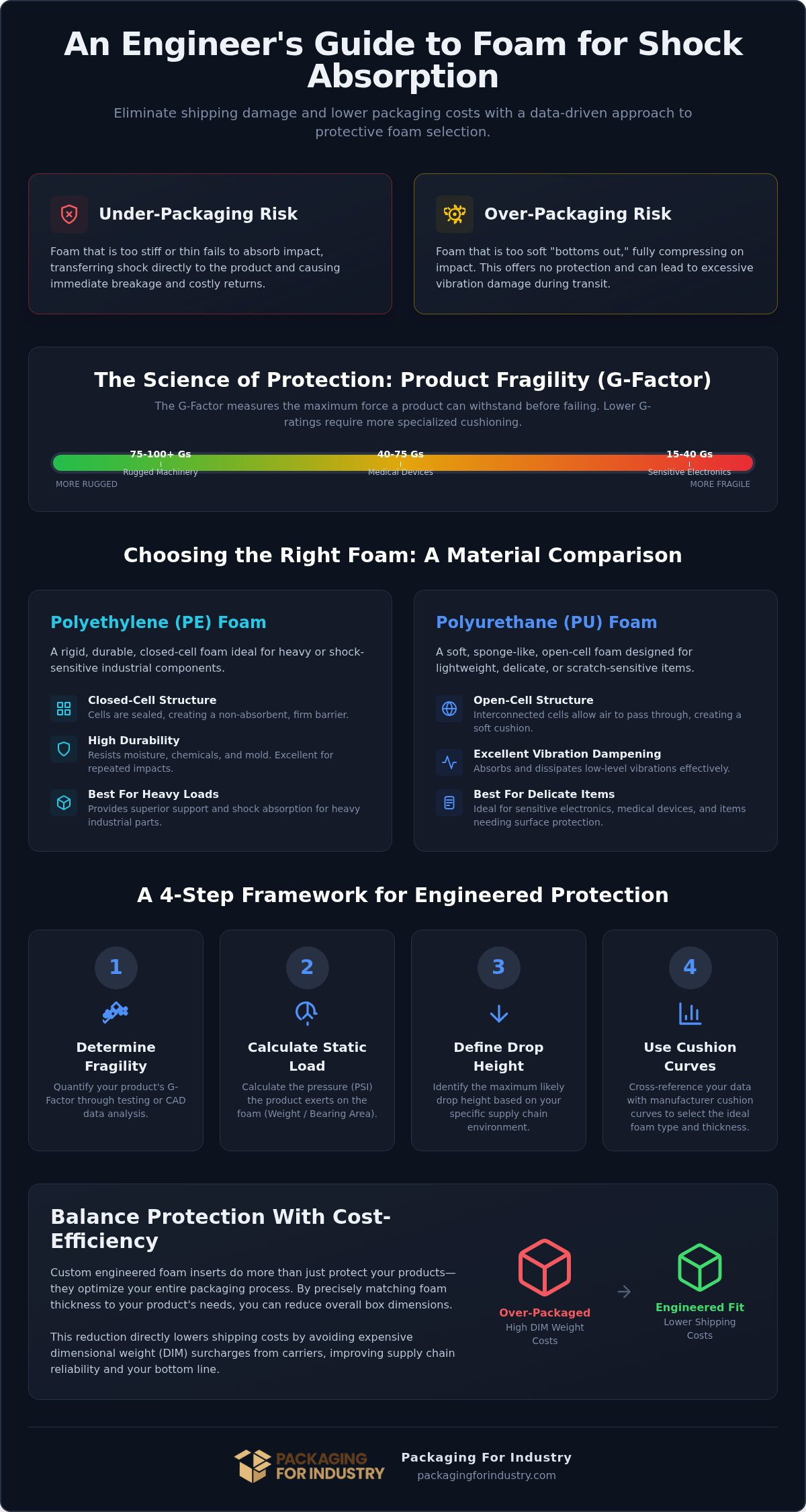
Under-packaging is an obvious risk that leads to immediate breakage, but over-packaging is equally dangerous for high-value industrial goods. If a foam is too stiff, it won’t compress enough to absorb the shock, passing the vibration directly to the product. If it’s too soft, it might “bottom out,” meaning the foam fully compresses and the product hits the hard outer wall of the container. Both scenarios lead to costly returns and damaged reputations.
Understanding Product Fragility and G-Ratings
The first step in any engineering-led packaging design is determining the “G-Factor,” or the fragility of your item. This rating represents the maximum amount of force a product can withstand before it fails. For example, sensitive electronics or semiconductors typically have low G-ratings, often between 15 and 40 Gs, meaning they require highly specialized, soft cushioning. In contrast, heavy industrial machinery or rugged mechanical parts might handle 75 to 100 Gs or more.
Aerospace components and medical devices demand the highest precision because their internal calibration can be ruined even if the exterior remains intact. You can determine these ratings through standardized drop testing or by analyzing CAD data. Knowing this number allows you to choose a foam density that decelerates the product safely within its specific limits. This precision is why many manufacturers in Irvine and Anaheim rely on custom design packaging to ensure every shipment meets exact safety profiles.
The Role of Deceleration in Preventing Damage
Foam works by increasing the time it takes for a product to stop after an impact. By extending the duration of the deceleration, the peak force is lowered. This relationship between “cushion thickness” and deceleration is the core of effective protection. If your foam is too thin, it won’t have enough distance to slow the product down before hitting the limit of its compression.
Custom foam inserts are superior to generic rolls or peanuts because they provide consistent protection across all axes. Whether a box is dropped on its corner or its side, the engineered fit ensures the product remains centered and the deceleration remains uniform. This level of reliability is essential for warehouses and distribution centers handling recurring shipments of high-value parts where any variation in protection could lead to a total loss of the shipment.
Comparing Industrial Foam Materials: Polyethylene vs. Polyurethane
Selecting the right material is the most critical decision in the engineering process. While there are dozens of specialty polymers, Polyethylene (PE) and Polyurethane (PU) are the primary workhorses for most industrial applications. Each offers distinct physical properties that dictate how to select foam for shock absorption based on your product’s weight and fragility. At Packaging For Industry, we specialize in providing custom foam packaging across various densities to ensure your specific load requirements are met with precision.
The fundamental difference lies in cell structure. Polyethylene is a closed-cell foam, meaning each cell is sealed off from its neighbors. This creates a rigid, durable material that resists moisture, chemicals, and mold. Polyurethane is an open-cell foam, behaving more like a sponge. It’s highly breathable and soft, making it ideal for delicate items but less effective in high-moisture or heavy-load environments. For electronics and semiconductors, we also offer ESD (Electrostatic Discharge) variants of these foams to prevent static damage during transit.
Polyethylene (PE): The Durable Closed-Cell Choice
PE foam is favored for its high load-bearing capacity and resilience. It’s the industry standard for aerospace packaging solutions and heavy machinery because it doesn’t lose its shape under significant weight. Its non-abrasive properties also protect sensitive finishes and polished surfaces from scratching. If your product is heavy or has sharp edges, PE provides the necessary structural integrity to prevent the item from shifting or puncturing the container. It’s a reliable choice for warehouses that need a material that won’t degrade during long-term storage.
Polyurethane (PU): The Versatile Open-Cell Solution
PU foam is the go-to choice for lightweight, highly fragile items that require a gentle touch. Because it’s so soft, it can be easily cut into convoluted, or egg-crate, shapes that securely cradle irregularly shaped products. It offers excellent vibration dampening for sensitive lab equipment or glassware. However, it’s important to remember its limitations. PU can break down if exposed to heavy static loads for long periods and absorbs water easily, which might be a concern in certain shipping environments. Understanding these material trade-offs is key when deciding how to select foam for shock absorption for your specific inventory.
If you’re unsure which material fits your application, you can request a packaging quote to have our engineers analyze your product specs and recommend the optimal density.
A 4-Step Framework to Select Foam for Shock Absorption
Moving from technical theory to practical application requires a structured approach. To ensure your products survive the rigors of the supply chain without overspending on materials, you need a repeatable process. This framework helps operations managers and engineers determine how to select foam for shock absorption by balancing physical requirements with logistical realities. Following these steps will help you lower packaging costs while maintaining zero-damage shipping standards.
- Step 1: Calculate the Static Load. Determine the weight of the product and the “bearing area,” which is the surface area of the foam actually supporting that weight.
- Step 2: Determine the Drop Height. Assess your shipping environment. Small parcel carriers (UPS/FedEx) typically require protection for higher drops than LTL (Less-Than-Truckload) palletized shipments.
- Step 3: Select Material Density. Use the static load and your product’s G-Factor to choose a foam density that provides the necessary deceleration.
- Step 4: Prototype and Test. Create a physical sample to verify the fit and performance before committing to a bulk production run.
Calculating Static Loading and Bearing Area
Foam performs differently depending on the pressure applied to it. A specific density might provide perfect shock absorption for a 5lb electronics component but will completely fail under a 50lb industrial motor. Static load is calculated by dividing the product weight by the bearing area. A common mistake is using the total surface area of the product instead of only the area in contact with the foam. Overestimating this area leads to “foam fatigue,” where the material is too stiff to compress, while underestimating it leads to bottoming out. Precision here is vital for packaging for manufacturers and warehouses handling heavy-duty parts.
The Importance of Prototyping in Custom Design
Theory only goes so far in the complex world of industrial logistics. High-precision industries like aerospace and medical manufacturing require custom design packaging that accounts for irregular shapes and delicate calibration. PFI utilizes CAD/CAM support to ensure every die-cut foam insert fits your product with exact tolerances.
We offer a free prototyping service for local Southern California manufacturers in cities like Anaheim, Irvine, and Los Angeles. This allows you to test real-world scenarios, such as drop tests and vibration dampening, before placing a full order. Having a physical prototype ensures that the final foam packaging solution actually performs as intended in the field. If you are ready to see how custom engineering can reduce shipping damage for your specific product line, our team is available for a technical consultation.
Balancing Protection with Packaging Cost-Efficiency
Engineering a protective solution is only half the battle. The other half is ensuring that your chosen material doesn’t inflate your logistical expenses. Understanding how to select foam for shock absorption is as much an economic decision as it is an engineering one. You must account for the total landed cost, which includes the price of the material, the size of the box, and the resulting freight charges. Many operations managers overspend because they choose the cheapest foam available from generic catalog suppliers, which often requires a larger volume to achieve the same protection as a higher-performance alternative. This inefficiency leads to oversized shipping containers and unnecessary carrier fees.
Optimizing your foam selection can significantly lower packaging costs by reducing the overall dimensions of your shipments. Small parcel carriers like UPS and FedEx use dimensional (DIM) weight formulas that penalize large, light boxes. By selecting a foam with higher energy absorption per inch, you can use thinner inserts, shrink your box size, and avoid these expensive surcharges. This “right-sizing” approach ensures you aren’t paying to ship empty air while maintaining the integrity of your high-value inventory.
Avoiding Surcharges with Integrated Solutions
The most effective way to control costs is to treat the foam and the container as a single integrated system. Combining custom-engineered foam with heavy-duty corrugated boxes allows you to maximize protection while minimizing the package footprint. For example, switching from a two-inch thick low-density foam to a one-inch thick high-density polyethylene can often provide superior shock absorption while allowing for a much smaller outer box. This strategy doesn’t just reduce material waste; it directly lowers your shipping rates and improves your pallet density, allowing you to move more product in a single freight shipment.
VMI and Stocking Programs for Southern California Manufacturers
For recurring production lines, bulk packaging pricing is only one part of the savings equation. Managing the inventory of custom foam inserts can be a logistical headache that ties up valuable warehouse space. Implementing a Vendor Managed Inventory (VMI) program allows you to optimize your facility by storing only what you need for the immediate production cycle. This is a critical component of how to select foam for shock absorption when considering long-term operational efficiency and cash flow.
PFI specializes in supporting Southern California manufacturers with local next-day delivery across Anaheim, Irvine, and Los Angeles. By leveraging our stocking programs, you can maintain a lean operation without the risk of shortages. This local proximity ensures that your custom inserts are always available when your production schedule ramps up, providing a reliable supply chain that matches the speed of your business.
Why Choose PFI for Your Custom Foam Packaging Needs?
Choosing a packaging partner is about more than just finding a material vendor; it’s about securing an engineering resource that protects your bottom line. While understanding the technical steps of how to select foam for shock absorption is vital for your operations team, having a supplier who can validate those choices prevents catastrophic shipping failures. We specialize in high-stakes industries where precision is non-negotiable, including aerospace, medical devices, and electronics manufacturing. Our team understands that a single damaged component can result in thousands of dollars in lost revenue and logistical delays.
We provide a comprehensive range of materials, including polyethylene, polyurethane, and specialized anti-static (ESD) foams for sensitive semiconductors. Our capability extends beyond the foam itself. We offer integrated design services where custom foam inserts are matched perfectly to custom wooden crates or heavy-duty corrugated boxes. This holistic approach ensures a single point of accountability for your entire protective system, streamlining your procurement process and reducing the number of vendors you need to manage.
Tailored Solutions for Local Industry
For manufacturers in Anaheim, Santa Ana, and the Inland Empire, PFI offers a distinct local advantage that national catalog suppliers cannot match. We provide on-site reviews to analyze your production line and storage constraints firsthand. This proximity allows us to support mil-spec packaging requirements for defense contractors with rapid turnaround times and precise documentation. Whether you need low-volume prototypes for a new product launch or high-volume bulk production for an established warehouse, our flexible ordering system scales with your specific demand cycles.
Request a Custom Packaging Quote
Starting your packaging review is a straightforward process focused on cost-reduction and reliability. To provide an accurate how to select foam for shock absorption analysis, our engineers require three key pieces of data: the product’s physical dimensions, its total weight, and its estimated fragility or G-Factor. If you aren’t sure of your product’s G-Factor, we can assist in the determination process through our prototyping and testing services.
We provide local next-day delivery across Southern California, including Orange County and Los Angeles, ensuring your facility maintains high supply reliability. Don’t let high damage rates or rising freight costs impact your operational efficiency. Request a packaging quote today to receive a comprehensive analysis of your protective needs and discover how our custom engineered foam solutions can lower your packaging costs and eliminate shipping damage.
Optimize Your Protection and Your Logistics Budget
Effective industrial packaging is a balance of engineering precision and fiscal responsibility. By moving away from generic padding and utilizing a structured framework, you can eliminate the “bottoming out” or excessive vibration that leads to high damage rates. Mastering how to select foam for shock absorption allows your operation to right-size its containers, which directly reduces dimensional weight surcharges and lowers overall freight costs. Whether you’re shipping sensitive medical devices or heavy-duty aerospace parts, the right material density is your primary defense against transit failure.
PFI is ready to act as your technical partner in this process. Our team provides free prototyping and CAD design support to validate every custom fit before you commit to bulk production. With local next-day delivery across Southern California, including Orange County and Los Angeles, we ensure your supply chain remains reliable and cost-effective. Let’s work together to secure your high-value goods and streamline your warehouse operations.
We look forward to helping you achieve zero-damage shipping and improved supply reliability for your business.
Frequently Asked Questions
How do I know if I need Polyethylene or Polyurethane foam?
Polyethylene (PE) is a closed-cell material best for heavy industrial machinery and aerospace parts that require high load-bearing capacity. It resists moisture and chemicals effectively. Polyurethane (PU) is an open-cell, softer foam ideal for lightweight, highly fragile items like medical devices or glassware. If your product is heavy or needs to withstand long-term storage without losing its shape, PE is usually the correct choice for your warehouse operations.
What information do I need to provide for a custom foam insert quote?
To provide an accurate custom packaging quote, we require the physical dimensions and total weight of your product. It’s also helpful to know the item’s fragility rating, or G-factor, and the expected drop height based on your shipping environment. If you have CAD files or a physical sample, our engineering team can use them to create free prototypes that ensure a precision fit for your specific industrial application.
Can custom foam inserts help reduce my UPS and FedEx shipping costs?
Yes, optimized foam design is a primary strategy for reducing dimensional weight surcharges. By choosing a foam density that offers higher energy absorption per inch, you can use thinner inserts. This allows you to shrink the overall size of your corrugated boxes. Smaller box dimensions help you avoid the expensive penalties carriers like UPS and FedEx apply to large, lightweight packages, directly lowering your total shipping costs.
Does Packaging For Industry offer ESD foam for electronic components?
We offer a full range of anti-static and ESD (Electrostatic Discharge) foams designed specifically for the electronics and semiconductor industries. These materials prevent static buildup during transit, protecting sensitive circuit boards and components from internal damage. You can choose between ESD Polyethylene for heavier components or ESD Polyurethane for lighter, delicate items. Our local Southern California facility maintains a consistent stock of these specialized materials for recurring production needs.
What is the lead time for custom die-cut foam prototypes in Southern California?
PFI provides fast turnaround for custom die-cut foam prototypes to support local manufacturers in Orange County and Los Angeles. Since we’re located in Anaheim, we can often review your designs and provide a physical sample much faster than national catalog suppliers. This local proximity allows your engineering team to perform immediate drop testing and fit verification, keeping your production schedule on track without the delays associated with long-distance shipping.
Is it possible to combine foam inserts with custom wooden crates for international shipping?
Combining custom foam inserts with heavy-duty wooden crates is a core specialty for our engineering team. This integrated approach is essential for international shipping of high-value aerospace or industrial equipment. We ensure the foam is matched to the crate’s internal dimensions to prevent shifting. All our wood packaging meets ISPM-15 standards for export, providing a single, reliable solution that simplifies your international logistics and reduces product damage.
How does static loading affect the shock absorption of packaging foam?
Static loading measures the pressure your product exerts on the foam’s surface while at rest. It’s a critical factor in how to select foam for shock absorption because it determines the foam’s starting compression level. If the static load is too high, the foam will be pre-compressed and may bottom out during an impact. If it’s too low, the foam won’t compress enough to decelerate the product safely during a drop.
Do you provide local delivery for bulk foam orders in Orange County?
We provide local next-day delivery for bulk foam orders and custom inserts throughout Orange County, including Anaheim, Irvine, and Santa Ana. Our delivery fleet also covers Los Angeles, Riverside, and the Inland Empire to support regional manufacturers and distribution centers. By leveraging our local Southern California presence, you can reduce lead times and maintain a leaner inventory, ensuring you have the right packaging materials exactly when your production line requires them.