
A shipment needs to do more than contain a product: it must move efficiently through fulfillment, protect its contents in transit, and arrive ready for the customer. Fulfillment packaging for e-commerce brands brings together the boxes, protective materials, and packing practices that make this possible.
Packaging works alongside the order process. Staff pick products from storage, prepare each order, and pack it for shipment. The right materials can keep products secure without adding unnecessary size, while organized supplies help maintain smooth inventory and packing operations.
It’s also reasonable to expect packaging to serve more than one purpose. It may need to meet retail or distribution requirements and create a consistent unboxing experience, as well as protect an order on its journey. This article explains what fulfillment packaging includes, how it supports packing, inventory, transit protection, and presentation, and where custom packaging and packaging management can help align the system with your operation.
Key Takeaways
- Match box size and protective materials to each order to balance product protection with efficient shipping.
- Coordinate packaging inventory with warehouse demand to keep packing operations organized and supplied.
- Separate outer transit protection from the inner presentation to support both safe delivery and a polished unboxing.
- Plan packaging around the different handling and presentation needs of direct-to-consumer, B2B, and retail orders.
- Use consistent packaging components and clear packing processes to create a more reliable customer experience.
Order packing with optimal box sizes and protective materials
Order packing connects warehouse inventory to a shipment ready for the customer. In a Los Angeles fulfillment operation, clear picking and packing steps help teams handle changing order volumes without adding unnecessary materials or shipping complexity.
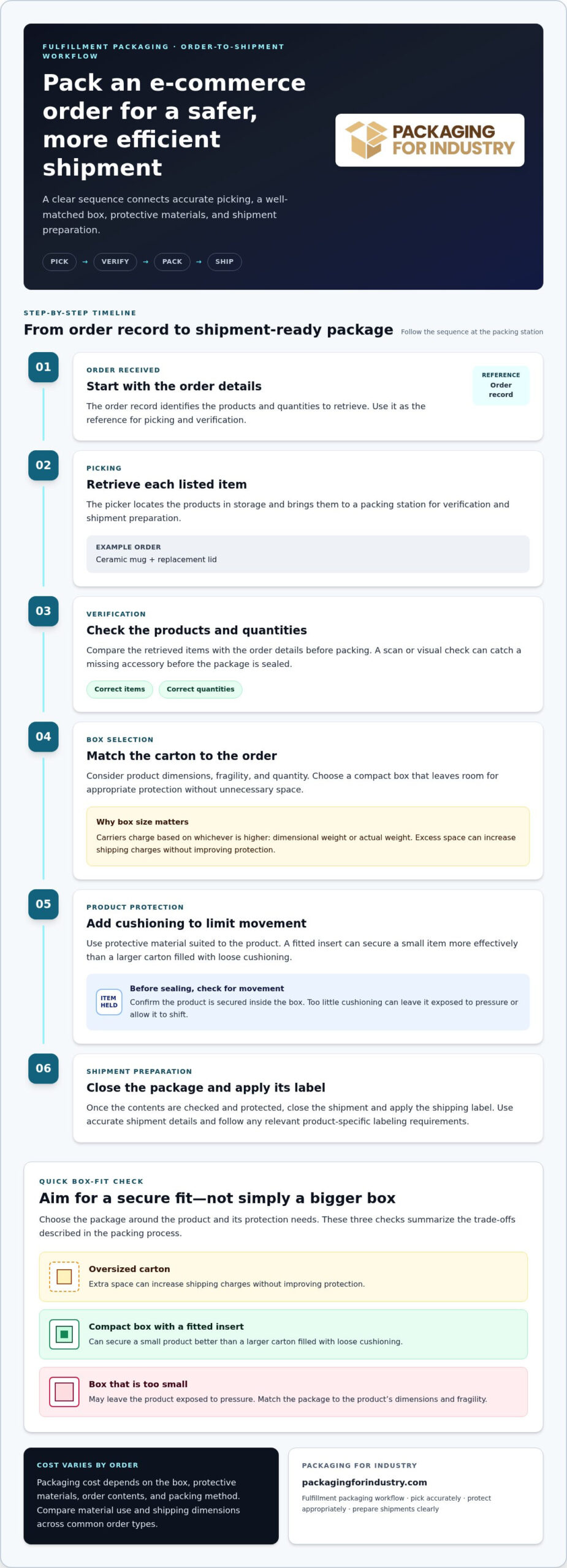
Processing starts when an order enters the system. A picker retrieves each listed item from its storage location and brings it to a packing station for verification and shipment preparation. For an order containing a ceramic mug and a replacement lid, the picker checks both against the order details before packing. The packer then selects a box, adds protective material, closes the shipment, and applies its shipping label. Separating these tasks makes it easier to identify whether an error occurred during picking or packing.
Box dimensions affect how efficiently an order moves through packing and shipping. Carriers charge based on whichever is higher, dimensional weight or actual weight, so excess space can increase shipping charges without improving protection. A compact box with a fitted insert may secure a small product better than a larger carton filled with loose cushioning. A box that is too small, however, can leave the product exposed to pressure. Match the package to the product’s dimensions, fragility, and quantity, then choose cushioning that limits movement.
Outsourcing decisions often reflect monthly volume and the resources needed to process orders. Some brands consider a third-party logistics provider around 500-1,000 orders per month, while businesses with around 100 orders per month may save money by fulfilling orders themselves. The right model depends on how demand changes, available warehouse space, labor, inventory management, and the cost of maintaining packing operations. At higher volumes, a process designed for 1,000 monthly orders may struggle when demand reaches 3,000 or more.
For U.S. e-commerce orders, labeling and shipping requirements depend on the product, carrier, and destination. Regulated products may have additional rules. Use accurate shipment details and apply relevant product-specific labeling requirements before dispatch.
Common mistakes include choosing oversized cartons, using too little cushioning, and picking the wrong item or quantity. Compare the product with the order record before sealing, then check whether it can shift inside the box. These steps help prevent avoidable errors and damage.
Picking Accuracy and Damage Prevention
Picking accuracy means retrieving the correct products and quantities for an order; damage prevention means securing them for shipment. Both affect whether customers receive the intended items in usable condition. A scan or visual check against the order record can catch a missing accessory before packing. Then, a fitted insert or suitable cushioning can limit movement around a fragile product in transit.
Packaging Costs per Order
There is no single average cost for every e-commerce package. The amount depends on the box, protective materials, order contents, and packing method. A lightweight, single-item shipment has different requirements from a multi-item order containing fragile goods. Compare material use and shipping dimensions across common order types to see how packaging choices affect costs. For a specific packaging quote, pricing depends on the order mix, material selection, and required package design.
Warehousing and inventory management
A fulfillment center stores inventory, picks products, packs orders, and prepares shipments. Receiving connects incoming goods and packaging supplies to the records warehouse staff use. For example, when a Los Angeles operation receives a carton shipment, staff can compare it with the purchase order, count the units, and record discrepancies before storing stock. Accurate receiving records give inventory management a dependable starting point.
Storage locations should make products and materials easy to identify and retrieve. Assign each item a location, label it clearly, and separate sellable inventory from packaging supplies. Keep frequently used cartons near packing areas; slower-moving stock can go in less accessible warehouse space. Packaging for warehouses works best when storage reflects how staff pick and replenish items, rather than placing supplies wherever space happens to be available.
Inventory records need to track incoming quantities and material usage. Update available quantities when staff receive a shipment, and record or monitor supplies as they move to packing stations. Comparing records with physical stock helps teams spot mismatches before they disrupt fulfillment. For example, a carton count that differs from the system can prompt a recount before the next replenishment decision.
Packaging demand can change with order mix, promotions, and seasonal sales. Review which materials support common orders, then plan replenishment around actual usage and supplier lead times. A sudden increase in multi-item orders may raise demand for larger cartons, while a product change may leave older packaging unused. Regular reviews can help lower packaging costs by limiting excess stock and avoiding emergency purchases.
Purchasing teams can compare packaging costs by reviewing recurring materials, order quantities, and storage requirements together. Bulk pricing may suit steady usage, while smaller replenishments can help preserve warehouse space when demand varies. A useful comparison considers both purchase terms and the operational effect of holding stock. Include custom sizes in the review when standard packaging creates excess material use or storage challenges.
Receiving schedules should align with the warehouse’s available space and operating calendar. For a Southern California facility, local packaging delivery can support replenishment planning; other supply arrangements may suit operations with different locations or demand patterns. Clear records of material usage, current stock, and expected needs help purchasing teams plan deliveries with fewer surprises.
For a packaging quote, share the materials, usage patterns, and replenishment needs tied to your warehouse workflow through a packaging quote request.
Separating transit protection from premium presentation
Use the shipping container to manage transit risk and the inner package to shape the customer’s first impression. For example, a skincare brand can place its products in a branded inner box, then use a plain corrugated shipper to protect that presentation during delivery. Separating these layers keeps premium presentation from dictating the size or construction of the outer package.
The outer layer handles the practical demands of parcel transit. It should securely contain the product and inner presentation, with cushioning placed where movement or impact could cause damage. The inner layer can focus on visual order, branded details, and an easy opening sequence. A glass bottle, for instance, can sit in a fitted insert inside its retail box, with that box secured in an appropriately sized shipping carton.
This approach can serve different sales channels without forcing one package to do every job. A direct-to-consumer order may benefit from a branded unboxing, while a wholesale shipment may prioritize efficient handling and clear product identification. Customers still see the intended presentation, while warehouse teams can use a protective outer pack suited to transit. Keeping these functions distinct also makes packaging choices easier to review.
Consider a brand selling the same product through its website and Amazon. It can maintain a consistent inner presentation while selecting an outer shipper for each channel’s handling and shipping workflow. This avoids redesigning the customer-facing package whenever the order route changes. Before assigning a standard pack configuration, map each channel’s order profile, product mix, and fulfillment steps.
Separating the layers can also help control package volume. A large decorative box does not need to serve as the shipping carton if a compact outer shipper can protect it. Dimensional weight can affect shipping charges, as described in the order-packing section. Keep the interior presentation compact, prevent it from shifting, and avoid empty space added solely to create a more dramatic opening.
Document the configuration for each product family so packing teams can repeat it. A simple pack specification can identify the inner presentation, outer container, protective materials, and placement sequence. For a two-piece gift set, for example, it can show where each item sits and how the set is secured before the shipper is closed. Consistent instructions reduce variation across shifts and make packaging changes easier to assess.
B2B and retail fulfillment
E-commerce fulfillment must serve different order types without confusing their packing and handling requirements. A direct-to-consumer shipment may contain one item for an individual customer, while a B2B order can include multiple cases for a retailer or distributor. Fulfillment packaging for e-commerce brands should account for these differences before packing, since quantities, labels, and destination handling may vary.
Both channels rely on a connected fulfillment flow: inventory is received and stored, orders are picked and packed, shipments are dispatched, and returns may be processed and restocked. The same product can follow different paths. A retailer’s replenishment order, for example, may need cases grouped for receiving, while an e-commerce order needs individual units prepared for parcel shipment. Clear order identification helps teams route each shipment to the right packing process.
Retail and B2B shipments also benefit from defined quality-control steps. For a high-value order, staff can document a sign-off, track the product lot, and take photographs before dispatch. These records create a reference if a retailer reports missing or damaged goods. A separate check of item count, case quantity, and destination label can catch errors before a pallet or parcel leaves the facility.
Kitting and assembly can support orders that combine products arriving or stored separately. A fulfillment team can prepare a set containing a main item, accessories, and printed instructions, then keep that configuration consistent across orders. This reduces extra handling at the packing station and helps prevent a component from being omitted. For B2B buyers, the same process can group items into a ready-to-stock assortment.
Order volume and shipping frequency shape staffing, materials planning, and logistics. Forecasting helps operations prepare for retailer purchase cycles, seasonal e-commerce demand, and changes in product mix. A brand shipping frequently to multiple accounts may need a different packing schedule from one sending occasional bulk orders. Review order history, destination patterns, and packaging configurations together instead of planning from unit volume alone.
Third-party logistics providers, or 3PLs, operate fulfillment centers on behalf of brands. Regional providers can handle warehousing, packing, and shipping through established networks and partnerships. In-house, outsourced, and hybrid models each affect how a brand controls inventory and fulfillment services. A hybrid approach may keep B2B case preparation in-house while routing individual ecommerce orders through a 3PL.
Automation can support repeatable processing, especially when different order types require different packing rules. For fulfillment packaging for e-commerce brands, define which orders need case packing, assembly, special checks, or returns handling, then map those requirements into the workflow. Clear instructions help warehouse teams avoid applying one packing method to every channel.
Consistent unboxing and brand presentation
Custom-branded packaging can cost more than standard packaging when it adds printing, special finishes, or custom inserts. Standard formats generally avoid those custom elements. Price depends on material, print, quantity, and design, and is provided after a quote request.
Sustainable options for U.S. e-commerce packaging include recycled board, FSC-certified paper, low-VOC inks, compostable tissue, and biodegradable adhesives. Choose materials based on the product’s protection needs and the package’s presentation requirements.
A consistent unboxing experience starts with a defined packaging specification for each product or order type. Document the approved box, insert, tissue, and placement of branded materials. For example, a skincare set can use the same printed card and product arrangement across orders, even when fulfillment shifts between teams or locations.
Build the presentation around the moment a customer opens the parcel. A branded inner box, neatly arranged products, and a clear product card can make the package feel intentional. The outer shipment still needs to suit the carrier and transit conditions. Keep visual elements inside the protective shipper so presentation choices do not require unnecessary outer-package size or decoration.
Retail orders may need a different presentation from individual e-commerce shipments. A retail buyer could require a clean product display and consistent case quantities, while a direct order might include an insert or branded tissue. Specify which components belong in each channel. This helps picking and packing teams avoid sending retail materials to consumers or omitting them from the intended orders.
Returns also test packaging consistency. Customers may return products without their original inserts or arrangement, so clear instructions and practical packaging can help keep returns manageable. For reusable product packaging, define which components should stay with the item and how they should be placed. This gives warehouse staff a consistent basis for inspecting returned goods.
Use a brief quality check before sealing each branded shipment: verify the product, presentation components, and placement. A packing guide with a product photo can show the intended arrangement without relying on memory. Review customer feedback and return reasons to identify recurring presentation or damage issues, then update the specification when a change improves the process.
Consistent presentation depends on repeatable materials and assembly. Packaging kitting and assembly can prepare coordinated components for packing, while custom design can align the package with product fit and brand requirements.
Packaging For Industry (PFI): Foam Packaging
Packaging For Industry (PFI) supports e-commerce brands, fulfillment centers, manufacturers, and warehouses with industrial packaging. Its foam packaging helps protect products during handling and shipment, while stretch film helps secure packaged goods as they move through operations.
For businesses with recurring packaging demand, PFI also offers Vendor Managed Inventory (VMI) and Just-In-Time (JIT) inventory management for packaging. These programs help teams coordinate supply with ongoing warehouse or production requirements. PFI serves businesses in Orange County, Los Angeles, and San Diego, with packaging solutions that support product protection and a more dependable supply process.
Contact Packaging For Industry to discuss packaging requirements for your operation.
Build a Packaging System That Can Scale
Use your next packaging review to connect customer experience with operational performance. Identify which products need specialized protection, which orders need coordinated presentation, and where supply gaps interrupt packing. Then assess whether your materials and replenishment process support the order mix your team handles. This gives you a practical basis for refining fulfillment packaging for e-commerce brands as products, sales channels, and demand change.
Packaging For Industry (PFI) offers foam packaging and stretch film, along with Vendor Managed Inventory (VMI) for packaging. These solutions can support product protection and supply planning as you refine fulfillment operations. Share the products you ship, the challenges your team faces, and the packaging requirements you want to improve.
A well-planned packaging system can help your team serve customers consistently while keeping day-to-day fulfillment practical. Take the next step with a clear understanding of what your operation needs.
Frequently Asked Questions
What Does E-Commerce Fulfillment Include?
E-commerce fulfillment covers the operational work that moves an online purchase from available inventory to the customer. This includes receiving stock, storage, order processing, shipping, and returns. For example, a warehouse may receive a replenishment shipment, update its stock records, prepare individual orders, and route returned products for inspection. Packaging supports these activities by protecting goods, identifying shipments, and keeping order contents organized through each handoff.
How do I get started?
Start by listing the products you ship, their dimensions, fragility, and typical order combinations. Then identify the packaging in use, any damage or packing issues, and which materials run short. A Los Angeles brand shipping a single product and a bundled set may need separate packing plans. Record these differences alongside order patterns and storage constraints to create a practical basis for reviewing packaging design, purchasing, and replenishment needs.
What packaging materials are best for e-commerce fulfillment?
The right materials depend on the product’s weight, shape, fragility, and shipment configuration. Corrugated boxes suit many parcel orders, while paper or bubble mailers can work for products that need less structural protection. Bubble wrap, air fillers, or foam can cushion items that may shift or break. For example, a small electronic component may need cushioning around its edges, while a soft textile may need a protective mailer.
How to choose the right box or mailer size for online orders?
Choose a package that accommodates the product and required cushioning without excessive empty space. Measure the item at its widest points, then allow room for protective materials and easy closure. For a bundle of two products, assess the combined arrangement rather than adding the dimensions of separate packages together. Test common order combinations: one box size may fit a single item but waste space around a multi-item order.
How to reduce dimensional weight shipping costs with packaging?
Reduce unused space by matching the outer package to the packed product and its protective materials. Dimensional-weight divisors vary by carrier network: some use 139 cubic inches per pound, while others use 166 cubic inches per pound. Compare package dimensions for recurring order types, especially lightweight products shipped in large cartons. A compact, well-fitted package can reduce billed dimensional weight while still leaving room for suitable protection.
How to design packaging that protects products during fulfillment and shipping?
Design around the product’s vulnerable points, how it sits in the package, and the handling it encounters during fulfillment and transit. Secure loose components separately, cushion exposed edges, and prevent the product from shifting after closure. For a device with a delicate screen, position cushioning to keep that surface away from the carton walls. A packaging review should also check whether workers can assemble and close the package consistently.
What packaging workflows and equipment do e-commerce fulfillment centers use?
Fulfillment centers commonly organize packing around workstations where staff verify orders, assemble packages, apply labels, and sort completed shipments. Depending on the operation, equipment may include barcode scanners, scales, label printers, tape dispensers, and conveyor belts. A smaller facility might use manual stations, while a higher-volume operation may automate selected tasks. Clear station instructions help workers choose the right materials and route each finished package appropriately.