
The more material-efficient box isn’t always the right box for a heavy load. Full overlap slotted containers for heavy parts in Los Angeles can provide added coverage because their top and bottom flaps overlap, while a regular slotted container’s outer flaps meet at the center. That added coverage uses approximately 20-40% more flap board than a regular slotted container, so it makes sense when the extra protection suits the product and shipping conditions.
Choosing packaging for machinery, dense components, or fragile goods means balancing protection, material use, and handling needs. This guide explains how full overlap containers compare with regular slotted containers, what affects performance in transport and storage, and when the added board may be worthwhile.
You’ll also learn which design factors matter for heavy parts, including board construction, dimensions, load, and closure method. Use these points to assess your packaging requirements and plan shipments moving through Los Angeles.
Key Takeaways
- Choose a full-overlap design when added coverage for heavy or fragile goods justifies its additional material use.
- Account for board grade, flute, carton dimensions, humidity, pallet pattern, load, and closure method when evaluating protection.
- Use the comparison with regular slotted containers to weigh product protection against material efficiency for each shipment.
- For a packaging specification, define the part’s dimensions, packed weight, handling needs, and storage or shipping conditions.
- Pair protective packaging with foam cushioning or stretch film when those materials address the product’s handling and load-stability needs.
Protection during transport and storage
Full-overlap cartons add protection where heavy loads often stress packaging: the top, bottom, corners, and edges. Their overlapping flaps extend across the box when closed, reinforcing the full perimeter. A standard full overlap container is designed for 360-degree corner and edge reinforcement. This construction can suit dense metal parts, fragile glass, automotive components, and machinery moving through Los Angeles warehouses or longer shipping routes.
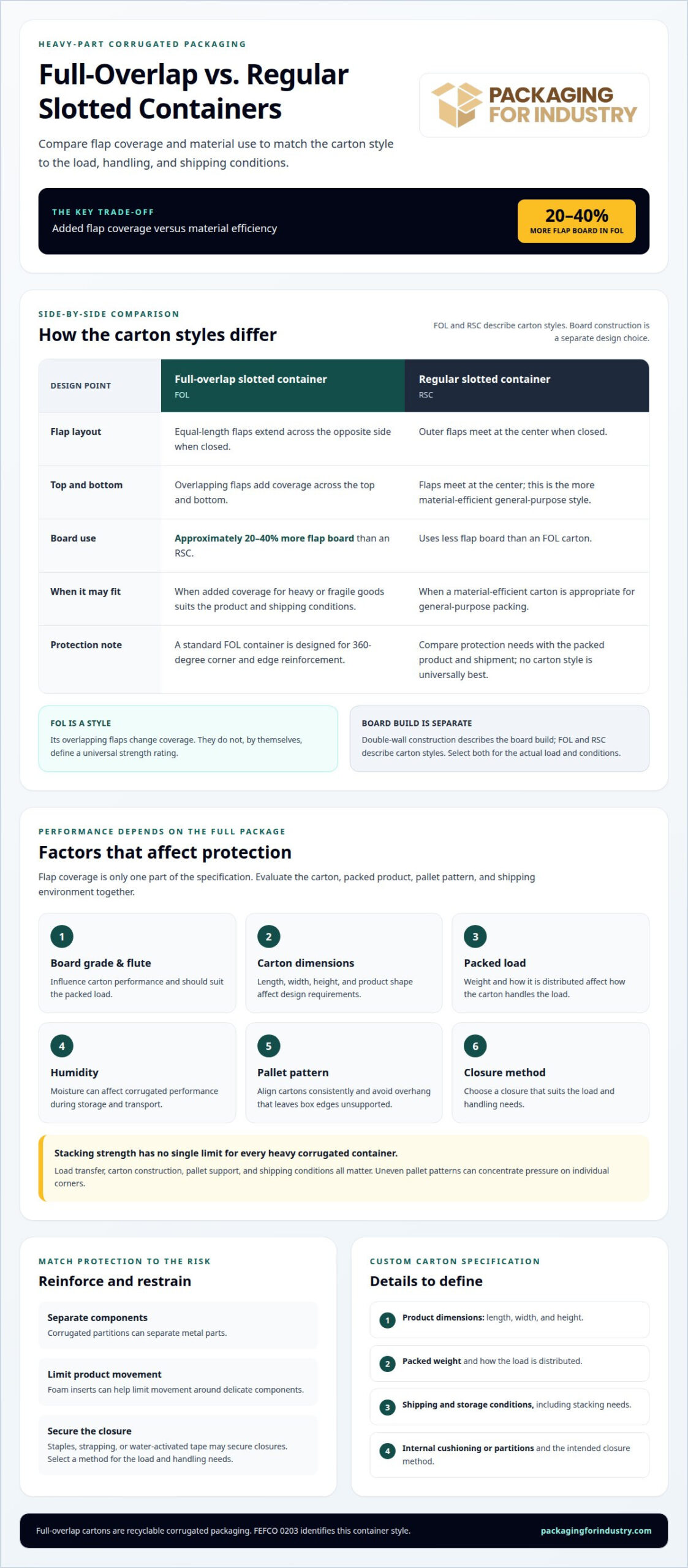
Added flap coverage does not provide a universal strength rating. Performance depends on board grade, flute, carton dimensions, humidity, load, pallet pattern, and closure method. A heavy engine component, for example, places different demands on a carton than a wide panel, even when both use full-length overlapping flaps. Match the construction to the packed product’s weight and dimensions, then account for stacking and shipping conditions.
Stacking strength depends on how the load transfers through the carton and onto the pallet. Distribute packed weight across the base, align cartons consistently, and avoid overhang that leaves box edges unsupported. Uneven pallet patterns can concentrate pressure on individual corners, while moisture can affect corrugated performance. These factors matter during storage as well as transport, especially when cartons remain stacked before dispatch.
There is no single shipping or palletization limit for every heavy corrugated container. Board grade, flute, dimensions, humidity, load distribution, pallet pattern, and closure method all affect performance. The packed product and the way cartons are stacked determine the design requirements.
Compared with a regular slotted container, a full-overlap design uses approximately 20-40% extra flap board. In an RSC, outer flaps meet at the center; in a full-overlap container, the flaps extend across the top or bottom. The RSC is usually more material-efficient for general-purpose packing. Choose the extra coverage when its protection for heavy or fragile goods justifies the added board.
Reinforcement and packing methods address different risks. Corrugated partitions can separate metal parts, while foam inserts help limit movement around delicate components. Staples, strapping, or water-activated tape can secure closures. Select the method to suit the load and handling needs rather than assuming one closure works for every shipment. A part that shifts inside the carton, for example, needs internal restraint as well as a secure closure.
Minimum order quantities and lead times vary with run setup, order volume, board construction, and delivery schedule. These factors also help determine whether a custom container is a better fit than a stock carton for your Los Angeles shipment.
Full-overlap cartons are recyclable corrugated packaging, and the FEFCO 0203 designation identifies this container style. Printing can support handling identification, while the carton’s board, dimensions, and closure remain central to physical protection. Treat printing as an operational aid, not a substitute for engineered strength or suitable palletization.
Full overlap containers versus regular slotted containers
The main difference is flap coverage, which affects material use, closure, and carton fit. Compare those design choices with the packed product’s weight and dimensions before selecting a style.
Container Style Comparisons
A regular slotted container, or RSC, has outer flaps that meet at the center when closed. Full-overlap slotted containers have equal-length flaps that extend across the opposite side. This changes how corrugated board covers the top and bottom, making the FOL style an option for dense components that need added flap coverage.
FOL cartons use approximately 20-40% more flap board than RSC cartons. An RSC is usually the more material-efficient general-purpose choice. A full-overlap design uses more board, so weigh that material against the protection required for the shipment rather than treating one style as universally better.
Double-wall construction describes the board build, while FOL and RSC describe carton styles. These are separate design decisions: an FOL carton can use a corrugated construction selected for the packed load, dimensions, and shipping conditions. A heavy component, for example, may need both overlapping flaps and a board build suited to its handling demands.
Available Dimensions and Weight Capacities
Container dimensions and weight capacity depend on the product and the complete package design. Specify the component’s length, width, and height, along with its packed weight. Include clearance for cushioning or partitions, since internal packaging affects the space the carton needs to provide.
Weight alone doesn’t determine carton performance. Board grade, flute, dimensions, and closure method all influence how a container handles its load. Pallet pattern and shipping environment matter too. A compact metal part and a wide machine panel can place different demands on a carton, even at similar weights.
To specify a custom FOL container, provide the product dimensions, packed weight, expected shipping and storage conditions, and stacking needs. Note whether components need partitions or internal cushioning, and describe the intended closure. These details help define a carton around the actual load instead of relying on an assumed capacity.
Ordering also involves aligning the specification with production requirements. Share the required container style, dimensions, board construction, closure, and order quantity in a custom packaging quote request. Minimum quantities and lead times vary with order and production details, so include your target schedule when requesting pricing. That gives the supplier the information needed to assess the design and order requirements.
Heavy industrial parts and fragile goods
Heavy parts and fragile goods need packaging that addresses both load and contact damage. A full-overlap carton can suit dense components, metal parts, machinery, and fragile products because its flaps cover much of the top and bottom. The carton still needs internal support matched to the item. A loose metal component can shift and strike the walls, while a delicate product can be damaged by pressure at a single contact point.
Start the design with the product’s shape, packed weight, and handling needs. Identify projections, exposed edges, and surfaces that cannot bear pressure. A machined component with protruding fittings, for example, needs clearance around those points, while a flat fragile item needs support across its face. This assessment helps determine whether partitions or foam inserts are needed, so the carton isn’t left to provide all the protection on its own.
Consider how the product moves during packing, pallet handling, and transit. Restrain components so they don’t slide into carton walls or each other. Separate loose parts with partitions, and use cushioning where impact or vibration could damage a sensitive surface. A container holding several metal components may need individual compartments; a single heavy item may need fitted support that spreads contact across a broader area.
Carton durability depends on its construction and use, not its style alone. Board grade, flute, dimensions, load, humidity, pallet arrangement, and closure method all influence performance. A full-overlap container can be made with double- or triple-wall corrugated material, reinforced flaps, or foam inserts. Select these features to suit the product and shipping conditions rather than relying on a general label such as “heavy duty.”
For irregular industrial products, an engineered package can coordinate the container with internal protection. A manufacturing component with a delicate finish, for instance, may need separation from hard edges and restraint against movement. Inside printing or barcoding can support identification and handling workflows, but neither replaces physical protection. The design should make the product’s orientation and packing method clear to the people preparing each shipment.
Use a practical review sequence: document product dimensions and weight, mark vulnerable surfaces, identify likely movement, then select internal support and carton construction. Check how the packed unit sits on its pallet and whether carton edges remain supported. An RSC may suit a less demanding load, while FOL overlapping flaps extend coverage across the top and bottom. Choose based on the item’s risks and protection requirements, not appearance alone.
For heavy industrial parts and fragile goods, combine a suitable carton with product-specific restraint. This helps reduce shipping damage without adding materials that don’t address a defined handling risk.
What container dimensions and weight capacities are available?
Full-overlap containers can be made to specified packaging requirements, so begin with the product rather than an assumed standard size. Record its length, width, and height, then identify protrusions, handles, and surfaces needing clearance. A compact gearbox and a broad equipment panel need different internal layouts, even if their packed weights are similar.
Measure the product in its intended shipping orientation. Then account for partitions, cushioning, or foam that take up space inside the carton. Distinguish internal dimensions from the carton’s external footprint, since pallet planning and warehouse storage depend on outside measurements. A part placed on a protective base, for example, needs room for both the product and the base.
No single weight capacity applies to every FOL container. The appropriate construction depends on packed weight, board grade, flute, dimensions, closure method, and stacking needs. A short, compact load distributes pressure differently from a tall, narrow one. Specify the load weight and how cartons will be stacked instead of choosing a box by weight alone.
Connect the carton design to the pallet configuration. The footprint should support the carton base without overhang, and the planned pattern should keep carton edges supported. Include the intended pallet arrangement and storage conditions in the specification. A wide container holding a machine panel may need a different footprint and stacking plan from a carton carrying compact industrial components.
- Product length, width, and height in its shipping orientation.
- Packed weight, including internal supports and protective materials.
- Required clearance for fittings, edges, handles, or fragile surfaces.
- Expected pallet footprint, stacking arrangement, and storage conditions.
- Closure method and any internal partitions or cushioning.
Those details help determine both usable space and the corrugated construction. A full-overlap slotted container is identified as FEFCO 0203, but that style code does not define the carton’s dimensions or weight rating. Specify the actual measurements and load requirements alongside the style so the design addresses the shipment, not just its format.
For Los Angeles shipments, align carton dimensions with the product, pallet, and handling process. Excess internal space can let a component move; insufficient clearance can press vulnerable surfaces against the walls. A clear specification connects the product’s shape, protective materials, and load distribution in one package design.
Weight capacity is a design outcome, not a universal figure attached to the FOL name. Board grade, flute, size, load, humidity, pallet pattern, and closure all affect performance. Providing these conditions gives a packaging designer the basis to select dimensions and construction for the intended transport and storage.
Which Los Angeles manufacturers or suppliers make heavy-duty slotted containers?
Los Angeles-area buyers can approach corrugated packaging manufacturers and industrial packaging suppliers for heavy-duty slotted container requirements. Some manufacturers produce custom cartons, while packaging distributors coordinate sourcing and supply. For buyers sourcing full overlap slotted containers for heavy parts in Los Angeles, identify the style as FEFCO 0203 and provide the product, load, and shipping requirements.
Begin by defining the application. Provide the product’s length, width, and height, packed weight, pallet arrangement, and intended use. Explain whether the shipment contains one machine component or multiple parts. A consistent specification helps assess the same requirements and prepare comparable proposals, rather than estimating from a general description such as “large heavy-duty box.”
Address the design factors that affect performance: board grade, flute, dimensions, humidity, pallet pattern, load, and closure method. These details influence how a container performs in transport and storage. A request for a “heavy-duty box” alone may not specify the construction needed for a dense component or fragile equipment.
Clarify the requested scope before comparing proposals. List the container style, board construction, closure, and any requirements for partitions, foam inserts, reinforced flaps, printing, or barcoding. A proposal for an engine component, for example, should state whether internal separation is included. Keep requested features consistent so pricing comparisons reflect equivalent specifications.
Production and ordering details also affect supplier fit. Establish the minimum order quantity, lead time, delivery terms, and whether cartons ship flat. These details influence purchasing schedules and warehouse space. Minimum quantities and lead times vary with order volume, custom requirements, production setup, and scheduling needs.
A practical comparison should cover:
- Whether the container style, dimensions, and board construction match the specification.
- Which closure method and internal protection are included.
- Minimum quantities, lead times, and delivery arrangements.
- Whether printing or barcoding requirements appear in the proposed scope.
- Pricing after technical details and order quantities align.
For a Los Angeles shipment of fragile panels, include measurements, surface-protection needs, carton construction, pallet support, and handling requirements in the specification. This makes it easier to compare bulk packaging pricing without overlooking important design differences.
Los Angeles-area buyers can approach corrugated packaging manufacturers that produce custom cartons and industrial packaging suppliers that coordinate sourcing and supply.
Packaging For Industry (PFI)
Packaging For Industry (PFI) helps manufacturers in Los Angeles, Orange County, and San Diego coordinate cushioning and load stability for heavy-part shipments. Foam Packaging can cushion components inside a carton, while Stretch Film helps secure packaged goods on pallets for handling and storage. These materials complement a container specification; they don’t replace selecting suitable corrugated construction.
Turn to PFI when packaging damage, material use, or supply planning calls for a broader review. Vendor Managed Inventory (VMI) for Packaging and Just-In-Time (JIT) Inventory Management for Packaging can support recurring packaging supply. Share the product’s handling needs, packing process, and inventory requirements to discuss a practical approach.
Contact Packaging For Industry to discuss your packaging requirements.
Turn the packaging decision into a repeatable process
Selecting full overlap slotted containers for heavy parts in Los Angeles is one step toward a consistent shipping workflow. Next, align purchasing, warehouse, and production teams around the same packaging requirements. Clear specifications and packing instructions help everyone work from the same plan as shipments move through your operation.
Use your next packaging review to identify how packaging choices affect handling, storage, and replenishment. A coordinated approach can help your team manage supply while keeping protection requirements tied to operational needs. Packaging For Industry can help you assess how its packaging services fit your workflow.
Share your application and packaging requirements with Packaging For Industry to discuss a practical next step.
A well-defined process gives your team a clear foundation for more reliable shipments.
Frequently Asked Questions
Why Choose Full Overlap Containers for Your Logistics?
Choose a full-overlap design when a shipment needs additional corrugated coverage and that added material suits its handling risks. A production team shipping dense components between facilities, for example, may value broader flap coverage during repeated handling. Consider how cartons will be packed, moved, stored, and replenished. The right choice supports an operating process, not just a single trip, while an RSC may suit less demanding shipments.
What Does FOL Mean in Packaging?
FOL means “full overlap,” a corrugated carton style with flaps that overlap when closed. The term describes the flap arrangement, not a guaranteed weight rating or board construction. In a purchase request, specify “FOL” alongside the required dimensions, board specification, and intended load. This distinguishes the carton style from material choices such as single-wall or double-wall corrugated.
What is a full overlap slotted carton?
A full overlap slotted carton is a corrugated box whose top and bottom flaps extend across the box and overlap when closed. The style is identified as FEFCO 0203. A buyer specifying one for a shipment should include the container code plus the package’s measurements and intended use. That combination describes both the carton format and the practical requirements for the order.
Why are FOL boxes used for stacking and rough handling?
FOL boxes are used when overlapping flaps and added board coverage suit a shipment’s handling demands. Their stacking suitability still depends on carton construction and how the load is arranged. For warehouse storage, consider whether cartons sit evenly on the pallet and whether the product’s weight is distributed through the package. Carton style alone doesn’t establish a universal stacking limit.
What are full-overlap slotted containers for heavy parts?
They are corrugated containers with overlapping flaps, used for shipments such as machinery, dense components, and automotive parts. A heavy part’s shape matters as much as its weight: projecting fittings, sharp edges, or delicate finishes may need internal separation or cushioning. A component with exposed surfaces, for example, should be restrained so it doesn’t shift against the carton during handling.
What is the price of full-overlap slotted containers in Los Angeles?
The price depends on the order and is provided after a quote request. Key factors include carton dimensions, board construction, order quantity, printing, closure method, and any internal protection required. For a useful quote, provide the packed product’s measurements and weight, along with its handling and storage needs. This helps align the proposed specification and bulk order requirements with the actual application.