A successful packaging transition is actually an engineering audit disguised as a logistical switch. You aren’t just changing where your invoices come from; you’re optimizing the protection of your bottom line. We understand the high stakes involved when production lines shut down due to box shortages or when high freight costs from national catalog suppliers eat into your margins. Learning how to transition to a new primary packaging supplier smoothly requires a methodical approach that balances inventory levels with technical precision.
You likely feel the pressure to reduce shipping damage and lower costs without risking a supply chain stockout. It’s a common concern for operations managers who’ve dealt with poorly engineered packaging or unreliable lead times. This guide provides a strategic blueprint to switch suppliers without inventory gaps, production delays, or costly damage claims. We’ll preview the essential steps for auditing your current specs, implementing vendor-managed inventory (VMI), and ensuring your new corrugated boxes and custom foam meet the latest regulatory standards like California’s SB 343. By the end, you’ll have a clear path to a more reliable and cost-effective operation.
Key Takeaways
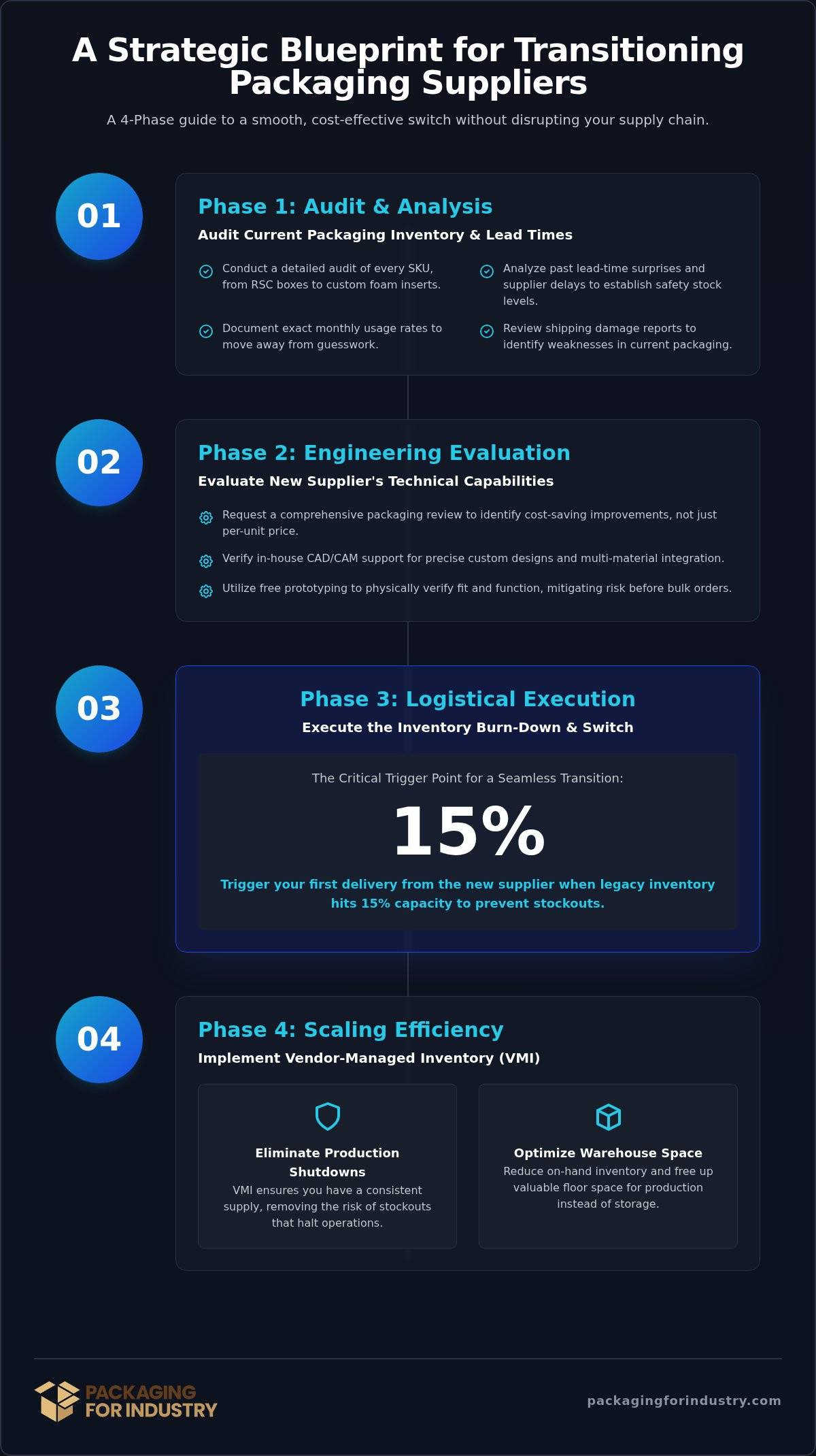
- Conduct a detailed audit of every SKU, from RSC corrugated boxes to custom foam inserts, to establish accurate monthly usage rates.
- Utilize CAD/CAM support and free prototyping to verify fit and identify cost-saving engineering improvements before placing bulk orders.
- Learn how to transition to a new primary packaging supplier smoothly by triggering your first delivery when legacy inventory hits 15% capacity.
- Transition to a Vendor Managed Inventory (VMI) model to eliminate the risk of production shutdowns while optimizing warehouse floor space.
- Partner with a supplier that understands the specific logistical requirements of industrial manufacturing and provides localized support.
Phase 1: Auditing Your Current Packaging Inventory and Lead Times
Learning how to transition to a new primary packaging supplier smoothly begins with a granular audit of your current operations. You can’t improve what you haven’t measured. This phase requires identifying every SKU currently in your warehouse, from standard RSC corrugated boxes to technical components like custom foam inserts. Most manufacturers discover “ghost SKUs” during this process, items that are ordered sporadically but take up valuable rack space. By documenting exact monthly usage rates, you can move away from guesswork and establish data-driven minimum stocking levels that prevent production line shutdowns.
Beyond simple counts, you must analyze past lead-time surprises. If a national catalog supplier failed to deliver during a peak period, document that delay to ensure your new partner builds a sufficient safety stock. This is also the time to review shipping damage reports. These reports aren’t just complaints; they’re engineering blueprints that highlight weaknesses in your current packaging. If corner boards are failing or stretch film is snapping under load, your next supplier needs this data to propose a more durable solution.
Categorizing Stock vs. Custom Requirements
Effective Supplier relationship management requires separating your commodity items from your engineered solutions. Standard supplies like stretch film and tape are easily replaced, but custom corrugated boxes and protective foam require longer lead times for prototyping and testing. You must also flag specialized compliance needs. For instance, if you’re shipping sensitive components that require aerospace packaging or military-spec materials, these items must be prioritized in the transition timeline to avoid regulatory bottlenecks.
Establishing Your Transition Timeline
You don’t want to flip a switch and hope for the best. Establishing a transition timeline involves calculating a safety cushion of inventory that carries you through the vendor switch. We typically recommend setting a hard cut-off date for your incumbent supplier only after your new partner has verified their production capacity. Remember to account for the physical realities of manufacturing. New die-cut tooling and printing plate creation take time. If you ignore these lead times, you risk a gap in supply that could stall your shipping department. A methodical timeline ensures that as your old stock burns down, your new, optimized inventory is ready for immediate deployment.
Phase 2: Evaluating the New Supplier’s Engineering Capabilities
Once you have audited your current inventory, the next step is vetting the technical bench of your potential partner. Many procurement managers make the mistake of choosing a vendor based solely on the lowest per-unit price. However, understanding how to transition to a new primary packaging supplier smoothly requires a deep dive into their structural engineering capabilities. You should request a comprehensive packaging review to identify where your current designs are failing or where excessive material use is driving up costs. A supplier that functions as a consultant rather than just a vendor will look for ways to optimize your protection while reducing your overall footprint.
Industrial packaging is a complex system that often requires multi-material integration. You need a partner who demonstrates expertise in combining different elements, such as custom foam-lined crates or heavy-duty RSC boxes with integrated corner protection. Ensure the supplier offers in-house CAD/CAM support for bespoke designs. This technical capability allows for precise adjustments that “off-the-shelf” catalog suppliers cannot provide. If your products have unique geometries or sensitive surfaces, having an engineering team that can design custom-tailored solutions is essential for maintaining production flow.
The Role of Prototyping in Risk Mitigation
Skipping the physical sample phase is a high-risk gamble that leads to expensive errors. For high-value aerospace or medical components, even a small variance in custom foam packaging can result in catastrophic shipping damage. Physical prototypes allow your operations team to verify fit and function before you commit to a full production run. PFI provides free prototyping to ensure every design is validated in the real world. This proactive approach aligns with modern Sustainable Packaging Trends by eliminating material waste caused by poorly sized boxes or over-engineered inserts.
Comparing Total Cost of Ownership (TCO)
A low unit price is meaningless if high freight costs or storage fees erode your operational budget. When you request a packaging quote, you must look at the Total Cost of Ownership. National suppliers often ship from distant hubs, adding significant freight-in expenses to every pallet. Local support in Orange County, Los Angeles, and the Inland Empire changes the economic equation. By utilizing local next-day delivery, you can achieve packaging cost savings that national vendors simply cannot match. If you want to know how to transition to a new primary packaging supplier smoothly, focusing on these local logistical advantages is often the deciding factor.
Phase 3: Executing the Logistical Switch and Inventory Burn-Down
Executing the physical transition is where many operations fail due to poor timing. Knowing how to transition to a new primary packaging supplier smoothly requires a strict inventory burn-down strategy. You must implement a First-In, First-Out (FIFO) strategy to ensure all legacy stock is cleared before new materials are introduced. This prevents the confusion of having two different versions of the same SKU on your warehouse floor. We recommend coordinating the first delivery from your new partner to arrive exactly when your old stock hits 15% capacity. This small buffer protects you against transit delays while keeping your warehouse footprint lean.
Running a pilot program with a single high-volume SKU is a pragmatic way to test the new relationship. This trial run acts as a stress test for the supplier’s delivery reliability and product quality before you transition your entire catalog. This collaborative approach aligns with the Future of Packaging, where long-term success is built on strategic R&D and vendor transparency. Clear communication channels between your warehouse team and the supplier’s logistics desk are vital during this window to manage real-time adjustments.
Managing Custom Tooling and Die Transfers
Deciding whether to transfer existing dies or invest in new precision tooling is a critical choice for your operations. While moving dies might save initial costs, fresh CAD designs for modern manufacturing packaging often result in better fit and faster throughput on your packing line. You must also ensure compatibility between new corrugated boxes and your existing automated pallet wrappers. A mismatch in board grade or dimensions can lead to machine jams and costly downtime. Our team reviews these technical specs early to ensure a seamless fit with your current machinery.
Phased Rollout vs. Hard Cut-Over
A phased rollout by product line or material type is generally safer than a hard cut-over. This allows you to set up a ‘Quality Gate’ for the first three shipments from your new partner, verifying that every RSC box or foam insert meets your documented standards. If an incumbent supplier cuts service early or lead times slip during the exit, having a local Southern California partner allows for rapid emergency orders to bridge the gap. We maintain the agility to provide next-day delivery in Orange County or Los Angeles, ensuring your production line never stops moving during the switch.
Phase 4: Scaling Efficiency with Managed Inventory Programs
The final stage in mastering how to transition to a new primary packaging supplier smoothly involves shifting from a transactional ordering mindset to a proactive supply partnership. Many organizations find themselves trapped in a cycle of ’emergency rush orders’ because they lack visibility into their actual consumption rates. This cycle is often a symptom of a fragmented supply chain where the vendor has no insight into the customer’s production floor. By leveraging the data gathered during your Phase 1 audit, you can implement a managed system that eliminates these inventory gaps. This proactive model doesn’t just save time; it creates a predictable logistical flow that stabilizes your entire operation. You’ll free up significant warehouse floor space and improve cash flow because you only pay for the packaging your production line actually consumes.
Leveraging Vendor Managed Inventory (VMI)
A VMI program removes the administrative burden from your purchasing department by automating the replenishment process. Instead of your team manually checking pallet counts and issuing purchase orders, we monitor your stock levels for you. We establish precise Min/Max levels based on the actual usage patterns observed in your Anaheim or Irvine facility. When your inventory hits the predefined minimum, a replenishment order is triggered automatically. This ensures you always have the right mix of RSC boxes and protective foam without over-ordering or risking a stockout. It transforms the supplier into a steady partner that values long-term reliability over one-off sales.
Just-In-Time (JIT) Delivery for Lean Manufacturing
In high-rent industrial markets across Southern California, warehouse space is a premium asset that shouldn’t be wasted on bulk safety stock. Just-in-time inventory management turns your packaging supply chain into a lean operation by synchronizing arrivals with your production schedules. Rather than receiving a massive quarterly shipment that clogs your loading docks, you receive smaller, more frequent deliveries. PFI utilizes a local fleet to provide reliable, scheduled deliveries throughout Los Angeles and Orange County. Our drivers understand the specific dock requirements of industrial parks in San Diego and the Inland Empire. This localized expertise means we can navigate tight delivery windows that national catalog suppliers often miss, ensuring your corrugated boxes and crates arrive exactly when they are needed for packing.
Why Packaging For Industry is Your Strategic Choice
Selecting a partner who understands the granular details of industrial logistics is the final requirement for a successful switch. You don’t just need a vendor; you need a strategic ally who understands how to transition to a new primary packaging supplier smoothly while protecting your operational uptime. Packaging For Industry (PFI) positions itself as this ally by combining technical engineering with a deep understanding of warehouse flow. We specialize in solving high-stakes challenges, particularly in aerospace packaging where precision and compliance are non-negotiable. Our team doesn’t just deliver boxes. We provide a unified supply chain solution that covers everything from stretch film and pallets to custom-engineered crates.
This comprehensive approach eliminates the fragmentation that often leads to packaging shortages. Instead of managing five different vendors for foam, corrugated, and shipping supplies, you consolidate your needs with a team that understands how these materials interact. This integration is critical for specialized sectors like medical and electronics manufacturing, where the wrong combination of materials can lead to ESD damage or contamination. We provide the direct, professional support your warehouse team needs to maintain a steady production rhythm through a single point of contact.
The PFI ‘Fixer’ Approach to Packaging
We approach every client relationship as a seasoned “fixer” would: by identifying the root cause of high freight costs or shipping damage and engineering a direct solution. This technical utility takes precedence over generic catalog-style selling. We provide custom sizes and bulk quantities specifically designed for recurring industrial orders, ensuring you never pay for “shipping air” or excess material. When you request a packaging quote from PFI, you aren’t just getting prices. You’re receiving a roadmap to lower total packaging costs through optimized design and smarter material selection that prioritizes your bottom line.
Local Presence with Nationwide Reach
Our logistical footprint is a major advantage for manufacturers across Southern California. We provide reliable next-day delivery for businesses in Anaheim, Irvine, and the Inland Empire. This proximity allows us to respond to sudden production spikes that would stall a company relying on national shipping lead times. For multi-location manufacturers, we balance this local agility with nationwide distribution capabilities. You get direct contact with experts who prioritize your production uptime. This ensures that your transition to PFI is the last vendor switch you’ll need to make, resulting in a system of protection and logistical optimization that scales with your growth.
Optimize Your Industrial Supply Chain
Transitioning your supply chain isn’t just a change in vendor; it’s an opportunity to re-engineer your entire logistical flow. By following a methodical audit and inventory burn-down strategy, you can successfully avoid the production gaps that plague unorganized switches. Prioritizing technical engineering through free prototyping ensures that every custom crate or RSC box fits your specific industrial requirements perfectly.
Learning how to transition to a new primary packaging supplier smoothly allows your organization to move toward a proactive supply model. Implementing local VMI and JIT programs across Southern California will free up warehouse space and improve your cash flow. Our team stands ready to function as your industrial consultant and logistical partner to ensure your production line never stops moving.
Establishing a steady and dependable packaging partnership is the most effective way to eliminate operational stress and focus on your core manufacturing goals. We’re here to help you build a more resilient and cost-effective shipping operation.
Frequently Asked Questions
How long does a typical packaging supplier transition take?
A full transition typically takes between 30 and 60 days to complete. This timeline allows for a controlled burn-down of your existing stock while we finalize new CAD designs and prototypes. Learning how to transition to a new primary packaging supplier smoothly requires coordinating these lead times carefully. We ensure your production line never experiences a gap in supply as we move through the transition phases.
Will I need to pay for new die-cut or printing plates when switching?
New die-cut and printing plates are usually required to ensure precision and compatibility with our manufacturing equipment. While transferring old dies is sometimes possible, fresh tooling allows us to optimize the design for better material yield and lower packaging costs. We analyze your current specs to see if a more efficient layout can reduce your per-unit price during the setup process.
How do I ensure the new custom foam inserts will fit my product perfectly?
We eliminate fitting errors through our free prototyping and CAD/CAM support. Our engineers create physical samples of your custom foam inserts for real-world testing before full production begins. This process is essential for high-value aerospace or medical components where even a small variance can lead to damage. You’ll verify the fit in your own facility to ensure total protection.
What is the benefit of a Vendor Managed Inventory (VMI) program during a transition?
A VMI program acts as a logistical bridge that prevents stockouts during the vendor switch. We monitor your actual usage rates in facilities across Orange County or Los Angeles and replenish stock automatically. This managed approach removes the guesswork from your purchasing department. It ensures you have a consistent supply of RSC boxes and foam without tying up capital in excess safety stock.
Can I switch to a new supplier if I have a high-volume custom order?
High-volume custom orders are our specialty, and we manage these through a phased rollout. We prioritize your most critical SKUs to ensure you have the inventory needed for peak production. This strategy is a vital part of how to transition to a new primary packaging supplier smoothly. We set hard cut-off dates only after we’ve verified our initial production runs to protect your production uptime.
How does local Southern California delivery help lower my packaging costs?
Local delivery reduces your total cost of ownership by eliminating the high freight surcharges common with national catalog suppliers. Our fleet provides next-day delivery throughout the Inland Empire and San Diego. By sourcing locally, you don’t have to pay for long-distance transport or store massive amounts of inventory. This proximity allows for a leaner warehouse operation and more predictable shipping expenses.
What happens if my old supplier stops shipping before the new one is ready?
We maintain the agility to provide emergency bridge stock if your incumbent supplier cuts service early. Because we’re located in Anaheim, we can often deploy next-day delivery of stock corrugated boxes or stretch film to keep your loading docks moving. We work closely with your warehouse manager to identify which critical items need immediate replenishment to prevent any production line shutdowns.
Does PFI handle military-spec or aerospace compliant packaging?
We specialize in compliant solutions for the defense and aviation industries. Our offerings include mil-spec corrugated boxes, weather-resistant containers, and ESD protective foam. We understand the technical specifications required for military packaging and provide the necessary documentation for your quality audits. Our engineering team ensures your high-value components meet all regulatory standards for safe transport and storage.