
What if a single missing stamp on a shipping container costs your company thousands of dollars in fines and weeks of transit delays? At the Port of Long Beach, where cargo valued at approximately $300 billion moves annually, U.S. Customs and Border Protection doesn’t offer second chances for non-compliant packaging. If you’re shipping industrial machinery, aerospace components, or sensitive electronics, sourcing high-quality heat-treated wood crates for export from Long Beach isn’t just a logistical detail; it’s a critical safeguard for your bottom line.
We understand that managing international logistics is stressful enough without the constant threat of customs seizures or transit damage. This guide will show you how to specify and source ISPM-15 compliant, custom-engineered wood crates that ensure your goods clear the port without friction. You’ll learn the technical requirements for heat treatment, how to lower packaging costs through better engineering, and why choosing a local Southern California supplier is the most reliable way to maintain your production schedule.
Key Takeaways
- Ensure 100% ISPM-15 compliance by understanding the mandatory heat treatment standards required for all solid wood packaging leaving the Port of Long Beach.
- Discover how custom engineering and load-bearing analysis for heat-treated wood crates for export from Long Beach can lower packaging costs and prevent damage to heavy machinery.
- Learn to evaluate crate designs, such as open-slat versus fully enclosed options, to reduce shipping weight and avoid unnecessary freight surcharges.
- Implement a pre-delivery checklist to confirm legible IPPC markings and proper documentation, preventing costly customs rejections and terminal delays.
- Leverage local next-day delivery and VMI programs from PFI to improve supply reliability for your manufacturing or distribution operations.
Understanding ISPM-15: Why Heat-Treated Wood Crates are Mandatory for Long Beach Exports
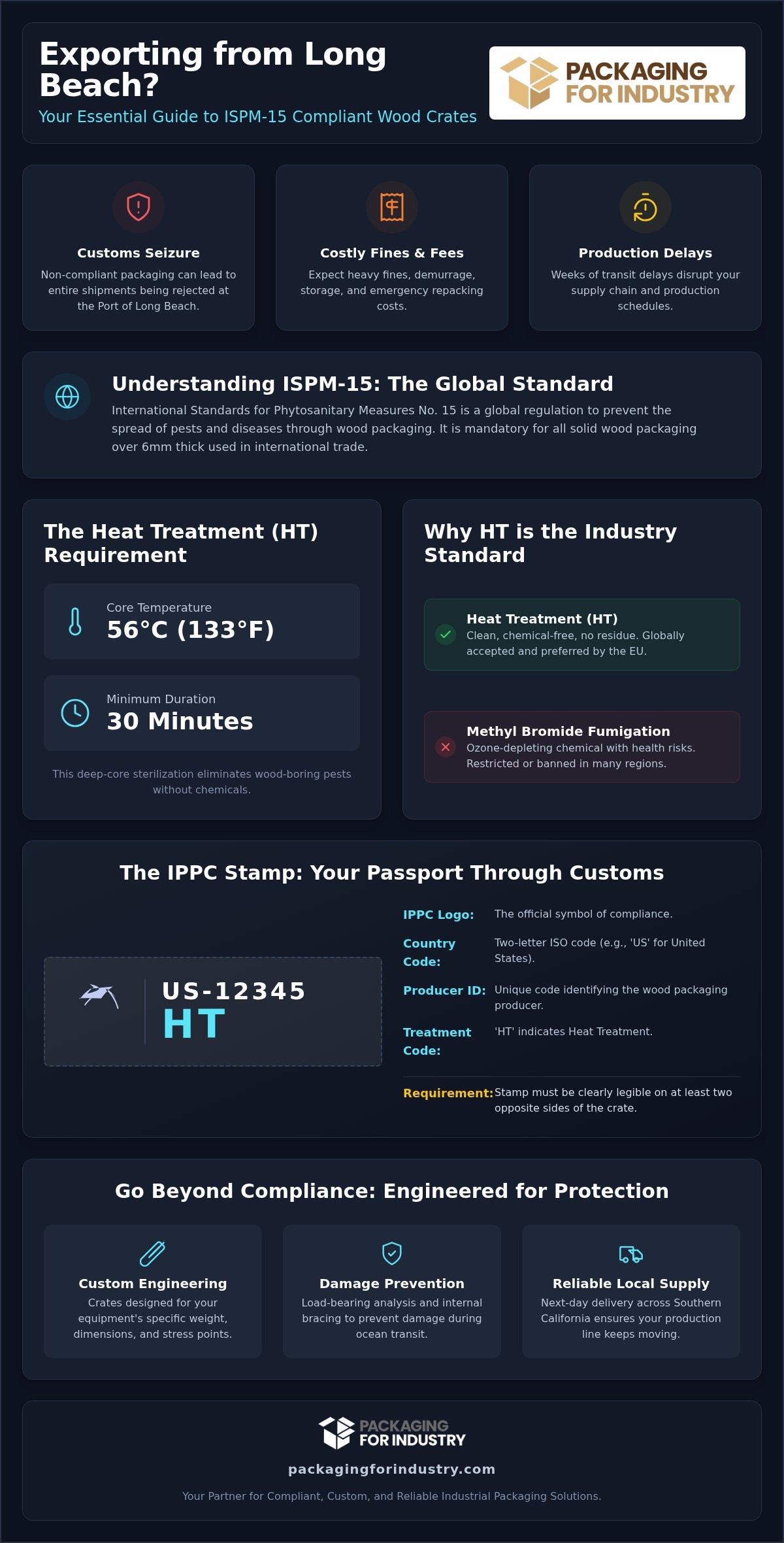
International shipping involves more than just secure loading; it requires strict adherence to biological safety standards. Understanding ISPM-15, or the International Standards for Phytosanitary Measures No. 15, is the first step for any manufacturer moving goods through the Port of Long Beach. This regulation prevents the international spread of pests and diseases that could devastate local ecosystems. For your operations, this means every piece of solid wood packaging thicker than 6mm must undergo a specific sterilization process before it reaches the terminal.
The core of this compliance is the heat treatment process. To meet the standard, the wood’s core temperature must reach at least 56°C for a minimum of 30 continuous minutes. This isn’t a surface-level treatment; it’s a deep-core sterilization that eliminates wood-boring pests like the emerald ash borer or Asian longhorned beetle. When you source heat-treated wood crates for export from Long Beach, you’re buying assurance that your shipment won’t be flagged by U.S. Customs and Border Protection (CBP) or foreign agricultural inspectors.
Ignoring these requirements leads to absolute outcomes at the port. If an inspector finds untreated wood or a missing mark, they don’t simply issue a warning. They often reject the entire shipment. This results in the mandatory re-export of the container at your expense, or the immediate destruction of the non-compliant packaging. The associated costs for storage, demurrage, and emergency repacking can quickly exceed the original value of the wooden crates themselves.
Heat Treatment vs. Fumigation: Why HT is the Standard
While ISPM-15 technically allows for methyl bromide fumigation, heat treatment (HT) has become the industrial standard for several pragmatic reasons. Many trading partners, including the European Union, have restricted or banned methyl bromide due to its status as an ozone-depleting chemical and its potential health risks to workers. Heat treatment is a clean, chemical-free process that doesn’t leave residues on your industrial equipment or sensitive electronics. Once wood is heat-treated and stamped, it remains compliant for the life of the crate, provided no repairs are made with untreated timber. This long-term reliability is why we exclusively recommend HT for Long Beach exporters.
The Role of the ISPM-15 Stamp
The IPPC stamp is a globally recognized certification mark that must be clearly legible on at least two sides of a crate to prove the wood has been treated according to international phytosanitary standards. This mark is your passport through customs. It consists of the IPPC “wheat” logo, a two-letter country code (US), a unique manufacturer identification number, and the “HT” treatment code. For manufacturers in Southern California, using untreated wood is a critical risk that isn’t worth the marginal savings. We ensure every crate we build features permanent, legible markings that satisfy inspectors at the Port of Long Beach and every major international gateway beyond it.
Custom Engineering: Matching Crate Design to Your Industrial Equipment
Standard “off-the-shelf” crates often fail when subjected to the dynamic stresses of ocean freight. When you’re shipping heavy-duty machinery or high-value aerospace components, a one-size-fits-all box isn’t a solution; it’s a liability. True protection requires a load-bearing analysis to ensure the crate’s base can support the specific weight distribution of your equipment without buckling. We engineer heat-treated wood crates for export from Long Beach to withstand the rigors of crane lifts, stacking pressures, and shifting container loads.
Beyond structural integrity, long ocean transits expose your cargo to extreme humidity and salt air. We utilize specialized moisture barriers and industrial-grade desiccants to create a controlled internal environment. This proactive approach prevents corrosion and mold before they can compromise your goods. For manufacturers who need to meet strict ISPM 15 treatment and certification standards, our engineering process integrates regulatory compliance with high-performance physical protection.
Material Selection: Lumber vs. Plywood
Choosing the right material is a balance of strength and weight. We use solid, heat-treated lumber for heavy skids and primary frames where maximum compression strength is required. For the outer walls of electronics or medical device crates, high-grade plywood offers a lightweight, fully enclosed alternative that reduces overall freight volume. By selecting the optimal material mix, we help you reduce shipping damage while keeping your dimensional weight as low as possible. This precision prevents you from paying for excess lumber that doesn’t add functional protection.
Internal Protection and Foam Lining
The exterior crate is only half the battle. To prevent internal movement, PFI specializes in integrating custom foam packaging directly into the crate design. We offer several specialized options to match your product’s sensitivity:
- Die-cut Polyethylene: Ideal for heavy parts that need rigid support and vibration dampening.
- Polyurethane: Best for delicate instruments requiring soft, shock-absorbing cushioning.
- ESD Foam: Essential for protecting sensitive electronics from static discharge during long-haul transit.
We provide a free prototyping service to ensure the fit is perfect before you commit to a full production run. This eliminates the guesswork and ensures your warehouse team can pack quickly and securely. If you’re ready to optimize your current design and lower your overall logistics risks, you can request a packaging quote to see how our custom engineering can improve your results.
Selecting Export Crates: A Guide for Procurement Teams
Procurement managers often balance the need for maximum protection against the reality of shipping budgets. Selecting the right style of heat-treated wood crates for export from Long Beach requires analyzing the product’s vulnerability and the logistical path it will take. It’s often more cost-effective to request a packaging quote during the initial product design phase rather than as an afterthought. Crate dimensions and total weight directly influence ocean freight surcharges and terminal handling fees, so engineering the smallest possible footprint without sacrificing safety is a primary goal for any efficient supply chain.
Fully Enclosed Crates vs. Open Slat Designs
The choice between enclosed and open designs depends heavily on the sensitivity of the cargo. Fully enclosed crates provide a complete barrier against dust, debris, and opportunistic theft, making them the standard for aerospace components or medical equipment. Conversely, open slat or “skeleton” crates use significantly less lumber and are ideal for rugged industrial parts that don’t require environmental shielding. This style provides structural support while allowing for easy visual inspection by customs officials.
| Crate Style | Best Use Case | Protection Level | Relative Cost |
|---|---|---|---|
| Fully Enclosed | Electronics, Medical Devices, Sensitive Gear | High (Environmental & Security) | Higher |
| Open Slat | Castings, Heavy Frames, Non-Sensitive Parts | Moderate (Structural Only) | Lower |
For companies shipping to international trade shows or managing recurring inter-facility transfers, we engineer reusable crate designs. By using heavy-duty hardware, recessed latches, and reinforced panels, these crates survive multiple transit cycles. While the initial investment is higher, the ability to reuse the packaging for three or four shipments significantly reduces your per-trip packaging costs. This approach is particularly effective for high-value machinery that requires frequent movement between global testing sites.
Load Capacity and Skid Bases
Structural failure during a crane lift at the Port of Long Beach can halt your entire supply chain and lead to catastrophic product loss. For equipment exceeding 1,000 lbs, we design heavy-duty skid bases that distribute weight evenly across the floor of the shipping container. These bases aren’t just thick lumber; they’re engineered platforms with specific fastener patterns to prevent shifting. We incorporate forklift pockets and four-way entry points to ensure that handlers in any global port can safely move the crate with standard equipment. You can view our full range of high-capacity wooden crates to see how we support heavy manufacturing and aerospace requirements with heat-treated wood crates for export from Long Beach.
Logistics and Compliance: Avoiding Customs Rejection at the Port of Long Beach
The Port of Long Beach handles cargo valued at approximately $300 billion annually, making it one of the nation’s busiest trade gateways. In this high-volume environment, terminal operators prioritize speed and strict regulatory adherence. Any delay caused by improper labeling or questionable packaging doesn’t just slow down your shipment; it can trigger cascading fees and storage costs. As a local Long Beach packaging supplier, we ensure that your custom boxes in Long Beach are “terminal-ready” before they ever leave your facility. Ensuring your heat-treated wood crates for export from Long Beach are properly documented is a prerequisite for maintaining a predictable supply chain.
Partnering with a supplier in close proximity to the port, such as our San Pedro and Long Beach service area, allows for faster response times when shipping schedules shift. We provide local next-day delivery to keep your outbound logistics on track. To prepare for terminal delivery, your team should follow this essential checklist:
- Verify that ISPM-15 “wheat stamps” are clearly legible on at least two opposite sides of every crate.
- Ensure all shipping labels and handling instructions are securely attached and unobstructed.
- Confirm that the crate’s weight and dimensions match the booking documents to avoid terminal weighing discrepancies.
- Inspect the crate for any visible damage or debris that might cause a safety rejection during crane operations.
Handling and Storage at the Terminals
The environmental conditions at the port are harsh for industrial packaging. High humidity and corrosive salt air can weaken untreated materials and lead to surface oxidation on metal components. We recommend using high-performance stretch film to provide an additional moisture barrier for palletized shipments. Additionally, heavy-duty corner protection prevents the strapping from biting into the wood during high-tension loading. Crate durability is tested most during the aggressive loading and unloading cycles at the terminal; our engineered designs account for these specific mechanical stresses to prevent structural failure.
Customs Documentation and Compliance Audits
Documentation is the backbone of international trade. While your bill of lading and commercial invoices are standard, the proof of phytosanitary compliance is non-negotiable. The HT stamp is the primary proof of compliance for U.S. Customs and Border Protection (CBP) and international agricultural inspectors. If a single piece of untreated wood is discovered within a shipment, the entire container can be flagged for rejection. This often results in the mandatory re-export of the goods at the shipper’s expense or the destruction of the packaging at a specialized facility. By sourcing heat-treated wood crates for export from Long Beach from a certified supplier like PFI, you eliminate the risk of compliance audits turning into financial disasters.
Packaging For Industry: Long Beach Custom Export Crating
PFI operates as a specialized industrial partner rather than a generic catalog vendor. We provide high-performance heat-treated wood crates for export from Long Beach designed to survive the rigorous handling of the global supply chain. Our engineering team ensures there are always custom sizes available to match your specific product dimensions, eliminating the need for oversized, expensive stock alternatives. We provide comprehensive packaging for manufacturers/warehouses/distribution centers that integrates regulatory compliance with physical durability.
Beyond custom engineering, we solve the common problem of inventory shortages. Our Vendor Managed Inventory (VMI) programs allow us to monitor your usage and replenish stock automatically. This system is backed by our dedicated local packaging delivery, ensuring next-day service throughout Long Beach, Los Angeles, and Orange County. By managing your inventory, we help you lower packaging costs and free up valuable warehouse floor space for your core production activities.
The PFI Advantage: Custom Design to Delivery
Our process starts with technical analysis. We don’t just build a box; we engineer a total protection system by combining heat-treated wood frames with custom foam packaging and heavy-duty corrugated components. This integrated approach is designed to reduce shipping damage and ensure your industrial goods arrive in perfect condition. We invite you to compare packaging pricing by requesting a custom quote. Our free prototyping service provides a physical sample for fit-testing before you commit to a full production run, removing the risk of purchasing errors.
Supporting Long Beach’s Core Industries
We have extensive experience supporting the high-precision requirements of aerospace, medical device, and electronics manufacturers. These sectors require a level of reliability that large national suppliers often fail to provide with off-the-shelf products. PFI offers a more responsive, local alternative that understands the unique logistical pressures of the Port of Long Beach. We provide competitive bulk packaging pricing for recurring export needs and high-volume production cycles. When you source heat-treated wood crates for export from Long Beach from PFI, you’re gaining a partner dedicated to optimizing your supply chain and protecting your bottom line.
Secure Your Global Supply Chain with Expert Crating
International trade involves significant risks; however, your packaging should never be one of them. By prioritizing heat-treated wood crates for export from Long Beach, you protect your company from the massive financial penalties and delays associated with non-compliant timber. We stand behind our products with a 100% ISPM-15 compliance guarantee and offer free prototyping to ensure every custom design fits your industrial equipment perfectly.
Our operation is built to support the speed of Southern California industry through local next-day delivery and integrated engineering services. Whether you’re shipping sensitive aerospace parts or heavy machinery, we help you reduce shipping damage and lower your overall logistics expenses. Choosing a reliable local partner ensures your goods clear the port and reach your customers without unnecessary friction.
We are ready to assist you in building a more efficient and reliable export process today.
Frequently Asked Questions
What is an ISPM-15 compliant crate and why is it required for export?
An ISPM-15 compliant crate is wood packaging that has undergone a certified sterilization process to eliminate wood-boring pests. This international standard is mandatory for all solid wood packaging thicker than 6mm moving through the Port of Long Beach to over 180 countries. Without this certification, your shipment risks being seized or rejected by customs authorities. We ensure every export crate meets these rigorous biological safety requirements to prevent costly transit delays.
How do I know if my wood crate has been properly heat treated?
Proper treatment is verified by the official IPPC “wheat stamp” permanently applied to at least two opposite sides of the crate. This mark must include the IPPC logo, the two-letter country code, the unique manufacturer ID, and the “HT” treatment code. If the stamp is missing, illegible, or uses the “MB” code where HT is required, the crate isn’t compliant. We guarantee that our heat-treated wood crates for export from Long Beach feature clear, compliant markings.
Can I use plastic crates for international shipping instead of wood?
Plastic crates are exempt from ISPM-15 regulations because they don’t harbor wood-boring pests. While they’re a viable option for some light-duty applications, most industrial manufacturers prefer wood for heavy or oversized equipment. Wood crates offer superior load-bearing capacity and are easier to customize for unique dimensions. Wood’s structural rigidity makes it the more cost-effective choice for protecting heavy machinery during the rough handling cycles of international ocean transit.
What are the most common reasons export crates are rejected at the Port of Long Beach?
Rejections at the Port of Long Beach usually stem from missing or illegible ISPM-15 stamps. Inspectors also look for the presence of bark on the wood, which is strictly prohibited under current standards. Even if a stamp is present, any sign of live pests or fungal growth will trigger an immediate rejection. Partnering with a reliable local supplier ensures your packaging is constructed from clean, debarked, and properly sterilized lumber that passes inspection every time.
How much do custom heat-treated wood crates cost compared to stock sizes?
Custom crates are engineered specifically for your product’s weight and dimensions, while stock sizes are general-purpose. While custom designs may carry a higher initial price point than stock options, they often result in lower total logistics costs. By optimizing the crate size, you avoid expensive dimensional weight surcharges from carriers. Additionally, custom-engineered crates significantly reduce shipping damage, preventing the massive costs of product replacement and insurance claims for high-value industrial goods.
Does PFI offer local next-day delivery to my warehouse in Long Beach?
Yes, PFI provides local next-day delivery for warehouses and manufacturing facilities throughout Long Beach and the surrounding Southern California area. Our proximity to the port allows us to respond quickly to urgent shipping requirements or sudden production increases. We also offer Vendor Managed Inventory (VMI) programs to ensure your team never runs out of compliant crates. Ordering heat-treated wood crates for export from Long Beach from a local partner is a faster alternative to national catalog suppliers.
Can you design a crate that includes custom foam inserts for sensitive parts?
We specialize in designing integrated packaging solutions that combine heavy-duty wood crates with custom-engineered foam inserts. Our team uses CAD/CAM support to create die-cut polyethylene or polyurethane foam linings that suspend sensitive components and dampen vibration. We also provide ESD foam for electronics and moisture-resistant barriers for long ocean transits. This holistic approach ensures your most fragile industrial equipment remains secure and functional throughout its journey from Long Beach to any global destination.
What is the difference between heat treatment and kiln drying for wood crates?
Kiln drying is a process used to reduce the moisture content of lumber to prevent warping or shrinking. While it improves wood stability, it doesn’t necessarily meet international export standards. Heat treatment (HT) is a specific sterilization process where the wood’s core reaches 56°C for at least 30 continuous minutes. Only wood that has undergone this certified HT process and received the official IPPC stamp is legal for international export under mandatory ISPM-15 regulations.