
The USDA intercepted over 24,000 non-compliant wood packaging shipments in 2025. This statistic highlights a growing trend of aggressive enforcement that every exporter must address. You’re likely aware that a single illegible mark or a missing hyphen on an IPPC stamp can lead to a $100,000 civil penalty or the immediate rejection of your cargo at the port. It’s an expensive disruption that threatens your delivery timelines and your bottom line. Securing high-quality heat treated pallets for international shipping is no longer a simple procurement task. It’s a vital safeguard against liability and supply chain instability.
We recognize the challenge of balancing strict ISPM 15 compliance with the need for cost-effective bulk procurement. This guide provides the technical and logistical clarity you need to streamline your export operations. You’ll learn how to navigate the 2026 hyphen marking requirements and the global phase-out of methyl bromide. We’ll also explore how specialized inventory programs can ensure you never face a stockout, allowing you to focus on manufacturing while we handle the complexities of compliant wood packaging.
Key Takeaways
- Understand the mandatory technical standards for ISPM 15, including the requirement to heat wood cores to 56°C for 30 minutes to eliminate pest risks.
- Ensure 100% customs compliance by verifying that your heat treated pallets for international shipping feature the newly enforced hyphenated IPPC marking.
- Evaluate the cost-efficiency of wood versus plastic pallets based on your specific freight mode and the frequency of your export cycles to lower packaging costs.
- Optimize your warehouse floor space and reduce overhead by implementing just-in-time delivery and vendor-managed inventory for your pallet supply.
- Learn how custom-engineered wood crates and integrated foam packaging protect oversized or sensitive industrial equipment during long-haul transit.
Understanding ISPM 15: Why Heat Treated Pallets Are Mandatory for Export
International shipping requires more than just a sturdy platform. It requires a certified barrier against ecological contamination. The ISPM 15 international standard was developed to prevent wood-boring pests from crossing borders and devastating local ecosystems. For exporters in Southern California, utilizing heat treated pallets for international shipping isn’t just a best practice; it’s a legal mandate. Failure to comply leads to cargo being quarantined, destroyed, or shipped back at your expense. In 2025 alone, the USDA intercepted over 24,000 non-compliant shipments. These errors often result in civil penalties reaching $100,000, which can cripple a logistics budget.
As of January 1, 2026, enforcement has tightened significantly. The USDA now strictly requires a hyphen between the country code and the facility code on all IPPC marks. There’s no grace period for this enforcement. This shift is particularly critical for manufacturing sectors like aerospace and defense, where a single day of customs delays can jeopardize high-value contracts. Using compliant packaging is the only way to ensure your goods move through international ports without friction.
The Anatomy of a Compliant ISPM 15 Stamp
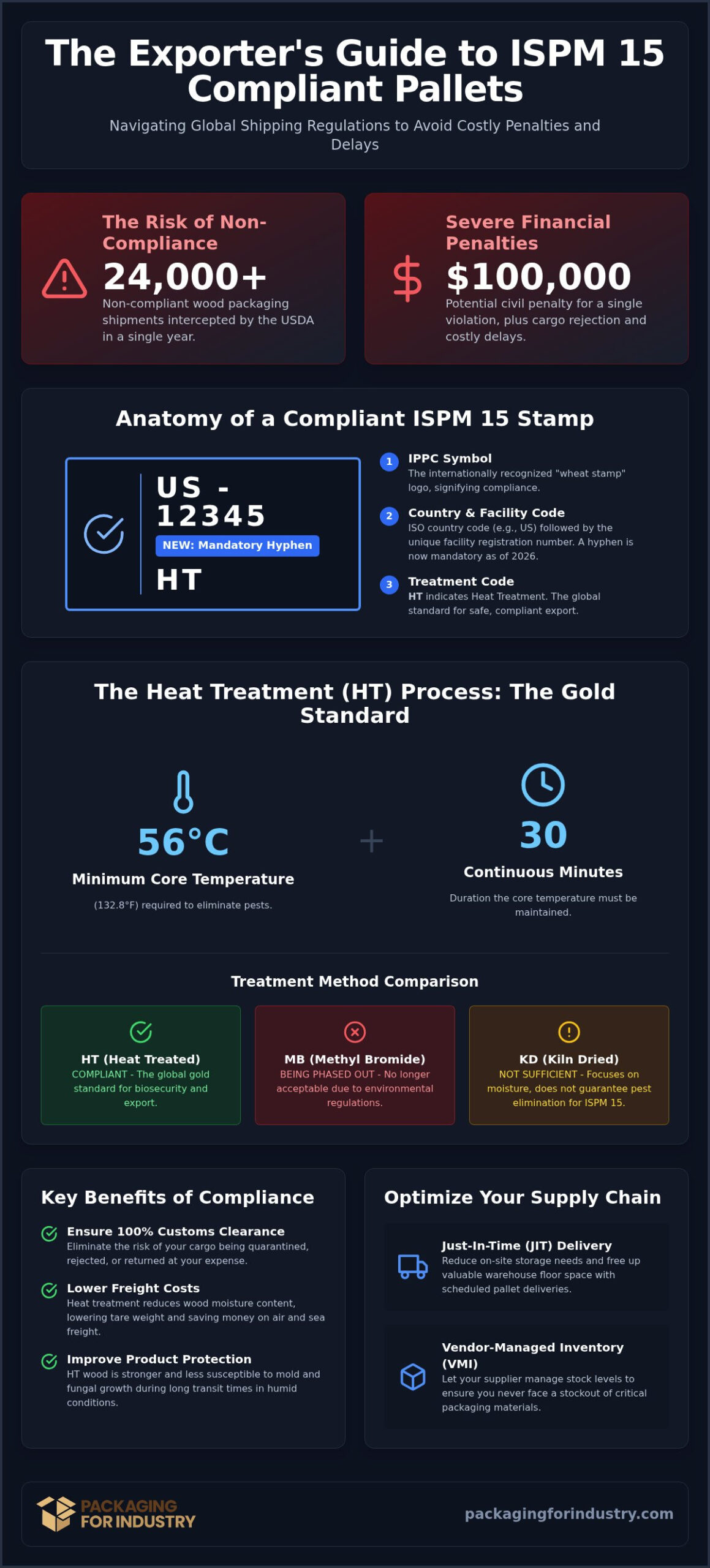
Every compliant pallet must bear a permanent, legible mark. This “wheat stamp” includes the IPPC logo, the ISO country code (US for the United States), and a unique registration number for the treatment facility. You’ll also see the “HT” mark. This indicates the wood reached a core temperature of 56°C for 30 continuous minutes. Don’t confuse this with “KD” (Kiln Dried), which focuses on moisture content rather than pest elimination. Since methyl bromide (MB) is being phased out globally due to environmental regulations, HT remains the gold standard for reliable export packaging.
Global Reach: Countries Requiring Heat Treated Wood
Currently, over 180 countries enforce ISPM 15 regulations. While the European Union, China, and Australia are known for rigorous inspections, even domestic shipments are seeing a rise in HT adoption. Using heat treated pallets for international shipping across all lines simplifies warehouse logistics. It eliminates the risk of an untreated pallet accidentally entering an export lane. If you’re shipping from hubs in Orange County or Los Angeles, ensuring every piece of wood packaging meets these global standards is the most efficient way to protect your margins and maintain your reputation with international distributors.
The Heat Treatment Process: Ensuring Durability and Biosecurity
The heat treatment process is a rigorous engineering standard designed to eliminate biological threats while enhancing the physical properties of the wood. To meet compliance, the wood core must reach a minimum temperature of 56°C (132.8°F) for at least 30 continuous minutes. This specific threshold ensures the total eradication of larvae and insects, such as the Asian Longhorned Beetle or the Emerald Ash Borer. Before the heating begins, the wood must undergo a thorough debarking process. Bark acts as a protective shield for pests, and removing it is a non-negotiable step outlined in the official ISPM 15 regulation text.
Many logistics managers confuse heat treatment with kiln drying. While kiln drying is primarily used to reduce moisture content for dimensional stability, it doesn’t always reach the sustained temperatures required for biosecurity. Choosing heat treated pallets for international shipping provides a dual advantage: they meet legal export criteria and offer superior structural reliability compared to green or untreated lumber. This process is also the environmentally superior choice, as it relies on thermal energy rather than the hazardous chemical applications used in older fumigation methods.
Structural Benefits of Heat-Treated Wood
Thermal modification significantly improves wood performance within the supply chain. By reducing moisture content, the wood becomes lighter. This lower tare weight directly translates to reduced freight costs, particularly in air cargo operations where every pound impacts the bottom line. HT wood is also less susceptible to mold and fungal growth. This is a critical factor for sea transits where high humidity in shipping containers can ruin untreated wood and contaminate cargo. For manufacturers shipping heavy industrial components, the enhanced strength-to-weight ratio ensures the pallet remains rigid under heavy loads. If you require a specific configuration for your machinery, you can request a packaging quote for custom-engineered solutions.
HT vs. Methyl Bromide (MB) Fumigation
Methyl bromide was once the standard for wood sterilization, but its use is declining rapidly. As an ozone-depleting substance, it’s being phased out under the Montreal Protocol. From a business perspective, MB-treated pallets carry significant liabilities. Many sectors, particularly medical device and food manufacturing, prohibit the use of chemically treated wood due to concerns over toxic residues. Standardizing your operations on heat treated pallets for international shipping avoids these risks entirely. It provides a clean, chemical-free solution that is accepted at every global port, future-proofing your supply chain against shifting environmental regulations.
Wood vs. Alternative Materials for International Shipping Pallets
Selecting the right material involves balancing procurement costs, tare weight, and regulatory hurdles. While wood remains the dominant choice, accounting for approximately 93% of the U.S. pallet market, plastic and corrugated options serve specific logistical needs. For most industrial exporters, heat treated pallets for international shipping offer the most versatile performance profile. They provide the high load-bearing capacity required for heavy machinery while remaining significantly more affordable than plastic alternatives. When you compare packaging pricing across different materials, wood consistently delivers the lowest cost-per-trip for one-way international transit.
Corporate ESG goals for 2026 place a heavy emphasis on circularity and carbon footprints. Wood is naturally biodegradable and easily repaired; this makes it a sustainable choice for high-volume export lines. Unlike plastic, which requires energy-intensive recycling, wood pallets can be repurposed or mulched at the end of their lifecycle. For heavy industrial equipment, wood is the only material that reliably supports multi-ton loads without the risk of sudden structural failure or excessive deformation during long sea voyages. It remains the king of the warehouse because it’s both fiscally responsible and structurally superior.
Plastic Pallets: When the Premium is Worth It
Plastic pallets are entirely exempt from ISPM 15 regulations because they are manufactured from processed materials. This eliminates the need for IPPC stamps and associated compliance documentation. While the initial investment is higher, plastic is ideal for closed-loop systems where the pallet returns to the origin. The non-porous surface also allows for easy sanitization. This makes them a preferred choice for the pharmaceutical and medical device sectors where hygiene is a critical operational requirement. If your supply chain doesn’t involve returning the pallet, the high cost often outweighs the benefits compared to heat treated pallets for international shipping.
Corrugated and Composite Pallets for Light Loads
For air freight, every ounce affects your shipping margin. Corrugated pallets offer a massive reduction in tare weight, which can substantially lower air freight expenses. These are often used in tandem with heavy-duty corrugated boxes to create a unified, lightweight shipping unit. However, they are sensitive to moisture. High-humidity environments or outdoor staging can compromise their integrity. They’re best suited for one-way light-duty shipments where disposal ease at the destination port is a priority for the receiver. Manufacturers should evaluate their specific transit route before committing to corrugated to ensure the load remains secure in all climates.
Procurement Strategies: Avoiding Customs Delays and Stockouts
Reliable procurement is the backbone of any successful export operation. While price is always a factor, the hidden costs of supply chain disruptions far outweigh a few cents saved per unit. You must verify that your suppliers maintain active ISPM 15 certification. A lapsed certification at the point of origin can lead to catastrophic delays at the destination port. Many logistics professionals report sudden lead time spikes and price volatility in the current market. Securing a consistent supply of heat treated pallets for international shipping requires moving beyond transactional purchasing toward a strategic partnership. We recommend auditing your vendors annually to ensure their treatment facility codes remain valid and recognized by the American Lumber Standard Committee (ALSC).
Vendor Managed Inventory (VMI) for Export Pallets
Emergency orders are the enemy of warehouse efficiency. High-volume exporters often face the “bullwhip effect,” where slight changes in demand lead to massive pallet shortages. Implementing a vendor managed inventory (VMI) program eliminates this risk. By sharing your usage history, we can automate your replenishment cycles and maintain safety stock at our facility. This proactive approach allows for planned production runs, which helps lower packaging costs and ensures you never face a stockout. It also frees up valuable warehouse floor space that would otherwise be occupied by stacks of idle pallets, allowing you to focus on your core manufacturing processes.
Southern California Logistics: Proximity to Long Beach and LA
In the Inland Empire and Orange County, proximity to the Ports of Long Beach and Los Angeles is a distinct competitive advantage. Sourcing from an Anaheim-based supplier reduces drayage costs and lead times significantly. Local manufacturers can take advantage of next-day delivery to keep their shipping docks moving. Coordinating your pallet arrivals with port schedules and container loading windows streamlines the entire logistical flow. By sourcing locally, you also reduce the carbon footprint associated with transporting heavy wood packaging over long distances. This aligns with 2026 corporate sustainability initiatives while improving your operational agility.
Efficiency is further improved when you integrate your pallet procurement with other packaging needs. Coordinating the delivery of heat treated pallets for international shipping alongside custom crates and heavy-duty corrugated boxes simplifies your receiving process. It reduces administrative overhead and ensures that every component of your shipping unit is engineered to work together. This holistic approach minimizes the risk of dimensional mismatches that lead to shifting loads and transit damage.
Custom Wood Packaging Solutions from Packaging For Industry (PFI)
Standard 48×40 pallets don’t always meet the requirements of specialized industrial sectors. When you’re shipping oversized turbines, sensitive medical imaging equipment, or heavy-duty aerospace components, a one-size-fits-all approach increases the risk of transit damage. PFI specializes in engineering custom wood solutions that integrate seamlessly with your wider packaging strategy. We don’t view a pallet as an isolated component. Instead, we design it as the foundation of a complete protective system. By combining HT wood with custom foam packaging, we provide a precision-fit environment that mitigates vibration and impact during long-haul international transit.
Our team brings deep expertise to aerospace and defense logistics, where military-spec packaging is often a contractual requirement. We understand the nuances of mil-spec wood packaging and ensure every crate and pallet meets the highest standards of durability and compliance. Whether you need bulk quantities of standard heat treated pallets for international shipping or a single custom-engineered export crate for a mission-critical component, our goal is to lower packaging costs while maximizing product safety. We utilize high-performance materials like triple-wall corrugated and polyethylene foam to create lightweight yet incredibly strong shipping units.
Integrated Crate and Pallet Engineering
Effective protection starts with the base. We design custom pallets specifically to support heavy-duty double-wall corrugated boxes, ensuring the weight is distributed evenly to prevent crushing. For high-value electronics, we can incorporate shock-absorption features directly into the pallet design. This proactive engineering approach reduces the need for expensive secondary cushioning. To guarantee performance, we offer free prototyping services. This allows you to test the fit and verify ISPM 15 compliance before committing to a full production rollout, ensuring your international logistics remain lean and reliable.
Reliable Supply for Southern California Manufacturers
Operational reliability depends on a supply chain that understands your local geography. PFI serves as a strategic partner for manufacturers across Anaheim, Irvine, Santa Fe Springs, and the wider Inland Empire. Our proximity to these industrial hubs allows us to offer local next-day delivery on many stock items. This speed is essential for maintaining just-in-time production lines and avoiding the bottlenecks that lead to late shipment penalties. We maintain a steady inventory of heat treated pallets for international shipping to hedge against the supply fluctuations that often disrupt high-volume export lines.
Your logistics challenges require tailored solutions, not generic products. If you’re ready to optimize your export packaging and ensure 100% customs compliance, our consultants are ready to assist. Direct contact for custom quotes: Request a Quote. We provide the technical oversight and logistical stability you need to move your products across the globe with total confidence.
Streamline Your 2026 International Shipping Compliance
Mastering ISPM 15 compliance is a fundamental requirement for protecting your international margins. As enforcement of the 2026 hyphenated marking standard intensifies, the risk of using untreated wood packaging becomes a liability your business shouldn’t carry. Transitioning to heat treated pallets for international shipping ensures your cargo clears customs without the threat of $100,000 penalties or expensive re-exports. It’s a pragmatic investment in operational stability and professional peace of mind.
PFI provides the technical expertise and logistical infrastructure to support your high-volume export lines. By utilizing vendor managed inventory and local next-day delivery in Southern California, we help you lower packaging costs while eliminating the risk of stockouts. Our ISPM 15 certified wood and custom engineering for aerospace and industrial machinery provide a comprehensive system of protection for your most valuable assets.
Don’t let regulatory hurdles slow your global growth. We’re here to engineer a reliable system of protection that keeps your supply chain moving at peak efficiency.
Frequently Asked Questions
Do I need heat treated pallets for shipping to Canada or Mexico?
Yes, you need ISPM 15 compliant pallets for all shipments to Canada and Mexico. While trade agreements like USMCA simplify many aspects of North American logistics, phytosanitary standards remain strictly enforced to prevent the spread of invasive species. Using heat treated pallets for international shipping within North America prevents costly border delays and ensures your cargo moves through customs without quarantine risks.
How can I tell if a pallet is truly ISPM 15 compliant?
A compliant pallet features a permanent, legible IPPC wheat logo branded into the wood. The stamp must include the ISO country code (US), a unique facility identification number, and the HT designation for heat treatment. As of 2026, ensure the facility code includes the mandatory hyphen. If the stamp is missing any of these components, the pallet isn’t legally certified for export.
What happens if my pallet stamp is faded or unreadable at customs?
Customs officials generally treat an unreadable stamp as a compliance failure. If the IPPC mark is faded, smudged, or partially missing, your shipment may be quarantined, destroyed, or returned at your expense. To avoid these disruptions, you should inspect every pallet before loading. Replacing a questionable pallet at the warehouse is significantly cheaper than paying for a re-export from an overseas port.
Can I heat treat my own pallets to save on procurement costs?
You can’t legally certify your own pallets unless your facility is officially audited and certified by an agency like the ALSC. The ISPM 15 standard requires that treatment be performed by an authorized provider who can apply a registered facility code. Attempting to DIY the process without certification won’t provide the necessary legal documentation and will lead to shipment rejections at the border.
Do plastic pallets require an ISPM 15 stamp for international shipping?
No, plastic pallets are exempt from ISPM 15 regulations. Because they’re manufactured from non-organic materials, they don’t harbor wood-boring pests. This exemption also applies to processed wood products like plywood and OSB. While plastic avoids the need for a wheat stamp, you should still evaluate if the higher cost of plastic fits your specific shipping margins and load requirements.
How long does the heat treatment on a wooden pallet last?
The heat treatment is effective for the entire lifespan of the pallet as long as the wood remains intact. However, if the pallet is repaired or remanufactured with new components, it must undergo the heat treatment process again. The original stamp is no longer valid once the structural integrity is altered with untreated wood, requiring a fresh certification mark from the repair facility.
Are there specific requirements for wood crates vs. wood pallets?
Both crates and pallets fall under the same Wood Packaging Material regulations. Every piece of wood thicker than 6mm used in a crate must be heat treated and stamped. For crates, it’s a best practice to apply the IPPC mark to at least two opposite sides. This ensures that inspectors can easily verify compliance regardless of how the crate is positioned in a container.
Why is heat treatment preferred over chemical fumigation in 2026?
Heat treatment is the preferred choice in 2026 because it’s chemical-free and environmentally sustainable. Methyl bromide fumigation is being phased out globally due to its status as an ozone-depleting substance. Many industries, particularly medical and food sectors, now prohibit chemically treated wood to avoid residue risks. Standardizing on heat treated pallets for international shipping future-proofs your logistics against these evolving environmental mandates.