
The right heavy-duty cardboard corner posts for palletizing should match the load’s height, edge coverage, and handling demands. For shipments in Orange County, Los Angeles, or San Diego, suitable dimensions help protect pallet loads without adding unnecessary packaging.
Compare packaging pricing alongside fit, duty level, and order quantity to help lower packaging costs. Whether you need bulk packaging pricing or custom sizes available for packaging for manufacturers, warehouses, and distribution centers, the load configuration is the practical starting point.
This guide covers corner-post selection and protection, then explains how related packaging and foam can support a shipment. It also considers needs in manufacturing, aerospace, food, and electronics, and how Packaging For Industry (PFI) supports packaging requirements in Southern California.
Key Takeaways
- Match post length to the palletized load so corner protection reaches the area that needs support.
- Compare thickness and side dimensions alongside length; these details affect fit and protection.
- Choose a duty level based on load stability needs, stacking conditions, and handling demands.
- Position corner posts to spread banding pressure and help protect load edges from compression.
- Consider foam packaging when products also need cushioning beyond the support provided by corner posts.
Custom leg lengths, thicknesses, and board lengths
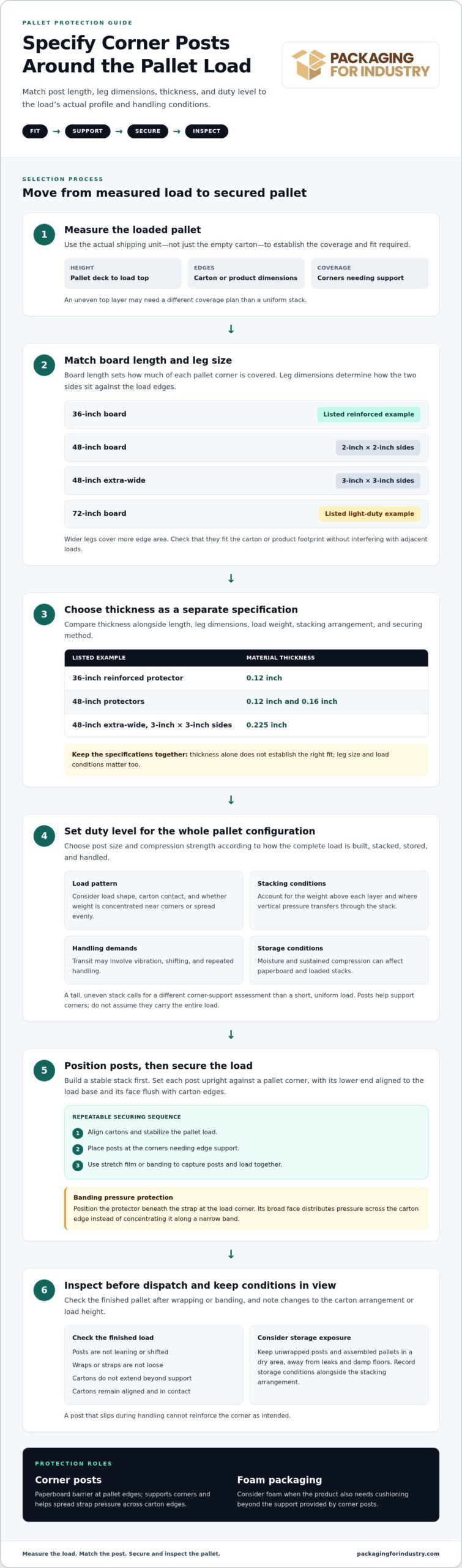
Corner-post dimensions determine fit, edge coverage, and contact with the pallet load. Compare post length, leg dimensions, and thickness with the measured load profile before choosing a specification.
Leg Length and Board Length Options
Board length determines how much of each pallet corner the protector covers. Listed examples include 36-inch and 48-inch boards, while a 72-inch example is also available in a light-duty specification. Measure the load from the pallet deck to its top edge, then match board length to the corner area requiring support.
Leg dimensions describe the two sides that sit against the load’s edges. A 48-inch protector is listed with 2-inch-by-2-inch sides; another extra-wide 48-inch example has 3-inch-by-3-inch sides. Compare these dimensions with the carton or product footprint. Wider legs cover more edge area, so check that they fit without interfering with adjacent loads.
Product Thickness Selection
Thickness is a separate specification from board length and leg size. Listed examples include 0.12-inch material on a 36-inch reinforced protector, 0.12-inch and 0.16-inch material on 48-inch protectors, and 0.225-inch material on a 48-inch extra-wide protector.
Compare thickness alongside the load’s weight, stacking arrangement, and securing method. A thicker board changes the protector’s material profile, but thickness alone doesn’t establish the right fit. For example, the 0.225-inch listing also has 3-inch-by-3-inch sides, so its leg dimensions differ from the 2-inch-by-2-inch examples.
Use a consistent measurement process for each pallet configuration:
- Measure the loaded pallet’s height and identify the corners needing coverage.
- Record the carton or product edge dimensions where the protector will sit.
- Compare the required coverage with 36-inch, 48-inch, and 72-inch examples.
- Review leg dimensions and thickness as separate choices before specifying a board.
Measure the actual shipping unit, not just the empty carton. A pallet with uneven top layers may need a different coverage plan than a uniform stack. For repeat shipments, record the post length, leg dimensions, and thickness together. This gives purchasing and warehouse teams a clear reference for reordering.
Pallet load stability and stacking strength
Position posts upright at the pallet corners, then secure the load with stretch film or banding. Compression performance depends on the post construction, load, stacking, moisture exposure, and storage conditions.
Choosing Post Size and Compression Strength
Select post size and compression strength based on the complete pallet configuration. A tall, uneven stack needs different corner support from a short, uniform load. Consider the weight above each layer, the load’s shape, and whether cartons make continuous contact with the posts. Performance depends on these combined conditions, not a strength label alone.
Check how the pallet will be stacked in storage and transit. For example, cartons concentrated near the corners place different demands on supports than a load with weight spread evenly. Review the stack pattern and where vertical pressure transfers through the load. Select posts that help keep corners aligned, without assuming they carry the entire load.
Securing Posts to the Pallet Load
Install each post vertically against a pallet corner, with its lower end aligned to the load’s base. Keep it flush with the carton edges so it supports the corner instead of leaning away. Secure the complete unit with stretch film or banding, holding the posts in place without shifting the cartons.
Use a repeatable sequence for each pallet:
- Build the load with cartons aligned and stable on the pallet.
- Place a post at each corner that needs edge support.
- Apply film or banding so it captures the posts and load together.
- Check for leaning posts, loose wraps, or cartons extending beyond support.
Inspect the finished load: a post that slips during handling cannot reinforce the corner as intended. Use consistent securing materials for the same pallet configuration, and document changes to the carton arrangement or load height.
Maintaining Strength During Transit and Storage
Transit can expose a pallet to vibration, shifting, and repeated handling. A stable stack starts with aligned cartons, firm contact between layers, and corner posts secured against the load. If cartons move out of alignment, the posts may lose contact where support is needed. Inspect the finished pallet before dispatch, especially after wrapping or banding.
Moisture can affect paperboard, and prolonged storage can keep a loaded stack under sustained compression. Store unwrapped posts and assembled pallets in a dry area, away from leaks and damp floors. A pallet staged beside a loading-bay entrance, for example, may face different moisture exposure from one kept indoors. Record storage conditions alongside the stacking arrangement.
For a load-specific packaging review, submit your pallet dimensions and handling details.
Protection from strapping and banding pressure
Cardboard corner posts sit between pallet straps and exposed load edges. Unlike plastic or wood protectors, they provide a paperboard barrier; foam adds cushioning where products need impact protection.
Protection Against Strapping Damage
Position each cardboard edge protector beneath the strap at the load corner. Its broad face distributes pressure across the carton edge instead of concentrating it along a narrow band. For example, a strap crossing a sharp carton edge can crush the corner; a properly positioned protector creates a buffer.
Check each strap’s path before wrapping or banding. Align the protector with the corner and secure it so tension cannot push it aside. After securing, inspect for crushed carton edges, shifted posts, or loose straps. These checks help show whether the post dimensions and strap placement suit the pallet configuration.
Comparing Pallet Protector Materials
Cardboard posts suit loads needing edge support beneath stretch film or banding. Plastic protectors may suit operations that recover and reuse them. Foam edge and corner protection serves a different purpose: cushioning contact points around products that need impact protection. Wood protectors provide a more rigid barrier when the load design calls for one.
Compare materials by the type of damage to prevent, not just the pallet shape. A sharp strap pressing into a carton calls for an edge barrier; a delicate component exposed to knocks may need foam at contact points. A mixed load could use corner posts to manage strap pressure and foam around vulnerable items. Each material addresses a different packaging need.
Reuse and end-of-life handling also affect material selection. An intact cardboard post can be reused if it remains dry and holds its shape. Clean cardboard may be recyclable through local paper recovery programs, depending on acceptance and condition. Plastic protectors can be collected for reuse when the operation has a return process. Inspect recovered protectors before using them on another load.
Before choosing, review these details on a sample pallet:
- Mark where each strap crosses the load’s exposed corners.
- Check whether the carton edge deforms beneath the secured strap.
- Identify products needing foam cushioning beyond edge protection.
- Decide whether the operation can recover and reuse protectors.
For a packaging quote, share the pallet arrangement, strap path, and damage points using the packaging quote request.
Light-, medium-, and heavy-duty options
Choose a duty level based on the work the pallet faces, not just the product label. Compare stacking, handling, and securing conditions before selecting a protector.
Light-duty protection may suit a uniform pallet of cartons with limited stacking demands. For example, a stable layer of lightweight cases may need only edge support during routine warehouse handling. After wrapping, check that the cartons remain in position and the posts stay against the corners. Reassess the duty level if the load changes.
Medium-duty protection may suit a pallet configuration with more demanding contact or handling. A mixed-height load, for instance, can put uneven pressure on corner edges as cases are secured. Check how each carton meets its neighbor and whether the stack stays aligned during movement. Choose support for the actual shipping arrangement rather than defaulting to a higher duty level.
Consider heavy-duty options when a shipment combines substantial stacking demands with firm securing or repeated handling. For a dense industrial load stored before dispatch, pressure may act on the corners longer than on a direct shipment. Review the full load path, including storage, loading, and transit, before deciding whether heavier protection is appropriate.
Use these checks to compare duty levels for a specific shipment:
- Light duty: assess uniform loads with modest stacking and handling demands.
- Medium duty: review mixed carton profiles and uneven pressure points.
- Heavy duty: account for demanding stacking, securing, and storage conditions.
Do not use duty level as a substitute for checking fit. A post that does not sit squarely against the pallet corner may shift, even if its category sounds suitable. Check contact at every protected edge, then confirm that straps or wrap hold the protector in place. On a pallet with an irregular top layer, inspect the upper corners as well as the base.
For repeat shipments, record the duty category alongside the load pattern and securing method. Warehouse teams can use the record when the same product returns to packing. If a production change alters the carton arrangement or storage conditions, update the packaging instructions before shipping again. This keeps the selection tied to the real load rather than an outdated assumption.
How do I choose the right corner post size and compression strength for a pallet load?
Choose a post specification for the shipment’s actual performance needs, not a general “heavy-duty” label. First define what the protector must do: shield exposed carton edges, maintain a square load profile, or support a particular stacking arrangement. Those goals guide the coverage and strength required. Record the product, pallet pattern, and securing method together in one packaging specification.
Review damage records before selecting compression strength. Note where cartons crush, where straps leave marks, and whether damage appears after storage or transit. A damaged top corner may indicate a different problem from a collapsed lower carton. Identify the failure pattern so the post addresses the pressure point instead of masking an issue elsewhere in the package.
Use an evaluation sequence for each recurring shipment:
- Define the damage or load-support issue the post must address.
- Record the product arrangement and the way cartons contact one another.
- Map areas exposed to straps, stacking pressure, or handling contact.
- Choose a candidate post specification that fits those contact areas.
- Pack a representative pallet and inspect it after normal handling.
During a trial, check that the posts stay in place and the carton edges retain their shape. Look for shifted protectors, visible crushing, strap impressions, or gaps between the post and load. Record the pallet arrangement and securing method with the inspection results. This makes comparisons useful when a later trial changes one specification at a time.
Evaluate compression strength as part of the complete load system. Carton construction, stacking pattern, securing tension, and storage conditions all affect how pressure reaches the corners. A post cannot compensate for poorly aligned cartons or unsupported areas in the pallet pattern. Check the packed load, then adjust the relevant component rather than automatically increasing post strength.
For repeat orders, record the product identifier, pallet layout, protector dimensions, and observed performance. If a product change alters the load profile, treat it as a new configuration and review the selection. This gives purchasing and warehouse teams a practical basis for consistent ordering, grounded in shipment experience.
Packaging For Industry (PFI): Foam Packaging
Packaging For Industry (PFI) can pair foam packaging with pallet corner protection when products need cushioning inside cartons. Corner posts help shield pallet edges from strap pressure, while foam cushions products against contact within the package. This combination can suit manufacturers shipping components that need both load support and product protection.
Stretch film can secure the wrapped pallet load. For businesses with recurring packaging needs, PFI also offers Vendor Managed Inventory (VMI) and Just-In-Time (JIT) inventory programs. These services support packaging supply planning alongside the physical protection selected for each shipment.
Contact Packaging For Industry to discuss foam packaging for your shipping needs.
Turn your pallet specification into a repeatable process
A dependable packaging decision should work beyond a single shipment. Add the selected post dimensions and load arrangement to the packing instructions, then have warehouse teams follow consistent placement and securing steps. This gives purchasing and operations a shared reference when orders repeat or shipping conditions change.
Use heavy-duty cardboard corner posts for palletizing when the load’s handling and stacking demands call for stronger corner support. Record the pallet configuration, strap locations, and any product damage observed in transit. These details help your team refine the setup based on actual shipment experience rather than assumptions.
Packaging For Industry (PFI) can help match packaging choices to your load and operational needs. Share the pallet dimensions, product-handling concerns, and current packing process to begin a practical review.
A well-documented packaging process helps your team maintain consistent shipments and avoid preventable disruptions.
Frequently Asked Questions
What are heavy-duty cardboard corner posts for palletizing?
Corner posts are rigid, angled paperboard protectors placed along pallet-load corners to support exposed edges. They create a broader contact surface between straps and cartons, helping limit concentrated pressure. For example, a manufacturer shipping stacked cases can use them to reinforce carton edges during handling. Posts work as part of the packaging setup, alongside stable cartons and suitable load securing.
What strengths, thicknesses, and dimensions are available for cardboard pallet corner posts?
Options vary by duty level, board length, leg width and depth, and material thickness. Compare these specifications together: a longer post and wider sides affect both coverage and fit. For a load with uneven carton sizes, check that each post contacts the edges consistently. Choose specifications to match the actual pallet arrangement rather than relying on a duty label alone.
How do cardboard corner posts improve pallet load stability and protect products?
Corner posts help keep pallet-load edges aligned and give straps a surface to press against. This can reduce direct contact between banding and carton corners. On a pallet of stacked cases, for example, posts can help preserve the outside edges as securing materials hold the load together. They support the packaging system but do not replace stable stacking, appropriate wrapping, or careful handling.
What is the price of heavy-duty cardboard pallet corner posts in the United States?
Pricing depends on post dimensions, thickness, duty level, order quantity, and delivery requirements. Custom lengths or wider leg profiles can affect the specification, while bulk quantities affect the order scope. For a quote, provide the pallet dimensions, required post specifications, quantity, and destination. This allows Packaging For Industry to price the specific configuration rather than a general product category.
Where can I buy cardboard pallet corner posts in bulk in the United States?
Businesses can source pallet protection through industrial packaging suppliers. Before ordering, prepare the pallet footprint, load height, post dimensions, material thickness, quantity, and delivery destination. Note whether the need is recurring or for a single shipment. These details help align the specification with warehouse and shipping needs, and make quotes easier to compare consistently.
Can cardboard corner posts be recycled, and are there any disposal requirements?
Clean, dry cardboard posts may be recyclable through paperboard recovery programs, depending on local facility rules. Remove attached film, tape, or other materials when the program requires it. Wet, heavily soiled, or laminated protectors may not be accepted with ordinary cardboard. For commercial disposal, follow your facility’s waste-handling procedures and recycling guidance.
What are common risks or mistakes when using corner posts for palletizing?
Common mistakes include choosing posts that do not fit the load, storing paperboard where it can get damp, and mixing specifications in one packing area. Similar-looking posts may differ in thickness or leg profile. Label storage locations by specification, keep posts dry, and inspect them for crushing or damage before use. Clear identification helps prevent incorrect substitutions on repeat orders.