
A single electrostatic discharge event, often invisible to the naked eye, can compromise a high-value circuit board long before the shipment reaches its destination. For manufacturers and distributors, the stakes for securing the best packaging for high-value electronics have never been higher. You’re likely already managing the dual pressures of rising return rates due to transit damage and the technical complexity of ESD requirements. It’s a delicate balance between ensuring total product integrity and the need to control freight costs through efficient box sizing.
This 2026 buyer’s guide provides a clear roadmap to engineering a multi-layered protection system that eliminates transit damage and static discharge for sensitive components. We’ll explore how to move beyond generic supplies to a standardized system of custom-contoured foam and specialized corrugated materials. You’ll learn how to achieve zero-damage shipping cycles and implement cost-effective bulk procurement strategies that protect your bottom line as much as your hardware. From Southern California’s aerospace hubs to nationwide distribution centers, these strategies ensure your most critical assets arrive in perfect working order.
Key Takeaways
- Learn why neutralizing Electrostatic Discharge (ESD) is often more critical than cushioning against physical drops for high-stakes electronics.
- Discover how to engineer the best packaging for high-value electronics by combining heavy-duty corrugated boxes with precision-cut anti-static foam.
- Understand the functional differences between Polyethylene and Polyurethane foams to ensure your cushioning density matches your product’s fragility.
- Explore advanced design strategies like the “box-in-box” method to provide a secondary safety zone for your most expensive equipment.
- Optimize your supply chain through vendor-managed inventory and local next-day delivery options available for manufacturers in Southern California.
The High Stakes of Shipping High-Value Electronics
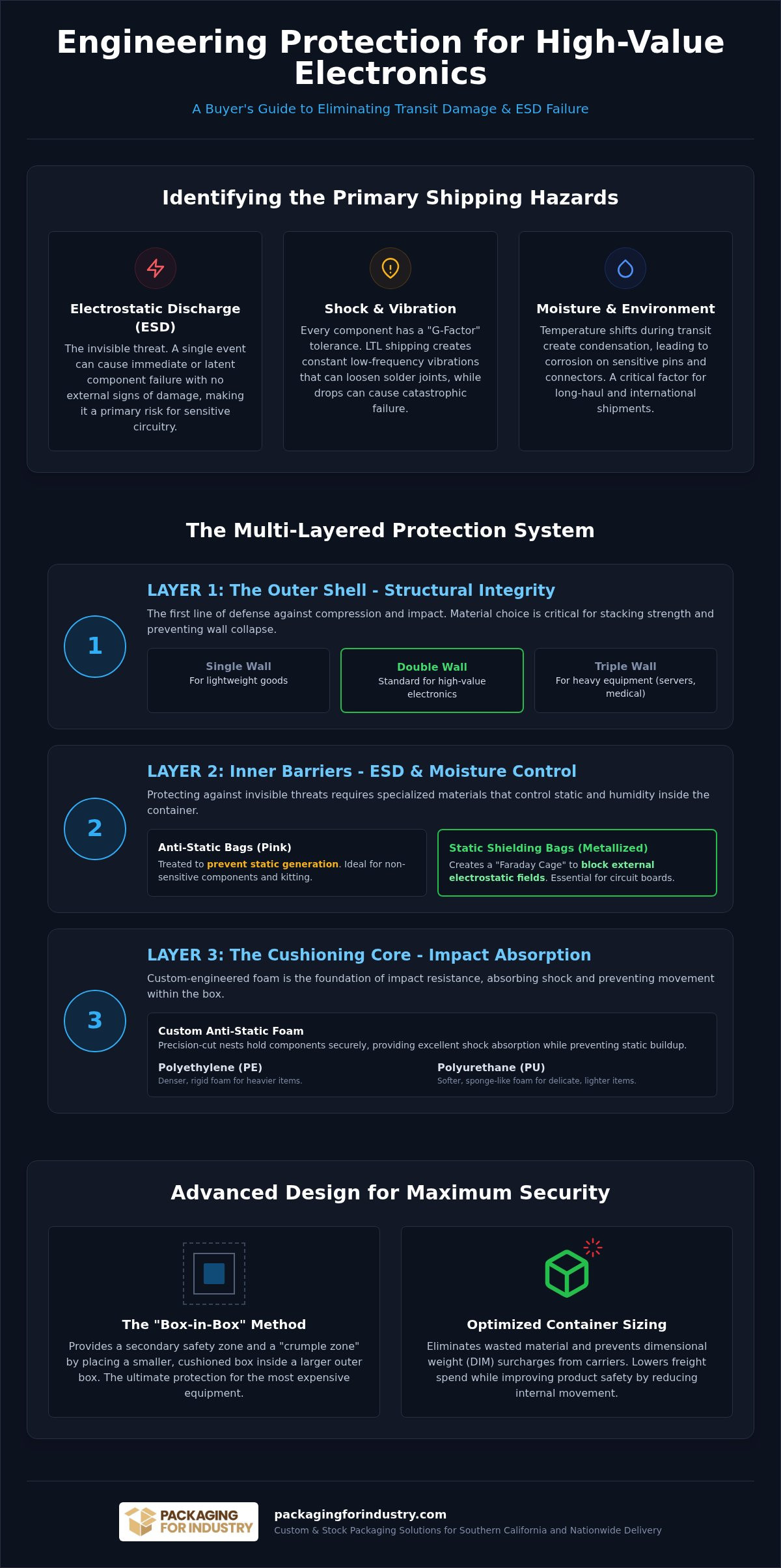
Shipping industrial electronics involves risks that go far beyond a simple dented box. While physical impact is the most obvious hazard, electrostatic discharge (ESD) remains the primary invisible threat to sensitive circuitry. Even a minor static event can degrade a component’s performance or cause immediate failure, often without any external signs of damage. Finding the best packaging for high-value electronics requires an engineering mindset that accounts for both visible and invisible hazards. When you’re moving high-ticket items, the “silent” failures are often the most expensive to resolve.
Every electronic component has a “G-Factor,” which represents the maximum acceleration it can withstand before internal damage occurs. A medical diagnostic sensor might have a G-Factor of 15 to 25G, whereas a ruggedized industrial controller might handle 50G. Standard catalog boxes aren’t designed to meet these specific thresholds. They often lack the structural integrity to maintain a consistent crumple zone, leading to catastrophic failure when stacked in a high-volume warehouse or a bumpy freight trailer. Relying on generic supplies for specialized gear is a recipe for operational stress.
Environmental Hazards: Shock, Vibration, and Moisture
LTL (Less-Than-Truckload) shipping environments subject your products to constant low-frequency vibrations. Over long distances, this vibration can loosen solder joints or cause internal components to rub against one another, leading to premature wear. Beyond mechanical shock, temperature shifts during transit create condensation. This moisture leads to corrosion on sensitive pins and connectors. Utilizing moisture barrier bags alongside desiccant packs is a standard requirement for long-haul or international shipments to maintain a dry environment for the lifespan of the journey.
The Financial Impact of Inadequate Protection
The true cost of a shipping failure isn’t just the price of the box; it’s the ripple effect of re-manufacturing, expedited shipping for replacements, and the erosion of customer trust. Even a 1% damage rate can be devastating when shipping high-ticket aerospace or medical equipment. Conversely, many companies over-package to compensate for poor design, which triggers dimensional weight surcharges from carriers like FedEx and UPS. This inefficiency inflates your freight spend without providing better protection.
Conducting a packaging review for damage reduction allows you to identify these inefficiencies. By optimizing box sizing and material selection, manufacturers in Los Angeles and the Inland Empire can lower packaging costs while simultaneously improving product safety. Standardizing your packaging for varied product lines ensures that every shipment meets the same rigorous protection standards without wasting material or warehouse space.
Essential Materials for ESD-Safe Electronic Packaging
Selecting the outer shell for your shipment is the first step in building a reliable protection system. For most industrial applications, heavy-duty RSC (Regular Slotted Carton) boxes provide the necessary structural integrity. While standard single-wall boxes suffice for lightweight consumer goods, high-value electronics demand at least double-wall corrugated material to ensure stacking strength. For exceptionally heavy equipment like server racks or medical imaging components, triple-wall corrugated offers the rigid support needed to prevent wall collapse during long-haul transit.
Choosing the best packaging for high-value electronics also requires a technical understanding of electrical hazards. There’s a common misconception that all “pink” packaging is equal. Anti-static materials are treated to prevent the generation of static electricity, making them ideal for kitting non-sensitive components. However, they don’t block external electrostatic fields. For sensitive circuit boards, you must use static shielding bags. These metallized barriers create a Faraday cage, neutralizing external charges before they reach the internal components. For cleanroom environments, custom poly bags and moisture barrier bags provide an additional layer of protection against dust and humidity.
Protective Foam: The Foundation of Impact Resistance
Pink anti-static foam remains the industry standard for internal cushioning. It provides excellent shock absorption while ensuring the packaging itself doesn’t become a source of static buildup. Integrating custom foam packaging into your shipping containers allows for precision-cut nests that hold components securely. This prevents “box walk,” where a product shifts inside the carton and loses its protective buffer. If your electronics feature sensitive screens or polished surfaces, it’s vital to use non-abrasive foam grades to prevent surface marring and cosmetic damage.
Securing the External Load
Protection doesn’t end at the individual box. Palletized shipments are often subject to crushing forces from tight strapping or double-stacking in warehouses. Using corner and edge protection distributes these vertical loads and prevents the corrugated walls from buckling. High-performance stretch film is then required to stabilize the entire load, ensuring the boxes don’t shift or slide during the vibrations of LTL transit. When the weight or fragility of the gear exceeds the capabilities of corrugated materials, transitioning to custom-engineered wood crates is the safest path forward.
If you’re currently evaluating your material requirements for a new product line, you can request a packaging quote to compare pricing on specialized ESD-safe supplies.
Custom Foam Engineering: Matching Density to Fragility
Effective protection for sensitive hardware requires more than just filling empty space. To engineer the best packaging for high-value electronics, you must match the density and structural properties of your cushioning to the specific fragility of the component. While previous sections addressed the outer shell and ESD barriers, the internal foam architecture serves as the primary defense against deceleration forces. Selecting the wrong material can lead to “bottoming out,” where the foam compresses fully and transfers the entire impact force directly to your product.
Calculating the required “Drop Height” is a critical step in this engineering process. Your supply chain determines this variable; a package handled by a single courier has different risks than one moving through a complex LTL network with multiple touchpoints. Die-cut foam inserts are superior to generic void fill like packing peanuts because they provide consistent, repeatable protection. Peanuts shift during transit and generate dust that can contaminate circuit boards, whereas precision foam holds the item in a fixed position, maintaining a calibrated safety zone on all sides.
PE vs. PU Foam: A Technical Comparison
Polyethylene (PE) foam features a closed-cell structure that provides excellent moisture resistance and high load-bearing capacity. This material is the preferred choice for heavy industrial gear and reusable “closed-loop” shipping programs where the packaging must withstand multiple trips without structural degradation. In contrast, Polyurethane (PU) foam is an open-cell material that offers a much softer “ride” for extremely lightweight or fragile instruments. While PU foam has slower recovery rates after repeated impacts, its superior shock absorption at low G-levels is essential for sensitive medical sensors and optical equipment.
Bespoke Inserts: Die-Cutting and Foam-in-Place
The precision of custom design packaging is vital for components with complex geometries. Utilizing CAD/CAM support ensures that every cutout matches the product’s dimensions perfectly before the first production run begins. This level of accuracy prevents localized pressure points that could crack a housing or dislodge a connector. When deciding on production methods, manufacturers must weigh the initial tooling costs of die-cutting against the speed and flexibility of foam-in-place systems. For high-volume, recurring orders, die-cut PE foam typically offers the best balance of per-unit cost and consistent performance.
Designing an Integrated Industrial Packaging System
Designing the best packaging for high-value electronics requires more than selecting high-quality materials; it demands a holistic system where each layer serves a specific functional purpose. For ultra-high-value gear, the “box-in-box” method is a standard industrial practice that creates a secondary crumple zone. By suspending a smaller inner carton within a larger outer RSC box using foam spacers, you provide a physical buffer that absorbs kinetic energy during a fall or sudden impact. This double-barrier approach ensures that even if the outer shell is punctured, the internal component remains isolated from the shock.
To manage costs across varied product lines, many manufacturers integrate foam end caps. This modular approach allows for standardized protection across different product lengths within the same outer container. Utilizing packaging kitting services further streamlines the assembly process. PFI delivers pre-assembled kits, including the box, ESD foam, and shielding bags, directly to your workstation. This eliminates the need for warehouse staff to source individual components, significantly reducing assembly time and labor costs on the production floor.
The Role of Prototyping in Electronics Packaging
PFI provides free prototyping services to validate protection levels before you commit to a full-scale rollout. We produce physical samples that allow your engineering team to perform real-world “drop tests” and vibration simulations without risking live inventory. This iterative design phase is essential for refining foam density based on actual prototype performance. If a prototype shows excessive movement, we adjust the CAD designs to ensure a tighter fit, preventing damage before it ever happens in the field.
Standardization and Cost Reduction
Consolidating your packaging materials into fewer, more versatile sizes helps reduce SKU counts and warehouse storage needs. When you standardize your corrugated boxes, you can often procure materials in larger bulk quantities, which helps lower packaging costs per unit. Custom-sized boxes are also engineered to stay within the dimensional weight limits of major carriers, helping you avoid the expensive “Large Package” surcharges that inflate freight budgets. Designing for pallet efficiency maximizes truckload density for manufacturers in Los Angeles and the Inland Empire, ensuring every shipment is as cost-effective as possible.
Optimizing Your Supply Chain with PFI
Engineering the best packaging for high-value electronics is only half of the equation; the other half is ensuring those materials are available exactly when your production line requires them. For manufacturers in high-stakes sectors like aerospace and medical devices, a single day of downtime due to a box shortage leads to significant financial losses. PFI functions as a proactive partner in your supply chain, offering localized expertise and logistical solutions that go beyond simple order fulfillment. Whether you’re operating out of a single facility in Anaheim or managing multiple distribution hubs across the country, we provide the infrastructure needed to maintain a lean, efficient operation.
Vendor Managed Inventory (VMI) for Electronics
Space is a premium asset in any Southern California warehouse. Our VMI programs allow you to free up floor space by storing your bulk packaging inventory at our facilities instead of yours. We use predictive replenishment to monitor your usage cycles, ensuring you never run out of critical supplies or have to resort to expensive emergency orders. This model also improves your cash flow. Instead of tying up capital in months of inventory, you pay for your packaging as it’s pulled for use. It’s a pragmatic approach that aligns your packaging spend with your actual shipping volume.
Local Support and Custom Engineering
Proximity matters when you’re dealing with tight production deadlines. PFI offers local next-day delivery for businesses in Los Angeles, Irvine, and across the Inland Empire, providing the responsiveness that national catalog companies can’t match. This local presence allows our engineers to visit your facility, assess your production line assembly, and help you implement the best packaging for high-value electronics in person. For firms with a broader footprint, we leverage our network of distribution partners to provide consistent, high-quality support nationwide. We understand the specific requirements of the semiconductor and aerospace industries, where precision and reliability are non-negotiable.
Ready to protect your high-value assets? Request a custom packaging quote today.
Future-Proof Your Electronics Shipping Strategy
Securing sensitive components in 2026 requires a shift from buying generic boxes to engineering comprehensive systems. We’ve explored how neutralizing electrostatic discharge and matching foam density to a product’s G-Factor eliminates the silent failures that erode your bottom line. By integrating the best packaging for high-value electronics, you move beyond reactive damage control toward a proactive model of logistical efficiency. Standardizing your materials and utilizing kitting services doesn’t just protect your hardware; it streamlines your entire production floor.
At PFI, we provide the technical expertise needed for high-stakes aerospace and medical shipments. Our team offers free prototyping and CAD design services to ensure your custom inserts provide a perfect fit before production begins. With specialized ESD material knowledge and local next-day delivery across Southern California, we help you lower packaging costs while improving reliability. It’s time to eliminate the professional stress of transit damage through precision engineering and dependable local support.
We look forward to helping you optimize your industrial logistics and secure your most valuable assets for the journey ahead.
Frequently Asked Questions
What is the best packaging for high-value electronics?
The best packaging for high-value electronics is an engineered system that integrates a heavy-duty outer shell with specialized internal protection. This typically involves using double-wall RSC boxes to ensure stacking strength and static-shielding bags to neutralize electrical fields. Precision-cut foam inserts are then used to suspend the product, creating a safety buffer that absorbs impact forces. This multi-layered approach ensures your components remain secure against both physical shock and invisible electrostatic discharge.
How do I prevent ESD damage during shipping?
Preventing ESD damage requires using materials that block external electrical fields and prevent charge buildup. You should utilize metallized static-shielding bags for sensitive circuit boards, as these create a protective Faraday cage. Additionally, lining your shipping containers with pink anti-static foam ensures that the packaging itself doesn’t generate a charge during transit. For high-stakes industrial electronics, these layers work together to neutralize hazards that standard plastic or corrugated materials cannot stop.
Is polyethylene or polyurethane foam better for electronics?
Polyethylene (PE) foam is generally superior for heavier industrial components and reusable shipping programs because of its high load-bearing capacity and moisture resistance. It provides excellent durability for recurring cycles. Conversely, polyurethane (PU) foam is better for extremely lightweight or fragile instruments that require a softer cushion. While PU foam absorbs shock at lower G-levels, it doesn’t offer the same structural longevity as the closed-cell structure found in PE foam.
Do I need double-wall corrugated boxes for electronic components?
High-value electronics almost always require double-wall corrugated boxes to prevent wall collapse and crushing during LTL transit. While single-wall boxes might suffice for small consumer gadgets, industrial gear needs the added structural integrity of a B/C flute combination. This ensures the box maintains its shape when stacked in high-volume warehouses. For exceptionally heavy equipment like server racks, transitioning to triple-wall corrugated or custom crates is often the most fiscally responsible choice.
What are moisture barrier bags, and when should I use them?
Moisture barrier bags are multi-layered foils designed to protect sensitive circuitry from humidity and salt air during long-distance or international transit. You should use them whenever your supply chain involves significant temperature fluctuations or sea freight, which can lead to internal condensation and corrosion. When paired with desiccant packs, these bags maintain a dry internal environment, ensuring that your electronics arrive ready for immediate installation without the risk of oxidation damage.
Can custom packaging help reduce my FedEx or UPS shipping costs?
Custom packaging directly lowers your shipping costs by optimizing the box dimensions to match your product size and fragility. Standard catalog boxes are often oversized, which triggers expensive dimensional weight surcharges from carriers like FedEx and UPS. By engineering a custom fit, you eliminate unnecessary void fill and reduce the overall footprint of your shipment. This allows you to maximize pallet density and lower your total freight spend without compromising protection.
How does a Vendor Managed Inventory (VMI) program work for packaging?
A Vendor Managed Inventory program allows PFI to oversee your packaging stock levels so you don’t have to. We store your custom boxes and foam inserts at our facility and monitor your usage cycles to ensure consistent availability. Instead of managing complex purchase orders, you receive replenishment exactly when needed. This model frees up your warehouse floor space and improves cash flow, as you only pay for materials as they’re pulled for production.
Does PFI offer local delivery in Southern California?
PFI provides local next-day delivery for manufacturers and distributors located throughout Southern California, including Los Angeles, Orange County, and the Inland Empire. Our proximity to major industrial hubs in Anaheim, Irvine, and Santa Fe Springs ensures that we can respond quickly to your operational needs. This local support is a critical advantage for companies running just-in-time production lines that require a dependable, responsive packaging partner to avoid costly shipping delays.