
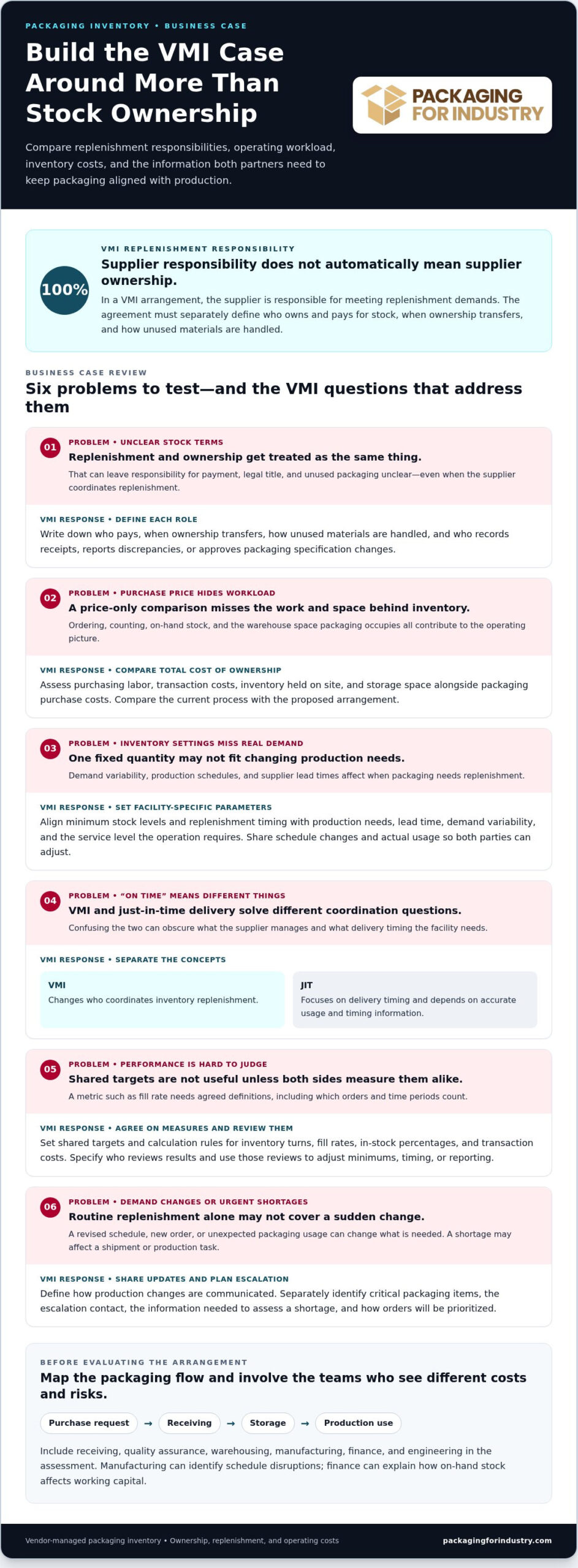
VMI shifts responsibility for packaging replenishment, but it doesn’t automatically determine who owns the stock. In a VMI arrangement, the supplier is responsible for 100% of meeting replenishment demands; stock ownership depends on the agreement between the supplier and manufacturer. Building a business case for VMI packaging services means assessing that ownership arrangement alongside the operational and financial effects.
It’s reasonable to focus on who pays for and holds packaging inventory, since those terms affect purchasing and working capital. A useful business case also accounts for the labor involved in ordering and counting stock, the warehouse space it occupies, replenishment reliability, and the quality of usage data shared by both parties.
This article shows how to compare buyer-managed purchasing with VMI, identify relevant costs and operational changes, and assess how replenishment rules and shared usage information shape the business case. You’ll have a practical framework for deciding whether VMI fits your packaging needs and what to measure when evaluating its value.
Key Takeaways
- Separate inventory ownership terms from replenishment responsibilities; the VMI agreement should make each party’s role clear.
- Build the case around total cost of ownership, including purchasing labor, on-hand stock, and the warehouse space packaging uses.
- Distinguish VMI from just-in-time delivery: VMI changes who coordinates inventory, while JIT focuses on delivery timing.
- Set replenishment parameters using production needs, lead time, demand variability, and the service level the operation requires.
- Use shared inventory and usage data to refine replenishment decisions and keep the program aligned with changing demand.
Does vendor-managed inventory mean the supplier owns the packaging stock?
Vendor-managed inventory (VMI) doesn’t automatically determine who owns packaging stock. It describes an arrangement in which a supplier manages replenishment at the manufacturer’s facility. The buyer and supplier coordinate responsibilities under agreed terms, which should specify when ownership transfers, who pays for stock, and how unused materials are handled. Treat ownership and replenishment as separate questions in your business case.
In a VMI system, the supplier is 100% responsible for meeting the customer’s inventory replenishment demands. That responsibility concerns supply, not necessarily legal title to every box, roll, or protective insert on site. The agreement should define the supplier’s access to stockrooms, replenishment frequency, and performance metrics. It should also identify who records receipts, reports discrepancies, and approves changes to packaging specifications. These details clarify how to build a business case for VMI packaging services without assuming stock ownership changes.
Start by assessing current inventory and supply-chain processes. Map how packaging moves from purchase request through receiving and storage to production use. Include stakeholders from receiving, quality assurance, warehousing, manufacturing, finance, and engineering. Each team sees different costs and risks: manufacturing can describe schedule disruptions, while finance can explain how on-hand stock affects working capital. Compare the current process with the total cost of ownership, not just the purchase price.
Next, align inventory parameters with production schedules and actual consumption. Set minimum stock levels with supplier lead times, demand variability, and desired service levels in mind. For example, a plant with changing production needs should share updated schedules and packaging usage with its supplier. This helps both parties adjust replenishment before a demand shift creates excess inventory or a stockout. Custom inventory solutions should reflect the facility’s operating rhythm, rather than applying one fixed quantity to every packaging item.
Define shared performance targets before launch. Partners can track inventory turns, fill rates, in-stock percentages, and transaction costs. The agreement should explain how each metric is calculated and who reviews the results. A fill-rate target is useful only when both parties agree which orders and time periods count. These measures link service performance to purchasing workload, availability, and total cost.
VMI depends on collaborative planning, not a handoff that ends communication. Supplier and manufacturer discussions should cover inventory variance, usage, expected demand, and production changes. A joint planning cycle can include forecasting, order fulfillment, and results analysis. Use each review to identify whether minimums, replenishment timing, or reporting need adjustment. For teams assessing how to build a business case for VMI packaging services, regular reviews connect inventory decisions to changing production needs.
Responsive replenishment and emergency supply needs
Responsive replenishment links packaging orders to actual usage and production timing. A sound business case also considers how the supply chain responds to demand changes and urgent material needs.
Packaging Replenishment
Packaging replenishment restores supplies based on inventory levels, usage, and operational demand. With VMI, the supplier and manufacturer coordinate orders so packaging arrives in suitable quantities when needed. This matters when production schedules change or an item is used faster than expected. Reviewing stock alongside usage helps prevent routine orders from causing shortages or unnecessary on-site inventory.
Supplier-Manufacturer Coordination
Supplier-manufacturer coordination means sharing inventory, usage, and relevant production information to guide replenishment. A manufacturer can communicate a schedule change, and the supplier can use it to adjust order timing and quantities. This helps both parties respond to demand shifts before they disrupt production. Clear responsibility for updates, order approval, and inventory reporting makes collaboration workable day to day.
For responsive service, define what counts as a demand change and how the supplier will be notified. A production team might flag a new order, a revised schedule, or a change in packaging consumption. The supplier can then assess available stock, replenishment timing, and the quantity needed for the updated plan. Just-in-time delivery depends on accurate usage and timing information, so set a replenishment cadence that matches the facility’s operating needs.
Plan separately for emergency supply needs. Identify packaging items that could stop a shipment or production task if unavailable. Document the escalation contact, the information needed to assess a shortage, and how the parties will prioritize orders. This doesn’t replace routine inventory control. It gives the manufacturer and supplier a defined response when normal replenishment no longer matches demand.
A clearer process can benefit both parties. The manufacturer may spend less time initiating routine orders and can share schedule changes sooner. The supplier gains better visibility into expected demand and can plan fulfillment around the customer’s operating requirements. Consistent availability can help protect shipment schedules, while joint analysis of order history and inventory variances shows where the process needs adjustment.
For a practical assessment, compare routine order activity with the current replenishment approach, then map the points where delayed information creates risk. Use the results to set shared expectations for order coordination and supply continuity. A packaging quote request can help frame those requirements around the packaging your operation uses.
What changes between buyer-managed purchasing and VMI?
The main change is who monitors packaging inventory and initiates replenishment. JIT describes delivery timing, so it can be used with either purchasing arrangement.
Purchasing and Delivery Models
In buyer-managed purchasing, the buyer typically handles inventory tracking and ordering. VMI shifts on-site inventory management to the supplier. This distinction matters because it changes daily purchasing tasks and how inventory information moves between partners. JIT, by contrast, sets delivery timing, not who places orders or manages stock.
For example, a buyer-managed plant might count corrugated boxes and send a purchase order when stock reaches its internal threshold. Under VMI, the supplier monitors agreed inventory and coordinates reordering and delivery. Either model can use JIT timing if production needs and packaging usage guide delivery schedules. Compare the responsibilities separately rather than treating VMI and JIT as interchangeable.
Supplier-Led Reordering
With supplier-led reordering, the supplier uses shared inventory and usage information to manage replenishment at the customer’s site. The manufacturer no longer needs to initiate each routine order, but still shares actual consumption and production changes. Clear roles for reporting stock and approving exceptions help the VMI program run without gaps.
During implementation, define which stock areas the supplier can access, how inventory counts are recorded, and how order changes are communicated. If a facility uses several packaging formats, identify each item by specification and intended production use. This gives the supplier a practical basis for replenishing the right materials instead of treating all packaging as interchangeable stock.
Include customer-specific requirements in the operating plan. A manufacturer may need one box size for a finished assembly and a different protective configuration for a fragile component. Document approved specifications, substitution rules, and the production lines using each item. When engineering changes a package or production revises its schedule, both teams need a clear way to update item records and replenishment decisions.
Before choosing a model, map the current purchasing process from inventory review through order placement, receipt, and use. Note who owns each task and where the records come from. Buyer-managed purchasing relies on the manufacturer’s inventory counts, usage records, orders, and production requirements. A VMI partner needs access to relevant information and timely notice of demand changes. Comparing workflows shows which administrative tasks shift and which remain with the manufacturer.
Discuss performance expectations while designing the VMI program. Set shared measures for fill rates, in-stock percentages, inventory turns, and transaction costs, then assign responsibility for reporting each one. Review variances with purchasing, manufacturing, and warehousing teams. This helps determine whether supplier-led replenishment supports the plant’s actual process or whether buyer-managed control is a better fit for particular packaging items.
Labor, working capital, and warehouse savings
VMI packaging savings may come from reduced purchasing labor, lower on-hand inventory, and less warehouse space devoted to stock. Estimate the opportunity by comparing current inventory, labor, storage, and freight records with the proposed process.
Potential Cost Savings
Potential VMI savings are operational and financial changes compared with traditional purchasing. Packaging costs include more than the price of materials. For example, fewer buyer-initiated orders may reduce the time spent requesting, tracking, and reconciling purchases. Lower on-hand stock may also improve working capital and free warehouse capacity.
Review purchasing tasks by recording who places orders, checks counts, follows up on deliveries, and resolves discrepancies. Then identify which activities would shift to the supplier and which would remain with the manufacturer. This prevents the business case from treating every purchasing hour as removable. Staff may still need to receive materials, report usage, and manage exceptions.
Assess warehouse effects by mapping where packaging is stored and how much operating space it occupies. Separate regularly used stock from excess materials stored between production runs. If VMI reduces inventory levels, the released area could support production staging or other warehouse needs. Include the operational value of that space in the analysis, but don’t count it as a direct cash saving.
Estimating Inventory, Labor, and Freight Savings
Estimate savings by comparing a documented purchasing baseline with projected VMI activity across inventory, labor, and freight. This gives finance and operations a consistent basis for evaluating changes instead of relying on assumptions. Use the same packaging items, production needs, and review period in both scenarios.
For inventory, record current quantities on hand, replenishment orders, and stock levels for each packaging item. Compare these with proposed minimums and replenishment patterns. Finance can then assess how changes in average inventory affect working capital. Warehouse teams can document the storage footprint and identify usable space that lower stock levels could free up.
For labor, log time spent counting, ordering, expediting, receiving, and correcting inventory records. Estimate which tasks would change under VMI, while retaining tasks that remain necessary. For freight, compare shipment frequency, order consolidation, delivery patterns, and charges in existing records. VMI doesn’t automatically reduce freight expense; the estimate depends on how order quantities and delivery timing change.
Bring purchasing, finance, and warehouse findings together in one analysis. Show the source for each assumption, such as order records, time logs, or inventory counts. This makes the business case easier to review and helps teams distinguish measurable savings from capacity or labor that could be redirected to other work.
VMI software, min/max levels, and usage data
VMI software can help monitor inventory levels and guide replenishment, but useful decisions depend on accurate usage and production information. Implementation typically combines agreed stock parameters, reporting practices, and regular reviews. Inventory-level optimization may take one to two business quarters to realize most benefits.
Usage Data and Inventory Thresholds
Usage data tracks how packaging moves from stock into production, while min/max levels indicate when inventory needs replenishment. Together, these inputs help a VMI program respond to actual demand rather than a static estimate. VMI software can monitor inventory weekly or bi-weekly, helping teams spot changes before corrugated boxes or other packaging reach their minimum levels.
Set thresholds based on lead time, demand variability, and the desired service level. For example, a manufacturer with changing production schedules should compare recent corrugated usage with planned output before adjusting its minimum. Maximum levels matter too: setting them too high can tie up working capital and warehouse space. Review usage alongside stock variance, then revise parameters when operating patterns change.
Implementation Steps and Technology
VMI implementation establishes item records, stock parameters, reporting responsibilities, and a review process. These steps matter because inaccurate packaging specifications or unclear data ownership can lead to incorrect replenishment. Depending on the facility’s needs, teams may use software alongside RFID, scales, artificial intelligence, or Internet of Things technology to capture inventory information.
Start by agreeing which stockrooms and packaging items the supplier can access. Then align item descriptions, count methods, minimums, maximums, and replenishment practices. Establish how production changes and inventory variances will be shared. A site visit, cycle count, or mobile scanning process can help maintain accurate records. Regular reviews compare actual fulfillment with expected demand and identify where settings need adjustment.
Technology should fit the facility’s process, not dictate it. A warehouse using manual counts may prioritize consistent count timing and clear variance reporting. A site with automated sensors may use those readings to inform inventory reviews. In either case, manufacturers need to share relevant future demand information, while suppliers report inventory variances. This keeps software outputs grounded in operational context.
Track implementation progress through inventory accuracy, replenishment performance, and fulfillment against agreed expectations. Review these measures with relevant teams, including receiving, warehousing, manufacturing, and finance. Their analysis can reveal whether a threshold reflects actual consumption or an outdated assumption. Documented adjustments help keep stock parameters aligned with production needs as demand changes.
For a VMI packaging quote, outline the inventory data, packaging items, and replenishment requirements your facility needs to manage.
Packaging For Industry (PFI): Foam Packaging
Packaging For Industry (PFI) helps manufacturers and warehouses manage recurring packaging needs. Its Vendor Managed Inventory (VMI) for Packaging supports coordination between purchasing and production teams, while Foam Packaging and Stretch Film help protect products and prepare shipments. PFI serves aerospace, electronics, and medical device businesses that rely on consistent packaging for industrial products.
Choose PFI when your operation needs packaging support shaped around its materials, workflows, and supply requirements rather than a generic approach. That practical focus can help teams improve supply reliability while addressing packaging needs across production and shipping. Explore Vendor Managed Inventory for Packaging, or contact Packaging For Industry (PFI) to discuss your requirements.
Turn Your VMI Analysis Into a Practical Next Step
Building a business case for VMI packaging services means connecting operational priorities with clear performance measures. Use your analysis to identify the process changes your team wants to evaluate and the outcomes that matter to purchasing, finance, and production.
Set a focused starting scope, then bring relevant stakeholders together to discuss responsibilities and review criteria. A shared plan gives your team a practical basis for evaluating the next phase.
A well-defined next step can help your team move forward with clarity.
Frequently Asked Questions
Can packaging VMI work when demand changes from month to month?
Yes, VMI can accommodate changing monthly demand when the manufacturer shares updated forecasts and usage information. For example, an Orange County producer with a variable order mix can communicate packaging needs as its schedule shifts. The supplier can use those updates to plan replenishment. Regular reviews help distinguish a temporary production adjustment from a lasting change in packaging consumption.
How can a company assess VMI if it uses only a few packaging items?
A company can assess VMI using items with repeat usage or purchasing challenges, even if its packaging range is small. Start with a corrugated box or stretch film used consistently in production, then compare current ordering workload and stock levels with a managed approach. This focused assessment can show whether coordinated replenishment would simplify purchasing without bringing low-use items into the program.
How does VMI benefit customers?
VMI can help customers spend less time managing recurring packaging orders and keep essential supplies available for production and shipping. Packaging For Industry’s VMI program maintains a 30-60 day supply buffer for on-site inventory. For a manufacturer in Los Angeles or San Diego, a managed program can also give purchasing and operations teams a clearer view of recurring packaging needs and support more consistent stock planning.
How does technology support VMI programs?
Technology helps partners capture inventory information and identify changes that affect replenishment. RFID and scales can support inventory counts, while artificial intelligence or Internet of Things tools can contribute to monitoring and analysis. Technology isn’t the whole program: clear item records, reliable usage reporting, and communication about production changes are still essential to interpreting the data and making useful replenishment decisions.
How should a manufacturer account for seasonal packaging demand in a VMI analysis?
Separate seasonal demand from ordinary usage by comparing packaging consumption with production plans and expected order patterns. For example, a food producer preparing for a seasonal product run can share the schedule and packaging requirements before demand rises. Include the planned change in the analysis, then review actual usage after the peak. This helps distinguish a temporary increase from a lasting shift in baseline needs.
What Does VMI Stand For?
VMI stands for Vendor Managed Inventory. In packaging, it describes an arrangement in which a supplier helps manage inventory and replenishment at the customer’s facility. The buyer and supplier coordinate their responsibilities, including how inventory information is shared and how replenishment is handled. The term describes the inventory management approach; it doesn’t, by itself, determine who owns the packaging stock or when ownership transfers.
What Is VMI Packaging, and Which Costs Can It Address?
VMI packaging is a managed approach to coordinating packaging inventory and replenishment between a supplier and a business. It may address costs related to purchasing labor, excess on-hand inventory, and warehouse space used for packaging storage. Manufacturers can also include order handling and inventory discrepancies in their cost analysis. The potential impact depends on the existing process and the responsibilities included in the arrangement.
What Is the Purpose of VMI?
VMI aims to improve coordination between a supplier and manufacturer so packaging replenishment better reflects actual demand. Sharing inventory and production information helps both parties plan supply instead of relying only on separate purchasing records. For a distribution operation in Southern California, including Orange County, Los Angeles, or San Diego, that coordination can support packaging availability for outgoing orders and give teams a clearer basis for reviewing and adjusting stock practices as needs evolve.