
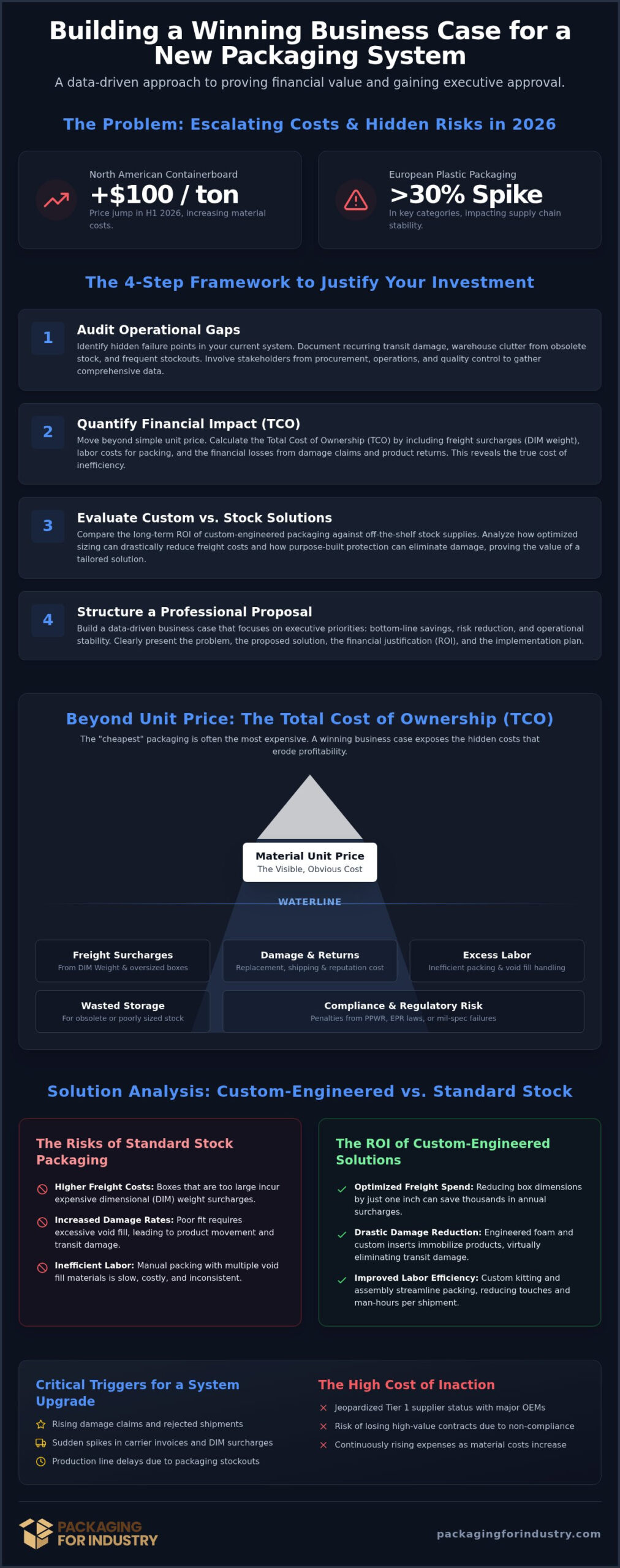
Could your current packaging strategy be costing you more in hidden surcharges and damage claims than the actual price of the materials? In the first half of 2026, North American containerboard prices jumped by a net $100 per ton, while European plastic packaging costs spiked by over 30% in some categories. If you’re struggling to justify an upgrade to your leadership, you must learn how to create a business case for a new packaging system that focuses on the total cost of ownership rather than just the unit price.
We know that obtaining budget approval for operational changes is often the most difficult part of a logistics manager’s job. It’s frustrating to watch rising freight surcharges and high damage rates eat into your margins while warehouse floor space is wasted on obsolete stock. This article will help you master the step-by-step process of building a data-driven business case that proves the financial value of upgrading your industrial packaging. We’ll examine how to quantify ROI through damage reduction, freight optimization, and compliance with 2026 regulatory shifts like the EU’s PPWR and new state EPR laws.
Key Takeaways
- Learn how to audit your current logistics chain to identify hidden failure points like recurring transit damage and warehouse clutter.
- Discover how to create a business case for a new packaging system by calculating the Total Cost of Ownership (TCO) rather than just material unit prices.
- Evaluate the long-term ROI of custom-engineered solutions compared to the hidden waste and damage risks associated with standard stock supplies.
- Master a professional proposal structure that focuses on executive priorities, including bottom-line savings and operational stability.
- Understand how Vendor Managed Inventory (VMI) and just-in-time delivery can optimize your cash flow and streamline manufacturing operations.
Identifying the Operational Gaps in Your Current Packaging System
A Business case for packaging isn’t just a request for a budget increase. It’s a strategic document that justifies an investment in protection, logistics, and long-term reliability. When you’re learning how to create a business case for a new packaging system, your first step is a thorough audit of existing operational gaps. You can’t fix what you haven’t measured. Look for recurring transit damage, frequent stockouts, or warehouse floors cluttered with obsolete stock. These aren’t just minor annoyances; they’re financial leaks that drain your profitability.
Many firms fall into the “Catalog Trap.” They rely on standard sizes from massive catalog suppliers because the initial ordering process seems simple. However, using an RSC box that’s even slightly too large requires excessive void fill and triggers higher dimensional weight (DIM) surcharges. This waste adds up quickly across thousands of shipments. To build a winning case, you must involve stakeholders from procurement, operations, and quality control early in the process. Their data on replacement costs and packing times will provide the necessary evidence to support your proposal.
Recognizing Critical Triggers for a System Upgrade
Identifying specific triggers is essential when determining how to create a business case for a new packaging system that leadership will actually approve. In the aerospace and high-value electronics sectors, even a minor scratch can lead to a total loss and a rejected shipment. If your damage claims are rising, your protective materials aren’t doing their job. Another trigger is a sudden spike in carrier invoices. With UPS and FedEx adjusting surcharges in 2026, oversized or poorly optimized corrugated boxes are becoming a massive liability. Finally, watch your production line. If delays occur because you’re waiting on packaging supplies with long lead times, your supply chain reliability is at risk.
The Cost of Inaction: What Happens if You Don’t Change?
Ignoring these operational gaps is a choice with its own price tag. With containerboard prices increasing by a net $100 per ton in early 2026, sticking with a wasteful system will only get more expensive. Beyond material costs, poor packaging compliance can jeopardize your Tier 1 supplier status with major OEMs. If your shipments consistently arrive damaged or fail to meet mil-spec standards, you risk losing high-value contracts. You must also account for labor. Inefficient manual packing processes waste hours every day. Upgrading to a custom-engineered system often pays for itself simply by lowering packaging costs and reducing the man-hours required to secure a shipment.
Quantifying the Financial Impact of Packaging Inefficiency
Understanding how to create a business case for a new packaging system requires moving beyond the invoice price of a single box. While procurement teams often focus on the lowest unit cost, this narrow view ignores the Total Cost of Ownership (TCO). Total Cost of Ownership represents the sum of all expenses associated with a packaging material from the moment it’s ordered to the moment it reaches the end customer. When you account for shipping, labor, and damage, the “cheapest” box often becomes the most expensive line item in your budget.
Freight optimization remains one of the most significant levers for cost control in 2026. Reducing a box’s dimensions by just one inch can save thousands of dollars in annual surcharges. Because carriers use dimensional weight (DIM) pricing, excess air in your corrugated boxes is a direct waste of capital. Additionally, you must factor in the cost of returns. A single damaged industrial component doesn’t just cost you the outbound freight; it costs you the inspection time, the repackaging labor, and the potential loss of customer trust. Transitioning to custom kitting and assembly can drastically improve labor efficiency by streamlining the packing process and reducing the number of touches required for each shipment.
Hard Costs vs. Soft Costs in Industrial Logistics
Hard costs are the visible line items: material prices, freight bills, and damage claims. Soft costs are the hidden drains on your resources. These include the administrative time procurement spends managing dozens of vendors and the opportunity cost of warehouse floor space occupied by obsolete stock. By consolidating your supply chain, you can free up capital and labor for higher-value activities. You can request a packaging quote to see how a streamlined system compares to your current multi-vendor approach.
Leveraging Data for Packaging Cost Savings
Success depends on using shipping logs to identify patterns in transit damage. If data shows recurring failures in specific shipping lanes, your current double-wall boxes are likely inadequate for the journey. Calculating the ROI of switching to engineered triple-wall solutions often reveals that the slightly higher material cost is dwarfed by the massive reduction in damage claims. Comparing your current spending against packaging cost savings benchmarks provides the concrete evidence needed to convince executive leadership that a change is necessary.
Evaluating Custom vs. Stock Solutions for Maximum ROI
When you’re deciding how to create a business case for a new packaging system, you must evaluate whether standard stock supplies are actually saving you money. Standard RSC boxes are readily available and seem convenient, but they often require significant amounts of void fill to secure the product properly. This creates a cycle of waste where you pay for excess material and the labor required to install it. Custom-engineered solutions eliminate this inefficiency by designing the container around the specific dimensions of your product, which is the most direct way to lower packaging costs over the long term. By avoiding the “air” inside a standard box, you reduce both material spend and the freight surcharges discussed in previous sections.
High-value industrial components, particularly in the aerospace and medical sectors, demand a level of precision that stock catalog items cannot provide. Utilizing custom foam packaging ensures that sensitive instruments are shielded from vibration and impact during transit. By taking advantage of free prototyping, you can test the performance of these materials in real-world conditions before a full rollout. This “measure twice, cut once” approach ensures that your final system is optimized for both protection and logistics, providing the data needed to support your request for quote with confidence.
When to Invest in Engineered Custom Packaging
If your facility handles heavy machinery or specialized defense components, engineered crates and mil-spec packaging are often mandatory requirements. Defense contracts demand strict adherence to material specifications that standard corrugated boxes cannot meet. There’s also a significant financial advantage to using integrated solutions where the box, foam, and film are designed as a single unit. This holistic design often includes pre-configured kitting, which reduces the total number of packaging components you need to stock and simplifies the assembly process on the warehouse floor.
Standard Supplies: When ‘Good Enough’ is Actually Costly
Many warehouses try to make stock supplies work by using excessive amounts of stretch film or bubble wrap to compensate for a poor fit. This is a hidden expense that often goes unmonitored in traditional procurement models. For instance, adding engineered corner boards to a palletized load provides far more structural stability and edge protection than multiple extra rotations of film. Similarly, standard tubes and cores may be insufficient for heavy long-format parts if they lack the specific crush strength required for industrial stacking. Identifying the point where bulk catalog ordering becomes less efficient than custom manufacturing is a key part of how to create a business case for a new packaging system that executive teams will actually approve.
Structuring Your Business Case for Executive Approval
Executives value brevity and precision. When presenting how to create a business case for a new packaging system, your document must follow a logical flow that addresses both financial risk and operational gain. Start with an Executive Summary that highlights bottom-line savings and improved supply chain stability. This section should be the only part a busy CFO needs to read to understand the value proposition. Follow this with a Problem Statement supported by the hard data you gathered on damage rates and DIM surcharges.
The Proposed Solution should detail the transition to an engineered system, such as moving from stock boxes to custom-fit corrugated solutions. Your Financial Analysis must present a clear 12-month ROI projection, accounting for material savings and reduced labor costs. Finally, include an Implementation Timeline that demonstrates how to switch vendors or systems without stopping production lines. A methodical structure reassures leadership that the upgrade is a calculated business move rather than a speculative expense.
Proving the Engineering: Prototypes and Testing
Technical proof is often the deciding factor for industrial projects. Including CAD designs or physical prototypes in your proposal provides tangible evidence of how the new system functions before a single dollar is spent on production. For firms in the electronics or aerospace sectors, documenting results from drop tests or vibration tests confirms that the custom engineering will withstand the rigors of transit. Prototyping reduces the risk of executive rejection by demonstrating that the solution is already verified and ready for deployment.
Addressing Common Executive Objections
The most frequent pushback is the “if it isn’t broken, don’t fix it” mentality common in stable operations. You must frame the upgrade as a necessary step to ensure long-term stability and protect margins against 2026 material price hikes. Executives may also hesitate to move from a familiar national catalog giant to a specialized packaging manufacturer. Address this by highlighting the cost-saving benefits of custom sizes and the technical expertise a specialist provides. If warehouse space is a concern, use Vendor Managed Inventory (VMI) to show how you can reclaim floor space while improving cash flow through just-in-time delivery.
Optimizing the Supply Chain: The Role of VMI and Custom Engineering
A final, compelling element of how to create a business case for a new packaging system is the transition from reactive purchasing to proactive inventory management. Implementing Vendor Managed Inventory (VMI) allows you to reclaim capital previously frozen in static stock. By shifting the responsibility of stock monitoring and replenishment to PFI, you can focus internal resources on production while we ensure that heavy-duty RSC boxes and custom-engineered foam are always available for your assembly lines. This model streamlines the procurement process and eliminates the hidden administrative costs of managing multiple vendors.
This strategic partnership model eliminates the high costs of emergency rush orders and production downtime caused by packaging shortages. For manufacturers in highly competitive hubs like Anaheim, Irvine, and Los Angeles, the ability to lower packaging costs through leaner inventory is a significant operational win. When you compare packaging pricing across the entire lifecycle of the product, the efficiency of a managed system far outweighs the administrative burden of traditional procurement. It moves packaging from a volatile expense to a predictable, optimized component of your supply chain.
Local Logistics: The Southern California Advantage
PFI’s regional infrastructure provides a distinct advantage for manufacturers operating in the Southern California corridor. Our local next-day delivery service covers Orange County, Los Angeles, San Diego, and the Inland Empire, ensuring that your just-in-time (JIT) schedules are never compromised. Whether you require mil-spec packaging for a defense contract or protective corner boards for palletized shipments, our local stocking programs prevent warehouse clutter. We also leverage nationwide shipping capabilities to support multi-location firms, maintaining consistency in protection standards across all your facilities.
Finalizing the Case: The Path to a Quote
Completing your business case requires moving from high-level strategy to concrete numbers. You have identified the gaps, quantified the TCO, and selected the engineered solutions that offer the best ROI. The next logical step is to request a packaging quote to validate your financial projections. Because we have custom sizes available for everything from corrugated crates to polyethylene foam inserts, we can provide a tailored estimate that supports your proposal. Scheduling a professional packaging review will give you the final data points needed to secure executive approval and begin optimizing your logistics chain.
Secure Your Operational Future with Data-Driven Packaging
Success in 2026 requires shifting your focus from material unit prices to the Total Cost of Ownership. By identifying operational gaps and quantifying the hidden expenses of transit damage and freight surcharges, you can build a compelling argument for modernization. Mastering how to create a business case for a new packaging system allows you to transform your logistics from a cost center into a strategic advantage that protects your bottom line.
Packaging For Industry (PFI) provides the specialized expertise in aerospace and industrial manufacturing needed to support your proposal. As a proven cost-saving alternative to large catalog suppliers, we offer custom-engineered solutions that eliminate waste. Our local next-day delivery across Southern California ensures your production lines stay moving without the burden of excessive on-hand inventory.
You now have the framework to secure executive buy-in and optimize your supply chain. Take the first step toward a more efficient warehouse and durable protection for your most valuable assets today.
Frequently Asked Questions
What are the most important metrics to include in a packaging business case?
The most critical metrics are transit damage rates, dimensional weight (DIM) freight surcharges, and labor hours per packed unit. You should also include material waste percentages resulting from over-sized stock boxes. By quantifying these hidden expenses, you can accurately determine how to create a business case for a new packaging system that focuses on ways to lower packaging costs and prove long-term profitability to executive leadership.
How can custom packaging reduce my freight and shipping costs?
Custom packaging reduces freight costs by eliminating the excess air found in standard catalog boxes. Carriers use dimensional weight pricing, meaning you pay for the space your package occupies. Right-sizing your corrugated boxes ensures you only pay for the actual product volume. This optimization can save thousands of dollars in annual surcharges, especially for high-volume Southern California manufacturers who need to lower packaging costs.
Is it really cheaper to buy custom boxes than bulk catalog boxes?
Yes, because custom solutions eliminate the hidden waste found in one-size-fits-all catalog products. When you compare packaging pricing across the entire supply chain, the reduction in void fill and freight surcharges often offsets the slightly higher unit cost. Because we have custom sizes available, you can avoid the “Catalog Trap” that leads to excessive material usage and higher transit damage rates.
How does Vendor Managed Inventory (VMI) help my company’s cash flow?
Vendor Managed Inventory (VMI) improves cash flow by reducing the amount of capital tied up in on-hand stock. Instead of purchasing large bulk quantities that occupy valuable warehouse floor space, you only pay for what you use. This just-in-time approach allows your company to reallocate funds toward production and growth while ensuring you never face a packaging shortage during critical shipping windows.
What information do I need to provide for a custom packaging quote?
You should provide the exact dimensions, weight, and fragility of your product to ensure the best fit. Knowing your current shipping environment helps our engineers select the right grade of corrugated board or foam density. Since we have custom sizes available for all our products, we can provide a precise estimate when you request a packaging quote to support your business case.
How long does it take to see an ROI on a new packaging system?
Most industrial firms see a return on investment within 6 to 12 months. Immediate savings typically come from reduced freight surcharges and lower labor costs associated with kitting and assembly. Over time, the reduction in product damage claims and the reclamation of warehouse floor space through VMI further accelerate the ROI, making the transition to an engineered system a financially sound decision for any business case.
Can custom foam inserts really lower my transit damage rates?
Custom foam inserts and corner boards significantly lower transit damage rates by providing precision shock absorption and edge protection. Unlike generic bubble wrap or paper fill, engineered polyethylene or ESD foam prevents movement within the box. This level of protection is the gold standard for sensitive electronics and medical devices, where even minor vibrations can lead to costly product failures and rejected shipments.
What is the benefit of a local Southern California packaging supplier for VMI?
A local Southern California supplier like Packaging For Industry (PFI) offers next-day delivery across Orange County, Los Angeles, and San Diego. For companies in these regions, local stocking programs eliminate the long lead times associated with national catalog giants. This proximity allows for tighter inventory control and ensures that your VMI program operates with the purposeful speed of a well-oiled supply chain.