
Operational buy-in isn’t won with a slide deck on brand aesthetics; it is earned on the packing line where seconds determine profitability. If you are struggling with how to get buy-in from operations on a packaging change, you likely face resistance rooted in concerns about throughput delays, SKU proliferation, and warehouse congestion. With 2026 regulations like the California Truth in Labeling law and various state PFAS bans now in effect, operations teams also worry about the added complexity of compliance. They need to know that a change won’t just meet legal standards; they need it to run faster.
We agree that your operations team values reliability and floor-level efficiency above all else. This guide provides a strategic roadmap to present packaging upgrades as an operational win rather than a logistical burden. You’ll learn how to use data-driven insights to address fears of downtime while highlighting benefits like reduced shipping damage and lower freight costs. We will examine how to leverage engineering-led logistics and integrated material solutions to secure executive approval while maintaining a seamless transition on the floor.
Key Takeaways
- Address the “if it isn’t broken” mindset by proving that new packaging designs reduce assembly time and improve floor-level throughput.
- Discover how to get buy-in from operations on a packaging change by shifting the conversation from unit costs to total operational efficiency and damage reduction.
- Utilize CAD/CAM prototyping to provide physical samples that demonstrate exactly how custom foam and corrugated integration simplifies the packing process.
- Leverage Vendor Managed Inventory (VMI) to ensure a seamless transition between old and new SKUs without causing warehouse congestion or production downtime.
- Prioritize local logistical support and next-day delivery to eliminate the risk of stockouts during the transition period.
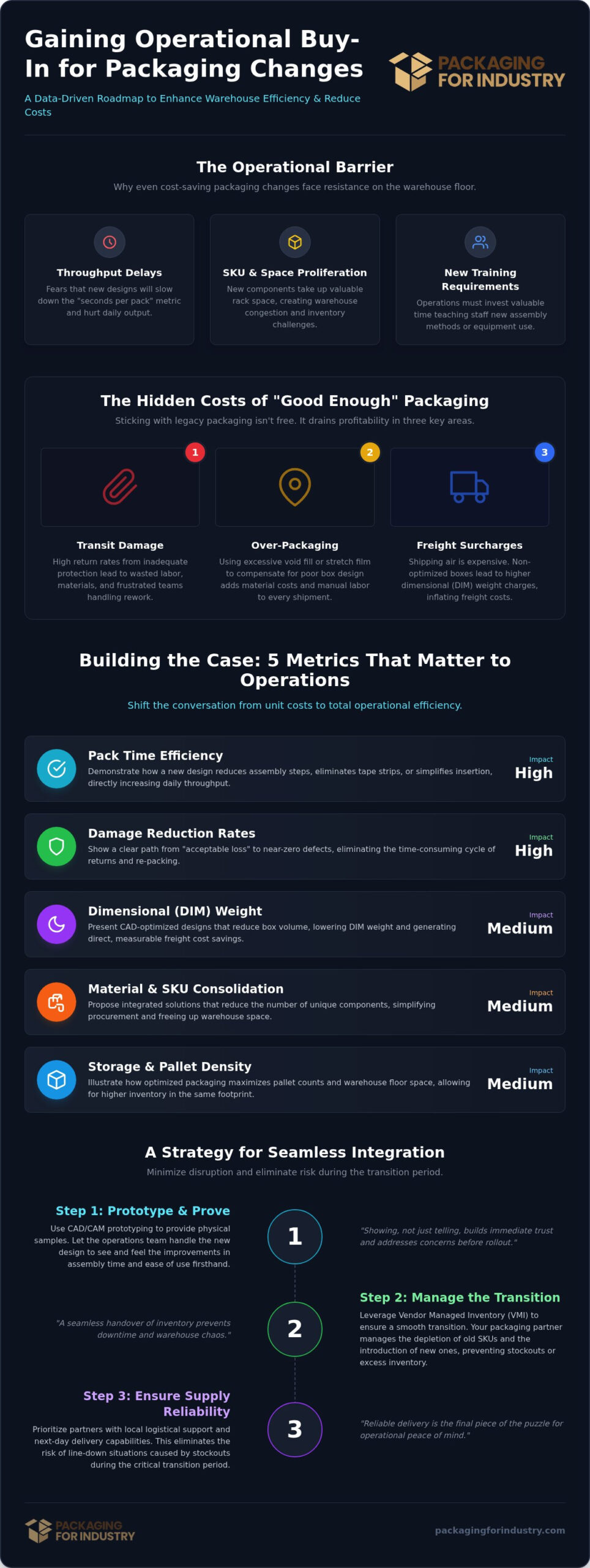
The Operational Barrier: Why Packaging Changes Often Stall
Industrial operations thrive on predictability. In a high-volume manufacturing or distribution environment, any deviation from the established workflow is viewed as a risk. The “if it isn’t broken, don’t fix it” mindset isn’t just stubbornness; it’s a calculated protection of throughput. Understanding how to get buy-in from operations on a packaging change requires recognizing that an operations manager’s primary metric is uptime. If a new material or design threatens to slow down the line, it will face immediate resistance. Top-down mandates often fail because they ignore these floor-level realities. Without advocacy from the people who actually handle the materials, even the most cost-effective packaging strategy will stall during implementation.
Common Friction Points in the Warehouse
The transition from standard corrugated boxes like RSC (Regular Slotted Containers) to more complex die-cut designs often causes friction. While a custom design might save material, it may require more steps to assemble, which impacts the “seconds per pack” metric. Additionally, new foam packaging inserts can occupy significant rack space. In crowded SoCal facilities, finding room for new SKUs without clearing out old inventory creates immediate pushback. Finally, every new method requires training. Operations teams don’t want to spend valuable shifts teaching staff how to fold a complicated insert or calibrate a new piece of equipment. Identifying these specific pain points is the first step in learning how to get buy-in from operations on a packaging change effectively.
The Cost of Maintaining the Status Quo
Sticking with legacy packaging isn’t free. It carries hidden expenses that drain the bottom line and create long-term logistical stress. These costs include:
- Transit Damage: High return rates due to inadequate protection are often treated as an “acceptable loss” rather than a design flaw. This creates a cycle of rework that frustrates the floor team and wastes labor.
- Over-Packaging: Floor teams often use excessive void fill or extra layers of stretch film to compensate for poorly sized boxes. This adds unnecessary manual labor to every unit shipped.
- Freight Surcharges: Shipping air is expensive. Non-optimized dimensions lead to higher dimensional (DIM) weight charges. These costs add up quickly for companies shipping bulk quantities nationwide.
Effective Change management starts by framing the new packaging as a tool to eliminate these daily headaches. By focusing on these operational drains, you can present the upgrade as a way to simplify the packer’s job while protecting the company’s profitability.
Building the Case: 5 Metrics That Matter to Operations
Operations managers rarely care about the aesthetic appeal of a box; they care about how that box moves through the facility. Learning how to get buy-in from operations on a packaging change requires moving beyond abstract savings to hard, floor-level data. To win their support, you must speak in terms of throughput, reliability, and space. Focus your proposal on these five critical metrics:
- Pack Time Efficiency: Does the new design reduce seconds per unit? A box that eliminates three tape strips or a complex fold can significantly increase daily output.
- Damage Reduction Rates: Moving from an “acceptable loss” threshold to a zero-defect goal removes the labor-intensive cycle of returns and re-packing.
- Dimensional (DIM) Weight: Optimized sizing ensures you pay for the product’s actual mass rather than the volume of empty space surrounding it.
- Material Consolidation: Reducing the number of unique SKUs simplifies procurement and reduces the risk of stockouts on critical packing components.
- Storage Density: Maximizing pallet counts and warehouse floor space allows for higher inventory levels without expanding the physical footprint.
Translating Cost Savings into Operational Wins
When you lower packaging costs, you create a budget surplus that can fund floor-level upgrades like automated stretch wrappers or improved conveyor systems. Operations teams are often more receptive to material changes when they see a direct path to reducing manual labor. As you compare packaging pricing, evaluate how custom designs eliminate the need for secondary packaging kitting and assembly steps. Optimized DIM weight directly reduces the total cost per unit shipped by eliminating the financial penalty for transporting empty space. By presenting these changes as a way to “work smarter,” you position the transition as a benefit to the team’s daily workload.
Gathering Data from the Floor
The most persuasive data doesn’t come from a spreadsheet; it comes from the packing station. Start by interviewing packers to identify current pain points, such as boxes that are difficult to square or inserts that require excessive force to seat. Tracking the actual time spent on current multi-step processes provides a baseline to compare against new prototypes. Combine this with actual shipping claims data to prove that the “status quo” is actually a source of operational friction. If you’re ready to see how custom designs can streamline your workflow, you can request a packaging quote to begin a formal analysis of your current line efficiency.
The Power of Prototyping: Showing, Not Just Telling
A digital slide deck might show cost savings, but it cannot demonstrate how a box feels in a packer’s hands. When you are determining how to get buy-in from operations on a packaging change, a physical prototype is your most persuasive tool. Operations managers live in a world of tangible constraints; they need to see that a new design doesn’t just look good on a screen but actually functions on the floor. By utilizing CAD/CAM support, you can present precision-fit foam packaging and corrugated boxes that prove the engineering behind the upgrade. Bringing the operations team into the design phase allows them to identify potential bottlenecks before they become production delays.
Confidence is built through testing, not just talking. Conducting “drop tests” in front of the operations team provides visceral proof that a new design protects the product better than the status quo. This transparency eliminates the fear of hidden costs associated with transit damage. It also creates an opportunity for iterative feedback. Letting the floor team suggest tweaks to the design ensures the final product is optimized for their specific workflow, turning potential critics into advocates for the change.
The Pilot Program Approach
A full-scale rollout is often too risky for a busy facility. Instead, propose a small-batch test on a single production line. This pilot program allows you to compare performance data between the old and new packaging in real-time. You can track metrics like “seconds per pack” and assembly ease without disrupting the entire warehouse. Inviting operations leadership to witness the “unboxing” of a prototype on the line demonstrates your commitment to their daily success. This data-driven, low-risk approach is a cornerstone of how to get buy-in from operations on a packaging change.
Leveraging PFI’s Custom Design Services
Partnering with an engineering-minded supplier removes the guesswork from the transition. At PFI, we offer free prototyping and CAD/CAM support to ensure your new packaging is floor-ready from day one. You can collaborate directly with our custom design packaging engineers to solve specific fit issues or assembly hurdles. This high-touch support reduces the risk of the change and provides your operations team with a steady, dependable partner. You can request a packaging quote for a prototype today to jumpstart your internal buy-in process and prove the value of a more efficient design.
Seamless Integration: Minimizing Disruption During the Rollout
The most dangerous phase of any packaging upgrade is the rollout. If the warehouse floor becomes cluttered with overlapping SKUs or production stalls because of a stockout, you will lose the support you worked so hard to build. Mastering how to get buy-in from operations on a packaging change requires a logistical strategy that prioritizes a clean transition. By implementing Vendor Managed Inventory (VMI), you shift the burden of inventory tracking to your supplier. This ensures that new corrugated boxes and foam inserts arrive exactly when the old stock is depleted, preventing the “double-stocking” that irritates warehouse managers.
For facilities in Southern California, space is always at a premium. Utilizing Just-In-Time (JIT) delivery allows you to maintain aggressive production schedules without dedicating half your floor to packaging storage. Standardizing your labels and thermal ribbons during this time also simplifies the process for the floor team. It ensures that the new packaging doesn’t require a complete overhaul of their existing printing equipment or software settings. Operations managers value this level of foresight because it protects their throughput during the most volatile part of the change.
Inventory Management Strategies
Successful rollouts rely on setting clear min-max levels for the new materials. A robust stocking program eliminates the need for bulk storage on-site, which is a major concern for warehouse managers in high-rent areas like Irvine or Santa Fe Springs. We coordinate with local partners to provide next-day delivery across Orange County and Los Angeles. This proximity allows operations to pivot quickly if demand spikes suddenly. Having a local safety net is a powerful argument when explaining how to get buy-in from operations on a packaging change, as it removes the fear of long lead times from distant suppliers.
Training and Documentation
The learning curve is a frequent source of operational resistance. To counter this, provide visual Pack Sheets that show exactly how the new design assembles. You can also leverage packaging kitting services to deliver pre-assembled components directly to the line. This reduces the number of touches required by the packer and ensures consistency from the first unit shipped. Providing on-site support during the first week of implementation demonstrates that the change is a partnership. When the floor team sees that the new design actually makes their job easier, their advocacy will secure the long-term success of the project.
Why PFI is the Ideal Partner for Operational Transitions
PFI positions itself as an engineering partner rather than a simple box vendor, which is critical when presenting a new strategy to your operations team. Most packaging suppliers focus strictly on unit price; we focus on the intersection of material costs and logistical flow. With custom sizes available for every unique product footprint, we eliminate the waste associated with oversized stock containers. Our expertise in complex integrations, including mil-spec packaging for the aerospace and defense sectors, demonstrates a level of precision that reassures operations managers of our reliability. When you partner with a supplier that understands the floor-level logistics of a high-volume facility, the question of how to get buy-in from operations on a packaging change becomes much easier to answer through technical data and physical proof points.
Local Support for Southern California Manufacturers
We provide hands-on operational support that distant national suppliers cannot match. Our team conducts detailed on-site packaging reviews to identify specific stability and protection opportunities, such as implementing heavy-duty corner boards to improve pallet integrity during transit. We offer local next-day delivery across our Anaheim service area, Irvine, and Los Angeles to ensure your production lines never stall. This proximity allows our engineers to visit your facility, observe your packing process, and suggest real-time improvements. This level of service helps how to get buy-in from operations on a packaging change by demonstrating that you have a local partner ready to troubleshoot any issues on the warehouse floor immediately.
Taking the Next Step
Initiating a packaging review with a PFI specialist is the most effective way to build a data-backed case for your operations manager. By consolidating your industrial packaging supplies with a single partner, you reduce the administrative burden on procurement and the storage footprint in the warehouse. We provide the CAD designs, the physical prototypes, and the logistical safety net of VMI programs to make the transition risk-free. Our cost-reduction analysis speaks the language of Finance through lower freight spend and the language of Ops through optimized material handling and reduced labor. We act as the “fixer” for your supply chain, ensuring that every material change results in a more stable and profitable operation.
Secure Your Operational Advantage
Success in packaging optimization requires moving beyond unit price to focus on floor-level efficiency. By addressing downtime fears through physical prototyping and using data to prove damage reduction, you transform a logistical hurdle into a competitive advantage. Understanding how to get buy-in from operations on a packaging change is fundamentally about demonstrating that the transition won’t just save money; it will simplify the packer’s job and protect the production schedule.
PFI supports this transition with technical expertise and localized logistics. Our free prototyping for custom designs allows your team to test fit and function before a full rollout. With Vendor Managed Inventory (VMI) to save warehouse space and local next-day delivery in Southern California to prevent stockouts, we remove the risks that typically stall industrial changes.
Your operations team deserves a partner that values their uptime as much as you value your bottom line. We are ready to help you build the case for a more efficient future.
Frequently Asked Questions
How do I handle an operations manager who is resistant to any change?
Focus your conversation on throughput metrics like “seconds per pack” and floor-level reliability. You can overcome resistance by proposing a pilot program on a single production line to prove efficiency without risking the entire facility’s output. This data-driven approach is the most effective way to learn how to get buy-in from operations on a packaging change because it addresses their primary fear of downtime.
What are the most common hidden costs when switching packaging suppliers?
Transition downtime and inventory overlap are the most frequent hidden expenses. Switching suppliers often results in “double-stocking” old and new corrugated boxes, which consumes valuable rack space and complicates warehouse logistics. You should also account for the labor hours required to recalibrate automated machinery or retrain floor staff on new assembly methods for custom foam inserts during the first week.
Can a new packaging design actually reduce labor costs in the warehouse?
Yes, optimized designs reduce the number of “touches” required to pack a single unit. Integrated solutions, such as custom foam already kitted inside a corrugated box, eliminate several manual assembly steps on the floor. If a new design saves just 15 seconds per unit in a high-volume facility, the cumulative labor savings often justify the initial engineering and material costs.
How long does it take to get a custom packaging prototype?
PFI typically delivers custom prototypes within 24 to 48 hours depending on the complexity of the design. We utilize on-site CAD/CAM support to move from a conceptual engineering drawing to a physical sample quickly. Rapid prototyping allows you to test fit and function immediately, which is essential when you need to show tangible progress to your operations leadership.
What is VMI and how does it help with warehouse space issues?
Vendor Managed Inventory (VMI) is a program where the supplier monitors and replenishes your stock levels automatically. It helps with space issues by eliminating the need for bulk safety stock on your warehouse floor. Instead of storing a three-month supply of pallets or stretch film, you only keep what you need for immediate production, freeing up rack space for revenue-generating inventory.
Is custom packaging always more expensive than stock boxes?
Custom packaging is often more cost-effective when you factor in dimensional (DIM) weight and damage rates. While a stock RSC box might have a lower unit price, it frequently requires more void fill and incurs higher freight surcharges due to wasted space. Right-sized packaging reduces material waste and optimizes pallet density, which lowers your total cost of ownership over time.
How do I prove that a packaging change will reduce shipping damage?
Use physical “drop tests” and ISTA-style testing protocols to provide empirical evidence of protection levels. Record the results of these tests using your actual products and present the data to your operations manager. Shipping a small batch of prototypes through your standard carrier network also provides real-world proof of how the new design handles transit stress compared to your legacy packaging.
Does PFI offer local delivery in San Diego and the Inland Empire?
Yes, PFI provides reliable local delivery throughout San Diego and the Inland Empire. Our Southern California fleet ensures that manufacturers in cities like Riverside, Ontario, and Chula Vista receive their supplies on a next-day basis. This local presence is a key part of how to get buy-in from operations on a packaging change because it guarantees supply reliability and eliminates long lead times.