
With North American containerboard prices surging by a net $140 per ton in July 2026, the pressure on procurement managers to optimize material costs has reached a critical point. However, cost savings often stall when they meet the engineering department’s rigid standards for product protection. Understanding how to get engineering buy-in on a packaging material change requires more than just a lower price point; it demands a technical strategy that prioritizes risk mitigation and structural integrity.
We understand the frustration of seeing a viable cost-saving transition blocked by fears of shipping damage or lengthy approval cycles. This article provides a practical roadmap for procurement and operations managers to overcome internal friction and successfully implement new packaging solutions. We’ll explore how to use data-backed evidence, rapid prototyping, and technical compliance to satisfy even the most skeptical engineering teams. By the end of this guide, you’ll have the tools to streamline the approval process and reduce costs without compromising the safety of your high-value components.
Key Takeaways
- Learn how to get engineering buy-in on a packaging material change by shifting the conversation from unit price to technical performance and risk mitigation.
- Discover how to use ASTM and ISTA testing standards to provide the data-backed evidence engineers require to approve new materials confidently.
- Utilize CAD/CAM design support and physical prototyping to eliminate guesswork and demonstrate a precision fit for complex industrial parts.
- Build a comprehensive business case that quantifies the reduction in shipping damage and return logistics to prove long-term ROI.
- Leverage local expertise in Anaheim and Orange County for rapid prototyping cycles that significantly shorten approval timelines.
The Internal Conflict: Why Engineering Resists Packaging Material Changes
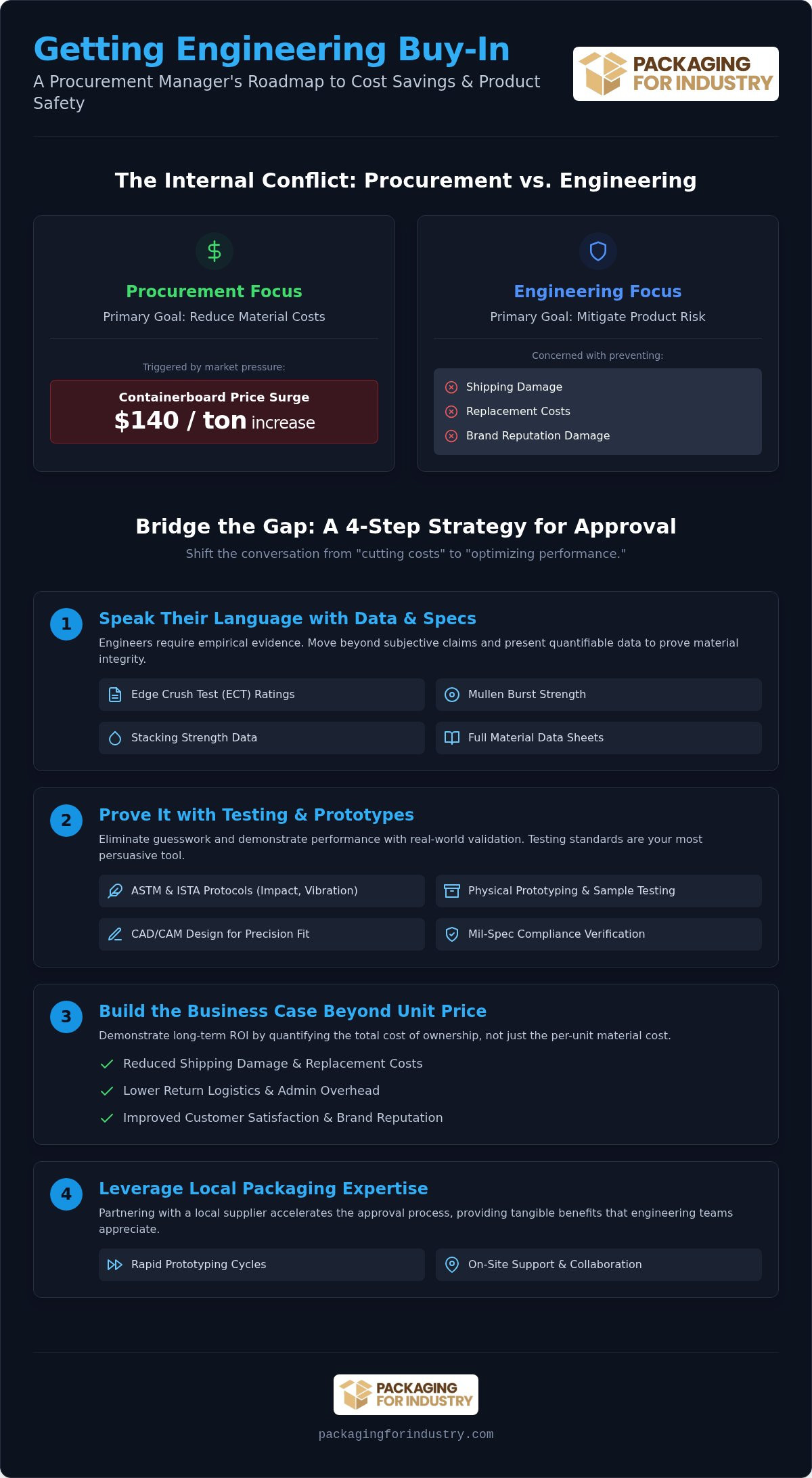
The friction between procurement goals and engineering requirements is a standard hurdle in industrial manufacturing. While a purchasing manager focuses on the rising cost of raw materials, such as the $140 per ton increase in containerboard seen in July 2026, an engineer focuses on the physical integrity of the product. This creates a fundamental disconnect. To understand how to get engineering buy-in on a packaging material change, you must first acknowledge that for an engineer, the cost of a packaging failure far outweighs the savings of a cheaper material.
Engineers are trained to prioritize reliability. If a high-value component arrives at a customer site damaged, the fallout includes replacement costs, logistical delays, and damage to the brand’s reputation. This is why the “if it ain’t broke, don’t fix it” mentality prevails. They aren’t trying to be difficult; they are protecting the product. Purchasing sees a line item on a budget; Engineering sees a potential failure point that could halt a production line or void a warranty.
Common Engineering Objections to New Materials
Resistance often stems from specific technical concerns. Engineers frequently question the shock absorption capabilities of custom foam packaging when moving from a known density to a newer, potentially lighter alternative. They worry about structural integrity. Will a thinner corrugated board withstand the stacking pressures in a warehouse? In sectors like aerospace or medical devices, any change introduces variables into a validated supply chain. These fears are rooted in the reality of transit environments where vibration and impact are constant threats. They also worry about compliance. If a material change impacts ESD protection or moisture barriers, the entire product integrity is at risk.
The Role of Risk Mitigation in the Buy-In Process
Risk mitigation is the primary language of the engineering department. They design for the worst-case scenario, not the average day in the warehouse. To bridge the gap, procurement must treat the transition as a formal change management process rather than a simple vendor swap. This involves documenting the reason for the change, identifying potential risks, and outlining a clear plan for validation.
Validating a new packaging manufacturer early helps build trust. Instead of leading with price, lead with protection. Show how the new material meets or exceeds current ASTM or ISTA testing standards. When you demonstrate that you’ve considered the engineering requirements first, you pave a smoother path for how to get engineering buy-in on a packaging material change. This approach shifts the focus from “cutting costs” to “optimizing performance,” which is a goal both departments can support. It transforms the conversation from a conflict of interests into a collaborative engineering solution.
Speaking the Language: Technical Specs and Compliance Standards
Engineers require empirical evidence to validate any shift in the supply chain. When you are presenting how to get engineering buy-in on a packaging material change, you must move beyond subjective descriptions. Use Mullen burst strength and Edge Crush Test (ECT) ratings to define the structural boundaries of the proposed solution. If you’re currently using standard single-wall containers, presenting data on heavy duty, double wall, or triple wall corrugated boxes allows the technical team to evaluate stacking strength and puncture resistance against known variables. This technical approach is essential for products with high mass or irregular dimensions that demand superior compression strength.
Testing standards are your most persuasive tool. Cite specific ASTM and ISTA protocols for impact, vibration, and compression to prove the new material’s durability. For defense contractors, addressing mil-spec packaging requirements is non-negotiable. Proving that a transition maintains compliance with MIL-STD-2073 ensures that the change won’t jeopardize government contracts or audit results. You can request a packaging quote that includes full material data sheets to facilitate these internal reviews.
Mapping Material Performance to Product Fragility
Mapping material performance to the product’s G-factor is a critical part of the technical case. Different materials handle deceleration differently. For instance, sensitive electronics often require the soft, open-cell structure of polyurethane (PU) foam for high-frequency vibration dampening. Conversely, heavier industrial components might need the rigid, closed-cell protection of polyethylene (PE). Use this data to show that custom corrugated boxes can be engineered with specific foam densities to meet or exceed the protection levels of your current pack-out.
Compliance and Regulatory Hurdles
Technical buy-in also hinges on environmental compliance. If you’re shipping electronics, materials must meet Electrostatic Discharge (ESD) requirements to prevent latent defects. Medical and aerospace components frequently require cleanroom-compatible substrates that won’t introduce particulates. Additionally, for international logistics, all wood components must meet ISPM 15 heat-treatment standards. Documenting these compliance points within your Quality Management System (QMS) provides the traceability engineers need to approve the change confidently. This transforms the conversation from a simple vendor swap into a documented engineering improvement.
Prototyping and Testing: The Shortest Path to Approval
Physical evidence is the most effective tool to eliminate internal resistance. While technical data sheets provide a foundation, putting a physical sample in an engineer’s hands removes the remaining guesswork. This hands-on approach is a critical component of how to get engineering buy-in on a packaging material change. It allows the technical team to verify fit, feel, and function in real-time. By leveraging CAD/CAM design support, you can demonstrate exactly how new materials will interface with complex, high-value parts without the risk of a full-scale rollout failure.
Requesting a custom design packaging review from your supplier helps identify potential failure points before they reach the production floor. This proactive design phase often includes 3D renderings that allow engineers to visualize the protective envelope around their product. Once the design is finalized, performing a physical drop test on the prototype provides the empirical proof needed to validate the material’s performance under stress. It moves the conversation from theory to reality.
The 5-Step Prototyping Workflow
A structured approach ensures that the engineering team feels included and informed throughout the transition. Follow this workflow to streamline the approval process:
- 1. Share specifications: Provide product dimensions, weights, and fragility ratings to the designer.
- 2. Review CAD drawings: Analyze 3D renderings to catch initial design flaws early in the process.
- 3. Order a prototype: Request a physical sample to test material tactile properties and assembly speed.
- 4. Conduct fit testing: Perform in-house function tests with the engineering team to ensure a precision fit.
- 5. Refine the design: Use real-world feedback to make final adjustments before committing to bulk production.
Bridging the Gap with Custom Foam Inserts
The debate between maximum protection and warehouse space is common. Custom foam inserts solve this by optimizing the protective footprint. Using prototypes, you can show how integrated foam and corrugated solutions reduce kitting time and simplify the pack-out process for warehouse staff. Visualizing the final assembly ensures that the system is error-proof, which is a significant factor in how to get engineering buy-in on a packaging material change. When the process is easy for the operations team and safe for the product, engineering resistance usually disappears.
Building the Business Case: Beyond the Unit Price
While the technical team focuses on G-factors and structural integrity, the executive board requires a financial justification that accounts for the total landed cost. Success in how to get engineering buy-in on a packaging material change depends on your ability to prove that a new material isn’t just technically sound but economically superior. As a leading bulk packaging supplier, we help manufacturers move beyond the simple “cost per box” metric to analyze variables like transit damage, storage overhead, and labor efficiency. This holistic approach transforms a technical proposal into a compelling business strategy.
Shipping damage is a silent profit killer that often goes unquantified during material reviews. When you calculate the cost of replacement parts, expedited shipping for returns, and lost customer trust, the ROI of a superior packaging design becomes clear. Furthermore, optimizing the footprint of your shipment helps you avoid expensive dimensional (DIM) weight surcharges from major carriers. If you are searching for a reliable industrial packaging supplier near me, you need a partner who can provide the data necessary to justify these transitions to both the board and the engineering lab.
Efficiency Gains for the Warehouse Team
Hidden labor costs often undermine the perceived savings of cheap, generic packaging. Utilizing packaging kitting services allows your team to receive pre-assembled sets, which significantly reduces pack-out time on the production floor. This operational shift simplifies the assembly process and ensures that the engineering team’s design is executed perfectly every time. Additionally, implementing Vendor Managed Inventory (VMI) and Just-In-Time (JIT) delivery programs frees up valuable warehouse space. By reducing the amount of cash tied up in bulk inventory, you improve the company’s liquidity while maintaining the steady flow of materials required for high-volume manufacturing.
Environmental and Sustainability Buy-In
Sustainability mandates are no longer just a marketing preference; they are a corporate requirement that can assist in how to get engineering buy-in on a packaging material change. Modern substrates allow you to switch to curbside-recyclable corrugated materials without sacrificing the structural strength required for heavy industrial parts. Lighter, more efficient material choices also reduce your overall carbon footprint by maximizing trailer space and reducing fuel consumption. By aligning environmental goals with engineering requirements, you create a dual-purpose case that satisfies both technical standards and corporate social responsibility targets. This strategic alignment often provides the final validation needed to move a project from the design phase to full-scale production.
Partnering with a Southern California Packaging Expert for a Seamless Transition
Proximity is a strategic advantage when determining how to get engineering buy-in on a packaging material change. As a premier Los Angeles packaging supplier, PFI provides the rapid response times required for complex industrial projects. Local manufacturing in Anaheim and Orange County allows your team to participate in live design sessions and receive physical prototypes in a fraction of the time required by distant vendors. This hands-on collaboration ensures that every custom foam insert and corrugated design meets the rigid tolerances your technical staff expects. Faster iteration cycles mean you can compare packaging pricing and performance in real-time, moving from CAD renderings to production-ready samples without logistical delays.
Industrial Packaging Solutions and Industries Served
PFI is a leading bulk packaging supplier providing high-performance materials for the most demanding environments. Our product lineup includes custom heavy duty, double wall, and triple wall corrugated boxes designed for maximum stacking strength. We also specialize in protective foam packaging, including PE, PU, and ESD inserts to mitigate shock and vibration for sensitive electronics. Whether you need a Riverside packaging supplier for medical device protection or custom boxes in San Diego, we have the manufacturing capacity to deliver high-volume orders with precision.
Our expertise extends across specialized sectors including aerospace, medical, electronics, and food companies. We understand the unique compliance standards of each industry and provide the technical data needed to lower packaging costs without compromising safety. From military-spec packaging to high-volume stretch film and mailing tubes, we support your entire supply chain with precision-engineered solutions that reduce shipping damage.
Why Choose PFI?
When searching for an industrial packaging supplier near me, manufacturers choose PFI for our intersection of engineering expertise and operational efficiency. As a trusted Inland Empire packaging supplier, we act as a technical partner rather than just a box vendor. Our value-added services provide tangible benefits for your operations:
- Free Prototyping: We provide CAD/CAM design and physical samples for all custom designs to ensure a perfect fit before bulk production.
- Operational Efficiency: Our Vendor Managed Inventory (VMI) and Just-In-Time (JIT) programs optimize your warehouse floor space and reduce carrying costs.
- Comprehensive Kitting: We offer packaging kitting services to deliver pre-assembled sets directly to your production line.
- Nationwide Shipping: While we are local to Southern California, our nationwide capabilities ensure your distribution centers remain supplied across the country.
Initiating a review is straightforward. We invite you to visit our facility for a design consultation or provide your product dimensions for a custom packaging quote. Our team is ready to help you build the technical case required to secure engineering approval and improve your supply chain reliability.
Optimize Your Industrial Packaging Strategy with Technical Precision
Winning over an engineering team requires a shift from discussing unit costs to demonstrating technical reliability. By focusing on ASTM testing standards, physical prototypes, and precision CAD/CAM design, you remove the risk factors that cause internal resistance. We’ve shown that understanding how to get engineering buy-in on a packaging material change is a matter of aligning procurement’s fiscal goals with engineering’s demand for product safety.
PFI serves as your technical partner in this transition. We specialize in custom engineering for high-stakes industries like aerospace and medical, ensuring your high-value components remain protected throughout the supply chain. With our Southern California local delivery and nationwide shipping capabilities, you maintain reliability regardless of your facility’s location.
Take the first step toward lower packaging costs and reduced shipping damage. Our team is ready to provide the free prototyping and engineering support you need to secure internal approval and streamline your operations.
Frequently Asked Questions
How do I start a conversation with Engineering about changing materials?
Start the conversation by focusing on performance improvements or risk reduction rather than purely financial gains. Engineers prioritize product integrity. Present the potential change as a way to enhance protection or streamline the assembly process. This approach is the most effective way for how to get engineering buy-in on a packaging material change because it aligns with their primary objective of preventing damage.
What data do engineers typically need to approve a packaging change?
Engineers require technical documentation like material data sheets and certified testing results. Be prepared to provide Edge Crush Test (ECT) ratings, Mullen burst strength, and material density measurements. They will also look for evidence of compliance with standards like ASTM D4169 for shipping containers. Providing this data upfront demonstrates that the new material meets the necessary performance thresholds for your specific application.
Can custom corrugated boxes really save as much money as they say?
Savings from custom corrugated boxes come from optimized dimensions and reduced material waste. By tailoring the box to the product, you reduce the dimensional (DIM) weight, which lowers freight costs from carriers like UPS and FedEx. Additionally, a precision fit reduces the need for excessive internal cushioning. These operational efficiencies often result in a lower total landed cost compared to using standard stock sizes.
How long does the prototyping process usually take for industrial packaging?
The prototyping timeline depends on the complexity of the design and the proximity of your supplier. Local experts in Southern California can often deliver physical samples within a few business days. Utilizing CAD/CAM design support allows for rapid adjustments based on initial feedback. This speed is critical for keeping your project on schedule while ensuring the engineering team has a physical part to validate.
Is it possible to switch from plastic foam to more sustainable materials?
Transitioning to sustainable materials is possible if the alternative substrate matches the required protection levels. Many manufacturers are moving toward curbside-recyclable corrugated inserts that provide similar shock absorption to plastic foams. We can help you analyze the G-factor requirements of your product to determine if a fiber-based solution is a viable replacement for traditional polyethylene or polyurethane foam.
What if my product is highly sensitive to ESD or vibration?
Highly sensitive products require specialized protective materials like ESD-safe foam or high-dampening polyurethane. If your components are prone to vibration damage, you must select materials with the correct cell structure to absorb high-frequency energy. We use technical data to show how to get engineering buy-in on a packaging material change by proving that the new solution maintains or improves the current level of electrostatic and shock protection.
How does a VMI program help with engineering buy-in?
A Vendor Managed Inventory (VMI) program builds trust by ensuring material consistency and supply chain reliability. Engineers often resist changes because they fear new suppliers might have variable quality or lead time issues. VMI guarantees that the approved, high-spec materials are always in stock. This reliability eliminates the professional stress of potential production shutdowns due to packaging shortages or inconsistent material performance.
Do I need to re-validate my shipping process if I change the box size?
Re-validation is typically necessary if the dimensions or material properties change significantly. Even a small adjustment in box size can alter how the internal cushioning performs during an impact. In specialized sectors like aerospace or medical manufacturing, documenting this validation is part of your quality management system. Performing a new drop test or vibration study ensures that the optimized design still protects the product under worst-case transit conditions.