
Did you know that the fully loaded cost of a single shipping damage incident often reaches five times the raw value of the product? While your warehouse team sees the wreckage of a failed shipment, leadership often only sees the price-per-unit of a corrugated box. If you’re finding it difficult getting management approval for packaging investment, it’s usually because the proposal hasn’t been framed in the language of the CFO. It’s a common frustration for operations managers who know that cheap materials are actually driving up total landed costs through carrier surcharges and replacement labor.
At Packaging For Industry (PFI), we specialize in helping manufacturers move beyond the unit-price mentality to focus on Total Cost of Ownership. This article provides the framework you need to build a bulletproof business case that secures the budget you require. We’ll show you how to demonstrate clear ROI by focusing on damage reduction, carrier DIM weight optimization, and reclaiming expensive floor space. With industrial warehouse rates in Southern California reaching over $20 per square foot, your packaging strategy must be an economic one. You’ll learn how to present a risk-mitigation strategy that transforms packaging from a line-item expense into a competitive advantage for your supply chain.
Key Takeaways
- Shift the internal conversation from simple unit pricing to a Total Cost of Ownership (TCO) model that aligns with executive financial goals.
- Quantify the fully loaded cost of shipping damage, which often reaches five times the raw product value, to justify investments in high-quality protective materials.
- Master the data-driven framework for getting management approval for packaging investment by demonstrating clear savings in dimensional weight (DIM) and carrier surcharges.
- Utilize free prototyping and engineering analysis to present a risk-free proof of concept to leadership before committing to a large-scale rollout.
- Leverage local Southern California delivery and vendor-managed inventory (VMI) programs to reclaim expensive warehouse floor space and improve overall supply reliability.
Why Getting Management Approval for Packaging Investment Requires a Business-First Approach
Securing budget for operational upgrades is rarely about the physical product itself. Executives at manufacturing and distribution firms focus on risk mitigation and financial optimization. If you’re struggling with getting management approval for packaging investment, it’s likely because the proposal emphasizes “better boxes” instead of “better margins.” Leadership sees packaging as a consumable expense to be minimized, while operations teams see it as a critical tool for protection. Bridging this gap requires a shift in language.
Successful proposals identify the stakeholders early. The Finance team cares about ROI and cash flow. Operations focuses on throughput and warehouse efficiency. Sales and Marketing prioritize brand reputation and customer retention. By aligning your packaging needs with these diverse goals, you move the conversation away from procurement and toward strategic investment.
Moving Beyond the Price-Per-Unit Mentality
Focusing purely on the invoice price of a corrugated box is a tactical error. This narrow view ignores the secondary costs that accumulate when materials fail to perform. Total Cost of Ownership (TCO) is the sum of material, labor, damage, and freight costs. When you buy the cheapest possible supplies from mass-market distributors, you often pay the difference in shipping damage claims, which can cost two to five times the original product value.
To win over leadership, you must present a formal business case framework that highlights these hidden expenses. High damage rates don’t just cost money; they erode customer trust. A single damaged shipment to a major aerospace or medical client can jeopardize a multi-million dollar contract. Quality packaging is an insurance policy for your brand’s reputation.
Identifying Management’s Hidden Pain Points
Operations executives are currently battling historic warehouse lease rates. In Southern California hubs like Anaheim and Los Angeles, industrial space can cost between $12 and $22 per square foot. Cluttering this expensive real estate with obsolete stock or oversized boxes is a massive drain on resources. Getting management approval for packaging investment becomes much easier when you show how vendor managed inventory (VMI) can reclaim floor space and improve working capital.
Labor is another critical bottleneck. If your team spends excessive time on complex kitting or applying layers of void fill to compensate for poor box sizing, you’re wasting man-hours. Partnering with an industrial packaging supplier like PFI allows you to treat packaging as a strategic asset. We act as consultants to identify where engineered foam packaging or custom inserts can slash assembly time and prevent production stops, ensuring your supply chain remains reliable and cost-effective.
Quantifying the ROI: Metrics That Win Over Finance and Operations
Proving value to Finance requires moving beyond anecdotal evidence. Leadership needs hard data to justify any shift in procurement. When you’re getting management approval for packaging investment, your proposal should focus on two primary financial levers: cost avoidance and operational throughput. While a stock box might seem like a bargain during the initial purchase, the hidden surcharges applied by carriers and the compounding costs of transit failure often negate those initial savings.
The True Cost of Shipping Damage
The invoice value of a broken product is only the tip of the iceberg. Industry data suggests the fully loaded cost of a single shipping damage incident typically runs 2x to 5x the raw product value. This includes replacement goods, expedited freight, customer service labor, and reverse logistics. To build your case, use this simple formula: Total Damage Loss = (Number of Returns x Replacement Value) + (Labor Hours x Rate) + Freight Fees.
Implementing custom foam packaging targets the root cause of these losses. Engineered inserts eliminate internal movement and provide calibrated cushioning for sensitive electronics or aerospace components. This precision reduces return rates and protects the lifetime value of your customers. High-risk industrial goods often see damage rates drop significantly when moving from generic void fill to engineered protection.
Optimizing for Freight: Reducing Dimensional Weight Surcharges
Carriers like UPS and FedEx bill based on whichever is greater: actual weight or dimensional (DIM) weight. With a standard DIM divisor of 139, even a few inches of wasted space can lead to massive freight bill inflation. For example, trimming just two inches off each dimension of a large carton can reduce billable weight by over 25%. Right-sizing your corrugated boxes ensures you aren’t paying to ship air.
Beyond DIM weight, oversized packaging often triggers an Additional Handling Surcharge (AHS) if the volume exceeds 6 cubic feet. These fees range from $26 to over $59 per parcel. For heavy machinery or large assemblies, custom crates and heavy-duty triple-wall boxes maximize pallet density and ensure stackability. A strategic shift toward domestic and regional supplier sourcing provides the agility needed to adjust packaging specs as carrier rules change, directly impacting your freight ROI.
Labor efficiency is the final metric. Custom inserts allow for a “drop and ship” workflow, eliminating the time-consuming process of hand-wrapping items in bubble wrap. This reduces pack-line labor costs and increases daily output. To see the specific impact on your bottom line, you can compare packaging pricing based on your current freight and labor spend.
How to Build a Compelling Business Case for Custom Packaging Solutions
Management often views customization as an unnecessary premium. However, custom design packaging is actually a precision tool for cost control. When getting management approval for packaging investment, you must demonstrate that custom solutions solve specific engineering hurdles that catalog items cannot. Whether it’s a fragile aerospace assembly or a medical device with strict requirements, a custom-engineered box or foam insert ensures the product arrives intact. This precision eliminates the “trial and error” costs associated with generic supplies.
De-risking the Investment with Free Prototyping
One of the biggest barriers to project approval is the fear of a failed rollout. We eliminate this risk by providing comprehensive CAD/CAM support and physical samples before you commit to a full production run. This “proof of concept” allows your warehouse and production teams to handle the packaging and verify the fit in real-world conditions. In sectors like aerospace and military manufacturing, where tolerances are tight, prototypes prevent expensive errors. PFI offers these prototyping services because we believe your leadership should have total confidence in the solution before signing off on the budget.
Improving Cash Flow with VMI and Just-In-Time Programs
Traditional procurement often relies on bulk-buying to achieve a lower unit price, but this ties up significant capital in “safety stock.” A more efficient approach is Vendor Managed Inventory (VMI). By transitioning to just-in-time inventory, you only pay for what you need when you need it. This significantly improves working capital by reducing the amount of cash sitting on your warehouse floor as unused material.
This shift is particularly valuable for businesses in Southern California. With warehouse lease rates in Anaheim and Orange County reaching historic highs, reclaiming floor space is equivalent to direct revenue. Our VMI programs allow you to:
- Free up pallet positions for finished goods rather than empty packaging.
- Eliminate the administrative burden of tracking stock levels and placing manual orders.
- Avoid emergency rush orders that disrupt production throughput and shipping schedules.
- Improve overall supply reliability by having a local partner manage your safety stock levels.
Our local delivery fleet provides next-day service across Southern California, ensuring your lean operations never experience a stockout. By presenting packaging as a cash-flow optimization strategy, getting management approval for packaging investment becomes a logical financial decision for the executive team. We help you move from a reactive purchasing model to a proactive, managed system that supports long-term growth.
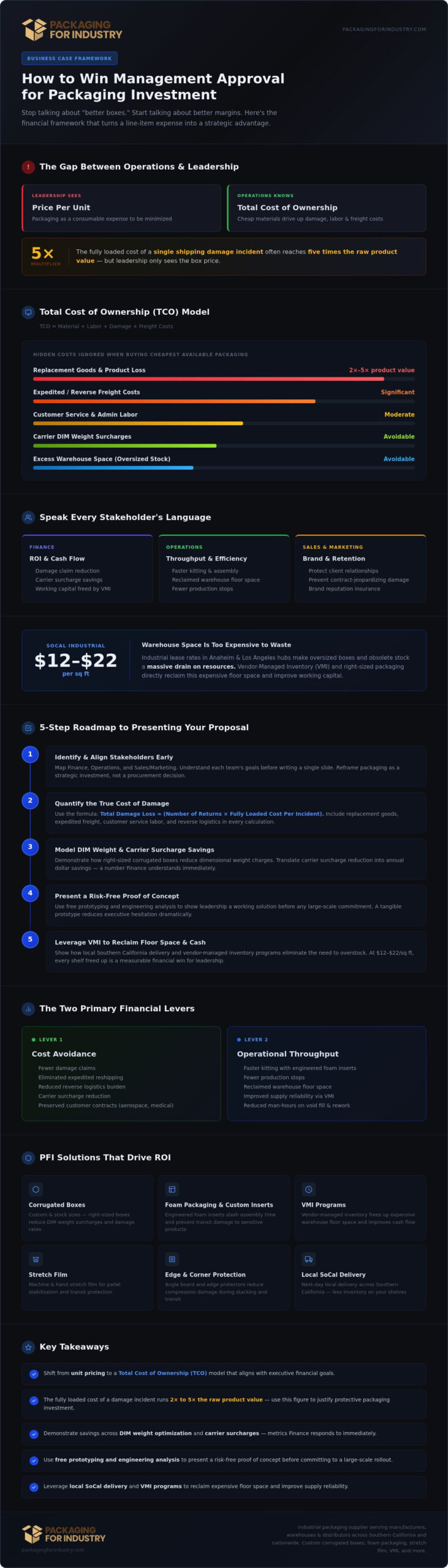
A 5-Step Roadmap to Presenting Your Packaging Proposal
Successful procurement isn’t just about finding a lower price; it’s about demonstrating a superior operational strategy. If you’ve laid the groundwork by understanding Total Cost of Ownership and ROI metrics, you’re ready to formalize your case. Use this structured roadmap to streamline the process of getting management approval for packaging investment and ensure your proposal addresses the specific concerns of every executive stakeholder.
Step 1 & 2: Gathering the Data and Finding a Partner
Begin by auditing your current shipping performance over a 30-day period. Document every instance of transit damage, including the labor time spent processing returns and the freight surcharges appearing on your carrier invoices. This data creates a baseline for your “cost of doing nothing” argument. You should request a detailed packaging review from your supplier to uncover hidden costs that standard procurement audits often overlook. This diagnostic phase identifies where stock boxes are failing your specific product lines.
Early in this process, you should request a packaging quote from a specialized manufacturer. It’s critical to partner with a supplier that understands the technical requirements of your industry, whether you’re shipping sensitive electronics or heavy aerospace components. A partner with engineering expertise can help you translate warehouse pain points into quantifiable financial savings, making your proposal far more persuasive to the finance team.
Step 4 & 5: The Final Pitch and Closing the Deal
Your executive summary must be tailored to the specific priorities of your audience. When speaking to a CFO, emphasize cash flow improvements, the reduction of dimensional weight surcharges, and the mitigation of liability. When presenting to an Operations Director, focus on warehouse throughput, the reclamation of floor space through VMI, and the elimination of pack-line bottlenecks. Visual aids are highly effective here. Contrast photos of damaged shipments in generic boxes with clean, professional prototypes that demonstrate engineered protection.
Finally, emphasize the “safety net” provided by a local Southern California packaging supplier. For businesses in Anaheim, Orange County, or Los Angeles, the speed of local next-day delivery is a massive risk-mitigation factor. It allows you to maintain lean inventory levels without the fear of stockouts or long lead times from national distributors. By highlighting how a local partnership stabilizes the supply chain, you provide the final reassurance management needs to approve the investment. This structured approach proves that your proposal isn’t just an expense, but a calculated move toward a more reliable and profitable operation.
Why Partnering with a Local Industrial Packaging Supplier is the Logical Conclusion
The final hurdle in getting management approval for packaging investment is proving that your chosen partner can execute the strategy reliably. While national catalog distributors offer convenience, they often lack the specialized engineering expertise required for complex industrial applications. Partnering with a local manufacturer allows you to transition from a generic purchasing model to a high-performance supply chain. This shift eliminates the hidden costs of shipping empty air and provides the technical support needed for demanding sectors like aerospace and defense.
Southern California’s Local Advantage
Proximity is a powerful economic driver in packaging logistics. When you source from a national distributor, you’re often paying significant freight costs just to move empty custom corrugated boxes from a distant warehouse. By working with a local Anaheim packaging supplier, those freight expenses are minimized. Our fleet provides next-day delivery across Orange County, Los Angeles, and Irvine, ensuring your production lines never stall due to lead-time delays.
Local partnership also enables on-site collaboration that national giants cannot match. We can perform physical inventory reviews at your facility to identify kitting bottlenecks or oversized containers that trigger surcharges. For companies requiring military packaging or aerospace-grade protection, this hands-on approach is vital. We ensure every component meets strict Mil-Spec standards before the first production run begins. Packaging For Industry (PFI) serves as a cost-saving alternative to mass-market distributors by providing custom-engineered solutions without the high-margin retail markups.
Next Steps: Finalizing Your Business Case
Securing budget approval requires a professional, data-driven presentation. To move forward, gather your current shipping data and document the frequency of transit damage as outlined in the previous steps. Use the metrics we’ve discussed-Total Cost of Ownership, DIM weight savings, and reclaimed warehouse space-to build your narrative. Management will respond to a proposal that proactively reduces risk while improving the bottom line. PFI supports this process by offering both custom and stock solutions to fit any budgetary constraint.
Your business case is now complete. You’ve identified the stakeholders, quantified the ROI, and established a roadmap for implementation. The final step is to validate your findings with actual pricing and technical specifications. A regional partner provides the agility you need to adapt to changing carrier rules and production demands without sacrificing quality or protection.
Modernize Your Logistics Strategy for Long-Term ROI. Mastering the process of getting management approval for packaging investment requires a shift from procurement tactics to financial strategy. By highlighting the Total Cost of Ownership and the compounding expenses of transit damage, you transform packaging into a vital tool for risk mitigation. You now have the framework to quantify freight savings and leverage VMI programs to reclaim expensive warehouse floor space in Southern California. Partnering with a specialist like PFI de-risks this transition through free prototyping and CAD/CAM support, ensuring a perfect fit for aerospace or industrial components before you commit to a full rollout. Our local next-day delivery fleet across Anaheim and Orange County provides the agility your supply chain needs to stay competitive. You’ve built the roadmap; now it’s time to present a bulletproof business case that leadership can’t ignore.
Take the first step toward a more reliable and efficient shipping operation today. We’re ready to help you build the data-driven case your management team needs to see to approve your next project.
Frequently Asked Questions
What is the most common reason management denies packaging investments?
Management often views these requests as discretionary spending rather than operational necessity. If your current bulk packaging supplier only provides off-the-shelf items, leadership likely assumes costs are already minimized. To shift this perspective, you must demonstrate how standardized materials are actually inflating your total landed cost. Presenting a comparison between stock prices and engineered savings is the most effective way of getting management approval for packaging investment.
How do I calculate the ROI of switching to custom foam inserts?
Start by requesting a foam packaging quote to establish a baseline for material costs. Compare this to your documented “cost of failure,” which includes replacement product value, reverse logistics, and the labor required for repackaging. When you factor in the reduction of transit damage for high-value aerospace or electronics components, the ROI becomes clear. This data-driven approach proves that engineered protection is a financial gain, not a cost increase.
Can right-sizing my corrugated boxes really lower my freight costs?
Right-sizing is the primary defense against dimensional (DIM) weight penalties. When you request a corrugated box quote for custom dimensions, you ensure your parcels aren’t being billed at the 139 divisor for empty space. This strategy also helps you avoid the cubic volume surcharges that carriers apply to oversized items. For high-volume shippers in Southern California, these freight savings often far outweigh the minor cost difference of custom-sized corrugated.
Why should I choose an industrial packaging supplier near me?
Selecting an industrial packaging supplier near me provides logistical agility that national distributors cannot match. Local partners in Anaheim or Orange County offer next-day delivery, which is essential for maintaining lean inventory levels and preventing production stockouts. A packaging distributor near me can also perform on-site audits to identify bottlenecks in your kitting process, helping you build a stronger business case for operational improvements that management can physically verify.
What data do I need to prepare before presenting a packaging proposal to my CFO?
Your CFO will require a custom packaging quote that highlights cost-avoidance metrics rather than just unit pricing. Prepare a 30-day snapshot of your current damage rates, freight surcharges, and labor hours spent on manual wrapping. Showing how a specialized custom box manufacturer can automate protection or reduce DIM weight provides the financial justification leadership needs. This data transforms your request into a risk-mitigation strategy that aligns with corporate fiscal goals.
How can I justify the cost of high-performance stretch wrap or tubes?
Request a stretch film quote or a mailing tube quote to evaluate the performance of industrial-grade materials against standard catalog options. High-performance films often allow for lower gauge thickness with higher containment strength, reducing material waste. Similarly, heavy-duty mailing tubes prevent crushing for sensitive roll goods. Demonstrating that these materials prevent expensive replacement cost multipliers is a powerful argument for getting management approval for packaging investment in higher-quality supplies.
How does free prototyping help in getting management approval?
Prototyping serves as a physical proof of concept that removes technical uncertainty from the decision-making process. By providing your production team with samples of custom crates or foam inserts, you can verify fit and durability before any capital is committed. This “test-drive” allows management to see the solution in action, effectively de-risking the investment and proving that the proposed changes will integrate seamlessly with your current warehouse workflows.
Is custom industrial packaging more expensive than stock shipping supplies?
The initial unit price for custom solutions may be slightly higher, but the total landed cost is typically lower. Stock supplies often require excessive secondary void fill and more labor-intensive packing methods. By contrast, custom-engineered solutions streamline the pack-line and eliminate the wasted space that triggers carrier penalties. When you look at the entire lifecycle of the package, custom designs provide a superior financial return by protecting high-margin industrial products.