
A single design “optimization” can inadvertently halt an entire production line if the transition isn’t managed with engineering precision. Most operations managers recognize that updating specifications is essential for long-term cost reduction, yet they often dread the hidden tooling fees and the spike in shipping damage that can follow a poorly executed rollout. Learning how to manage packaging design changes with a supplier requires more than just a new CAD drawing; it demands a synchronized logistical strategy that protects your bottom line.
You can master the technical and logistical steps of updating your industrial packaging specs without disrupting your production schedule or increasing your total cost of ownership. This guide provides a professional roadmap for transitioning from legacy designs to high-performance solutions. We’ll explore how to leverage custom prototyping and Vendor Managed Inventory (VMI) to ensure your supply of RSC boxes or protective foam remains constant. Whether you’re operating in Orange County or managing a nationwide distribution network, these steps will help you achieve a seamless transition while reducing damage rates through better engineering.
Key Takeaways
- Learn to identify critical design triggers by analyzing structural failures in current corrugated boxes and changes in product footprints.
- Discover how to manage packaging design changes with a supplier by leveraging CAD/CAM engineering and free prototyping to ensure precision before full-scale production.
- Prevent production downtime and minimize waste through a structured “phase-in, phase-out” inventory strategy supported by Vendor Managed Inventory (VMI).
- Optimize your total cost of ownership by selecting the ideal corrugated wall thickness and foam density to balance protection with shipping efficiency.
- Utilize the geographic advantage of a local Southern California supplier to accelerate design feedback loops and resolve carrier-specific surcharge issues.
Identifying the Triggers for Packaging Design Changes
Industrial packaging is not static. It must evolve alongside your product line and the volatile logistics market. Recognizing these triggers early is the first step in learning how to manage packaging design changes with a supplier effectively. If you wait until a production halt or a spike in freight costs to act, you’re already losing margin. Pragmatic managers look for specific indicators that their current specs no longer serve the bottom line.
When Product Redesigns Force Packaging Updates
A new product iteration often brings shifts in weight distribution, center of gravity, or surface sensitivity. If you’re shipping heavy industrial components, a slight change in a casting’s dimensions can render your current corrugated boxes inadequate. Forcing a new part into an old box creates “void space” that allows the item to shift during transit. This movement is the primary cause of structural failures in RSC boxes and increasing damage rates.
Sensitive electronics and medical devices require even more precision. An update to a circuit board layout might necessitate redesigned protective foam packaging with specific ESD (electrostatic discharge) properties. Relying on “legacy” foam inserts for new hardware often results in cracked housings or internal component failure. You should audit your protective footprint whenever a product’s bill of materials changes to ensure the engineering still matches the risk profile.
Economic Triggers: Surcharges and Material Costs
Logistics costs are frequently the loudest trigger for a design change. Major carriers like UPS and FedEx regularly update their dimensional weight (DIM) formulas. If your current packaging is 30% larger than the product it holds, you’re paying for air. Transitioning from standard stock sizes to custom-engineered solutions allows you to “right-size” your shipments. This optimization is a core component of packaging cost savings, as it eliminates oversized fees and reduces the amount of stretch film and dunnage required per pallet.
Market shifts also dictate when to move from expensive catalog items to custom bulk orders. When your volume increases, the per-unit cost of a generic stock box becomes a liability. You can often lower your total cost of ownership by switching to a custom-engineered design that uses less material but offers superior protection. We recommend that you request a packaging quote whenever your freight invoices show a consistent pattern of DIM weight surcharges or when your production volume scales beyond the efficiency of “off-the-shelf” supplies.
Common triggers to monitor include:
- Repeated corner crush or joint failures in damage reports.
- New carrier surcharges for “non-standard” or “oversized” dimensions.
- Increased material waste on the packing line due to poorly fitting inserts.
- A shift from domestic shipping to more rigorous international transit lanes.
The Technical Process of Managing Design Specs
Success in industrial shipping depends on technical precision. When you’re figuring out how to manage packaging design changes with a supplier, the transition starts with engineering data rather than just sketches. You need to define specific technical requirements early to avoid costly revisions later. This proactive approach prevents the “trial and error” phase that often leads to increased costs and shipping failures.
These requirements typically include:
- Static and dynamic load-bearing capacities for heavy components.
- G-force sensitivity ratings for electronics or medical devices.
- Environmental resistance for international transit lanes.
- Stacking strength requirements for high-density warehouse storage.
CAD Design and Virtual Prototyping
Virtual modeling allows engineers to identify impact points before a single sheet of corrugated is cut. By using CAD/CAM software, we can simulate how custom design packaging integrates with complex multi-part kits. For example, a heavy industrial pump might require a combination of polyethylene foam and custom-engineered corrugated partitions. 3D modeling ensures these components lock together perfectly, preventing the internal movement that leads to shipping damage. This digital verification phase also allows for rapid iterations, helping you visualize different configurations without the lead time of physical tooling.
Verifying Performance with Physical Samples
Virtual models are essential, but physical prototyping is where the design is proven. We produce functional samples for real-world testing. For high-value aerospace or medical equipment, this often involves rigorous drop tests to meet ASTM D4169 or ISTA transit standards. This phase is critical for refining die-cut box dimensions and adjusting foam density based on warehouse handling feedback. It’s much cheaper to catch a fitment issue during prototyping than after a production run of 5,000 units. You can also use these samples to train your warehouse staff on the most efficient kitting process. If you’re currently seeing damage in your supply chain, you can compare packaging pricing for a prototype-backed solution that offers better protection.
Once the physical prototype passes inspection, the final specifications are locked. This includes creating precise die-lines for custom boxes and setting production tolerances for heavy-duty inserts. These technical documents become the blueprint for your recurring orders, ensuring that every batch meets the same standard of protection and fit. We maintain these digital records to streamline any future adjustments, making the process of how to manage packaging design changes with a supplier faster and more predictable as your product line evolves.
Inventory Transition: Avoiding Stockouts and Waste
Transitioning to a new packaging design often fails on the warehouse floor rather than the drawing board. If you have 5,000 obsolete RSC boxes and only 100 legacy products remaining, you’re looking at wasted capital and cluttered aisles. Learning how to manage packaging design changes with a supplier requires a rigorous audit of your existing materials. You must identify the “burn rate” of legacy stock to determine an exact cut-over date. This prevents the nightmare scenario of running out of packaging while your production line is still moving at full capacity.
A “Phase-In, Phase-Out” strategy is the most pragmatic approach. This involves a tiered rollout where new custom sizes are introduced only as old stock hits a predetermined critical level. It requires constant communication between your purchasing department and your supplier’s logistics team to ensure that lead times for new die-cuts or foam tooling don’t create a gap in supply. Managing this overlap correctly protects your cash flow by ensuring you don’t pay for new inventory until the old assets are fully utilized.
Leveraging VMI for Seamless Transitions
A Vendor Managed Inventory (VMI) program is the most reliable way to synchronize this change. Instead of your team guessing when to place the first order for updated specs, we conduct scheduled inventory reviews. We track your usage in real-time to ensure that new foam end caps and corrugated boxes arrive exactly as the old stock depletes. This level of oversight eliminates the risk of stockouts that often occur when lead times for custom tooling are miscalculated. It turns a complex logistical headache into a predictable, automated process.
Just-In-Time (JIT) Delivery for New Specs
Warehouse space is a premium asset, particularly in high-demand Southern California hubs like Orange County and the Inland Empire. You don’t want to double-stock two different packaging designs simultaneously. We utilize Just-In-Time (JIT) delivery to keep your floor clear. By coordinating with your production teams on specific cut-over dates, we provide local next-day delivery for the new specifications. This ensures that your warehouse only holds what is immediately necessary for the current production cycle. This precision allows you to reclaim floor space and reduce the risk of material damage during long-term storage.
To ensure a smooth inventory cut-over, follow these steps:
- Perform a physical count of all legacy corrugated and foam components.
- Establish a hard “stop date” for the production of old designs.
- Verify that all new custom tooling is tested and ready for high-volume runs.
- Communicate the new kitting instructions to your warehouse staff 48 hours before the transition.
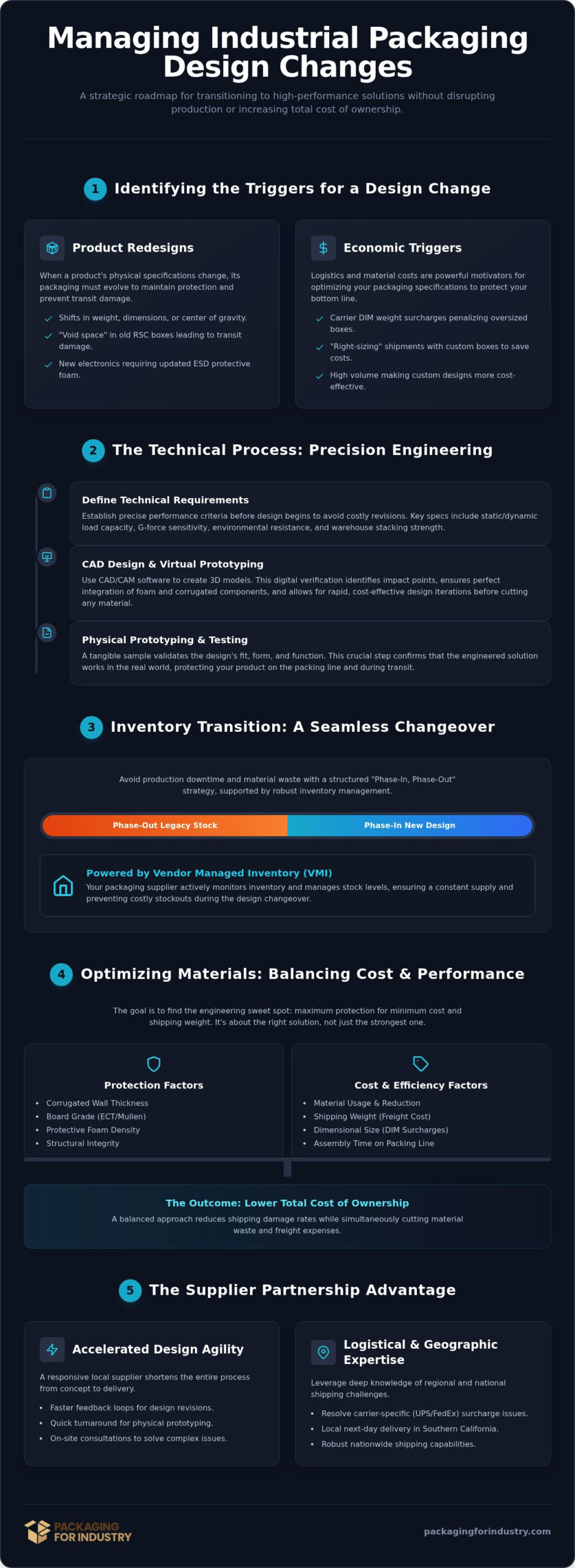
Optimizing Material Selection for Performance and Cost
Material selection is where engineering meets the bottom line. When you’re evaluating how to manage packaging design changes with a supplier, you must prioritize material density and structural integrity over simple per-unit pricing. A cheaper material that fails during transit is far more expensive than a high-performance solution that eliminates damage claims. Effective design updates balance the physical requirements of the product with the economic realities of the shipping environment.
Choosing the Correct Corrugated Grade
Selecting the right wall thickness is essential for protecting heavy industrial components. While standard single-wall corrugated box solutions work for light goods, heavy manufacturing parts often require double-wall or heavy-duty triple-wall constructions. These grades provide the stacking strength necessary for high-density warehouse environments and long-haul transit. If your products are moving through international lanes, you should also consider weather-resistant coatings to prevent moisture from compromising the box’s structural integrity. Moving from a standard RSC box to a custom die-cut design allows you to place strength exactly where it’s needed, often reducing the total amount of material used while increasing protection.
Foam Material Selection: PE vs. PU
The choice between polyethylene (PE) and polyurethane (PU) foam depends entirely on your product’s fragility and weight. Polyethylene is a closed-cell foam that offers high durability and excellent shock absorption for heavier items. It’s the standard for protective foam packaging in the aerospace and defense sectors. Polyurethane is an open-cell foam that’s softer and better suited for lightweight, highly fragile components. For electronics manufacturing, you must also specify anti-static or ESD foam inserts to prevent latent damage from electrostatic discharge. These precision materials ensure that sensitive hardware remains operational upon arrival, regardless of the handling conditions.
Beyond the primary box and foam, consider these reinforcement options:
- Corner and edge protection to prevent strap damage on palletized loads.
- Mil-spec packaging materials for defense contracts requiring specific preservation methods.
- Heavy-duty stretch film with high puncture resistance for irregular loads.
- Custom-sized mailing tubes for protecting specialized industrial blueprints or precision rods.
Engineering these materials into a unified system allows you to lower packaging costs by reducing the footprint of each shipment. This “right-sizing” approach ensures you aren’t paying to ship air or unnecessary dunnage. By integrating technical specifications with fiscal responsibility, you create a supply chain that is both resilient and cost-effective.
Partnering with a Local Supplier for Design Agility
Proximity is often the deciding factor between a smooth rollout and a production delay. When you are determining how to manage packaging design changes with a supplier, geographic distance creates friction in the prototyping phase. A local partner provides the design agility required to respond to sudden product updates or carrier rate hikes. This proximity ensures that your engineering team and your packaging supplier are synchronized, reducing the risk of miscommunication that leads to wasted tooling costs.
Rapid Feedback in Southern California
Our presence in Southern California industrial hubs, including Anaheim, Irvine, and Carson, allows for rapid on-site reviews. We don’t just look at CAD drawings; we observe your warehouse logistics in person. This hands-on approach is vital for identifying structural failures that virtual models might miss. If your current corrugated boxes are incurring heavy DIM weight surcharges from UPS or FedEx, we can engineer a right-sized solution and provide a physical sample within 24 to 48 hours. Local next-day delivery of stock supplies further ensures your production lines never stop during a design cut-over.
Integrated Solutions: Beyond the Box
Complexity increases when your products require more than just a standard box. High-value gear often necessitates Aerospace & Aviation Packaging solutions that combine heavy-duty custom crates with specialized foam-lined interiors. Managing multiple vendors for these components introduces unnecessary risk into your supply chain. We offer a “one-stop” sourcing model that integrates everything from tubes and cores to mil-spec foam. By utilizing our packaging kitting and assembly services, you receive fully assembled protective systems. This simplifies your internal logistics and ensures that every component fits the final design specification perfectly.
Working with a local industrial partner offers several strategic advantages:
- Elimination of long-distance freight costs for bulky foam and corrugated samples.
- Face-to-face engineering consultations to solve complex “un-boxable” equipment challenges.
- Immediate access to corner and edge protection to reinforce loads during design transitions.
- Faster response times for adjusting die-cut tolerances based on live assembly line feedback.
Every design change is an opportunity to lower packaging costs and improve shipping reliability. By partnering with a technical expert who understands the intersection of engineering and economics, you move beyond “off-the-shelf” limitations. We help you transition from legacy specs to high-performance, custom-engineered solutions that protect your margin. To begin your design optimization project and receive a technical review of your current specs, request a packaging quote today.
Streamline Your Industrial Packaging Transition
Mastering how to manage packaging design changes with a supplier is a matter of integrating technical precision with logistical foresight. By utilizing CAD/CAM engineering and physical prototyping, you ensure that new specs protect your product before the first high-volume production run. Synchronizing this transition through Vendor Managed Inventory (VMI) prevents the twin risks of production stockouts and obsolete material waste. These steps transform a potential operational headache into a strategic opportunity for cost reduction.
Packaging For Industry (PFI) provides the technical expertise and local Southern California support needed for these complex shifts. Our team offers free prototyping and CAD support to ensure your aerospace or industrial manufacturing components remain secure throughout the design cycle. With local next-day delivery across Orange County and Los Angeles, we help you lower packaging costs while maintaining a steady, reliable supply chain. It’s time to move beyond standard stock sizes and embrace custom-engineered protection that fits your specific operational needs.
We’re ready to help you optimize your specifications for maximum efficiency and professional peace of mind.
Frequently Asked Questions
How long does the custom packaging design process typically take?
The timeline for custom packaging design depends on the complexity of the project and the materials required. A simple adjustment to an RSC box may take only a few days, while custom-engineered foam inserts or wood crates involving CAD/CAM support typically require one to two weeks for initial design and physical prototyping. Local Southern California proximity often accelerates this cycle by allowing for faster feedback loops and on-site reviews in cities like Anaheim or Irvine.
What information should I provide to a supplier for a design change?
To ensure a precise update, provide your supplier with detailed product specifications, including exact dimensions, weight distribution, and fragility ratings. You should also share data on your current shipping methods and any specific damage reports or UPS/FedEx DIM weight surcharge issues you’ve encountered. Providing 3D CAD files of your product allows our engineering team to design custom foam packaging and corrugated partitions that lock the item securely in place, reducing the risk of transit damage.
Can I get a physical prototype before placing a bulk order?
Yes, physical prototyping is a critical step in verifying fit and performance before committing to a high-volume production run. Packaging For Industry (PFI) offers free prototyping and CAD support to ensure your custom corrugated boxes or foam end caps meet your exact requirements. This allows your operations team to perform real-world drop tests and verify kitting efficiency on the warehouse floor, preventing expensive errors during the full rollout of your new design.
How do I avoid paying for new tooling or die-cuts every time I change a design?
While custom die-cuts often require initial tooling fees, you can minimize recurring costs by “right-sizing” your design to work across multiple product lines. Utilizing modular foam inserts or adjustable corrugated partitions allows a single outer box to serve various components. However, it’s important to remember that the cost of a new die-cut is usually offset by the long-term savings gained from reduced shipping damage and the elimination of carrier oversized fees or surcharges.
What is the best way to manage old packaging inventory during a transition?
The most efficient way to manage legacy inventory is through a structured “Phase-In, Phase-Out” strategy synchronized by a Vendor Managed Inventory (VMI) program. This approach uses real-time usage data to trigger the first order of new specifications only as your old stock hits a critical minimum level. This prevents the accumulation of obsolete materials and ensures you don’t run out of packaging during the transition. It’s a pragmatic way to protect your cash flow and warehouse space.
Does a design change always mean higher packaging costs?
Not necessarily. In many cases, learning how to manage packaging design changes with a supplier leads to a lower total cost of ownership. By optimizing material selection and “right-sizing” your containers, you can reduce freight expenses and eliminate expensive dunnage. Moving from a generic catalog item to a custom-engineered bulk order often results in a lower per-unit price while simultaneously providing superior protection for high-value industrial or aerospace components that standard boxes can’t protect.
How do I know if my new packaging design meets shipping standards?
Verification is achieved through rigorous testing against established industry standards such as ASTM D4169 or ISTA transit protocols. Our engineering process includes physical drop tests and vibration dampening analysis to ensure your custom crates or heavy-duty triple-wall boxes can withstand the rigors of your specific transit lanes. This data-driven approach provides professional peace of mind and ensures your design meets the strict requirements of both domestic carriers and international export regulations for heavy industrial goods.
Can you help with mil-spec compliance for design updates?
Yes, Packaging For Industry specializes in mil-spec packaging and defense contract compliance. When you update designs for military or aerospace applications, we ensure that the materials, preservation methods, and labeling meet all necessary government specifications. This includes selecting the correct grades of moisture barrier bags, ESD foam, and heavy-duty corrugated materials. Our expertise helps you avoid the costly delays and rejections that often occur with non-compliant industrial packaging during contract fulfillment or auditing.