
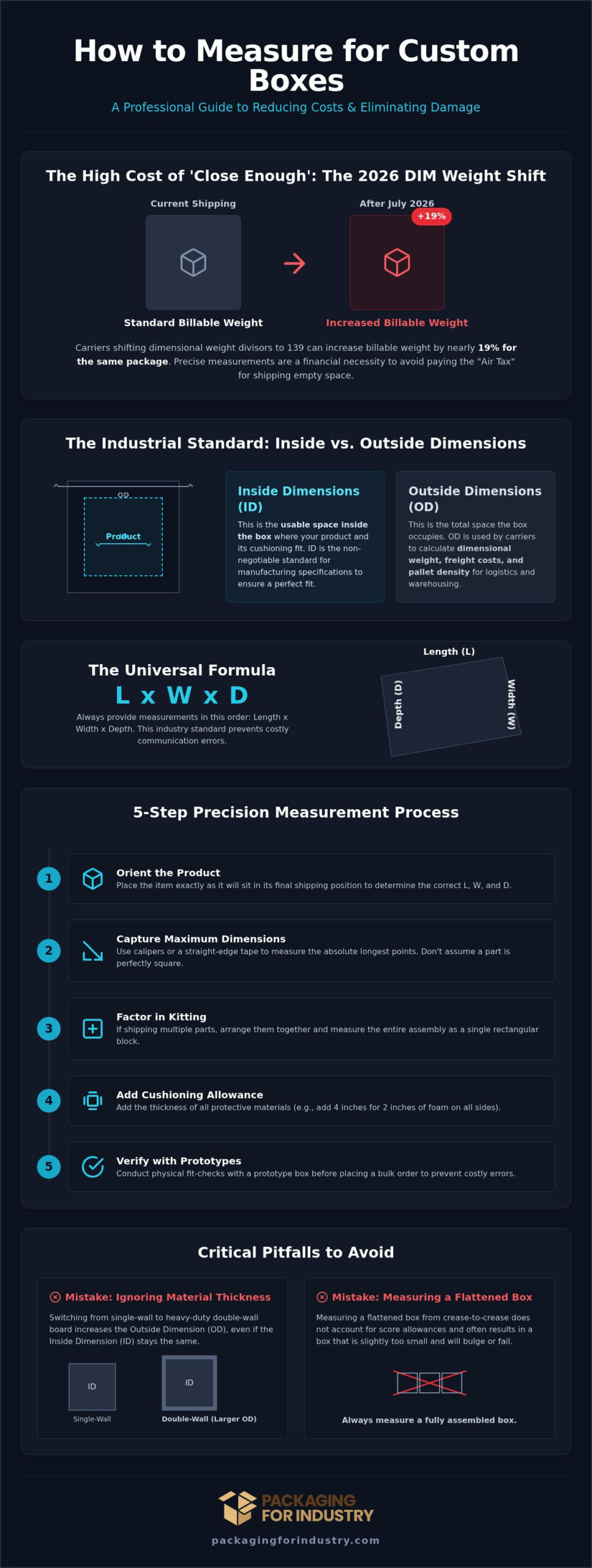
Did you know that the July 2026 shift in dimensional weight divisors to 139 can increase your billable shipping weight by nearly 19 percent for the exact same package? Learning how to measure for custom boxes with professional precision is no longer just a logistics preference; it’s a financial necessity. You likely understand the frustration of seeing products shift and sustain damage because of an oversized box, or worse, paying a premium to ship empty space. In an era where carriers round every fraction of an inch up to the next whole number, even a small measurement error directly impacts your bottom line.
Mastering these dimensions is about protecting your margins and your inventory. This guide will show you how to establish a precise measuring process that eliminates internal movement and minimizes dimensional weight surcharges. We’ll break down the critical differences between inside and outside dimensions, explain how to account for protective foam cushioning, and provide a standardized workflow your entire warehouse team can follow to ensure a perfect fit every time.
Key Takeaways
- Learn why manufacturers prioritize Inside Dimensions (ID) to ensure a precise product fit while using Outside Dimensions (OD) to calculate freight costs and pallet density.
- Master the professional 5-step process on how to measure for custom boxes to eliminate excess air and significantly reduce dimensional weight shipping surcharges.
- Account for the “protection stack” by factoring in the specific thickness of foam packaging and corner guards required for sensitive aerospace or medical components.
- Discover how physical fit-checks and custom prototyping can prevent bulk ordering errors and ensure long-term supply chain reliability.
- Optimize your logistics strategy by aligning box dimensions with 2026 carrier divisor changes to avoid unnecessary “Air Tax” fees and maximize warehouse efficiency.
The Industrial Standard: Why Inside Dimensions (ID) Matter Most
In the industrial packaging sector, Inside Dimensions (ID) are the non-negotiable standard for order specifications. ID measures the actual usable space within the box walls, ensuring your product and its protective cushioning fit securely. When you learn how to measure for custom boxes, you must start from the inside out. If you provide a manufacturer with Outside Dimensions (OD) instead, you risk receiving a container that’s too small for its contents. This is because OD varies significantly based on the thickness of the corrugated material used, from thin E-flute to heavy-duty triple-wall boards.
Professional specifications always follow a strict notation: Length (L) x Width (W) x Depth (D). This sequence is the cornerstone of Corrugated box design and prevents costly communication errors during the manufacturing process. By adhering to this standardized language, purchasing managers and operations teams can ensure consistency across multiple vendors and production runs.
Understanding the Three Dimensions: L, W, and D
To avoid confusion, orient the box opening toward you. The Length is the longer dimension of that opening. The Width is the shorter dimension of the opening. The Depth, often referred to as height, is the vertical distance measured from the top of the opening to the bottom of the box. Precise depth measurements are especially critical for electronics and medical devices that require specific top-and-bottom foam clearance to prevent impact damage during transit.
Material Thickness and Score Allowances
A common mistake in procurement is measuring a flattened old box or a competitor’s container without accounting for material thickness. Industrial packaging often requires double-wall or triple-wall corrugated for heavy aerospace components. These thicker materials take up more physical space than standard single-wall board. Understanding these material differences is a key part of learning how to measure for custom boxes that perform in high-stress shipping environments.
During production, manufacturers use ‘score lines,’ which are the creases where the board folds. These scores are set based on your ID requirements. If you’re switching from a single-wall box to a double-wall box to improve stacking strength, the OD will increase even if the ID remains the same. Measuring a flattened box is a frequent point of failure. When a box is flattened, the distance between the score lines doesn’t accurately reflect the internal volume once the box is squared up. This ‘crease-to-crease’ measurement often results in a box that is slightly too small, causing the corrugated walls to bulge or the seams to fail under tension.
For industries like aerospace and medical manufacturing, where tolerances are tight, this discrepancy can lead to rejected shipments. By focusing on the physical product and its required protective layers first, you provide the manufacturer with the data needed to calculate the exact score allowances for the specific board grade being used.
How to Measure Your Product for a Custom Box: A 5-Step Process
Measuring for industrial applications requires more than a standard tape measure; it requires an understanding of how items interact with their enclosure. To execute how to measure for custom boxes effectively, follow this structured 5-step process to ensure operational efficiency.
- Step 1: Orient the product. Place the item exactly how it should sit in the final shipping position. For heavy machinery or liquid containers, the vertical orientation is often fixed to prevent structural stress or leaks.
- Step 2: Capture maximum dimensions. Use a set of calipers or a straight-edge tape to measure the absolute longest points for Length, Width, and Height. Don’t assume a part is perfectly square.
- Step 3: Factor in kitting. If you’re using packaging kitting to ship a primary component with accessories, arrange them together. Measure the entire assembly as a single rectangular block to find the minimum required volume.
- Step 4: Add the Cushioning Allowance. This is the space required for protective materials. If you’re using two inches of polyethylene foam on all sides, add four inches to each of your primary dimensions.
- Step 5: Verify with a prototype. Never move to bulk production based on a spreadsheet alone. A physical fit-check or a CAD drawing ensures that real-world tolerances are met.
Following this sequence helps you avoid the common pitfall of ordering thousands of units that don’t quite fit your assembly. If you’re unsure about the allowances needed for your specific items, you can request a packaging quote to have a specialist review your dimensions.
Measuring Irregular or Cylindrical Industrial Parts
For irregular shapes, use the “box method.” Imagine the product is inside a transparent rectangular container; measure the edges of that imaginary container to find your dimensions. This ensures that the furthest protruding points are protected. When dealing with circular items, you may need tubes and cores instead of standard boxes. For these, specify the internal diameter and the total length. Heavy machinery components often require custom crates where the base measurements must account for pallet jack or forklift clearance.
The Importance of Precision to the Nearest 1/16th Inch
While carriers round up to the next whole inch, your manufacturing specs shouldn’t. Sloppy measurements lead to product shifting, which is the primary cause of transit damage. Precision also directly affects your bottom line. If your product is 11.1 inches, a box designed at 11.25 inches keeps you at the 12-inch billable rate. However, a loose 11.75-inch measurement might push the box wall out just enough for the carrier to round you up to 13 inches, significantly inflating your Dimensional Weight Pricing. For industrial electronics, a snug fit means the item remains immobile during a three-foot drop test without putting pressure on delicate connectors.
Accounting for Protection: Factoring in Foam and Corner Guards
A precision-sized box is only effective if it accounts for the internal “protection stack.” For manufacturers in the aerospace and medical sectors, the product’s physical dimensions are just the starting point. You must calculate the exact space required for cushioning to ensure the item survives rigorous ISTA Test Procedures. When you determine how to measure for custom boxes, failing to account for the thickness of engineered inserts often results in a box that cannot be closed or provides inadequate shock absorption.
Integrating custom foam packaging directly into your box design allows for a more compact footprint. This is essential for minimizing billable weight while maximizing protection. Instead of using generic void fill, engineered foam provides repeatable, predictable security for high-value components. This “stack” includes the product, the primary cushioning, and any secondary barriers like ESD bags or moisture-vapor foils. Each layer adds to the total internal volume required.
Calculating Tolerance for Foam Inserts
The type of foam you select dictates the necessary clearance. Polyethylene foam is rigid and excellent for heavy parts, while polyurethane is softer and ideal for delicate electronics. Standard industrial foam inserts typically range from one to two inches in thickness. You must also account for “compression set.” This is the tendency of foam to lose some of its original height after being under a load for an extended period. If your internal box height doesn’t account for this slight settling, the product may eventually shift during transit. In mil-spec packaging, where precision is mandatory, we often design around a specific foam assembly to ensure the final fit remains consistent from the warehouse to the field.
Corner Protectors and Outer Box Sizing
For palletized shipments or oversized industrial cartons, the “protection stack” extends to the exterior. Using cardboard edge protectors is a standard practice to increase vertical stacking strength and prevent “strap crush.” When plastic or steel strapping is tightened, it can easily collapse the scores of a double-wall box if edge protection isn’t present. This addition changes your outside dimensions (OD) and must be factored into your pallet density calculations.
Ensuring the outer box can withstand the weight of heavy-duty contents requires a balance between board grade and internal support. If you’re shipping heavy automotive parts, the corner guards don’t just protect the edges; they act as internal pillars that support the weight of stacked pallets. Understanding these variables is a critical step in how to measure for custom boxes that actually perform in the real world. By designing the box and the protection as a single system, you reduce the risk of structural failure and product damage.
Optimizing for Logistics: Dimensional Weight and Freight Costs
Precision in how to measure for custom boxes is the most effective way to eliminate the “Air Tax” that erodes shipping margins. In July 2026, the industry saw a significant shift as USPS aligned its dimensional (DIM) weight divisor with UPS and FedEx at 139. This change alone represents a roughly 19 percent increase in billable weight for the same box size compared to previous standards. When every fractional inch is rounded up to the next whole number by carriers, a box that’s slightly too large becomes a recurring financial liability. Custom-sized boxes offer a superior ROI compared to generic catalog “stock” boxes because they eliminate the need for expensive void fill and reduce billable shipping volume.
Specialized fitness brands like Team Industry rely on these precise measurement techniques for their global logistics, ensuring their heavy-duty weightlifting belts are packaged efficiently to minimize dimensional weight surcharges across different carriers.
While Inside Dimensions (ID) ensure product fit, Outside Dimensions (OD) dictate your logistics efficiency. OD determines your pallet density and how effectively you can utilize trailer space. By implementing optimized box sizing, you maximize the number of units per pallet, which reduces the total number of shipments required. This efficiency also minimizes the volume of stretch film and corner protection needed to stabilize a load, as properly sized boxes create a more uniform and structurally sound pallet stack.
Reducing Surcharges with Custom Sizes
Carrier “Large Package Surcharges” are often triggered by a single half-inch mistake in measurement. Reducing a box’s length or girth by a small margin can frequently save over $50 per package in added fees. Custom boxes also eliminate the risks associated with pallet overhang, where oversized boxes extend past the pallet edge and sustain impact damage. For Southern California manufacturers, precise custom sizing directly lowers the total landed cost by maximizing the utility of every square foot in the supply chain.
Freight Class and Box Durability
The National Motor Freight Classification (NMFC) uses dimensions and weight to determine your freight class. Bulky, lightweight items often fall into higher, more expensive classes. You must choose the right board grade, whether that’s Edge Crush Test (ECT) for stacking strength or Mullen burst testing for puncture resistance, to ensure the box remains durable without adding unnecessary bulk. In high-rent regions like Orange County and Los Angeles, warehouse efficiency is paramount. Learning how to measure for custom boxes to fit your racking systems allows you to store more inventory in less space, effectively lowering your overhead costs per unit.
The PFI Advantage: Custom Design, Prototyping, and VMI
Understanding how to measure for custom boxes is the foundation of a successful logistics strategy, but the transition from a spreadsheet to a production-ready container requires a partner with industrial expertise. Packaging For Industry (PFI) serves as a specialized consultant for manufacturing packaging throughout Anaheim and Los Angeles. We don’t just take orders; we verify your engineering requirements to ensure that every custom corrugated box or foam assembly performs exactly as designed. Our goal is to eliminate the professional stress caused by shipping damage and supply chain delays by positioning ourselves as a steady, dependable “fixer” for your operational challenges.
Prototyping: Eliminating the Guesswork
A primary differentiator of the PFI process is our insistence on physical prototyping before moving to full-scale production. Even when you’ve mastered how to measure for custom boxes, real-world variables like board score allowances or foam compression can affect the final fit. Our CAD design team converts your technical specs into a functional sample for a comprehensive fit-check. This step is especially critical for aerospace packaging, where mil-spec compliance and tight tolerances are mandatory. We encourage clients to conduct a “test ship” with these prototypes. This validates that the internal protection stack remains secure through the entire distribution cycle and prevents the financial disaster of ordering thousands of units that don’t meet your quality standards.
Inventory Management Through VMI
Custom packaging often presents a significant storage challenge for high-volume manufacturers and distributors. To solve this, PFI offers Vendor Managed Inventory (VMI) programs that align your supply with actual production demand. We manufacture your custom boxes in bulk to secure the lowest pricing, then manage the stock levels for you. This system allows Southern California businesses to reclaim valuable floor space while ensuring they never face a stock-out. We monitor your consumption patterns and replenish inventory automatically, providing a steady logistical flow that standard catalog suppliers cannot match. It’s a pragmatic solution for businesses looking to lower their total landed costs without increasing their warehouse footprint.
Local Support for Southern California Operations
Reliability is built on proximity. PFI provides local next-day delivery across Southern California, including Irvine, Long Beach, and San Bernardino. This local presence allows us to reduce lead times significantly compared to national distributors who ship from out-of-state hubs. Whether you need heavy-duty double-wall boxes or specialized ESD foam, our team is positioned to support your operations with the speed of a local partner and the capabilities of a national manufacturer. We understand the specific warehouse needs of the Inland Empire and Orange County, allowing us to provide tailored support that keeps your supply chain moving without interruption.
Ready to optimize your shipping? Request a Custom Packaging Quote from PFI Today.
Secure Your Supply Chain with Precision Packaging
Precision in your packaging specifications transforms your logistics from a cost center into a competitive advantage. By prioritizing Inside Dimensions and accounting for the full protection stack, you eliminate the billable weight surcharges that erode your margins. Mastering how to measure for custom boxes ensures that your high-value aerospace or medical components remain immobile and secure during transit. It’s a pragmatic step that standardizes your warehouse operations and reduces professional stress.
PFI supports your operations with free prototyping and expert CAD design to remove the guesswork from your procurement process. We specialize in complex industrial requirements and provide local next-day delivery to businesses across Orange County, Los Angeles, and San Diego. Our team’s ready to help you lower your landed costs through optimized design and reliable Vendor Managed Inventory. We don’t just sell boxes; we engineer systems of protection that ensure your products arrive exactly as intended.
We look forward to partnering with your team to improve your supply reliability and protect your bottom line.
Frequently Asked Questions
Do I measure the inside or the outside of a custom box?
You should always provide Inside Dimensions (ID) when ordering from a manufacturer. These measurements represent the actual usable space available for your product and its protective cushioning. Outside dimensions vary based on the thickness of the corrugated board, so providing ID ensures your contents actually fit without bulging or structural failure.
What is the standard order for box dimensions?
The industry standard for specifying dimensions is Length x Width x Depth (L x W x D). Length and Width always refer to the dimensions of the box opening, while Depth represents the vertical distance from the top of the opening to the bottom. Maintaining this specific sequence prevents production errors and ensures your order is processed accurately.
How much extra space should I add for bubble wrap or foam?
You must add double the thickness of your protective material to each dimension of your product. For example, if you’re using two inches of polyethylene foam for aerospace components, you need to add four inches to the length, width, and depth of your product measurements. This “protection stack” calculation is a vital part of how to measure for custom boxes to ensure a secure, immobile fit.
What is the difference between Length and Width on a box?
Length is defined as the longer side of the box opening, while Width is the shorter side. When you’re looking down at the open flaps, the longer measurement is your Length. Correctly identifying these two dimensions is necessary for the manufacturer to set the score lines properly during the conversion process.
How do custom box dimensions affect shipping costs with UPS and FedEx?
Carrier pricing is heavily influenced by Dimensional (DIM) weight, which is calculated by multiplying the outside dimensions and dividing by a standard factor, currently 139. If your box is unnecessarily large, you’ll be billed for “air” rather than the actual weight of the package. Learning how to measure for custom boxes with precision allows you to right-size your packaging and avoid significant billable weight surcharges.
Can I get a prototype of my custom box before ordering in bulk?
Yes, PFI provides free prototyping and CAD design support to ensure a perfect physical fit-check. We insist on this step for complex industrial designs to eliminate the risk of ordering bulk quantities that don’t meet your specifications. This allows you to perform a test shipment and verify the structural integrity of the design before committing to a full production run.
What corrugated thickness is best for heavy industrial parts?
Heavy industrial parts typically require double-wall or triple-wall corrugated board to provide adequate stacking strength and puncture resistance. These materials offer higher Edge Crush Test (ECT) ratings, which are essential for protecting automotive or machinery components during long-haul transit. The choice depends on the total weight of the contents and your specific pallet stacking requirements.
How do I measure an irregular-shaped product for a custom box?
Use the “box method” by measuring the maximum distance between the furthest protruding points on each axis. Imagine the product is inside a perfectly rectangular container and capture the length, width, and height of that imaginary space. This ensures that even the most irregular parts, such as molded medical housings, are fully protected by the box walls and internal foam.