
A single “Over Maximum Limits” fee from UPS now costs a staggering $1,875 per package. For industrial manufacturers and distributors, the financial risk of shipping heavy equipment has never been higher. When you’re moving high-value machinery or bulk industrial parts, you’re not just looking for a box. You’re looking for a way to protect your bottom line. We understand the pressure of rising freight surcharges and the professional stress that comes with high product damage rates. Learning how to package heavy items for shipping is no longer a warehouse afterthought; it’s a critical operational strategy that requires precise engineering and the right material selection.
You probably already know that standard packaging won’t cut it for industrial-grade loads. This 2026 guide will help you master the engineering required to secure heavy loads, optimize your box sizing, and eliminate transit damage entirely. We’ll walk through the technical requirements for triple-wall corrugated boxes, custom foam inserts, and density-based freight classification. By the end of this article, you’ll have a clear roadmap to reduce shipping costs and ensure your products arrive in perfect condition every time.
Key Takeaways
- Identify why standard single-wall boxes fail and how to account for the “crush factor” that threatens heavy industrial loads during transit.
- Master the engineering behind material selection, including triple-wall corrugated and custom crates, to understand exactly how to package heavy items for shipping without risk.
- Determine when to use high-density polyethylene versus polyurethane foam to provide the necessary shock absorption for high-value machinery.
- Follow a professional packing protocol that prioritizes the item’s center of gravity and ensures structural weight capacity exceeds the load.
- Learn how custom-engineered solutions and Vendor Managed Inventory (VMI) can lower your dimensional weight surcharges and stabilize your supply chain.
Understanding the Structural Risks of Shipping Heavy Items
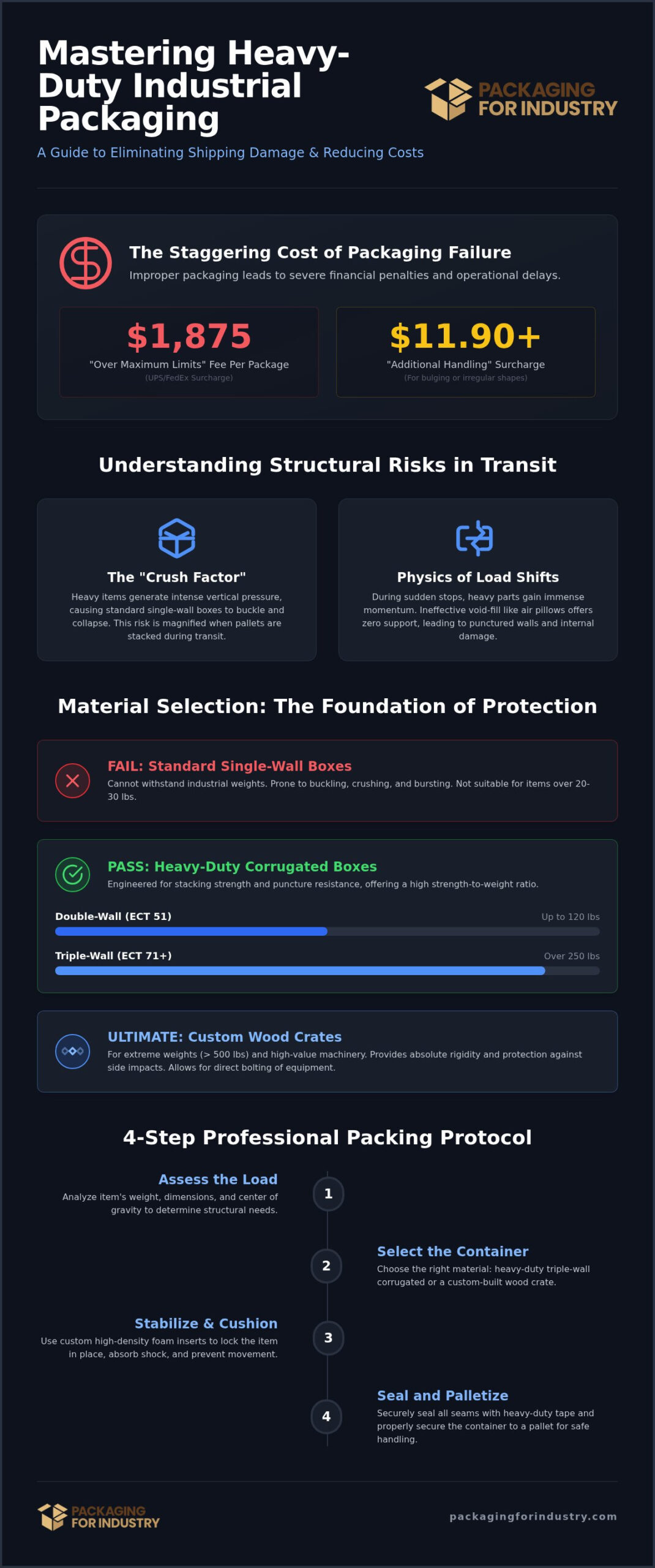
Shipping a 150-pound motor isn’t the same as shipping a 5-pound consumer product. Heavy items generate intense vertical pressure, leading to what we call the “crush factor.” Standard single-wall boxes fail because their vertical fluting buckles under localized weight. This failure often triggers a domino effect on industrial production lines, where a single damaged component can halt operations for days. Learning how to package heavy items for shipping requires a shift from simple containment to structural engineering. If your packaging doesn’t meet carrier standards, insurance claims for transit damage will be denied immediately. Professional corrugated box design is the only way to ensure structural integrity and liability protection for high-value industrial goods.
The Physics of Heavy Load Shifts
Heavy industrial parts possess immense momentum. During a sudden stop or sharp turn in a delivery truck, an unsecured heavy item continues to move with the vehicle’s original speed. Standard void-fill materials like air pillows or kraft paper provide zero structural support against these forces; they simply deflate or compress under high pressure. You must stabilize the item by centering its center of gravity. An off-center load causes the box to tilt or tip, which increases the likelihood of a punctured sidewall or a collapsed pallet stack. Effective protective foam packaging is necessary to lock the item in place and absorb these kinetic shifts.
Carrier Surcharges and Weight Limits
Carriers have become aggressive with penalties in 2026. As of January 26, 2026, UPS and FedEx apply an Oversize or Large Package Surcharge if a package exceeds 110 lbs. More critically, the “Over Maximum Limits” fee now sits at a flat $1,875 per package. Improper packaging that leads to bulging or irregular shapes also triggers “Additional Handling” surcharges, which reach $11.90 per package during peak demand seasons. Beyond flat fees, dimensional weight (DIM) remains a primary driver of cost. If your box is unnecessarily large to accommodate poor cushioning, you’re paying for air at a premium rate. You can request a packaging quote for custom-sized heavy duty corrugated boxes to help minimize these surcharges and improve your bottom line.
Selecting Heavy-Duty Materials: Triple-Wall vs. Custom Crates
Choosing the right material is the first step in solving how to package heavy items for shipping without risking structural failure. Industrial buyers must choose between corrugated fiberboard and wood based on the item’s weight, fragility, and destination. While standard boxes are rated for light loads, heavy industrial parts require double-wall or triple-wall construction to withstand the rigors of the supply chain. These materials are tested against the Large Packagings Standards to ensure they don’t collapse under the weight of stacked pallets or sudden load shifts.
Corrugated Strength: ECT and Mullen Ratings
The Edge Crush Test (ECT) is the primary metric for stacking strength. For heavy loads, you should look for ratings like ECT 51 or ECT 71. An ECT 51 double-wall box can typically handle up to 120 pounds, while an ECT 71 triple-wall box is engineered for loads exceeding 250 pounds. Triple-wall heavy duty corrugated boxes provide a high strength-to-weight ratio, making them a cost-effective alternative to wood when freight weight is a concern. The Mullen test measures the puncture resistance of a box’s wall, determining the amount of force required to burst through the corrugated material. If your item has sharp edges or protruding bolts, a high Mullen rating is essential to prevent the product from piercing the packaging during transit.
Wood Crates and Pallets for Extreme Weight
Corrugated materials have limits. When machinery exceeds 500 pounds or requires absolute rigidity to prevent internal calibration shifts, you must transition to wooden crates. Wood provides superior protection against side-impacts and allows for direct bolting of the equipment to the base. This level of security is vital for high-value industrial assets that cannot tolerate even minor vibrations. For international shipments, you must ensure your wood packaging meets ISPM-15 heat-treatment standards to avoid customs delays and potential fines.
- Custom Wood Crates: These provide total enclosure and are necessary for sensitive aerospace or medical equipment.
- Heavy-Duty Skids: These are ideal for bottom-heavy industrial equipment that needs a stable base for forklift handling but doesn’t require a full enclosure.
- Heat-Treated Pallets: These ensure compliance with global shipping regulations for all wood-based packaging.
Selecting the wrong material often leads to expensive damage or carrier rejection at the warehouse dock. You can request a packaging quote to evaluate whether triple-wall corrugated or custom wood crates are the most efficient choice for your specific load requirements.
Stabilization and Cushioning for Heavy Industrial Parts
Static weight is relatively simple to manage; dynamic weight is the true challenge. When you’re figuring out how to package heavy items for shipping, you must account for the g-forces experienced during truck vibrations and sudden stops. Standard cushioning materials like bubble wrap or packing peanuts are insufficient for industrial parts. The high PSI (pounds per square inch) exerted by heavy metal components simply collapses the air cells in those materials. Instead, you need high-density protective foam packaging that maintains its structural integrity under constant pressure. This ensures the product remains suspended and protected throughout the entire transit cycle.
Engineering Custom Foam Inserts
Custom inserts are engineered to distribute the weight of a heavy part across the entire surface area of the outer container. This prevents localized pressure points from puncturing the box wall. Selecting the right foam density is a matter of physics. Polyethylene foam is the standard for heavy loads due to its closed-cell structure and high load-bearing capacity. It doesn’t compress easily, making it ideal for heavy machinery or aerospace components.
Polyurethane foam is softer and better suited for vibration dampening, but it carries a high risk of “bottoming out” if the item is too heavy. If the foam is too soft for the load, a vertical drop will cause the item to punch through the cushion and strike the floor of the box. Following federal large packaging standards for cushioning ensures that your material selection is verified for the specific weight and fragility of your shipment.
- Die-cut end caps: These lock the item in place and create a uniform buffer between the product and the corrugated walls.
- Void-fill blocking: Using rigid foam blocks prevents internal movement, which is the leading cause of “box walk” where items shift and eventually burst through the packaging.
- Weight distribution: Engineering the insert to spread the load prevents the bottom of the box from sagging or failing during manual handling.
Corner and Edge Protection Strategies
Stabilizing the exterior of the load is just as critical as the internal cushioning. For palletized heavy items, the tension required to secure the load often exceeds the strength of the box corners. Using cardboard edge protectors allows you to apply maximum strapping tension without crushing the corrugated container. This maintains the vertical column strength of the pallet stack, which is vital for safe warehouse storage.
For tall or top-heavy items, corner boards provide essential stabilization. They act as an external skeleton, preventing the load from tipping during forklift maneuvers or sharp turns. When you master how to package heavy items for shipping, you’re essentially building a system of protection that integrates internal suspension with external reinforcement. This holistic approach is what separates a successful industrial shipment from a costly insurance claim.
Step-by-Step Guide to Packing Heavy Shipments
Executing a consistent packing protocol is the only way to ensure heavy industrial goods survive the distribution cycle. When your warehouse team understands how to package heavy items for shipping, they can move through fulfillment with greater precision and fewer errors. Every heavy shipment should follow this five-step sequence to maintain structural integrity and minimize the risk of transit damage:
- Step 1: Inspect the item and determine the center of gravity. Use a permanent marker to indicate the heavy side on the outer container to guide forklift operators and prevent accidental tipping.
- Step 2: Select a triple-wall box or custom crate with a weight capacity that exceeds the item’s actual weight by at least 20% to account for dynamic forces during transport.
- Step 3: Apply custom foam inserts to all six sides, ensuring a minimum 2-inch buffer between the product and the outer walls.
- Step 4: Seal the container using the H-tape method with 3-inch reinforced water-activated tape to secure all seams.
- Step 5: Palletize the load and secure it with high-gauge stretch film and polyester strapping to anchor the item to the pallet frame.
The Industrial H-Tape Method
Standard pressure-sensitive plastic tape often fails under the extreme tension and weight of industrial cartons. You should use 3-inch reinforced water-activated tape for all heavy-duty packaging. This tape creates a molecular bond with the corrugated fibers, making it nearly impossible to peel off without destroying the box surface. Apply the tape along the center seam and across both end seams in an “H” pattern. This configuration provides maximum structural support to the box flaps. The H-tape method prevents flaps from opening under pressure during stacking or sudden load shifts in the delivery truck.
Palletization and Load Stabilization
A heavy item is only as secure as its connection to the pallet. Use heavy-duty polyester strapping to anchor the item or crate directly to the pallet frame, which prevents lateral sliding during transit. Once anchored, utilize machine stretch film to provide total load containment. Machine wrapping allows you to set precise tension levels that hand-wrapping cannot consistently match. This tension creates a unified load that resists the centrifugal forces experienced during sharp turns. Start the wrap at the pallet base and move upward, overlapping each layer by 50% to ensure the item and pallet move as a single, stable unit.
Lowering Costs and Improving Reliability with PFI
Mastering how to package heavy items for shipping is an economic necessity as much as an engineering one. Large catalog suppliers often force manufacturers into “one-size-fits-all” solutions that result in excessive void space and inflated dimensional weight charges. PFI operates as a specialized industrial packaging supplier, focusing on precision-engineered protection that aligns with your specific logistical constraints. By eliminating wasted volume and utilizing high-performance materials like triple-wall corrugated and custom foam, we help you avoid the compounding surcharges that now dominate the 2026 freight market.
Custom Engineering vs. Catalog Overspending
Buying stock boxes for heavy industrial parts leads to catalog overspending and increased transit risk. When a box is too large, you pay for air via DIM weight; when it’s too small, you compromise the 2-inch buffer required for shock absorption. PFI uses CAD design and free prototyping to create integrated solutions where the box, foam, and pallet work as a single structural unit. This custom approach lowers the total cost of ownership by preventing shipping damage and ensuring your high-value assets arrive production-ready. We don’t just sell supplies; we engineer a system of protection that stabilizes your overhead.
Reliability is further improved through our Vendor Managed Inventory (VMI) programs. For manufacturers in Southern California, warehouse space is at a premium. Our VMI service ensures you have a consistent supply of heavy-duty materials without cluttering your floor. We offer local next-day delivery across Orange County and Los Angeles, serving industrial hubs in Anaheim, Irvine, and Santa Fe Springs. This proximity allows your team to maintain a just-in-time workflow while knowing that your custom crates or triple-wall boxes are always available when a critical shipment is ready to move.
Request a Packaging Quote for Heavy Items
If you’re struggling with rising freight costs or high damage rates, it’s time to evaluate your current material selection. PFI provides the expertise needed to navigate complex 2026 carrier standards and optimize your heavy-duty loads for maximum efficiency. When you understand how to package heavy items for shipping using custom materials, you eliminate the guesswork that leads to carrier penalties. Whether you need a local Anaheim packaging supplier or fast nationwide shipping for a distribution network, our team is ready to assist. You can request a packaging quote today to compare pricing and see how custom engineering can stabilize your shipping operations.
Optimize Your Industrial Shipping Strategy
Shipping heavy industrial equipment in 2026 demands a strategic shift from standard containers to engineered protection. We’ve explored the structural risks of heavy loads, the necessity of triple-wall corrugated materials, and the critical role of high-density foam stabilization. Mastering how to package heavy items for shipping ensures your products withstand the physics of transit while helping you avoid aggressive carrier surcharges. PFI specializes in these custom solutions, offering free prototyping and specialized engineering for the aerospace and manufacturing sectors. Whether you need local next-day delivery across Southern California or nationwide support, our team provides the reliability your supply chain requires. By integrating custom corrugated boxes with high-performance cushioning, you create a logistical system built for durability and fiscal responsibility. We’re here to help you reduce shipping damage and stabilize your operational costs through precise material selection and proactive design.
Let’s build a more secure and cost-effective future for your industrial logistics together.
Frequently Asked Questions
What is the best type of box for shipping heavy items?
Triple-wall corrugated boxes are the superior choice for heavy industrial items due to their high stacking strength. Unlike standard cardboard, these heavy-duty boxes use three layers of fluting to resist crushing and punctures. They provide a lighter, more cost-effective alternative to wood while maintaining enough structural integrity for loads up to 300 pounds. PFI specializes in custom triple-wall solutions for Southern California manufacturers looking to optimize their shipping protection.
How do I calculate the weight capacity of a corrugated box?
You can determine a box’s weight capacity by checking the Box Maker’s Certificate (BMC) printed on the bottom flap. This stamp indicates the Bursting Test (Mullen) or Edge Crush Test (ECT) rating. For heavy loads, focus on the “Gross Weight Limit” listed on the certificate. If you’re unsure how to package heavy items for shipping, our engineering team can perform a packaging review to ensure your materials exceed your product’s actual weight.
When should I switch from a box to a wooden crate for shipping?
You should transition from corrugated boxes to wooden crates when your product exceeds 500 pounds or requires absolute rigidity. Heavy machinery with sensitive internal calibrations often needs to be bolted directly to a wooden base to prevent vibration damage. Wood crates also provide superior side-impact protection and are necessary for items that can’t be safely stabilized with foam inserts alone within a cardboard container.
How much weight can a triple-wall corrugated box hold?
A standard triple-wall corrugated box is typically rated to hold between 250 and 300 pounds, depending on the specific ECT rating. Some specialized configurations can handle even higher weights when combined with internal reinforcements. These boxes offer a significant strength-to-weight advantage over wood, helping you lower freight costs while meeting the rigorous demands of industrial shipping cycles across the United States.
What is the most effective way to prevent heavy items from shifting in transit?
The most effective way to prevent internal movement is using custom-engineered foam inserts tailored to the item’s dimensions. High-density polyethylene foam provides the necessary PSI resistance to keep heavy parts suspended. Combining these inserts with the industrial H-tape method and proper pallet strapping ensures the load remains centered. This holistic approach eliminates “box walk” and prevents the product from shifting and puncturing the outer walls during transit.
How can I reduce shipping surcharges for heavy or oversized packages?
Reducing shipping surcharges requires optimizing your packaging dimensions to lower your dimensional weight (DIM). Carriers apply steep penalties for oversized or bulging boxes that require manual handling. PFI helps you how to package heavy items for shipping by designing custom-sized containers that eliminate wasted space. This precision engineering reduces the overall footprint of your shipment, helping you avoid “Additional Handling” fees and Large Package Surcharges.
Does PFI offer custom foam inserts for heavy machinery?
Yes, PFI provides custom-engineered foam inserts specifically designed for heavy machinery and aerospace components. We offer free prototyping to ensure a perfect fit before you commit to a full production run. Our team utilizes die-cut polyethylene and polyurethane foam to create end caps and pads that distribute weight evenly. This specialized protection is essential for Southern California businesses shipping high-value industrial assets that require maximum shock absorption.
Do I need special pallets for shipping heavy industrial equipment?
Heavy industrial equipment often requires heavy-duty skids or heat-treated (ISPM-15) pallets to ensure load stability and regulatory compliance. Standard stringer pallets may collapse under concentrated heavy loads. Using a reinforced pallet with a higher weight capacity prevents the base from sagging, which is a common cause of forklift damage. PFI supplies custom pallets and skids designed to support the specific footprint and weight distribution of your machinery.