
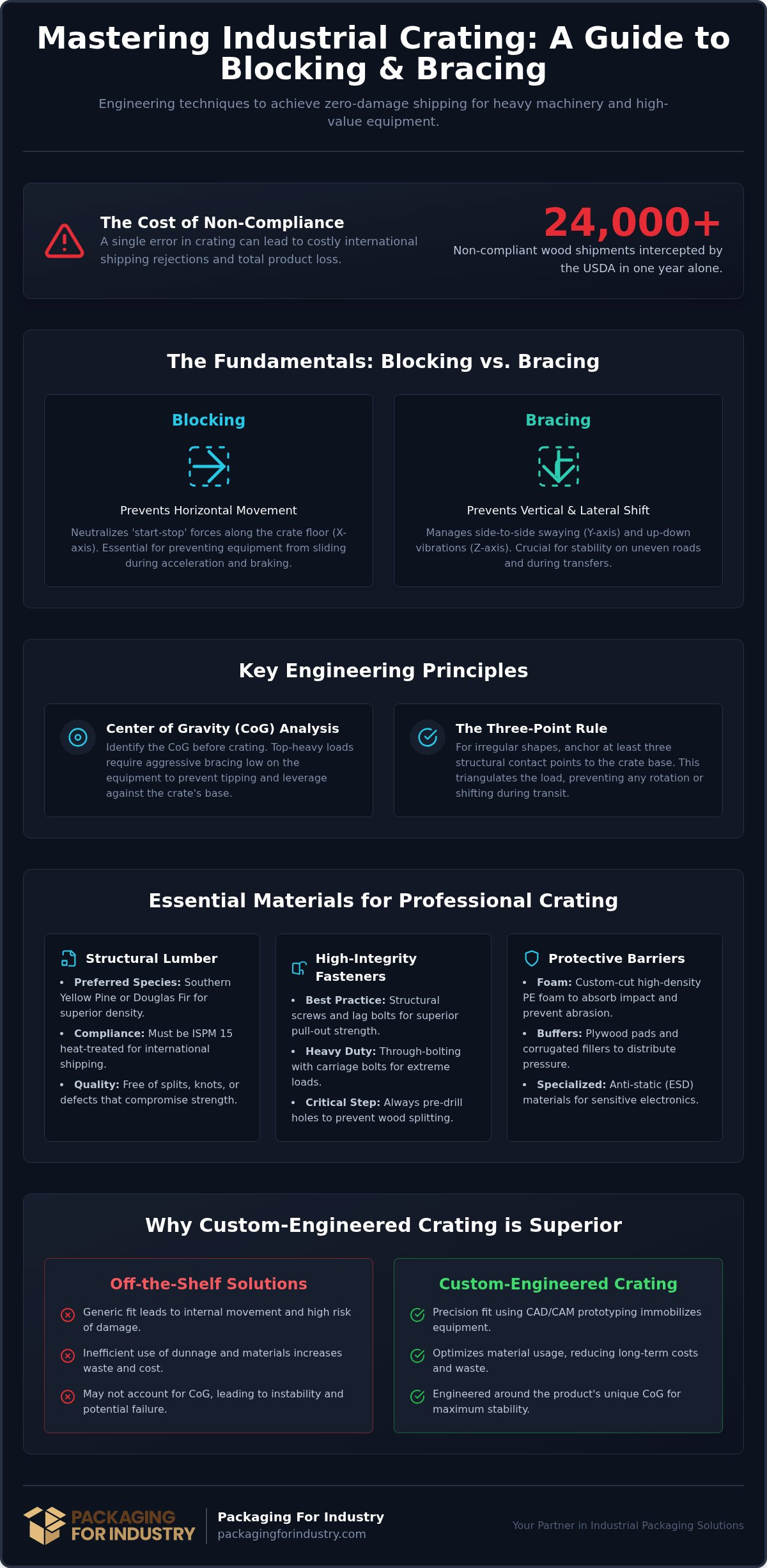
With the USDA intercepting over 24,000 non-compliant wood packaging shipments in 2025 alone, the margin for error in industrial crating has effectively disappeared. You already know that a single shifted component during transit can lead to a total loss, yet inconsistent packing methods often leave your most valuable equipment vulnerable. Learning how to properly block and brace equipment in wood crates is not just about filling space. It is a technical discipline that redirects kinetic energy into the crate’s strongest structural points to ensure your cargo arrives intact.
This guide will help you master the industrial engineering techniques required to secure heavy machinery and achieve zero-damage shipping reports. We’ll examine how to build a standardized internal SOP that reduces material waste while ensuring full compliance with ISPM 15 heat treatment standards. From selecting the right lumber to integrating protective foam packaging, you will gain the expertise needed to streamline your warehouse operations and eliminate the stress of international shipping rejections. We will cover the specific blocking strategies, bracing patterns, and material requirements that professional shippers in Southern California and across the country use to protect their bottom line.
Key Takeaways
- Understand the critical distinction between blocking to prevent horizontal movement and bracing to neutralize lateral or vertical shifting.
- Master how to properly block and brace equipment in wood crates by applying engineering principles that redirect kinetic energy into structural load-bearing points.
- Identify the essential materials, such as Southern Yellow Pine and structural lag bolts, that provide the integrity needed for heavy-duty industrial shipping.
- Learn advanced stabilization techniques, including K-braces and hold-down bars, designed to eliminate vertical bounce and protect sensitive components.
- Discover how custom-engineered crating and CAD/CAM prototyping reduce long-term costs by preventing transit damage and optimizing material usage.
The Fundamentals of Blocking and Bracing in Industrial Crating
Securing heavy machinery for long-distance freight requires a shift in perspective. You aren’t just building a box; you’re engineering a localized environment that can withstand the violent physics of transport. Mastering how to properly block and brace equipment in wood crates is the first step toward eliminating transit damage. Blocking refers specifically to the method used to prevent horizontal movement along the crate floor. Bracing, conversely, is the system designed to prevent lateral or vertical shifting during transit.
Learning how to properly block and brace equipment in wood crates involves accounting for the intense G-forces present in Less-Than-Truckload (LTL) environments. When a truck brakes suddenly or hits a significant road hazard, the cargo inside can exert thousands of pounds of force against the crate walls. To counter this, we use the ‘Three-Point Rule’ for securing irregular machinery shapes. This technique involves identifying at least three structural contact points on the equipment and anchoring them to the crate’s base to triangulate the load and prevent rotation.
Blocking vs. Bracing: Knowing the Difference
To visualize these techniques, consider the X, Y, and Z axes of movement in a moving freight truck. The Fundamentals of Blocking and Bracing involve neutralizing energy in every direction. Blocking handles the ‘start-stop’ forces of the X-axis. Bracing manages the side-to-side swaying of the Y-axis and ‘up-down’ vibrations of the Z-axis. Without both systems, equipment eventually works loose, leading to structural failure.
Load Distribution and Center of Gravity
Our custom design packaging team identifies the center of gravity (CoG) before any lumber is cut. Top-heavy loads require aggressive bracing to prevent the equipment from acting as a lever against the base. Load distribution is the spread of weight across the crate’s base members. By aligning the heaviest components with the load-bearing runners of the skid, we ensure the crate’s foundation remains stable under demanding shipping conditions.
Essential Materials for Professional Equipment Bracing
The structural integrity of a crate depends entirely on the quality of the components used to build it. Choosing the correct lumber is the first decision in the engineering process. For heavy machinery, Southern Yellow Pine or Douglas Fir are the preferred options. These species offer superior density and load-bearing capacity compared to standard spruce or fir. When you are determining how to properly block and brace equipment in wood crates, the material must also be ISPM 15 compliant to ensure international acceptance and avoid costly customs delays.
Beyond the wood itself, dunnage materials like plywood pads and corrugated fillers play a vital role. These items act as buffers, distributing pressure across larger surface areas to prevent localized damage. Integrating custom foam packaging is equally critical for preventing surface abrasion on painted or polished equipment during long-haul transit. High-density polyethylene foam can be cut to fit specific machine contours, providing a cushioned interface that absorbs impact energy before it reaches your product.
Selecting the Right Fasteners
Fastener choice is often where internal packing teams fail. Standard nails lack the pull-out strength required to keep a 5,000 pound machine stationary during a sudden stop. Structural screws and lag bolts provide a mechanical bond that withstands the constant vibration of freight transport. For the most extreme loads, we recommend through-bolting directly to the skid using carriage bolts. Pre-drilling every wood member is a non-negotiable step; it prevents splitting and ensures the fastener maintains its full rated strength throughout the journey.
Protective Barriers and Interleaving
Direct wood-to-metal contact can lead to scratches or gouges that result in expensive rework. We solve this by installing corner and edge protection between the machine and the bracing members. This creates a non-marring interface that absorbs micro-vibrations. For specialized sectors like medical or semiconductor manufacturing, anti-static (ESD) materials must be used to protect sensitive circuitry from static discharge during handling.
If your equipment is destined for international export, you must also consider environmental factors. Vapor barrier bags and desiccants prevent corrosion in high-humidity maritime environments. Using the right combination of engineering and materials ensures your cargo arrives in the same condition it left the factory. You can request a packaging quote to see how high-grade materials and professional design improve your shipping reliability.
Step-by-Step Guide to Blocking Heavy Machinery
Positioning the asset is the first critical step in understanding how to properly block and brace equipment in wood crates. You must align the machine’s primary contact points directly over the crate’s load-bearing runners. If the weight rests only on deck boards, the floor may flex or fail during a forklift maneuver. Once positioned, install primary floor blocks against every side of the machine’s base. These blocks act as the primary defense against horizontal shifting and ensure the equipment remains centered throughout the journey.
For manufacturers in Orange County or Los Angeles looking to standardize their shipping, we recommend a methodical approach to block installation. Every block must be cut to a length that spans at least two deck boards to distribute the load effectively. After the blocks are in place, verify the tightness of the fit. There should be zero initial play between the equipment and the wood members. Even a quarter-inch gap allows the machine to gain momentum during transit, which can eventually shear through fasteners.
Securing the Base: The Foundation of Protection
The mass of your machine dictates your lumber choice. We typically use 2×4 blocks for lighter assemblies, while heavy industrial gear requires 4×4 or 6×6 timbers. If you are shipping wheeled equipment or assets with rounded bases, utilize the ‘Pocket Blocking’ technique. This involves creating a recessed frame that traps the contact point, preventing it from rolling or sliding in any direction. When driving fasteners, ensure they penetrate at least two inches into the crate’s heavy-duty runners. Securing blocks only to the deck boards is a common mistake that leads to catastrophic floor failure.
Reinforcing with Cleats and Backup Blocks
Cleats provide the secondary reinforcement needed to keep primary blocks from lifting or rotating. Angle your cleats to provide maximum resistance against the direction of potential shifting. We also use ‘scab’ blocks to reinforce joints between vertical and horizontal members, creating a rigid lattice that moves as a single unit. To achieve maximum shear resistance, installers should use a staggered screw pattern that places fasteners at alternating intervals to prevent the wood grain from splitting.
Implementing these steps ensures your warehouse team follows a repeatable, high-performance packing protocol. If your current methods are leading to inconsistent results, our team can provide custom design packaging support to engineer a solution tailored to your specific machinery. Following a standardized SOP helps reduce product damage and lowers the overall cost of your logistics chain. For local manufacturers, PFI serves as a reliable industrial packaging supplier with the expertise to secure even the most complex loads.
Advanced Bracing Techniques for High-Value Equipment
Advanced securement strategies are necessary when your cargo features a high center of gravity or delicate external components. While floor blocks prevent sliding, they don’t address the tipping forces or vertical bounce common in long-haul freight. When engineering how to properly block and brace equipment in wood crates for these complex loads, you must utilize structural bracing patterns that engage the crate’s entire frame. This approach turns the crate into a rigid exoskeleton that moves in unison with the machinery it contains.
Designing ‘K-braces’ and ‘X-braces’ provides the lateral stability required for tall or narrow machinery. These structures transfer side-to-side energy from the equipment into the crate’s vertical corner posts and horizontal headers. For assets prone to vertical movement, we install ‘Hold-down’ bars. These members apply consistent top-down pressure to the machine’s strongest structural points; this effectively neutralizes the impact of road vibrations and potholes that could otherwise dislodge the equipment from its base.
Lateral Bracing for Tall or Narrow Loads
Preventing a machine from tipping requires calculating the specific angle of support needed based on its height and weight distribution. We use ‘Bridge Bracing’ for equipment with delicate mid-sections, such as control panels or hydraulic lines, that cannot sustain direct pressure. This technique allows us to bridge the gap between the machine’s base and the crate walls without contacting sensitive areas. It ensures the load remains centered without compromising the machine’s functional integrity.
Hybrid Bracing: Combining Wood and Foam
Standard wood bracing can sometimes be too rigid for finished surfaces or sensitive sensors. Integrating custom foam inserts into the wood members creates a hybrid system that offers both structural rigidity and impact absorption. High-density polyethylene (PE) foam is the ideal interface for this, especially when meeting aerospace packaging solutions requirements. This material maintains its integrity across different shipping climates; it manages thermal expansion and contraction without losing its protective properties.
For extreme loads exceeding several tons, we supplement wood bracing with heavy-duty steel banding or polyester strapping. These tie-down strategies provide an additional layer of security, anchoring the machine directly to the skid runners to prevent any possibility of lift during transit. By combining these advanced bracing methods with high-quality materials, you eliminate the variables that lead to transit damage.
Why Custom Engineered Crating Beats Off-the-Shelf Solutions
Mastering how to properly block and brace equipment in wood crates begins long before your warehouse team picks up a hammer. While manual techniques are vital, the most reliable results come from a design-first approach that utilizes CAD/CAM technology. Digital modeling allows our engineers to identify potential failure points and stress concentrations before the first board is ever cut. This proactive method ensures that every block, brace, and fastener is positioned to handle the specific load requirements of your machinery, eliminating the guesswork that often leads to transit damage.
Engineering your crates also offers significant economic advantages. Off-the-shelf crates are frequently oversized, leading to inflated freight costs and wasted material. By optimizing crate dimensions to the exact footprint of your equipment, we maintain structural integrity while reducing your shipping volume. For recurring production needs, implementing Vendor Managed Inventory (VMI) further streamlines your operations. This service ensures you always have the right custom-engineered crates on hand without tying up valuable warehouse floor space.
The ROI of Professional Bracing
The cost of a custom-engineered crate is a fraction of the value of a single damaged industrial asset. Beyond the immediate repair costs, shipping damage erodes your brand’s reputation and creates administrative friction through insurance claims and liability disputes. Professional bracing also simplifies the unboxing process for your end customer. When equipment is secured using standardized, logical methods, it’s safer and faster for the receiving team to remove the bracing and put the machine into service. Documented packing standards provide the peace of mind that your logistics chain is fully optimized for safety and efficiency.
Southern California’s Partner for Industrial Crating
Manufacturers in Anaheim, Los Angeles, and Orange County require a partner that understands the speed of local industry. PFI provides the local expertise needed to manage complex crating requirements with next-day delivery and just-in-time stocking options. Our free prototyping service in Southern California allows you to verify the fit and function of your crate before committing to a bulk order. We focus on standardizing how to properly block and brace equipment in wood crates across your entire product line to ensure consistent protection for every shipment, whether it’s moving across the Inland Empire or across the globe.
Secure Your Heavy Machinery with Engineered Crating Solutions
Securing industrial assets requires more than just high-quality lumber. It demands a systematic approach to internal engineering that redirects kinetic forces and neutralizes the risks of long-distance freight. By mastering how to properly block and brace equipment in wood crates, you can eliminate inconsistent packing results and significantly reduce product damage rates. From selecting the right structural fasteners to integrating custom foam inserts for aerospace-grade protection, every technical decision impacts your bottom line and overall supply chain reliability.
Packaging For Industry (PFI) provides the expert CAD/CAM support and free prototyping required to design crates that fit your equipment perfectly. Whether you’re shipping sensitive medical gear or heavy manufacturing machinery, our team ensures your cargo meets all ISPM 15 export regulations while optimizing crate dimensions to lower freight costs. With local next-day delivery across Southern California and comprehensive nationwide shipping capabilities, we are the steady partner you need to streamline your logistics and protect your professional reputation.
Let’s build a safer, more efficient shipping process for your business today.
Frequently Asked Questions
What is the difference between blocking and bracing in a wood crate?
Blocking prevents horizontal sliding by anchoring lumber directly against the base or feet of the machine; bracing prevents lateral swaying or vertical bouncing during transit. Both systems must work together to neutralize movement across all three axes. Learning how to properly block and brace equipment in wood crates requires this dual approach to ensure the cargo doesn’t shift when the freight truck stops or turns suddenly.
What type of wood is best for blocking and bracing heavy machinery?
Southern Yellow Pine and Douglas Fir are the preferred materials for industrial securement due to their superior density and fastener retention. These species provide the structural integrity needed to handle the intense shear forces of heavy machinery. We use these high-grade lumbers to ensure your bracing doesn’t split or fail under the stress of long-distance LTL shipping or maritime transport.
How do I secure equipment that has an irregular shape or high center of gravity?
High center-of-gravity loads require advanced stabilization techniques like K-braces or X-braces to prevent the machine from tipping. For irregular footprints, we utilize custom-engineered blocks that match the machine’s contact points and apply hold-down bars to neutralize vertical bounce. This engineering-led strategy prevents top-heavy assets from acting as a lever that could otherwise compromise the crate’s structural walls.
Do I need ISPM-15 compliant wood for blocking and bracing if I’m shipping internationally?
Yes, all wood packaging materials used for international export must be ISPM-15 certified and marked with the IPPC heat-treatment stamp. This requirement applies to every internal blocking and bracing member, not just the exterior crate panels. Using non-compliant wood for internal securement can lead to immediate shipment rejection, heavy fines, or mandatory destruction of the packaging at the port of entry.
Can I use foam instead of wood for blocking and bracing?
Foam is an excellent supplement to wood bracing but should not be used as the sole securement method for heavy equipment. We recommend a hybrid system where high-density PE foam serves as a protective, non-marring interface between the machine and the rigid wood braces. This setup provides the structural strength of timber while adding the vibration dampening benefits of protective foam packaging.
How many fasteners should I use per block for a 5,000 lb machine?
A 5,000 lb machine typically requires at least four structural screws or lag bolts per primary block to achieve the necessary shear resistance. These fasteners must penetrate at least two inches into the crate’s heavy-duty runners rather than just the deck boards. Standard nails don’t offer the pull-out strength required to keep heavy industrial gear stationary during the violent vibrations of freight transport.
Should I bolt my equipment directly to the crate floor?
Through-bolting directly to the skid’s runners is the most secure way to anchor heavy industrial assets. This process involves drilling through the machine’s mounting points and the crate floor to install heavy-duty carriage bolts. When you combine through-bolting with traditional blocking, you create a rigid connection that eliminates the possibility of the equipment dislodging from its foundation during transit.
How can PFI help if I have a high-volume crating requirement in Southern California?
PFI provides Vendor Managed Inventory (VMI) and just-in-time delivery for high-volume manufacturers in Los Angeles, Orange County, and the Inland Empire. We offer custom CAD/CAM support and free prototyping to help you develop a standardized crating SOP that reduces material waste. You can request a custom packaging quote to see how our local expertise and nationwide shipping capabilities improve your supply chain reliability.