
How much of your project margin is being consumed by “invisible” reclassification fees and the rising cost of float glass? In 2026, the industry-wide shift to density-based LTL pricing means that improper crating doesn’t just risk breakage; it invites immediate carrier surcharges that can erase your profits. We understand that shipping tempered or laminated panels is a high-stakes operation where a single hairline fracture leads to site delays and expensive replacements. If you’re managing logistics in Los Angeles or the Inland Empire, securing reliable custom packaging for architectural glass Southern California is no longer just a line item. It’s a critical strategy for fiscal responsibility and operational stability.
You’re likely aware that standard catalog solutions often fail to meet the “controlled rigidity” required for specialized glass transit. This guide outlines the professional engineering standards for crating and foam protection designed to neutralize vibration and prevent flex. You’ll learn how to implement zero-damage shipping cycles and reduce freight costs by optimizing your shipment’s density to match the latest NMFTA standards. We’ll walk through the technical requirements of ISTA testing and show you how a local, precision-focused supply chain can stabilize your operations and provide the peace of mind your bottom line deserves.
Key Takeaways
- Understand why structural rigidity in custom wood crates is the only way to neutralize the “Flex Factor” that causes architectural glass breakage during transit.
- Learn how to navigate the 2026 density-based LTL freight model to avoid unexpected reclassification fees and lower your total shipping costs.
- Identify why closed-cell polyethylene (PE) foam is the engineering standard for protecting the vulnerable edges of high-value tempered and laminated panels.
- Source professional custom packaging for architectural glass Southern California to benefit from next-day delivery and Anaheim-based design support.
- Calculate the long-term ROI of custom-engineered solutions compared to the hidden “catalog tax” and high damage rates associated with stock packaging.
The High Stakes of Architectural Glass Logistics
Architectural glass encompasses high-performance materials like tempered safety glass, laminated panels, and massive storefront panes. These materials are engineered for structural integrity in buildings but remain incredibly vulnerable during the logistics cycle. Unlike flexible goods, glass doesn’t absorb energy; it transmits it. This fundamental property makes the shipping process a high-risk operation for manufacturers and distributors who rely on intact deliveries to maintain project schedules.
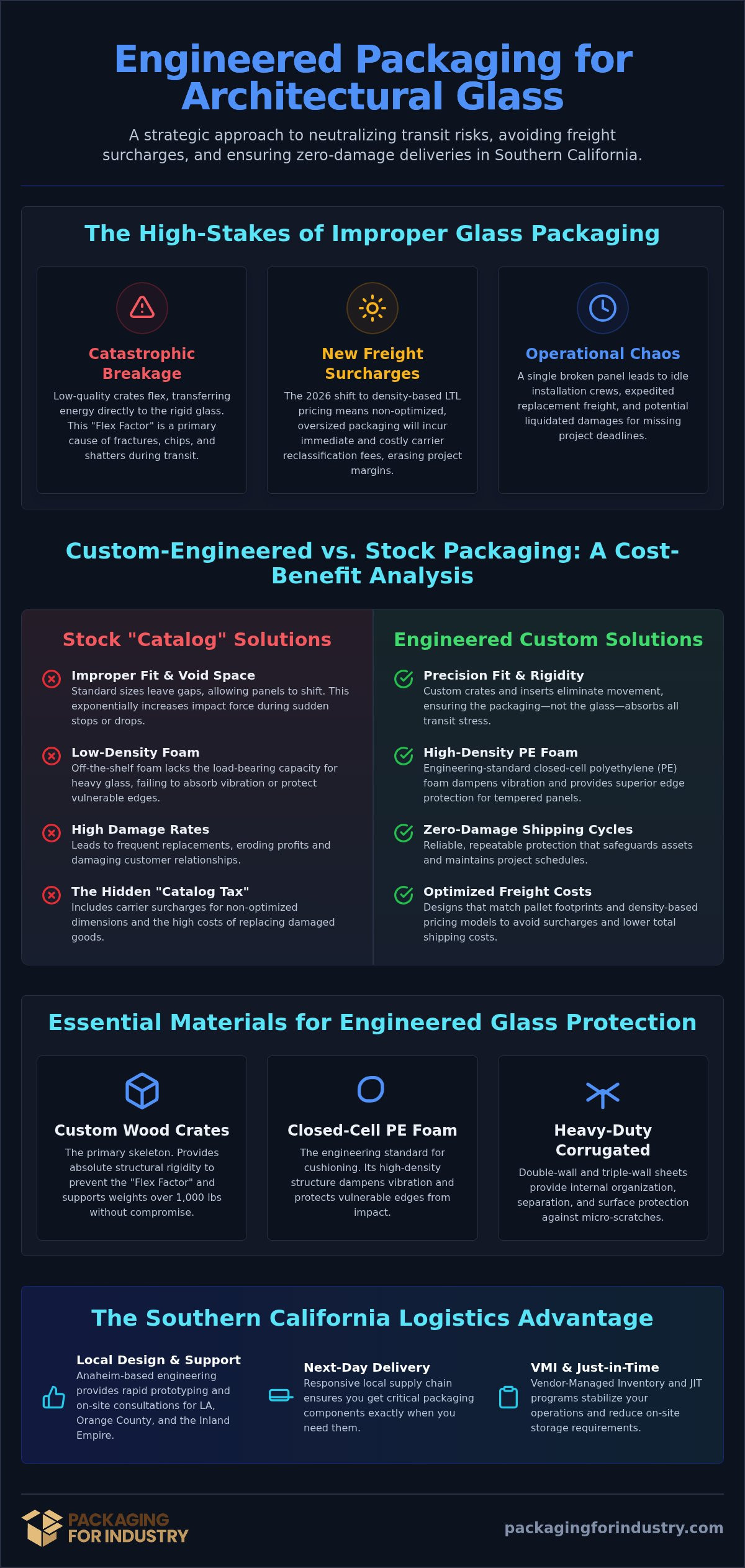
Glass is rigid. It doesn’t bend. When the outer packaging, such as a low-quality crate or a single-wall box, flexes during transit, that energy is transferred directly into the glass. This leads to catastrophic failure. Protecting these assets requires custom design packaging that maintains absolute structural rigidity. Without a rigid frame, the glass panel itself becomes the structural component of the package, which is a guaranteed recipe for transit damage.
It isn’t just about breakage; it’s about surface quality. Constant vibration during LTL transit causes microscopic scratches when panels rub against improper dunnage. These micro-cracks weaken the pane’s tension. This makes it more likely to shatter during installation or under thermal stress later in its lifecycle. Effective vibration dampening is essential to ensure the glass arrives with its structural and aesthetic properties fully intact.
Replacing a broken 500lb panel isn’t just the cost of the glass. It’s the expedited freight, the installation crew standing idle on-site, and the potential liquidated damages for project delays. Investing in custom packaging for architectural glass Southern California is a preventative measure that safeguards project margins. This proactive approach ensures that the total cost of ownership remains low by eliminating the logistical chaos of transit damage.
Common Causes of Glass Damage in Transit
Most transit damage stems from three specific mechanical failures. First is structural failure, where heavy-duty panels crush the walls of standard corrugated boxes, leading to stack collapses in the trailer. Second is inadequate edge protection. Without high-density corner and edge protection, the corners of tempered glass, which are its most vulnerable point, will chip or “explode” upon minor impact. Finally, environmental stress can affect coated glass. These products often react to moisture or static discharge, requiring specialized liners or protective films to maintain their high-performance coatings.
Why Standard Catalog Solutions Often Fail
Catalog suppliers focus on volume, not precision. Standard sizes create large “voids” within the package. If a panel can shift even a fraction of an inch, the impact force during a sudden stop increases exponentially. Additionally, off-the-shelf foam rarely possesses the load-bearing density needed for heavy architectural weights. By choosing custom packaging for architectural glass Southern California, manufacturers avoid the hidden “catalog tax.” This includes those steep carrier surcharges for non-optimized, oversized dimensions that don’t fit standard pallet footprints or density-based pricing models.
Engineering the Solution: Essential Materials for Glass Protection
Selecting the right materials for custom packaging for architectural glass Southern California requires a deep understanding of load-bearing physics. While your glass may meet the Safety Standard for Architectural Glazing Materials, it’s the packaging that ensures those standards aren’t tested by a transit impact. We focus on a multi-layered defense strategy that pairs rigid external structures with energy-absorbent internal components. This synergy is what prevents the catastrophic failures discussed in the previous section.
Custom wood crates serve as the primary skeleton for oversized panes. They provide the necessary rigidity to prevent the “Flex Factor” and can support weights exceeding 1,000 lbs without structural compromise. For internal organization, we utilize heavy-duty corrugated materials. Double-wall and triple-wall corrugated sheets act as effective dividers, keeping multiple panels separated and secure while adding an extra layer of puncture resistance. These materials are chosen for their high burst strength and ability to maintain integrity in humid warehouse environments.
Point-load failure is a common cause of breakage, occurring when a single corner or edge takes the full force of a drop. To combat this, we integrate high-density corner and edge protection. These components redistribute impact energy across a wider surface area, protecting the most vulnerable parts of the glass panel. If you’re looking to optimize your supply chain, you can request a packaging quote to see how these materials fit your specific dimensions.
Custom Crates vs. Heavy-Duty Corrugated Boxes
For maximum security of high-value storefront panes, foam-lined wood crates are the industry standard. These are essential for any shipment where rigidity is the top priority. However, for lighter architectural components or smaller tempered panels, specifying triple-wall corrugated boxes can be a cost-effective alternative. The best results often come from a hybrid approach. We frequently use custom design packaging that combines a triple-wall corrugated outer shell with a reinforced pallet base for a balance of protection and freight efficiency.
Protective Foam Selection for Glass
Foam density is the most overlooked factor in glass shipping. We primarily use closed-cell polyethylene (PE) foam because it doesn’t “bottom out” under the heavy weight of architectural panels. It’s also water-resistant, which is vital for preventing moisture-trapping against coated glass. For panels with sensitive electronic coatings or smart-glass features, anti-static foam is used to prevent ESD damage. Utilizing custom die-cut foam packaging end caps allows us to “float” the glass inside the crate, ensuring that the panel never makes direct contact with the rigid outer walls.
Custom vs. Stock Packaging: A Cost-Benefit Analysis
Many manufacturers fall into the “Catalog Tax” trap by ordering stock boxes from national suppliers like Uline. While these boxes are convenient, they’re rarely optimized for the weight and dimensions of architectural glass. As of February 2026, the National Motor Freight Traffic Association (NMFTA) has finalized its shift to density-based pricing for LTL shipments. This means every inch of “void” or air in a stock box increases your shipping costs by pushing you into a higher, more expensive freight class.
Switching to custom packaging for architectural glass Southern California eliminates these dimensional weight penalties. By matching the crate size exactly to the glass dimensions, you maximize your pounds per cubic foot (PCF), ensuring the most favorable freight rate. The financial ripple effect is significant. When you calculate the ROI of custom engineering, consider the following:
- Damage reduction: Preventing the loss of just one high-value laminated panel often pays for the entire production run of custom crates.
- Warehouse efficiency: Custom sizes reduce your warehouse footprint by up to 20% compared to oversized stock boxes.
- Supply reliability: Utilizing Vendor Managed Inventory (VMI) ensures you always have the right crates on hand without tying up capital in excess stock.
Optimizing for Freight and Surcharges
Custom dimensions do more than just lower your freight class; they improve the structural integrity of the entire load. We design crates for maximum stackability, allowing you to utilize vertical space in the trailer without risking a crush failure. This optimization can lead to lower packaging costs by reducing the total number of pallet positions required for a project. Additionally, you can significantly reduce labor costs by using pre-engineered inserts. Our packaging kitting services deliver crates with foam already in place, cutting assembly time on your warehouse floor.
The Role of Free Prototyping
We don’t believe in guesswork for high-stakes logistics. Our Anaheim-based team provides custom CAD/CAM design support to create precise digital models of your protection system. We offer free prototyping to ensure a perfect product fit before you commit to bulk production. This process allows you to verify that the internal foam density and outer crate rigidity will withstand real-world transit shocks. It’s a risk-free way to transition from expensive catalog boxes to a streamlined, engineered solution that protects both your glass and your bottom line. Standardizing your custom packaging for architectural glass Southern California through a local partner reduces lead times and guarantees that every shipment meets your specific engineering standards.
Step-by-Step: How to Pack Architectural Glass for Shipping
Practical execution is where engineering meets the warehouse floor. Even the most robust custom packaging for architectural glass Southern California won’t perform if the loading process is flawed. We’ve developed a standardized protocol to ensure your high-value panels survive the rigors of LTL transit. It starts with a rigorous initial inspection. Ensure the glass is clean and entirely free of microscopic edge defects or chips. These minor flaws are stress concentrators that can lead to spontaneous breakage under vibration.
Pre-Packing Preparations
Precision begins with the tape measure. You must account for all panel dimensions, including any integrated hardware, offsets, or standoffs that might protrude. These elements require specific cut-outs in your foam inserts to prevent pressure points. Next, select a pallet or skid rated for the total load weight; architectural glass is deceptively heavy. Finally, select your corner and edge protection materials. High-density corner boards are essential for neutralizing the impact zones that cause the majority of transit failures.
Once the glass is prepped, apply surface protection. Use non-adhesive protective liners or high-quality stretch film to prevent surface abrasion. This layer acts as a barrier against dust and the fine particulates that cause scratches during long-haul transit. Secure the panel within the crate using high-density foam blocks strategically placed to “chock” the glass in place. This ensures zero movement within the enclosure.
Loading and Bracing Techniques
The “Vertical Load” rule is non-negotiable. Glass panels should always travel on their edge, never flat. Flat-loading increases the surface area exposed to vertical shock, which leads to immediate fractures. When shipping multiple panels, use stretch film to stabilize them into a single, unified unit before securing them to the crate’s internal bracing. This prevents individual sheets from vibrating against each other.
For the final seal, use durable labeling. We recommend thermal transfer ribbons for printing barcodes and handling instructions. These ribbons produce labels that remain readable even in high-humidity or abrasive environments. Consider installing impact indicators on the crate’s exterior to provide a visual record of handling throughout the supply chain. Standardizing your custom packaging for architectural glass Southern California ensures consistency across every warehouse shift, turning a high-risk task into a repeatable, safe operation.
Compare packaging pricing for your next glass project
Southern California Logistics: The PFI Advantage
The logistics of shipping high-value glass panels in the Western United States requires a partner that understands the specific demands of regional infrastructure. For manufacturers in the Inland Empire or Orange County, securing custom packaging for architectural glass Southern California from a local provider eliminates the risks of long-distance supply chains. We operate out of Anaheim, providing rapid-response engineering and CAD/CAM design support to ensure your crates are built to the exact specifications of your latest project. This proximity allows us to move from a digital prototype to a physical production run with unmatched speed.
Our local presence allows for next-day delivery across Anaheim, Los Angeles, and San Diego. This speed is critical for maintaining project timelines when site requirements change or unexpected orders arise. By partnering with a local specialist, you gain the agility of a just-in-time supply chain without the overhead of maintaining massive on-site packaging inventories. We manage the logistics of your packaging so you can focus on the fabrication of the glass itself.
Local Support for Major Industrial Hubs
We provide specialized logistics support to the aerospace and construction sectors in Irvine and Costa Mesa. These industries demand the highest level of precision in their protective packaging to meet strict safety and quality standards. For distributors near the Port of Long Beach and Carson, our heavy-duty pallets and crates are engineered to withstand the rigors of maritime and intermodal transit. We also offer on-site packaging reviews for manufacturers in Santa Fe Springs and Torrance. This consultative approach helps identify inefficiencies in your current warehouse flow and suggests improvements that lower your total packaging costs.
The PFI Partnership Model
Reliability is the foundation of our partnership. By utilizing our just-in-time packaging services, you can reduce lead times for custom corrugated and foam solutions from weeks to days. We focus on lowering your total cost of ownership through local supply chain stability and high-performance materials that prevent the damage-related expenses discussed earlier. Our Vendor Managed Inventory (VMI) program is especially valuable for recurring glass shipping needs, ensuring you always have the right crates on hand without tying up capital in excess stock. If you’re ready to optimize your logistics, you can request a custom packaging quote for your next glass project today.
While our roots are in the Southern California region, we provide nationwide shipping support for West Coast glass fabricators. This ensures that even your out-of-state deliveries benefit from the same engineering standards and high-density protection used in your local shipments. By standardizing your custom packaging for architectural glass Southern California through PFI, you ensure that every panel arrives at its destination in pristine condition, regardless of the distance traveled.
Stabilize Your Glass Logistics and Protect Your Project Margins
Securing architectural glass for transit is a matter of precision engineering and fiscal responsibility. By moving away from stock catalog solutions and implementing a system of “controlled rigidity,” you eliminate the breakage risks associated with the “Flex Factor.” Utilizing custom wood crates and high-density PE foam doesn’t just protect the glass; it optimizes your shipment’s density to meet the 2026 NMFTA standards, effectively lowering your total freight costs.
As you manage complex projects across Los Angeles, Orange County, and San Diego, having a reliable local partner is essential for maintaining supply chain stability. We specialize in custom packaging for architectural glass Southern California, offering free CAD/CAM prototyping and on-site design reviews to ensure your crating system is flawless before the first shipment leaves the floor. Our Anaheim-based team is ready to support your operations with next-day delivery and proactive inventory management.
Don’t let transit damage or carrier surcharges compromise your next installation. Take control of your logistics today and build a more resilient, cost-effective distribution cycle.
Frequently Asked Questions
What is the best foam density for shipping heavy architectural glass?
High-density polyethylene (PE) foam is the engineering standard for heavy architectural glass because it offers superior load-bearing capacity. For panels weighing several hundred pounds, we typically recommend foam densities between 1.7 lb and 2.2 lb. This ensures the material doesn’t “bottom out” during transit shocks. Unlike softer polyurethane, closed-cell PE foam maintains its shape and provides a consistent cushion that protects vulnerable glass edges from direct impact with the rigid crate walls.
How do I avoid UPS and FedEx oversized surcharges for glass panels?
You can avoid expensive oversized surcharges by utilizing custom-sized packaging that eliminates unnecessary void space. Carriers like UPS and FedEx apply heavy penalties for dimensions that exceed specific thresholds, often due to inefficient stock boxes. By designing custom packaging for architectural glass Southern California, we ensure the crate dimensions are optimized for the panel size. This reduces the overall cubic volume of the shipment, helping you stay below surcharge triggers.
Why is vertical shipping better than horizontal for glass?
Glass panels must travel on their edges because they possess significantly higher structural strength in a vertical orientation. When glass is shipped horizontally, the large surface area becomes a target for vertical shocks and vibrations, which can easily lead to “center-point” fractures. Shipping vertically allows the weight to be distributed through the edges into high-density foam blocks. This method minimizes the risk of flex-related breakage and is the industry standard for safe transit.
Can custom corrugated boxes replace wood crates for large glass panes?
Custom corrugated boxes are generally unsuitable for large, oversized architectural panes because they lack the structural rigidity required to prevent the “Flex Factor.” While triple-wall corrugated is an excellent choice for smaller or lighter tempered components, massive storefront panels require the absolute stability of a wood crate. Wood crates act as a rigid exoskeleton, ensuring that the glass doesn’t become a structural member of the package, which is the primary cause of failure.
What are the benefits of a Vendor Managed Inventory (VMI) program for glass packaging?
A Vendor Managed Inventory (VMI) program ensures you never face production delays due to packaging shortages. We perform regular on-site reviews of your crate and foam stock, replenishing materials based on your actual usage patterns. This eliminates the need for emergency bulk orders and frees up valuable warehouse floor space. For manufacturers with recurring shipping needs, VMI stabilizes the supply chain and allows your team to focus on production rather than managing inventory levels.
How does corner protection prevent structural failure in tempered glass?
Corner protection is vital because the corners of tempered glass are the most susceptible to “exploding” upon impact. High-density corner boards and edge guards redistribute impact energy across a wider surface area, neutralizing point-load failures. Without these guards, even a minor bump against a warehouse floor or trailer wall can cause a catastrophic failure of the entire pane. Our custom designs integrate these protectors directly into the foam-lined crate system for maximum security.
Does PFI provide free prototyping for custom glass crates?
Yes, Packaging For Industry provides free prototyping and CAD/CAM design support for all custom crating projects. We believe it’s essential to verify the fit and protective capabilities of a design before committing to a full production run. This process allows our Anaheim-based engineering team to refine the foam density and crate dimensions to match your specific glass hardware. It’s a risk-free way to ensure your custom packaging for architectural glass Southern California meets professional standards.
What is the typical lead time for custom foam inserts in Southern California?
Our lead times for custom foam inserts are among the fastest in the region due to our local manufacturing capabilities in Anaheim. While bespoke engineering projects depend on complexity, we prioritize rapid-response design and production to meet tight construction deadlines. For clients enrolled in our stocking programs, we offer next-day delivery throughout Los Angeles, Orange County, and San Diego. This ensures your production line stays moving without the delays common when sourcing from national catalog suppliers.