
A “perfect” finish doesn’t exist if it arrives at your customer’s facility with a single vibration scuff or surface scratch. For manufacturers and industrial finishers, the real challenge isn’t the oven cure; it’s the logistics. Understanding how to protect powder-coated surfaces during shipping is the difference between a profitable delivery and a costly rework cycle. You’ve likely dealt with the frustration of parts that look flawless on the rack but fail inspection upon arrival due to improper abrasion resistance or inadequate buffering during transit.
It’s frustrating to watch your production margins disappear into touch-up labor and freight claims. We understand that your packing process needs to be as efficient as your assembly line without sacrificing the integrity of high-value components. This guide provides professional engineering strategies to eliminate scuffs and vibration damage using a “no-friction” system. We’ll examine specialized materials like non-marring films and custom foam inserts, while ensuring your methods align with the latest ASTM D4169 performance standards for shipping containers. By the end of this article, you’ll have a clear roadmap to achieve zero-damage delivery and more professional presentation of your finished goods.
Key Takeaways
- Identify how transit vibration leads to micro-abrasion and why specific coatings require breathable packaging layers to prevent outgassing issues.
- Compare the performance of non-marring materials like Polyethylene (PE) and Polyurethane (PU) foam to select the right primary barrier for your components.
- Learn how to protect powder-coated surfaces during shipping by implementing a multi-layer “nested” strategy that isolates parts from both impact and internal movement.
- Understand the cost-saving advantages of custom-engineered inserts over generic void fill in reducing rework and streamlining production flow.
- Discover how integrating services like Vendor Managed Inventory (VMI) can stabilize your supply chain and ensure protective materials are always on hand.
Why Powder-Coated Finishes Fail in Transit
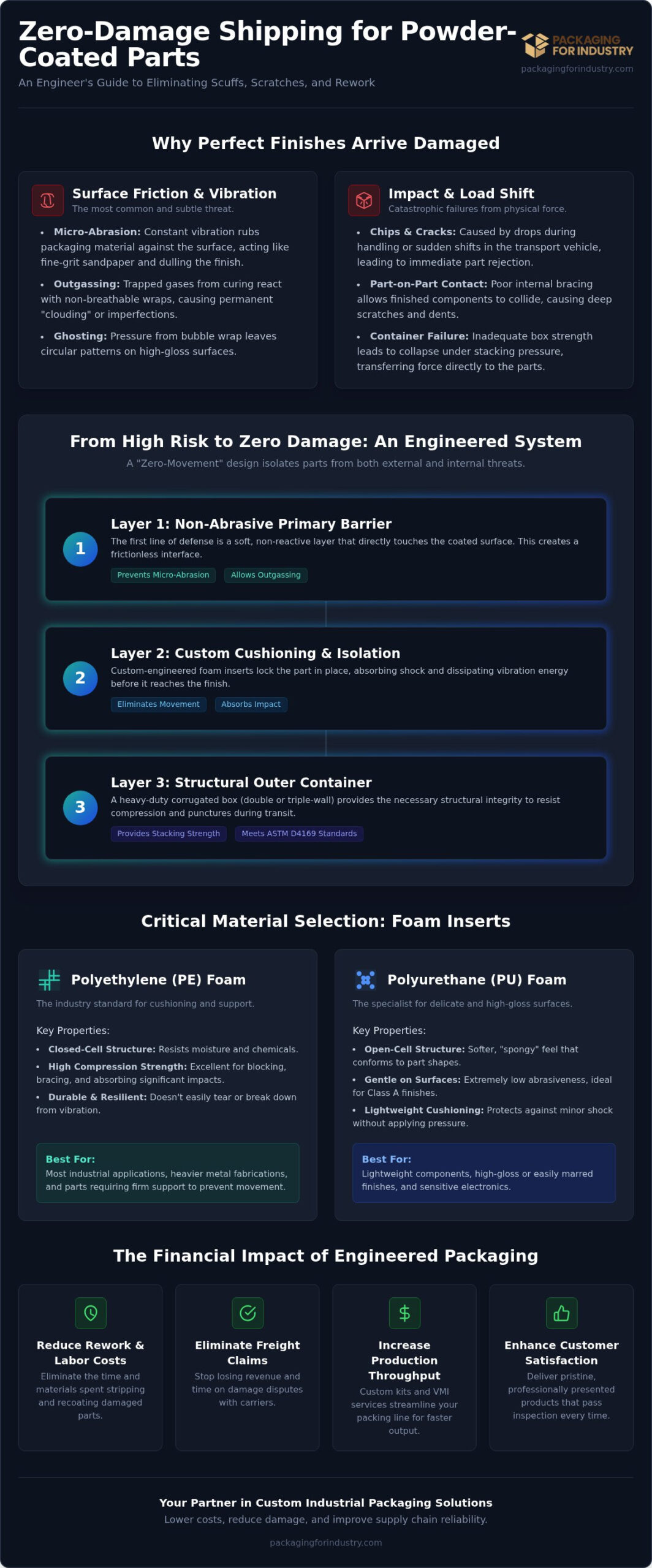
Powder coating provides a durable, aesthetically pleasing finish, but its structural rigidity makes it surprisingly vulnerable to mechanical stress during transit. While the coating is designed to resist chemicals and weather, it doesn’t always handle the repetitive abrasive forces of a long-haul trailer. Most damage occurs because of micro-abrasion. This happens when microscopic grit or even the packaging material itself rubs against the surface thousands of times per minute due to road vibration. Over several hundred miles, standard corrugated boxes or plastic wraps can act like fine-grit sandpaper, dulling the finish or creating permanent scuff marks.
Another overlooked failure point is outgassing. If a component is packed too quickly after curing or if the coating hasn’t fully stabilized, trapped gases can react with non-breathable plastic wraps. This often results in “clouding” or surface imperfections that can’t be buffed out. Understanding these variables is central to learning how to protect powder-coated surfaces during shipping effectively. You must ensure the finish has reached its final state before it’s sealed in an airtight environment.
We categorize transit damage into two primary threats: impact damage and surface friction. Impact occurs from drops or shifts in the load, leading to chips or cracks. Friction is a more subtle enemy, caused by the constant “shimmer” of parts within their containers. The financial consequences are severe. When a part fails inspection at the customer site, the cost isn’t just the freight back. It includes the labor to strip the failed coating, the cost of new powder, and the disruption to your production schedule. Utilizing custom design packaging helps mitigate these risks by ensuring a precise fit that eliminates movement.
The Problem with Standard Bubble Wrap
Many operations rely on standard bubble wrap, assuming the air pockets provide sufficient protection. However, under the pressure of stacked pallets, those bubbles can leave “ghosting” marks. High-gloss finishes are especially prone to this, as the heat-sealed circular patterns of the plastic can transfer onto the coating. Simply adding more layers doesn’t solve the problem; it often increases the pressure on the surface, making these polishing marks more likely. You need a barrier that doesn’t rely on pressurized air pockets against a sensitive finish.
Vibration and Harmonics in Freight
LTL (Less-than-Truckload) environments are notoriously harsh. Your goods are frequently transloaded, increasing the risk of part-on-part contact if the interior packaging fails. True protection requires a “zero-movement” design where parts are physically isolated. We define vibration damping as the process of absorbing and dissipating the kinetic energy generated by freight movement before it reaches the finished surface. Without proper damping, the harmonics of the truck can cause parts to vibrate against each other, even inside a heavy-duty box. This constant movement is what turns a minor packaging flaw into a major rework expense.
Material Selection: Choosing Non-Abrasive Protective Layers
Selecting the correct material is the most critical step in learning how to protect powder-coated surfaces during shipping. While standard packaging focuses on impact, powder-coated components require a focus on surface chemistry and friction reduction. Using the wrong plastic can lead to chemical migration, while using a foam that’s too abrasive will cause the micro-abrasion discussed previously. According to the Powder Coating Institute, proper handling and storage are just as vital as the application process itself. You must match the protective layer to the specific gloss level and weight of your component.
Polyethylene (PE) foam is the industry standard for most metal fabrications because its closed-cell structure resists moisture and provides high compression strength. In contrast, Polyurethane (PU) foam is open-cell and much softer, making it ideal for extremely light components with high-gloss finishes that cannot tolerate any pressure. For most industrial applications, a non-abrasive poly bag serves as the best primary barrier. It creates a smooth interface between the part and the secondary cushioning. If you’re shipping parts that are prone to moisture trap or “blushing,” micro-perforated films allow the coating to breathe while still providing a physical shield. For parts with intricate shapes, custom foam inserts provide the necessary isolation to keep components from shifting during transit.
Polyethylene (PE) Foam for Heavy Components
Density is a key metric when protecting heavy industrial hardware. We typically recommend 1.7lb or 2.0lb PE foam for components like engine parts or architectural panels. This density is high enough to prevent the part from “bottoming out” against the outer box. When choosing between foam types, crosslinked polyethylene (XLPE) is significantly safer for delicate finishes than non-crosslinked versions. XLPE has a much smoother surface profile, which minimizes the risk of the foam texture transferring to the powder coating under pressure. For large metal panels, using foam planks for edge and corner protection ensures that the most vulnerable areas don’t pierce the outer carton or suffer impact chips. If you’re unsure which density fits your specific part weight, you can request a packaging quote for a technical review.
Specialty Barrier Materials
Some finishes require more than just standard foam. Spun-bond polypropylene is a “soft touch” alternative often used for automotive finishes because it feels like fabric and won’t scratch even the most sensitive clear coats. For powder-coated electronic enclosures, anti-static (ESD) foam is mandatory to prevent static discharge that could damage internal components. Another professional tip involves using wax-free corrugated dividers. Standard corrugated can sometimes contain waxes or oils that transfer to the coating, creating permanent “burnishing” marks. Wax-free materials ensure that the only thing touching your finish is a clean, chemically neutral surface.
Multi-Layer Protection Strategies: Custom vs. Stock
Effective logistics management requires more than just high-quality materials; it requires a systematic “nested” approach. To master how to protect powder-coated surfaces during shipping, you must address three distinct levels of protection. The primary barrier sits directly against the finish to prevent surface friction. The secondary layer provides cushioning to absorb shock. Finally, the tertiary stabilization ensures the entire load remains immobile within the shipping container. As a leading bulk packaging supplier, PFI provides the specific technical materials required for each of these layers to ensure they work in tandem rather than against each other.
When evaluating the ROI of your packing process, consider the labor costs associated with manual wrapping. Employees spending minutes per part applying layers of generic bubble wrap or paper create a bottleneck in production. Utilizing custom packaging kits allows your team to pack parts in seconds with pre-cut materials that fit perfectly every time. This precision is especially important for heavy coated parts. If the weight isn’t distributed correctly, the component can crush its own protective foam, leading to “bottoming out” damage. Integrating advanced protective coatings and VCI materials can also provide a secondary defense against environmental factors if the outer packaging is breached during long-haul transit.
Custom Corrugated Partitions
For high-volume operations shipping small brackets or hardware, cell-based dividers are the most efficient stabilization method. We recommend using heavy-duty double-wall boxes to prevent heavy metal components from puncturing the box walls. When designing these partitions, the choice of corrugated finish matters. Coated corrugated dividers offer a smoother surface that significantly reduces friction compared to standard kraft board. This prevents the “burnishing” marks that often occur when parts vibrate against rough cardboard during LTL transport.
Stretch Film and Load Stabilization
Stabilizing a pallet of powder-coated goods requires a delicate balance of tension. There’s a common danger in over-tightening stretch film directly against a coated surface. High tension can “telegraph” the texture of the wrap onto the finish or trap residual heat from the curing oven. To prevent this, use edge protectors to distribute strap and film pressure away from the finished faces. Additionally, vented stretch film is superior for parts packed shortly after the oven. It allows for continued outgassing and prevents the moisture trap that leads to finish clouding or blushing.
Step-by-Step: Engineering a Damage-Proof Shipping Container
Executing a damage-free shipment requires a repeatable, engineered process. Once you understand the materials and the physics of vibration, you must standardize the assembly of your shipping units. This step-by-step approach ensures your team maintains consistency, which is the only way to effectively manage how to protect powder-coated surfaces during shipping at scale. Following a set protocol reduces the risk of human error and ensures every part receives the same level of protection.
- Step 1: Surface Cleanliness. Before any wrap touches the part, ensure the surface is free of grit, dust, or metal shavings. Trapped particles act as an abrasive during transit, leading to the micro-abrasion scuffs discussed in previous sections.
- Step 2: Primary Wrap. Apply a non-marring barrier, such as a high-quality PE foam sheet or a non-abrasive poly bag. This layer should be secured so it cannot slide against the finish.
- Step 3: Internal Bracing. Use custom foam end caps to “float” the part within the container. This eliminates the need for excessive loose-fill materials and provides a consistent buffer zone.
- Step 4: Box Selection. Match the box’s burst strength or Edge Crush Test (ECT) rating to the specific weight of your component. Overloading a weak box leads to wall failure and finish damage.
- Step 5: Sealing. Use high-tack industrial adhesive tapes to ensure the box remains rigid. A loose box allows the internal contents to shift, increasing the risk of vibration-related wear.
Request a custom packaging quote to optimize your assembly process.
Floating the Part: The End Cap Method
The end cap method is the gold standard for protecting heavy or sensitive powder-coated components. By using custom-engineered foam caps on either end of a part, you suspend the item in the center of the carton. We recommend maintaining at least a 2-inch clearance from all box walls to provide a sufficient “crumple zone” for impact protection. “Floating” prevents shock transfer to the finish by ensuring the component never makes direct contact with the outer walls of the shipping container, effectively isolating it from external blunt force.
Testing Your Packaging Design
You shouldn’t wait for a customer complaint to find out your packaging failed. Professional B2B standards involve rigorous testing, including drop tests and vibration table simulations that mimic the harsh environment of long-haul freight. At PFI, we offer free prototyping to verify the fit and performance of your custom inserts before you commit to full production. If you’re testing internally, conduct a “ship-to-yourself” test. Send a fully packed unit to a distant facility and back; this reveals exactly where scuffs or shifts occur during real-world handling. Identifying these failure points early saves thousands in potential rework costs and protects your brand’s reputation for quality.
Optimizing Your Logistics with PFI’s Custom Solutions
PFI’s custom design services are focused on reducing your total cost of ownership by eliminating the inefficiencies of generic packaging. As a leading Anaheim packaging supplier, we recognize that floor space and labor are your most significant overhead costs. Our packaging kitting solutions allow you to order custom boxes in Los Angeles alongside pre-cut foam inserts as a single, production-ready SKU. This streamlining reduces worker error and accelerates packing times. For high-volume operations, our Vendor Managed Inventory (VMI) program ensures a reliable supply of materials, allowing you to lower packaging costs by avoiding emergency stock-outs and last-minute procurement stress.
Products and Industries Served
We provide comprehensive protection for manufacturers in the aerospace, automotive, medical, and electronics sectors. If you are searching for an industrial packaging supplier near me in Southern California, we offer a full range of stock and custom corrugated boxes (heavy duty, double wall, and triple wall), as well as protective foam packaging (PE, PU, and ESD inserts). For businesses needing a San Diego packaging supplier or a Riverside packaging supplier, we supply high-performance stretch film, mailing tubes, pallets, and custom crates engineered specifically for the weight and sensitivity of powder-coated goods. Our solutions are designed to handle the rigorous demands of industrial logistics while maintaining the professional presentation of your finished products.
Why Choose PFI
Manufacturers partner with Packaging For Industry (PFI) because we prioritize supply chain reliability and engineering-led damage reduction. As your Orange County packaging supplier, we provide free prototyping and CAD design support to ensure a precise product fit before you commit to a full production run. We aren’t just a bulk packaging supplier; we are proactive problem-solvers focused on eliminating the rework costs that plague finishing operations. With local next-day delivery options from our Inland Empire packaging supplier facilities and robust nationwide shipping capabilities, we ensure your components arrive damage-free every time. You can request a custom packaging quote to compare packaging pricing and experience the stability of a dedicated industrial partner.
Secure Your Finish and Your Bottom Line
Protecting high-value powder-coated components requires a shift from generic packing to engineered isolation. By prioritizing non-marring materials like PE foam and utilizing a “nested” protection strategy, you eliminate the micro-abrasion that often leads to costly rework. Mastering how to protect powder-coated surfaces during shipping is a combination of material science and logistical discipline. It ensures your customers receive a professional presentation every time while protecting your margins from hidden touch-up costs.
PFI specializes in high-stakes sectors like aerospace and automotive protection, where surface integrity is non-negotiable. We provide free prototyping and CAD design support to ensure a perfect fit for your most complex geometries. For our partners in Orange County, Los Angeles, and the Inland Empire, we offer local next-day delivery to keep your operations moving without delay.
We’re ready to help you lower packaging costs and improve reliability through smarter design. Let’s work together to make shipping damage a problem of the past.
Frequently Asked Questions
Will standard bubble wrap damage my powder-coated finish?
Standard bubble wrap can leave permanent “ghosting” or polishing marks on powder-coated surfaces, especially high-gloss finishes. These marks occur when the heat-sealed circles of the plastic bubbles press against the coating under the weight of stacked pallets. For those researching how to protect powder-coated surfaces during shipping, we recommend using non-marring polyethylene foam or poly bags as a primary barrier instead of traditional bubble wrap.
What is the best foam density for protecting heavy metal parts?
Industrial hardware and heavy metal fabrications typically require 1.7lb or 2.0lb Polyethylene (PE) foam. This density provides the necessary compression resistance to prevent heavy components from “bottoming out” against the corrugated box walls. Lower density foams often collapse under the weight of industrial parts, leading to impact damage during transit. Using the correct density ensures your part remains suspended and isolated from external shocks.
How do I prevent “ghosting” marks on high-gloss powder coatings?
Ghosting is prevented by using chemically neutral primary barriers like crosslinked polyethylene (XLPE) foam or non-abrasive poly bags. You should also utilize the “end cap” method to suspend the part, ensuring that no packaging material is pressed directly against the finished faces. This “floating” technique eliminates the pressure points that cause texture transfer or polishing marks during the vibration of long-haul freight shipping.
Should I use poly bags or foam sheets for the primary layer?
Poly bags are often the superior choice for a primary layer because they have a lower coefficient of friction than foam sheets. This allows the part to shift slightly within the packaging without the material “grabbing” or burnishing the finish. Foam sheets are excellent for secondary cushioning, but a smooth poly bag creates a more effective initial shield against surface scuffing and micro-abrasion during the shipping process.
Does powder coating need to “breathe” during shipping?
Yes, powder coating often needs to breathe, particularly if parts are packed shortly after the curing process. Residual outgassing can lead to surface clouding or blushing if the parts are sealed in non-breathable plastic. Utilizing micro-perforated films or breathable foam materials helps maintain the integrity of the finish. This is a critical step in understanding how to protect powder-coated surfaces during shipping without compromising the chemical stability of the coating.
How can I reduce the labor cost of packing powder-coated parts?
Switching from manual wrapping to custom-engineered packaging kits and pre-cut foam inserts is the fastest way to reduce labor costs. These kits allow your production team to secure parts in seconds with a consistent, repeatable process. Eliminating the need for workers to cut foam or wrap parts by hand speeds up the production line and significantly reduces the risk of human error that leads to shipping damage.
What is the difference between PE and PU foam for surface protection?
Polyethylene (PE) is a closed-cell foam that offers high durability and moisture resistance, making it ideal for heavy-duty industrial support. Polyurethane (PU) is an open-cell, much softer foam that provides a “soft touch” for very lightweight or highly sensitive enclosures. Most manufacturers in Southern California prefer PE foam for its structural rigidity and ability to protect heavy metal components from puncturing the outer shipping containers.
Can custom-engineered crates save me money on shipping insurance?
Custom-engineered crates lower your total cost of ownership by drastically reducing damage rates and the frequency of insurance claims. Carriers are less likely to dispute a claim when you can demonstrate that your packaging meets or exceeds ASTM D4169 standards. By investing in professional stabilization, you protect your company from the administrative burden and financial loss associated with freight claims and customer dissatisfaction upon delivery.