
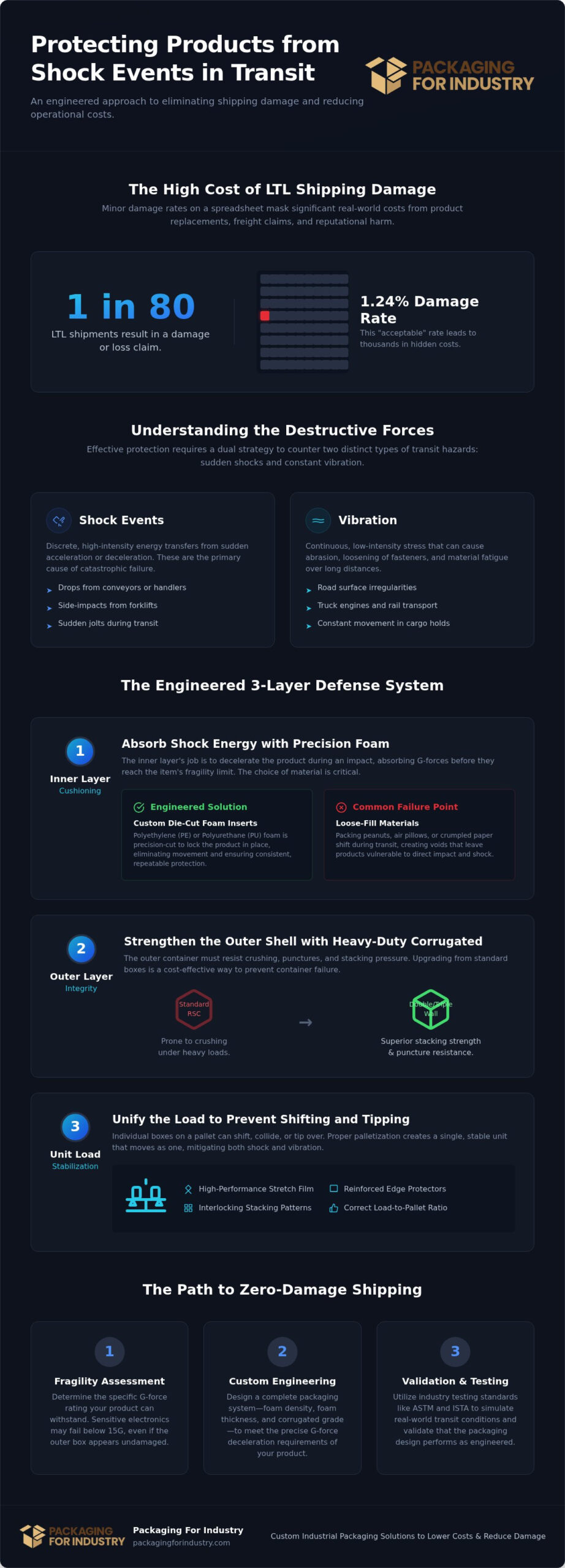
Recent industry data shows that approximately one in every 80 LTL shipments results in a damage or loss claim. While a 1.24% damage rate might seem manageable on a spreadsheet, the reality involves expensive replacement costs, frustrated clients, and endless insurance paperwork. If your operations team is struggling with invisible damage to internal components or crushed outer containers, you need a more rigorous approach to how to protect products from shock events during transit.
We know that maintaining a reliable supply chain is your top priority. It’s frustrating to watch your profit margins disappear into a pile of scrap because of poor pallet stabilization or inadequate cushioning. This guide provides the industrial engineering strategies and material selections required to eliminate shipping damage and significantly reduce your replacement costs. We’ll break down the science of internal deceleration using protective foam, the structural requirements for heavy-duty corrugated boxes, and the role of precision stretch film in load stabilization. You’ll learn how to streamline your warehouse pack-out while moving toward a zero-damage shipping model that protects both your products and your brand reputation.
Key Takeaways
- Understand the physics of shock events and how sudden acceleration or deceleration impacts your bottom line through replacement costs and reputational damage.
- Discover how to protect products from shock events during transit by utilizing custom die-cut foam inserts that provide superior deceleration compared to loose-fill materials.
- Learn why upgrading to double-wall or triple-wall corrugated boxes is a cost-effective strategy for improving structural integrity and reducing shipping damage.
- Identify how professional palletization and load stabilization techniques prevent side-impact shocks and tip-overs during LTL freight.
- Explore the benefits of custom packaging design and free prototyping to ensure your protective system is optimized for both safety and fiscal efficiency.
What are Transit Shock Events and Why Do They Occur?
To understand What are Transit Shock Events, you have to look at the physics of the industrial supply chain. A shock event is a sudden, high-intensity transfer of energy caused by rapid acceleration or deceleration. In a warehouse or freight environment, this usually happens when a package hits the floor, strikes a pallet rack, or experiences a sudden jolt during emergency braking. These events are measured in G-force, which represents the ratio of the maximum acceleration experienced during an impact to the acceleration of gravity.
Recent data indicates that LTL shipments have a damage rate of 1.24%, meaning roughly one in every 80 shipments fails to arrive intact. These failures often stem from drops from conveyor belts or side-impacts from forklifts during loading. While road vibration is a constant factor, it’s these isolated, high-G events that cause catastrophic failure in sensitive industrial components. Standard “off-the-shelf” boxes aren’t engineered to handle these loads. They often lack the structural rigidity required to prevent the energy from transferring directly into your product, leading to expensive insurance claims and operational delays.
The Difference Between Shock and Vibration
Distinguishing between these two forces is critical for logistics managers. Shock is a discrete, short-duration event, such as a four-foot drop or a collision. Vibration is a continuous, low-intensity stress caused by truck engines, rail tracks, or road surface irregularities. Knowing how to protect products from shock events during transit requires a dual-layered strategy. You need cushioning to absorb the immediate shock and structural integrity to withstand the long-term fatigue of vibration. Using high-quality stretch film and proper palletization helps mitigate the vibration, while internal materials handle the shock.
Identifying Fragility Levels in Industrial Goods
Every product has a fragility rating. Determining how to protect products from shock events during transit starts with a fragility assessment. Aerospace components, medical devices, and high-end electronics often require protection levels below 15G. If your packaging isn’t designed to decelerate the product within that specific window, internal components will fail even if the outer box looks perfect. This results in high replacement costs and damaged brand reputation. Utilizing current testing standards like ASTM D4169-23e1 helps us map these sensitivities to ensure your corrugated boxes and foam inserts are engineered for your specific G-force requirements. Ignoring these ratings leads to a cycle of replacement and freight costs that erodes your bottom line.
Engineering the Inner Layer: Selecting Protective Foam Inserts
Determining how to protect products from shock events during transit starts with the inner layer. While the outer box provides structural integrity, the cushioning material is what actually manages energy. Effective shock protection depends on the foam’s ability to decelerate the product within the container before it reaches its fragility limit. Following ISTA testing protocols, we design these layers to ensure that even a high-impact drop doesn’t result in a catastrophic failure. This engineering-first approach is essential for aerospace parts and delicate electronics that cannot survive a direct transfer of force.
Many warehouses rely on loose-fill materials like packing peanuts or crumpled paper to save time. However, these materials shift during transit, creating dangerous voids that leave your product vulnerable. For industrial-grade protection, you should explore custom foam packaging. Die-cut foam inserts provide a precision fit that locks the product in place. This eliminates movement and ensures consistent protection across every shipping cycle. By calculating the exact foam thickness and density required for your item’s weight, you can significantly reduce shipping damage without overspending on excess material.
Polyethylene vs. Polyurethane: Which Absorbs More Shock?
Choosing the right polymer is a matter of engineering, not just preference. Polyethylene (PE) foam is a closed-cell material known for its durability and resistance to moisture. It’s the standard choice for heavy industrial parts or recurring shipments because it maintains its shape after repeated impacts. In contrast, Polyurethane (PU) foam is an open-cell material that provides a much softer “landing” for lightweight, highly delicate items. If you’re shipping sensitive semiconductor components, we offer anti-static and ESD foam options to protect against both physical shock and electrostatic discharge. Selecting the correct density ensures your product doesn’t “bottom out” during a shock event, which is the most common cause of internal component failure.
The Benefits of Foam End Caps and Planks
You don’t always need to encase a product entirely in foam to achieve zero-damage shipments. Using foam end caps allows you to suspend heavy products away from the box walls, creating a protective air cushion. This strategy is particularly effective for long, heavy items like drive shafts or mailing tubes. It also helps lower packaging costs by reducing the total volume of foam used per shipment. If you want to optimize your protection strategy, you can request a packaging quote to see how custom-engineered planks can streamline your warehouse pack-out. Our team uses CAD/CAM design support to ensure every piece of foam serves a functional purpose, keeping your logistics flow efficient. With local next-day delivery available in Anaheim and Los Angeles, we help you maintain a reliable supply of these custom protective materials.
Strengthening the Outer Layer: Heavy-Duty Corrugated and Crates
While internal foam handles the deceleration of your product, the outer container serves as the first line of defense against structural failure. Many logistics managers rely on standard single-wall boxes for industrial shipments, but these often fail under the compression forces and impact stresses of a freight environment. When considering how to protect products from shock events during transit, you must evaluate the burst strength and edge crush test (ECT) ratings of your outer layer. Single-wall corrugated typically lacks the rigidity to prevent the walls from buckling when a pallet is jarred or dropped; this leads to the product bearing the weight of the impact directly.
Upgrading to double-wall or triple-wall corrugated boxes provides a significant increase in stacking strength and puncture resistance. Triple-wall corrugated is an exceptionally durable material that often serves as a lightweight, cost-effective alternative to wooden crates for heavy manufacturing parts. It offers the structural integrity needed for high-G events while keeping freight costs lower than heavier timber options. Additionally, for shipments moving through humid environments or outdoor storage, we provide weather-resistant corrugated treatments. These coatings prevent the fibers from softening, which ensures the box maintains its protective properties even in sub-optimal conditions.
Custom Corrugated Boxes vs. Stock Sizes
Using stock boxes for industrial components often leads to excessive void space. Even with internal cushioning, a box that is too large allows the product to shift during handling; this creates a secondary shock event inside the package. When you request a custom corrugated box quote, we engineer the dimensions to match your product and foam inserts precisely. This tight tolerance eliminates movement and ensures that the shock-absorbing properties of your foam work as intended. Custom sizing also helps you lower packaging costs by reducing dimensional weight (DIM) surcharges from carriers like UPS and FedEx.
When to Move from Boxes to Custom Wood Crates
There are specific weight and value thresholds where even the strongest triple-wall corrugated is no longer sufficient. For oversized aerospace components or high-value machinery, custom wooden crates for industrial equipment are the necessary standard. Wood provides the absolute rigidity required to prevent any flexing of the outer shell, which is vital for maintaining the calibration of sensitive instruments. We often design foam-lined crates that combine the structural power of timber with the precision deceleration of die-cut foam. This hybrid approach is the most reliable method for how to protect products from shock events during transit when shipping mission-critical hardware. Our Anaheim and Los Angeles facilities provide local next-day delivery for these heavy-duty solutions, ensuring your production line never stalls due to packaging lead times.
Load Stabilization: Preventing Shock Through Palletization
Even with engineered foam and heavy-duty boxes, your shipment remains vulnerable if the entire pallet load is unstable. Understanding how to protect products from shock events during transit requires a focus on the unitized load. When a freight truck takes a sharp turn or a forklift operator stops abruptly, centrifugal forces cause individual containers to shift. This movement creates high-G side-impact shocks that internal cushioning cannot always mitigate. Choosing the right pallet is the first step. Wood pallets offer natural friction and a degree of shock absorption that helps keep corrugated containers in place. In contrast, plastic pallets are more durable but often require high-friction top surfaces or specialized anti-slip sheets to prevent sliding during transit.
Stabilizing the load prevents the “domino effect” where one container’s failure compromises the entire shipment. By integrating corner and edge protection solutions, you distribute the tension of strapping and film more effectively across the load. This prevents concentrated pressure points that can crush corrugated walls during a sudden jolt. Proper palletization doesn’t just reduce shipping damage; it also streamlines your warehouse pack-out by creating a uniform, easily handled unit for your logistics partners.
The Science of Stretch Film and Containment Force
Containment force is the total pressure applied to the load by the film. While hand-wrapping is common, it’s often inconsistent and leads to loose loads that shift during LTL freight. Machine film provides the uniform tension needed to lock boxes to the pallet base securely. You should focus on specific wrap counts at the top and bottom to prevent “load bridge” failure. If you’re looking to optimize your wrap process, you can browse our wholesale stretch film supplies. You can also request a stretch film quote to compare pricing for high-performance cast or blown films that provide superior puncture resistance for irregular loads.
Utilizing Cardboard Edge Protectors
Vertical shock events, such as a pallet being dropped from a lift, put extreme pressure on the vertical corners of your boxes. Without reinforcement, these corners can buckle, causing the entire stack to collapse. Utilizing edge protectors allows for tighter strapping without box deformation. This reinforcement is essential for high-density warehouse storage where pallets are frequently moved or stacked. Edge protectors also improve overall stackability, which helps you maximize trailer space and lower packaging costs by reducing the number of shipments required. We offer custom sizes available to fit any pallet height, ensuring your specific industrial goods remain upright and protected.
Custom Packaging Design: The PFI Approach to Shock Protection
As a leading industrial packaging supplier near me for businesses throughout Southern California, PFI provides more than just materials; we provide an integrated system of protection. We specialize in designing custom solutions that combine heavy-duty corrugated boxes, precision foam inserts, and custom wooden crates to ensure zero-damage shipments. While we provide local next-day delivery across Anaheim, Orange County, Los Angeles, San Diego, Riverside, and the Inland Empire, we also support your broader logistics network with fast nationwide shipping. This comprehensive coverage ensures your team has access to the exact engineering required for how to protect products from shock events during transit, regardless of your destination.
Our commitment to supply reliability extends to Vendor Managed Inventory (VMI) services. We manage your stocking levels based on actual usage, ensuring you never run out of mission-critical protective gear. Whether you need packaging for manufacturers or distribution centers, our kitting and assembly services streamline your operations. This allows your team to focus on production while we handle the logistical flow of your custom and industrial packaging solutions.
Our CAD/CAM Prototyping Process
Precision is the cornerstone of effective shock protection. We offer free prototyping services and CAD/CAM design support to create die-cut foam samples tailored to your product’s specific fragility rating. This process allows you to test fit and protection levels before committing to a full rollout. Our team conducts thorough packaging reviews to identify weak points in your current setup that might be causing internal damage. Because we manufacture locally, we can significantly reduce lead times compared to catalog suppliers, helping you maintain a more agile supply chain.
Request a Packaging Quote Today
If you’re looking to lower packaging costs without sacrificing protection, our Anaheim team is ready to conduct a comprehensive analysis of your current strategy. We provide bulk packaging pricing on custom-engineered solutions that outperform standard options. With custom sizes available for every product category, you can stop paying for excess void space and start protecting your bottom line. We’re a proactive problem-solver focused on delivering tangible, real-world outcomes for your most challenging logistical hurdles.
Optimizing Your Industrial Protection Strategy
Achieving zero-damage shipments requires a methodical approach to packaging engineering. By integrating precision-cut foam inserts with heavy-duty corrugated materials and stabilized pallet loads, you eliminate the variables that lead to costly freight claims. We’ve explored the technical requirements for how to protect products from shock events during transit, focusing on the intersection of material density and structural integrity. Off-the-shelf boxes aren’t enough when your brand reputation and bottom line are at stake.
PFI serves as a proactive partner for manufacturers and distribution centers facing high replacement costs. We specialize in aerospace and manufacturing packaging, providing free prototyping and CAD/CAM design support to validate every solution before it hits the road. Our local manufacturing capabilities allow for next-day delivery across Orange County, Los Angeles, and the Inland Empire; this ensures you don’t face downtime due to supply shortages.
We’re ready to help you lower packaging costs and improve your supply reliability starting today.
Frequently Asked Questions
How do I calculate the G-force protection my product needs?
Determining your product’s fragility rating, or G-factor, is the first step in engineering effective protection. This rating represents the maximum acceleration an item can withstand without sustaining internal damage. We use CAD/CAM design support to analyze these specific requirements for aerospace and electronics components. By mapping these levels, we ensure your packaging provides the exact deceleration needed. This prevents the product from bottoming out during a drop, which is a common cause of failure.
What is the most cost-effective foam for shock absorption?
When you compare packaging pricing for cushioning materials, polyethylene often emerges as the most cost-effective choice for heavy industrial parts. Its closed-cell structure provides superior durability and moisture resistance, allowing it to maintain protective properties after repeated impacts. For lighter items, using strategic foam end caps rather than full encasement can further lower packaging costs. This method uses less material while suspending the product away from the box walls to absorb transit shocks effectively.
Can custom corrugated boxes really replace heavy wood crates?
Heavy-duty triple-wall corrugated boxes are often a viable, cost-saving alternative to wooden crates for many industrial loads. Triple-wall board offers high burst strength and stacking rigidity while being significantly lighter than timber. This reduces freight costs and simplifies the warehouse pack-out process for your team. While exceptionally heavy or high-value aerospace machinery still requires custom wood crates, many manufacturers successfully switch to corrugated to improve their overall logistical flow.
How does proper palletization reduce transit shock damage?
Proper palletization creates a unitized load that resists shifting and tip-overs during LTL freight. By using edge protectors and high-tension stretch film, you prevent individual boxes from moving independently. This stability is a key part of how to protect products from shock events during transit because it eliminates secondary shocks within the load. Securely locking the shipment to the pallet base ensures that centrifugal forces don’t lead to catastrophic side-impact damage.
What industries benefit most from custom foam inserts?
Industries handling high-value, sensitive, or complex components benefit most from custom die-cut foam. This includes aerospace, medical device manufacturing, and the semiconductor industry. These sectors require a precision fit to prevent any internal movement during the shipping cycle. Custom foam assemblies are also essential for kitting operations, where multiple parts must be organized and protected within a single container. PFI specializes in these custom solutions to help clients reduce shipping damage.
Does PFI offer local next-day delivery in Southern California?
PFI provides local next-day delivery throughout Southern California, including Anaheim, Orange County, Los Angeles, and the Inland Empire. Our local presence allows us to support your production lines with a reliable supply of custom boxes and protective materials. This proximity is particularly beneficial for businesses utilizing our Vendor Managed Inventory (VMI) programs. We aim to eliminate lead-time surprises and ensure your warehouse always has the necessary packaging supplies on hand.
How can I reduce shipping damage without increasing my packaging weight?
You can reduce shipping damage without adding weight by switching to higher-performance materials like triple-wall corrugated or high-density polyethylene foam end caps. Custom sizing also plays a major role; it eliminates the need for excessive void-fill while improving structural integrity. By engineering the package to fit the product precisely, you use less material overall. This strategy helps you lower packaging costs while avoiding expensive dimensional weight surcharges from carriers like FedEx.
What is the difference between polyethylene and polyurethane foam?
Polyethylene is a closed-cell foam that is firm, durable, and moisture-resistant, making it ideal for heavy industrial components. It provides excellent vibration dampening and shock absorption for repeated impacts. Polyurethane is an open-cell foam that is much softer and more flexible. It’s the preferred choice for protecting lightweight, delicate items that require a gentle cushioning effect. Both materials are available in anti-static and ESD versions for sensitive electronic shipments.